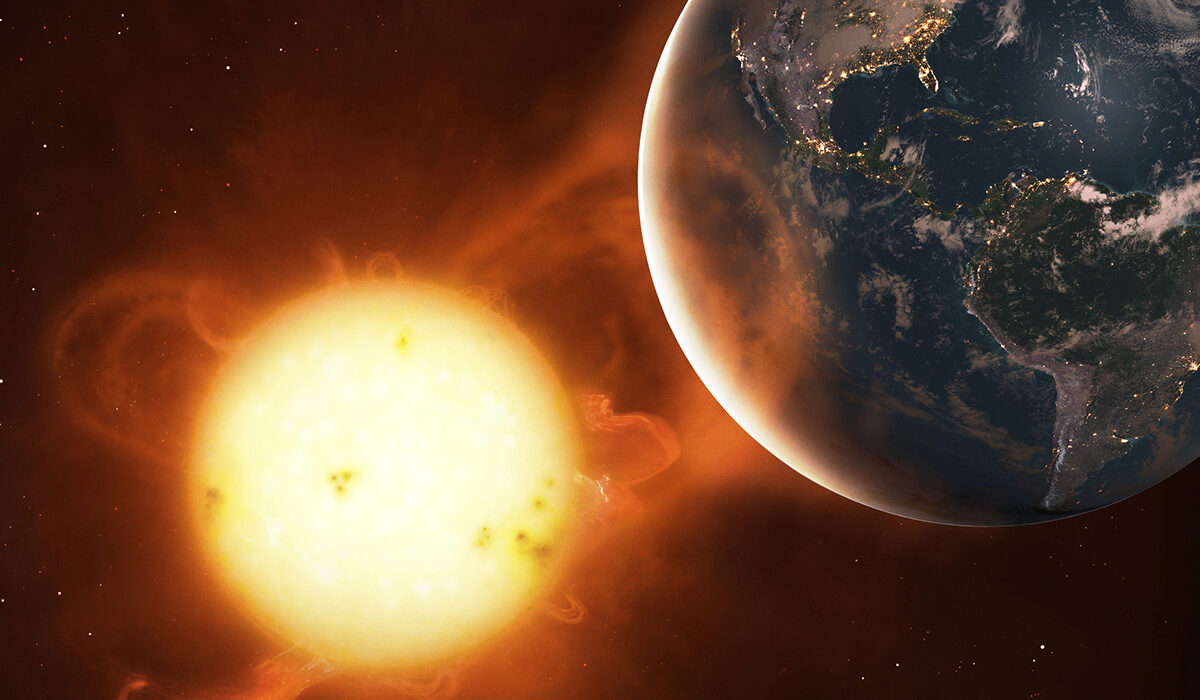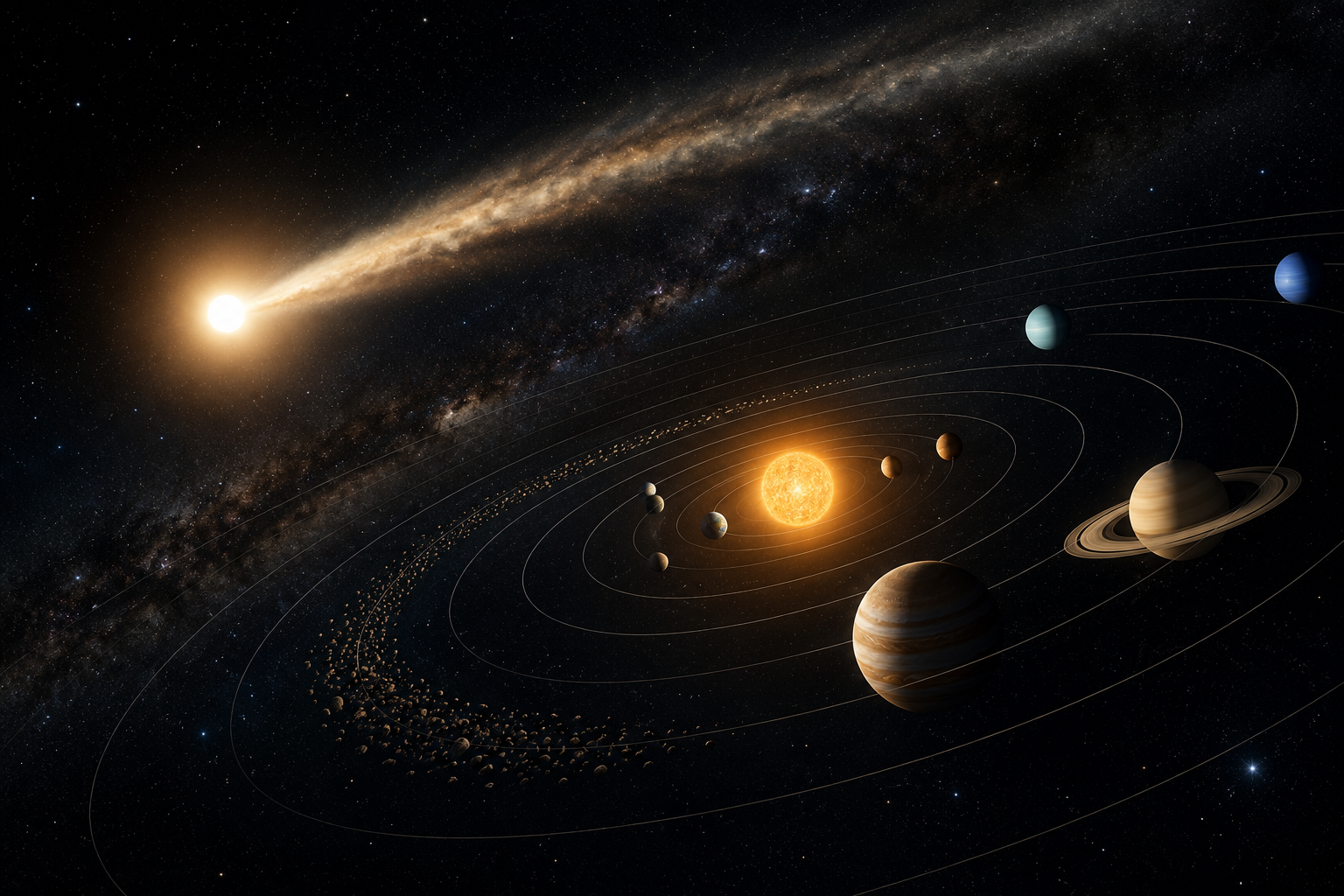
Imagine looking up at the night sky and seeing not one Sun, but two.
One shines with the familiar warmth that has sustained life on Earth for billions of years. The other slowly grows brighter over thousands of years, eventually becoming one of the most spectacular objects in the sky. Such a sight sounds like science fiction, yet it raises a fascinating scientific question: Could another star actually pass through the Solar System?
The short answer is yes—but probably not in the way most people imagine.
Stars move continuously through the Milky Way. Our Sun is not fixed in space, and neither are the hundreds of billions of other stars in our galaxy. Over millions and billions of years, stars wander through the galaxy, occasionally passing relatively close to one another. While an actual collision between stars is extraordinarily unlikely, close stellar encounters are a natural part of the Milky Way’s history.
Scientists know that the Solar System has experienced close encounters before, and it almost certainly will again. Understanding these cosmic flybys helps astronomers uncover the history of our planetary neighborhood and predict its distant future.
The Solar System Is Not Standing Still
When we picture the Solar System, it is easy to imagine the Sun sitting motionless at the center while the planets orbit around it.
In reality, the Sun is constantly moving.
The Sun orbits the center of the Milky Way at an average speed of about 220 kilometers per second (137 miles per second). At the same time, nearby stars are also traveling through the galaxy, each following its own orbit shaped by the Milky Way’s gravitational field.
These stellar motions mean that the distances between stars are always changing.
Over thousands or millions of years, stars that appear close together today may drift far apart, while distant stars may gradually approach one another.
The galaxy is less like a static picture and more like an enormous cosmic dance.
What Does “Passing Through the Solar System” Really Mean?
The phrase “passing through the Solar System” can be misleading.
Most astronomers distinguish between passing near the Solar System and passing through its outermost regions.
The planets occupy only a tiny part of the Sun’s gravitational domain. Beyond Neptune lies the Kuiper Belt, a region filled with icy objects, and much farther away is the enormous Oort Cloud, a vast spherical reservoir of icy bodies thought to extend tens of thousands of astronomical units from the Sun.
The Oort Cloud marks the outer reaches of the Sun’s gravitational influence.
A passing star is far more likely to travel through this distant region than anywhere near the planets themselves.
Even so, such an encounter would occur at distances vastly greater than the orbit of Pluto.
The Vast Distances Between Stars
To understand why stellar collisions are so rare, it helps to appreciate just how empty space really is.
The nearest star system beyond the Sun is Alpha Centauri, located about 4.37 light-years away.
A light-year is the distance light travels in one year—about 9.46 trillion kilometers (5.88 trillion miles).
Even though stars may seem densely packed in the night sky, they are separated by enormous distances.
If the Sun were reduced to the size of a tennis ball, the nearest star would still be hundreds of kilometers away.
This immense spacing makes direct collisions between stars almost impossible.
Could Another Star Collide with the Sun?
According to current scientific understanding, an actual collision between another star and the Sun is extraordinarily unlikely.
The Milky Way contains hundreds of billions of stars, but space is so vast that stars usually pass each other with enormous separations.
Even in regions where stars are more densely packed, such as globular clusters, direct stellar collisions remain uncommon.
In our relatively quiet part of the galaxy, the probability of another star striking the Sun is incredibly small.
The Solar System is far more likely to experience distant stellar flybys than catastrophic collisions.
Close Encounters Do Happen
Although direct collisions are extremely unlikely, close stellar encounters occur throughout the Milky Way.
Astronomers have identified stars that passed relatively near the Solar System in the past.
One famous example is Scholz’s Star, a small binary star system that passed through the outer Oort Cloud roughly 70,000 years ago.
At its closest approach, it remained far beyond the planets, but its gravity may have disturbed some distant icy objects.
At the time, Scholz’s Star would have been faintly visible from Earth, though it was much dimmer than the stars we notice today.
Its passage demonstrates that stars really do wander near the Solar System over astronomical timescales.
The Future Visitor Called Gliese 710
One of the best-studied future stellar encounters involves Gliese 710, a star located about 62 light-years from Earth today.
Using precise measurements from the European Space Agency’s Gaia spacecraft, astronomers have calculated that Gliese 710 is likely to pass unusually close to the Solar System in about 1.3 million years.
Even then, it is not expected to enter the planetary region.
Instead, it is predicted to travel through or near the Oort Cloud.
While the planets themselves should remain safe, the star’s gravity could disturb countless icy objects, potentially sending some comets toward the inner Solar System over the following millions of years.
This event illustrates how stars can influence our cosmic neighborhood without ever approaching Earth directly.
The Oort Cloud Is the Most Vulnerable Region
The Oort Cloud is believed to contain trillions of icy bodies left over from the Solar System’s formation.
These objects orbit so far from the Sun that the Sun’s gravitational grip is relatively weak.
A passing star does not need to come particularly close to alter the orbits of some of these distant objects.
Its gravitational pull can nudge icy bodies onto new paths.
Some may be ejected from the Solar System entirely.
Others may begin long journeys toward the inner Solar System, eventually becoming long-period comets.
This process is thought to have occurred many times throughout the Solar System’s history.
Could Earth Be in Danger?
For people living today—or even for countless future generations—the answer is reassuring.
No known star poses any threat to Earth.
Even Gliese 710, one of the closest predicted future visitors, is expected to remain thousands of times farther away than Pluto.
Its influence would mainly affect the distant Oort Cloud.
If additional comets were eventually sent inward, only a tiny fraction would ever come anywhere near Earth.
Most would either remain in distant orbits or pass harmlessly through the Solar System.
The increased number of comets could slightly raise the long-term impact risk, but there is no evidence of an imminent danger.
What Would We See in the Sky?
If a star passed relatively close to the Solar System, it could become one of the brightest objects in the night sky.
Over thousands of years, people might notice it gradually growing brighter.
Unlike meteors or comets, this change would happen extremely slowly.
Generations would pass before its movement became obvious.
Eventually, it could appear brighter than many familiar stars, perhaps even becoming visible during twilight depending on its intrinsic brightness and distance.
Even then, it would still be vastly farther away than the planets.
The appearance would be spectacular, but not necessarily dangerous.
How Astronomers Predict Stellar Flybys
Modern astronomy has become remarkably good at tracking stellar motion.
The Gaia mission has measured the positions, distances, and motions of more than a billion stars with extraordinary precision.
By combining these measurements with computer simulations, astronomers can reconstruct where stars were millions of years ago and estimate where they will be millions of years into the future.
These predictions are not perfect because tiny uncertainties grow over very long timescales.
Nevertheless, they provide valuable insights into the changing architecture of our stellar neighborhood.
The Solar System Has Probably Experienced Many Flybys
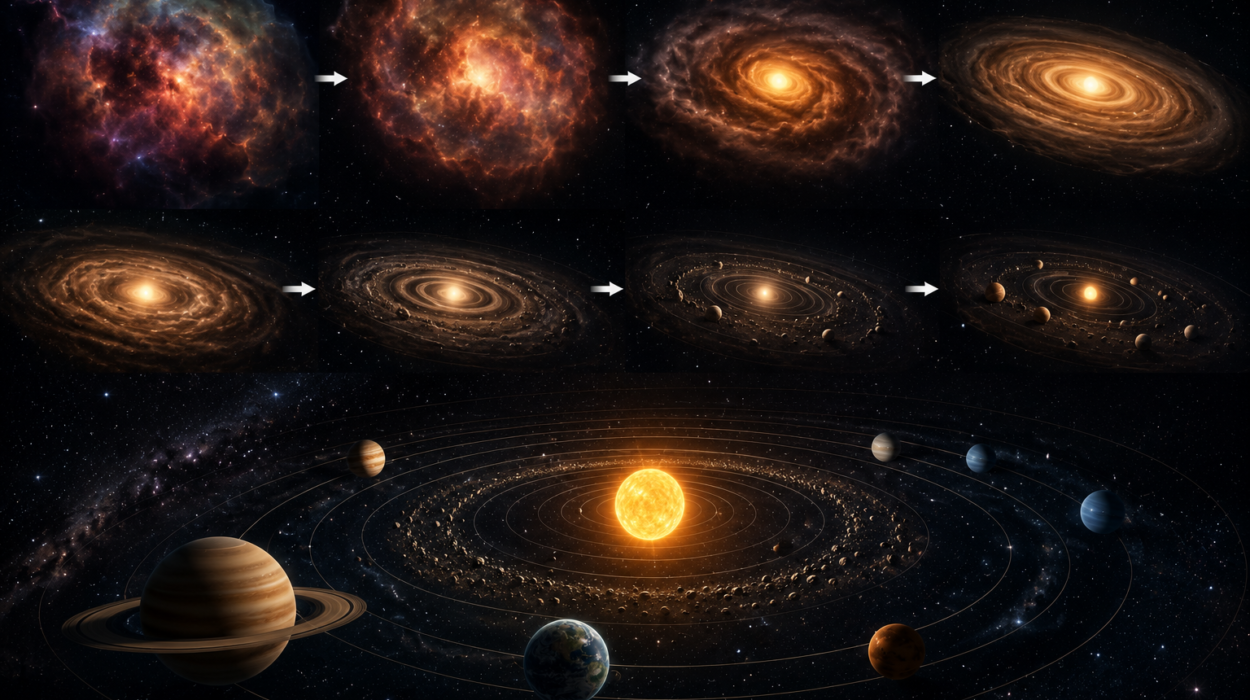
The Solar System formed about 4.6 billion years ago.
During that immense span of time, countless stars have likely passed relatively close.
Some encounters probably had little effect.
Others may have disturbed the distant Oort Cloud or altered the orbits of icy bodies.
Some researchers even suggest that stellar flybys during the Solar System’s earliest history may have influenced the formation of the outer planets or shaped the distribution of distant objects beyond Neptune.
Although many details remain under investigation, it is clear that the Solar System has never been completely isolated.
It has always been part of the dynamic environment of the Milky Way.
Could a Passing Star Steal Planets?
Gravity can produce surprising outcomes.
In theory, if two stars passed extremely close together at suitable speeds, one star might capture planets or smaller objects from the other.
Computer simulations show that such exchanges are physically possible under specific conditions.
However, these events are expected to be exceedingly rare in our region of the galaxy.
The large distances between stars make such close encounters uncommon.
Even if planets were affected, the encounter would need to be far closer than any currently predicted stellar flyby involving the Solar System.
What Happens if a Star Comes Much Closer?
Suppose, purely hypothetically, that another star passed much closer than Gliese 710.
Its gravity could significantly alter the orbits of comets, dwarf planets, or even the outer planets if the encounter were exceptionally close.
The stability of planetary orbits depends on the mass of the passing star, its speed, and its distance.
Fortunately, astronomers know of no star expected to come anywhere near close enough to produce such dramatic effects.
Current observations indicate that the planetary region of the Solar System will remain stable for the foreseeable future.
The Milky Way Is Always Changing
The night sky may appear timeless, but it is constantly evolving.
Stars are born inside giant clouds of gas.
They age.
They move.
Some explode as supernovae.
Others become white dwarfs, neutron stars, or black holes.
The Sun itself is just one traveler among hundreds of billions.
Over hundreds of millions of years, familiar constellations will become unrecognizable as stars continue their journeys through the galaxy.
The universe is dynamic on every scale.
Humanity’s Place in a Moving Galaxy
One of the most remarkable aspects of modern astronomy is realizing that nothing in the cosmos is truly motionless.
The Earth spins on its axis.
It orbits the Sun.
The Sun orbits the Milky Way.
The Milky Way moves through the universe.
Meanwhile, nearby stars follow their own independent paths.
Every star has a past and a future.
Some drift closer.
Others drift away.
The Solar System is part of an ever-changing galactic neighborhood.
A Rare but Natural Cosmic Event
Could another star pass through the Solar System?
Yes—but almost certainly only through its distant outer reaches, not through the region where the planets orbit the Sun.
Such stellar flybys are a natural consequence of the Milky Way’s constant motion. They occur over immense spans of time and usually affect only the remote Oort Cloud, where the Sun’s gravitational hold is weakest. Direct collisions between stars are so improbable that they are effectively negligible in our corner of the galaxy.
Rather than being something to fear, these encounters remind us that the Solar System is not an isolated island in space. It is part of a vast, living galaxy where stars slowly weave past one another over millions of years. Every close stellar passage tells another chapter in the long history of our cosmic neighborhood—a history that continues to unfold long after human lifetimes have passed.