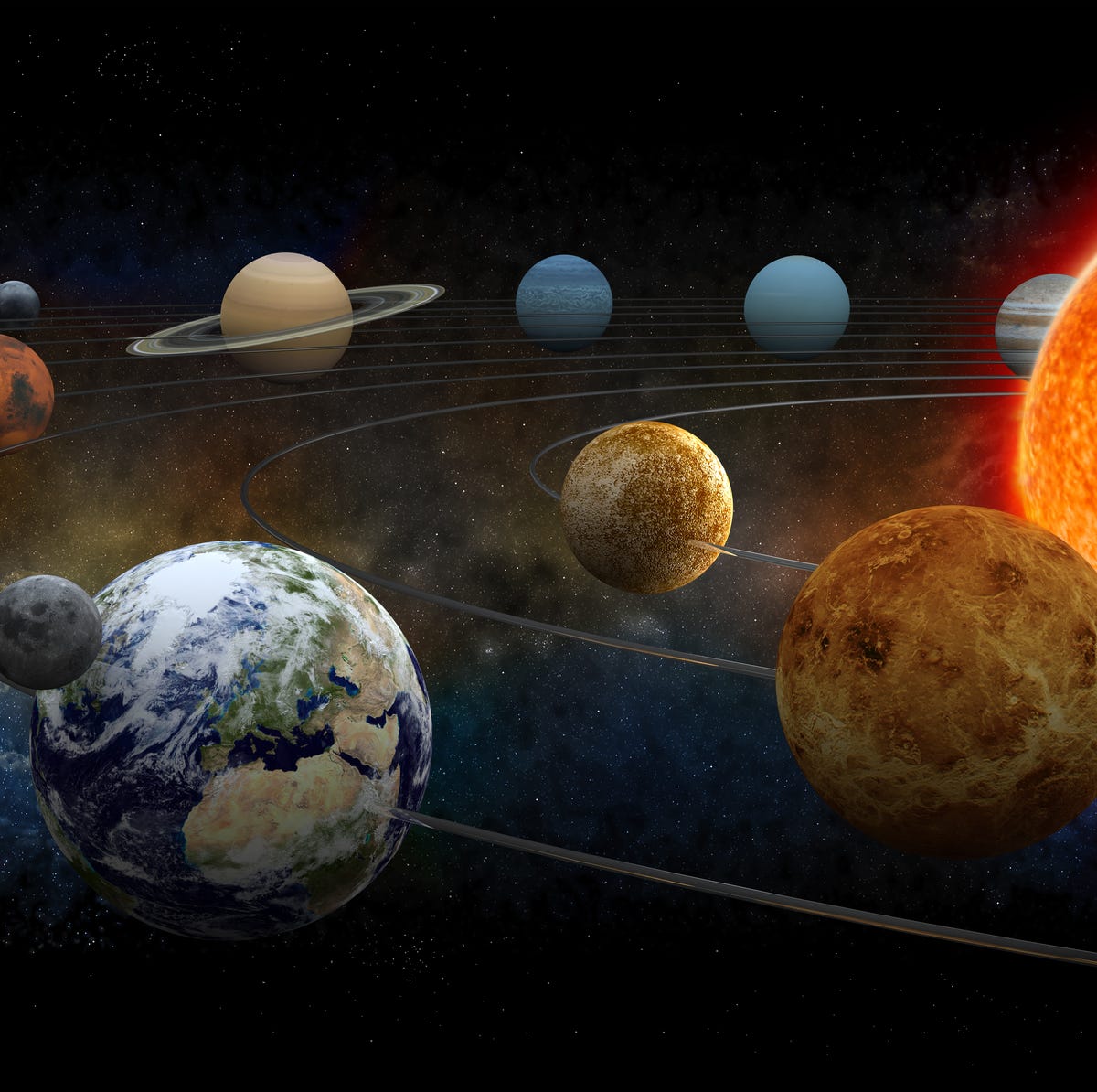
Every morning, the Sun rises in the east and sets in the west, giving the impression that it moves across our sky. Yet, in reality, it is Earth that is constantly moving—not only spinning on its axis but also traveling around the Sun at an incredible speed of nearly 30 kilometers (18.5 miles) every second. Alongside Earth, the other seven planets are also racing around the Sun, each following its own path through space.
Have you ever wondered why the planets do not simply drift away into the darkness of space? Or why they do not fall straight into the Sun, despite its immense gravitational pull? These questions have fascinated humanity for centuries. Ancient civilizations imagined invisible celestial spheres carrying the planets, while later astronomers sought mathematical explanations for their movements.
Today, thanks to centuries of scientific discovery, we know that planetary orbits are the result of a beautiful balance between gravity and motion. This balance has kept the Solar System stable for billions of years and continues to guide every planet, asteroid, comet, and spacecraft traveling around the Sun.
The Sun Is the Gravitational Heart of the Solar System
The most important reason planets orbit the Sun is gravity.
Gravity is a fundamental force of nature that attracts objects with mass toward one another. Every object in the universe exerts gravity, whether it is a tiny pebble, a planet, or an entire galaxy. However, the strength of gravity depends on two main factors: the masses of the objects and the distance between them.
The Sun contains about 99.86% of all the mass in the Solar System. Because it is so massive, it produces an extraordinarily strong gravitational field. Every planet feels this pull, no matter how far away it is.
Mercury, the closest planet, experiences the strongest gravitational pull from the Sun. Neptune, nearly 4.5 billion kilometers (2.8 billion miles) away, feels a much weaker pull. Yet even at that enormous distance, the Sun’s gravity remains strong enough to keep Neptune in orbit.
Without the Sun’s gravity, the planets would not stay together as a planetary system. They would simply continue moving through space in straight lines, each heading in its own direction.
Motion Is Just as Important as Gravity
Gravity alone does not explain planetary orbits.
Imagine throwing a ball into the air. Gravity pulls it downward, and eventually it falls back to the ground. If gravity worked alone on the planets, they too would fall directly into the Sun.
The reason this does not happen is that every planet is already moving sideways at tremendous speed.
Earth, for example, travels around the Sun at nearly 107,000 kilometers per hour (67,000 miles per hour). Mercury moves even faster, while Neptune moves more slowly.
This forward motion, called inertia, keeps each planet moving through space. At the same time, the Sun’s gravity continuously pulls the planet inward.
The result is a constantly curving path around the Sun.
Instead of falling into the Sun, the planet continually “falls around” it.
This remarkable balance creates an orbit.
Understanding Inertia
Inertia is one of the most important concepts in physics.
According to Newton’s First Law of Motion, an object in motion continues moving in a straight line at constant speed unless acted upon by an external force.
If the Sun suddenly disappeared—which is physically impossible without other dramatic consequences—Earth would no longer travel in an orbit. Instead, it would continue moving through space in a straight line at the same speed it had before.
The reason Earth follows a curved path today is because the Sun’s gravity constantly changes the direction of Earth’s motion.
Notice that gravity changes the direction much more than the speed. Earth is continually turning as it moves, creating a nearly elliptical orbit around the Sun.
Newton Solved One of Astronomy’s Greatest Mysteries
For thousands of years, people observed the motions of the planets without fully understanding why they moved as they did.
Everything changed in the seventeenth century when Sir Isaac Newton developed the law of universal gravitation.
Newton proposed that every object with mass attracts every other object with mass.
His equation explained not only why apples fall from trees but also why the Moon orbits Earth and why Earth orbits the Sun.
This was revolutionary because it showed that the same physical laws operate both on Earth and throughout the universe.
The motions of planets were no longer mysterious—they followed predictable mathematical rules.
Newton’s work became the foundation of modern celestial mechanics.
Kepler Discovered the Shape of Planetary Orbits
Before Newton explained why planets move, the German astronomer Johannes Kepler had already discovered how they move.
By carefully analyzing astronomical observations, Kepler found that planets do not travel in perfect circles.
Instead, they move in elliptical orbits.
An ellipse resembles a slightly stretched circle.
The Sun is located at one of the two focal points of each ellipse, not exactly at the center.
This means that the distance between a planet and the Sun changes slightly during each orbit.
Earth follows an orbit that is very close to circular, so this variation is relatively small.
Mercury, however, has a much more elongated orbit, causing its distance from the Sun to change significantly over the course of a year.
Kepler also discovered that planets move faster when they are closer to the Sun and slower when they are farther away.
This behavior perfectly matches the predictions of gravity.
How the Solar System Formed
To understand why planets orbit the Sun, we must travel back about 4.6 billion years.
At that time, the Solar System did not yet exist.
Instead, there was an enormous cloud of gas and dust called the solar nebula.
Over time, gravity caused this cloud to collapse inward.
As it collapsed, something interesting happened.
The cloud began to spin faster and faster, much like a figure skater pulling in their arms during a spin.
Eventually, most of the material collected at the center, where temperatures and pressures became high enough to ignite nuclear fusion.
The Sun was born.
The remaining gas and dust flattened into a rotating disk surrounding the young Sun.
Within this disk, tiny dust particles collided and stuck together.
Over millions of years, these particles grew into rocks, then planetesimals, then protoplanets, and finally the planets we know today.
Because all this material was already rotating around the newly formed Sun, the planets naturally inherited that motion.
Rather than falling into the Sun, they continued orbiting it.
Why All the Planets Move in Nearly the Same Direction
One fascinating feature of the Solar System is that nearly every planet travels around the Sun in the same direction.
Most planets also orbit within roughly the same flat plane.
This is not a coincidence.
It is a direct consequence of how the Solar System formed.
Since all the planets formed from the same rotating disk of gas and dust, they inherited the disk’s direction of rotation.
This is why the Solar System appears remarkably organized instead of chaotic.
Einstein Gave Us a Deeper Understanding
Newton’s theory explains planetary motion with remarkable accuracy.
However, in the early twentieth century, Albert Einstein developed an even deeper explanation through his theory of general relativity.
According to Einstein, gravity is not simply an invisible force pulling objects together.
Instead, massive objects such as the Sun bend the very fabric of space and time, creating what scientists call spacetime.
Planets move along the natural paths created by this curved spacetime.
An everyday analogy is placing a heavy bowling ball on a stretched rubber sheet.
The bowling ball creates a depression, and smaller balls rolling nearby naturally curve around it.
Although spacetime is not literally a rubber sheet, the analogy helps visualize how massive objects influence motion.
Einstein’s theory successfully explains subtle details of planetary motion that Newton’s theory cannot, including the tiny shift in Mercury’s orbit.
Why Planets Do Not Crash Into Each Other
At first glance, it may seem surprising that planets can orbit the Sun for billions of years without constantly colliding.
The answer lies in the stability of their orbits.
Each planet follows its own path at its own speed and average distance from the Sun.
These orbits rarely intersect.
In addition, the planets are separated by enormous distances.
Even Earth and Venus, which are neighboring planets, are usually tens of millions of kilometers apart.
Gravitational interactions between planets do occur, but over long timescales the Solar System has remained remarkably stable.
Computer simulations suggest that the current arrangement of the major planets has survived for billions of years because their motions naturally avoid repeated close encounters.
What Determines a Planet’s Orbital Speed?
Not every planet travels around the Sun at the same speed.
The closer a planet is to the Sun, the faster it must move to remain in orbit.
Mercury completes one trip around the Sun in only 88 Earth days because it travels very rapidly through the strongest part of the Sun’s gravitational field.
Earth takes about 365.25 days.
Neptune, much farther away, moves more slowly and needs about 165 Earth years to complete one orbit.
This relationship between distance and speed is a direct consequence of gravity.
What Would Happen If Earth Stopped Moving?
Imagine an impossible scenario in which Earth suddenly lost all of its sideways motion while the Sun’s gravity remained unchanged.
Without that forward motion, gravity would pull Earth almost directly toward the Sun.
Earth would no longer have the motion needed to maintain its orbit.
Conversely, if Earth somehow moved much faster than it does today, it could enter a larger orbit. If its speed became great enough to exceed the Sun’s escape velocity at Earth’s distance, it could even leave the Solar System entirely.
The precise balance between speed and gravity is what makes Earth’s orbit stable.
Are Planetary Orbits Perfectly Stable Forever?
Although planetary orbits are extremely stable, they are not completely unchanging.
The gravitational influence of other planets causes tiny variations over long periods.
The Moon also affects Earth’s motion slightly.
In addition, the Sun slowly loses a small amount of mass as it converts hydrogen into helium through nuclear fusion. This gradual change slightly weakens its gravitational pull over billions of years.
These effects are very small and do not threaten the overall stability of the Solar System on human timescales.
Do All Stars Have Orbiting Planets?
For centuries, people wondered whether our Solar System was unique.
Today we know the answer is no.
Astronomers have discovered thousands of exoplanets orbiting stars beyond our Solar System.
Just like our own planets, these worlds remain in orbit because of the gravitational attraction of their parent stars combined with their forward motion.
Some exoplanets orbit extremely close to their stars, completing an orbit in only a few days.
Others travel so far away that one orbit takes centuries.
These discoveries suggest that planetary systems are common throughout the Milky Way.
Spacecraft Also Orbit Using the Same Physics
The same physical principles that govern planets also guide human-made spacecraft.
When engineers send a spacecraft toward another planet, they carefully calculate its speed and trajectory so that gravity bends its path in exactly the desired way.
Satellites orbit Earth for the same reason that Earth orbits the Sun.
They are constantly falling toward Earth while moving sideways fast enough to keep missing it.
Whether the object is a tiny satellite or a giant planet, the underlying physics remains the same.
Why Understanding Planetary Orbits Matters
The study of planetary motion has shaped the history of science.
It helped scientists develop the laws of gravity, inspired Einstein’s theories, and laid the foundation for modern astronomy and space exploration.
Understanding orbits allows us to predict eclipses, launch satellites, send robotic explorers to distant worlds, study potentially hazardous asteroids, and search for planets that might harbor life around other stars.
It also reminds us that our own planet is part of a vast, dynamic cosmic system governed by universal laws.
The Endless Dance Around the Sun
Every planet in the Solar System is participating in an elegant cosmic dance that has continued for billions of years. The Sun’s immense gravity continually draws the planets inward, while each planet’s forward motion carries it onward through space. Neither influence wins completely. Instead, they work together to produce graceful, predictable orbits.
This delicate balance is one of nature’s greatest achievements. It keeps Earth at just the right distance for liquid water to exist, guides the changing seasons, and has allowed life to flourish on our world. The same laws that govern Earth’s journey around the Sun also shape the movements of moons, stars, galaxies, and even the largest structures in the universe.
When we look up at the night sky, we are witnessing far more than bright points of light. We are seeing a universe held together by gravity and set in motion billions of years ago—a universe where every planet continues its remarkable journey around its star, following the timeless laws of physics.