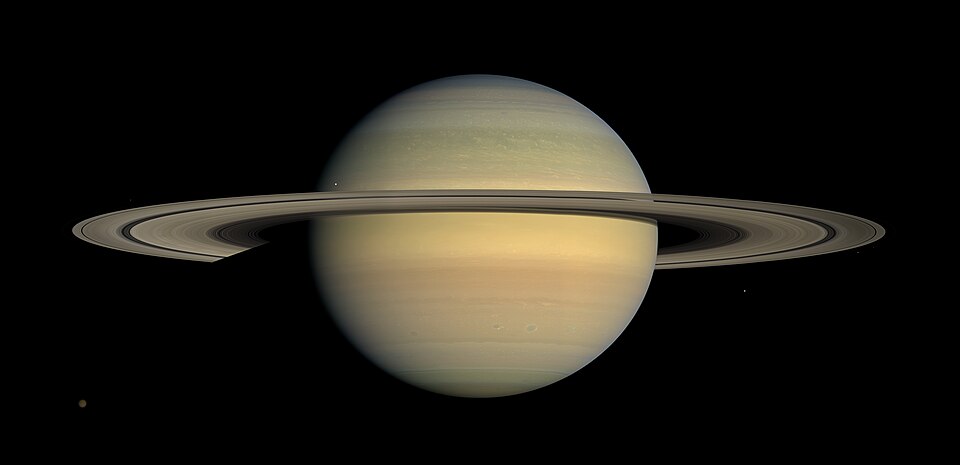
Few sights in the Solar System are as breathtaking as Saturn and its magnificent rings. Through even a small telescope, Saturn looks unlike any other planet. Its shimmering rings stretch far into space, giving the gas giant a beauty that has fascinated astronomers, artists, and skywatchers for centuries.
At first glance, the rings appear to be smooth, solid discs wrapped around the planet. But the truth is far more extraordinary. Saturn’s rings are not solid at all. They are made of countless individual pieces of ice and rock, each traveling around Saturn at incredible speeds. Together, these tiny and enormous fragments create one of the most spectacular structures in our cosmic neighborhood.
The story of what Saturn’s rings are made of is also the story of how planets, moons, and even the Solar System itself evolve over time.
Saturn’s Rings Are Mostly Water Ice
The most important ingredient in Saturn’s rings is water ice.
Scientists estimate that more than 90%—and possibly as much as 95% to 99%—of the rings’ mass is composed of nearly pure water ice. This high ice content explains why Saturn’s rings appear so bright. Ice reflects sunlight extremely well, making the rings shine brilliantly against the darkness of space.
Unlike dirty snow on Earth, much of the ice in Saturn’s rings is remarkably clean. Although the ring particles contain small amounts of rocky material, dust, and organic compounds, ice overwhelmingly dominates their composition.
This makes Saturn’s rings some of the brightest natural objects in the Solar System.
Not One Ring, but Countless Pieces
One of the biggest surprises about Saturn’s rings is that they are not giant, continuous circles.
Instead, they consist of billions to trillions of individual particles, each orbiting Saturn independently.
These particles range enormously in size.
Some are smaller than grains of sand.
Others are as large as pebbles or baseballs.
Many are the size of houses.
The largest ring fragments may even rival mountains, measuring several hundred meters across.
Each piece follows its own orbit around Saturn while constantly interacting with neighboring particles through gentle collisions and gravity.
Seen from far away, these countless icy objects blend together into the beautiful rings we admire from Earth.
Why Are the Rings So Bright?
The answer lies in ice.
Fresh water ice is highly reflective. It can bounce back a large fraction of the sunlight that strikes it.
Because Saturn’s rings contain so much clean ice, they reflect sunlight much more efficiently than most planets and moons.
However, they are not perfectly white.
Over millions of years, tiny meteoroids continually strike the rings, leaving behind dark dust and rocky debris. These impacts slowly contaminate the ice, making parts of the rings slightly darker than others.
Scientists believe that if the rings were much older, they would likely appear far dirtier than they do today.
Where Did All the Ice Come From?
This question has puzzled astronomers for decades.
The leading explanation is that Saturn’s rings formed from the remains of one or more icy moons or large comets that ventured too close to the giant planet.
Saturn’s enormous gravity can tear apart objects that cross a critical distance known as the Roche limit.
Inside this boundary, the planet’s tidal forces become stronger than the object’s own gravity.
Instead of remaining intact, an icy moon or comet may be pulled apart into countless fragments.
Those fragments then spread around Saturn, gradually forming the magnificent ring system we see today.
While scientists continue to investigate the exact origin, evidence increasingly suggests that Saturn’s rings likely formed from icy material rather than rocky asteroids.
The Rings Are Surprisingly Thin
One of the most astonishing facts about Saturn’s rings is how incredibly thin they are.
Although the rings extend roughly 280,000 kilometers (about 174,000 miles) across, most of them are only about 10 to 100 meters (roughly 30 to 330 feet) thick.
Imagine a sheet of paper stretched across the width of an entire football stadium. That comparison gives a sense of just how thin Saturn’s rings are.
This delicate structure exists because the ring particles orbit in nearly the same plane around Saturn, creating a remarkably flat system.
The Rings Are Constantly Moving
Saturn’s rings may appear peaceful, but they are actually incredibly dynamic.
Every icy particle races around the planet at speeds of tens of thousands of kilometers per hour.
Particles closer to Saturn travel faster than those farther away because gravity is stronger nearer the planet.
This difference in orbital speed means that ring particles are constantly overtaking one another.
Gentle collisions occur frequently.
Instead of destroying the rings, these collisions usually help keep the particles moving in orderly, nearly circular orbits.
The rings behave like an enormous, ever-changing river of ice.
There Is More Than One Ring
When viewed from Earth, Saturn’s rings often look like a single broad band.
In reality, they consist of thousands of separate ringlets grouped into several major rings.
The largest are traditionally named the D, C, B, A, F, G, and E rings.
Each has its own density, brightness, and particle distribution.
The B Ring is the brightest and most massive.
The A Ring contains the famous Encke Gap.
The delicate F Ring appears braided and twisted because of the gravitational influence of nearby small moons.
Farther out, the enormous E Ring is made mostly of microscopic ice particles supplied by Saturn’s moon Enceladus, whose icy geysers continuously spray water vapor into space.
Tiny Moons Help Shape the Rings
Saturn has more than a hundred known moons, and many of them play important roles in shaping the rings.
Some small moons orbit within or alongside the rings.
Their gravity acts like a cosmic shepherd, helping maintain sharp ring edges and narrow ring structures.
These “shepherd moons” gently influence nearby particles, preventing them from drifting away.
Without these moons, some of Saturn’s beautiful ring features might gradually disappear.
Cassini Changed Everything
Our understanding of Saturn’s rings improved dramatically thanks to NASA’s Cassini spacecraft.
Launched in 1997, Cassini arrived at Saturn in 2004 and spent more than thirteen years exploring the planet, its moons, and its rings.
The spacecraft flew astonishingly close to the rings, revealing details never seen before.
It discovered complex wave patterns, propeller-shaped disturbances caused by hidden objects, and subtle changes in ring composition.
Cassini also measured the total mass of the rings more accurately than ever before.
These observations helped scientists estimate their age and better understand how they formed.
When Cassini ended its historic mission in 2017 by diving into Saturn’s atmosphere, it left behind one of the richest collections of planetary data ever gathered.
Are Saturn’s Rings Ancient or Young?
For many years, scientists assumed Saturn’s rings formed alongside the planet about 4.5 billion years ago.
Today, the picture is less certain.
Measurements from Cassini suggest the rings may be surprisingly young in astronomical terms.
Some studies estimate they formed only about 100 to 400 million years ago.
If correct, this would mean Earth’s dinosaurs disappeared long before Saturn’s current rings even existed.
However, not all researchers agree.
Some scientists argue that the rings could be much older if processes continuously recycle and refresh the icy particles.
The exact age of Saturn’s rings remains one of planetary science’s most fascinating mysteries.
The Rings Are Slowly Disappearing
Although Saturn’s rings seem timeless, they are not permanent.
Scientists have discovered that tiny ring particles are gradually falling into Saturn’s atmosphere.
This process is known as ring rain.
Electric and magnetic forces, along with sunlight, can charge the icy particles, allowing some of them to spiral inward.
As they enter Saturn’s atmosphere, they vaporize and become part of the planet.
At the current estimated rate, Saturn’s magnificent rings may largely disappear within the next few hundred million years.
In the lifetime of the Solar System, they may be only a temporary feature.
Could You Stand on Saturn’s Rings?
The answer is no.
Even though the rings appear solid from a distance, they are mostly empty space.
The gaps between particles are often much larger than the particles themselves.
If a spacecraft traveled through the rings at the right location, it might pass long distances without encountering anything at all.
Landing on the rings would be impossible because there is no continuous surface to support weight.
Instead, you would drift among countless orbiting chunks of ice.
Do Other Planets Have Rings?
Yes.
All four giant planets in our Solar System have ring systems.
Jupiter, Uranus, and Neptune each possess rings.
However, their rings are much darker, thinner, and fainter than Saturn’s.
Most contain significantly more rocky dust and much less bright water ice.
Saturn’s rings stand apart because of their enormous size, extraordinary brightness, and complex structure.
They are by far the most impressive planetary rings known.
Why Saturn’s Rings Matter
Saturn’s rings are more than a beautiful decoration.
They serve as a natural laboratory where scientists can study how gravity shapes matter.
Many of the same physical processes occurring within the rings also happen in the disks of gas and dust surrounding newborn stars, where planets are forming.
By understanding Saturn’s rings, astronomers gain valuable clues about how planetary systems develop across the universe.
The rings also reveal how moons interact with surrounding material and how collisions gradually reshape celestial objects over time.
In many ways, Saturn’s rings offer a glimpse into the processes that built our own Solar System billions of years ago.
The Beauty Hidden in Ice
At first glance, Saturn’s rings seem almost magical. Yet their beauty comes from something surprisingly simple: billions upon billions of pieces of water ice orbiting together in perfect harmony under the influence of gravity.
Each tiny fragment follows the laws of physics, reflecting sunlight across the vastness of space. Together, they create one of the most recognizable and awe-inspiring sights in the cosmos.
Although these rings may eventually fade away, they continue to remind us that even ordinary materials like water ice can form structures of extraordinary beauty when shaped by the forces of nature. Saturn’s rings are not just one of the Solar System’s greatest wonders—they are a shining example of how the universe can transform simple ingredients into something truly unforgettable.