Every year, the world transforms in a beautiful and predictable rhythm. Flowers bloom after winter’s chill, long summer days invite people outdoors, colorful autumn leaves blanket the ground, and snow quietly covers landscapes in many parts of the world. These changes are so familiar that we often take them for granted. Yet behind every spring blossom, every summer heatwave, every autumn harvest, and every winter frost lies one of Earth’s greatest astronomical wonders.
Many people assume that the seasons happen because Earth moves closer to the Sun in summer and farther away in winter. It seems like a reasonable explanation—after all, getting closer to a fire makes you warmer. Surprisingly, this idea is incorrect.
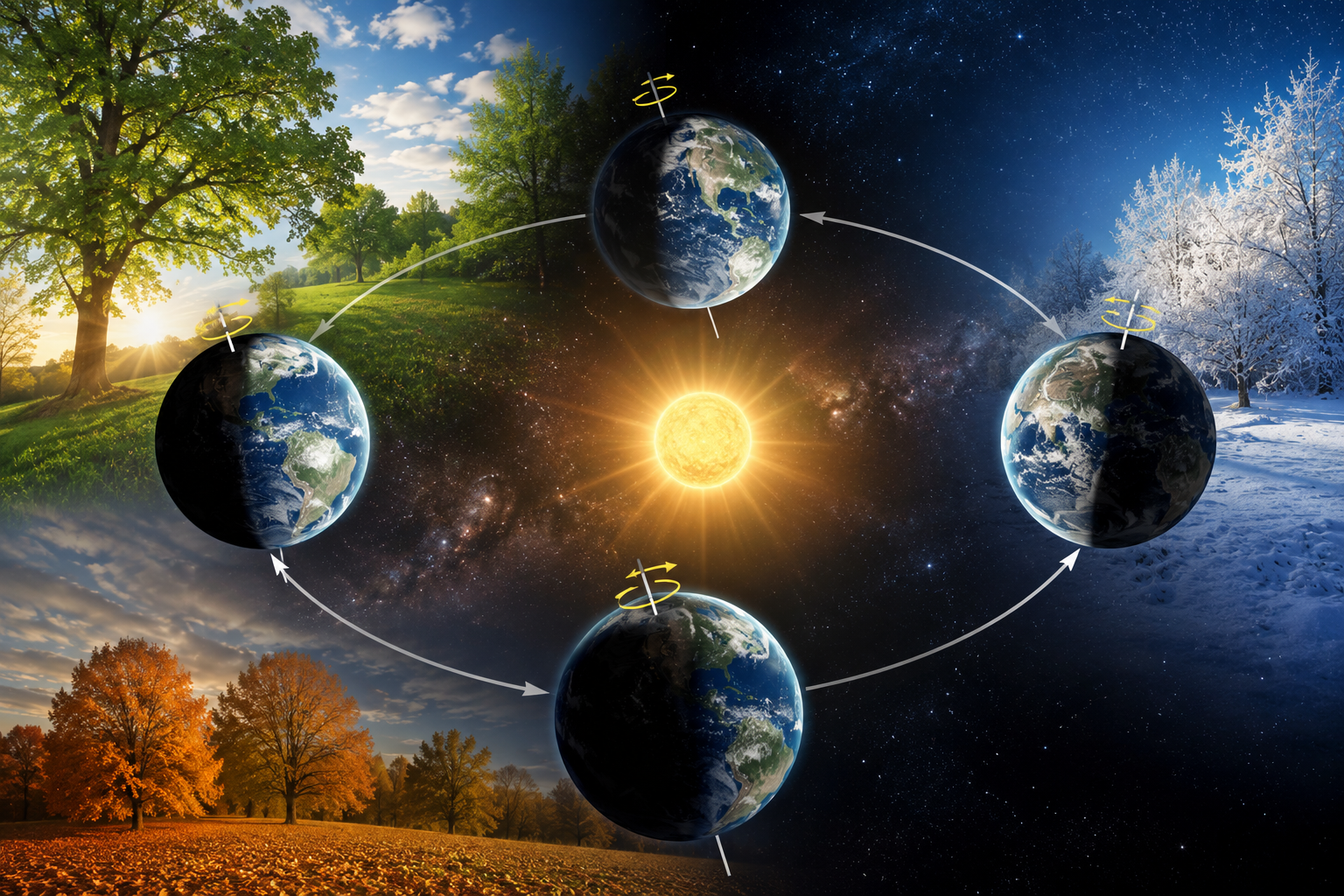
The true cause of the seasons is far more fascinating. The changing seasons are created by the tilt of Earth’s axis as our planet travels around the Sun. This simple tilt, combined with Earth’s yearly orbit, determines how much sunlight different parts of the planet receive throughout the year.
Understanding why the seasons change not only explains the weather around us but also reveals how delicately our planet is balanced to support life.
Earth Is Constantly Moving
Earth is never standing still. At every moment, our planet is spinning on its axis while simultaneously traveling around the Sun.
Earth completes one full rotation approximately every 24 hours, giving us day and night. At the same time, it orbits the Sun once every 365.25 days, creating the length of a year.
If Earth simply orbited the Sun while standing perfectly upright, the amount of sunlight received at every location would remain nearly constant throughout the year. In that case, there would be almost no seasonal changes.
Instead, Earth is tilted.
This tilt changes everything.
Earth’s Axis Is Tilted
Imagine placing a globe on a table. Instead of standing perfectly vertical, the globe leans slightly to one side.
Earth behaves the same way.
Our planet’s axis—the imaginary line running through the North Pole and South Pole—is tilted by about 23.5 degrees relative to the plane of its orbit around the Sun.
This tilt remains pointed in nearly the same direction throughout the year, toward a point in space near the star Polaris, often called the North Star.
As Earth travels around the Sun, this constant tilt causes different hemispheres to receive different amounts of sunlight at different times of the year.
This is the fundamental reason seasons exist.
More Sunlight Means Warmer Weather
The amount of solar energy reaching Earth’s surface depends largely on the angle at which sunlight arrives.
When sunlight strikes the ground more directly, its energy is concentrated over a smaller area. This delivers more heat and raises temperatures.
When sunlight arrives at a shallow angle, the same amount of energy spreads over a larger area. The heating becomes less efficient.
Think of shining a flashlight directly onto a wall.
The light forms a bright, concentrated circle.
Now tilt the flashlight.
The same light spreads into a larger, dimmer shape.
Nothing changed about the flashlight itself.
Only the angle changed.
The Sun behaves in exactly the same way.
During summer, sunlight reaches your part of Earth more directly.
During winter, sunlight arrives at a lower angle, making it less effective at warming the surface.
Day Length Also Changes
The angle of sunlight is only part of the story.
Earth’s tilt also changes the length of daylight.
During summer, the hemisphere tilted toward the Sun experiences longer days and shorter nights.
With more hours of daylight, the ground has additional time to absorb solar energy.
Even after sunset, much of that heat remains stored in the land, oceans, and atmosphere.
During winter, daylight becomes much shorter.
The Sun stays lower in the sky, and there are fewer hours available for heating.
Long nights allow the surface to lose more heat before sunrise.
Together, lower Sun angles and shorter days create colder temperatures.
Summer in One Hemisphere Means Winter in the Other
One of the most remarkable consequences of Earth’s tilt is that the Northern and Southern Hemispheres experience opposite seasons.
When the Northern Hemisphere is tilted toward the Sun, countries such as the United States, Canada, much of Europe, and northern Asia experience summer.
At exactly the same time, the Southern Hemisphere—including Australia, New Zealand, South Africa, Argentina, and Chile—is tilted away from the Sun and experiences winter.
Six months later, the situation reverses.
The Southern Hemisphere receives more direct sunlight and longer days, while the Northern Hemisphere enters winter.
This opposite seasonal pattern explains why people celebrate Christmas during snowy weather in Canada but often enjoy it on warm beaches in Australia.
The Solstices
Twice each year, Earth’s tilt reaches its maximum orientation toward or away from the Sun.
These moments are called the solstices.
Around June 20 or 21, the Northern Hemisphere experiences the June Solstice.
This marks the longest day of the year north of the equator and the beginning of astronomical summer there.
The Southern Hemisphere experiences its shortest day and the beginning of winter.
Around December 21 or 22, Earth reaches the December Solstice.
Now the Southern Hemisphere enjoys its longest day and summer begins there, while the Northern Hemisphere experiences its shortest day and winter begins.
These events have been observed and celebrated by cultures around the world for thousands of years.
The Equinoxes
Halfway between the solstices come the equinoxes.
During these times, Earth’s axis is tilted neither toward nor away from the Sun.
Instead, both hemispheres receive nearly equal amounts of sunlight.
As a result, day and night are almost equal in length worldwide.
The March Equinox marks the beginning of spring in the Northern Hemisphere and autumn in the Southern Hemisphere.
The September Equinox marks the beginning of autumn in the Northern Hemisphere and spring in the Southern Hemisphere.
These moments represent Earth’s seasonal balance before daylight begins increasing in one hemisphere and decreasing in the other.
Why Summer Is Not the Hottest Day of the Year
An interesting question often arises.
If the June Solstice brings the most direct sunlight to the Northern Hemisphere, why isn’t it also the hottest day of the year?
The answer lies in Earth’s ability to store heat.
Land, oceans, and the atmosphere absorb energy gradually.
Even after the longest day has passed, Earth continues receiving more solar energy than it loses for several weeks.
This delayed response is called seasonal lag.
As a result, the warmest days usually occur during July or August in many Northern Hemisphere locations.
The same delay occurs after the winter solstice.
Even though daylight begins increasing after late December, temperatures often continue falling into January because Earth is still losing more heat than it gains.
The Distance Between Earth and the Sun
One of the most common misconceptions about the seasons involves Earth’s distance from the Sun.
Earth’s orbit is slightly elliptical rather than perfectly circular.
This means our distance from the Sun changes slightly during the year.
However, these changes are far too small to cause the seasons.
In fact, Earth is actually closest to the Sun in early January, when the Northern Hemisphere is experiencing winter.
The closest point in Earth’s orbit is called perihelion.
The farthest point occurs in early July and is called aphelion.
This fact alone demonstrates that distance from the Sun cannot explain the seasons.
Earth receives about 7% more solar energy at perihelion than at aphelion, but the effects of the planet’s axial tilt are much larger and completely dominate seasonal temperature changes.
Seasons Near the Equator
Not every part of Earth experiences dramatic seasonal changes.
Near the equator, the Sun remains relatively high in the sky throughout the year.
Day length also changes very little.
Because sunlight remains fairly constant, temperatures stay warm year-round.
Instead of four distinct seasons, many tropical regions experience wet and dry seasons that are influenced primarily by shifting rainfall patterns rather than large temperature differences.
Rainfall, atmospheric circulation, and ocean currents play a much greater role than changing sunlight.
Seasons Near the Poles
Near Earth’s poles, seasonal changes become much more dramatic.
During summer, the Sun may remain above the horizon for weeks or even months.
This phenomenon is known as the Midnight Sun.
In parts of northern Alaska, Canada, Greenland, Scandinavia, and Antarctica, daylight can last continuously for an entire season.
During winter, the opposite occurs.
The Sun may never rise above the horizon for extended periods, creating the Polar Night.
These extreme changes result directly from Earth’s tilted axis.
No other regions on Earth experience such dramatic variations in daylight.
Why Seasons Are Different Around the World
Although Earth’s tilt controls the seasons everywhere, local climates vary greatly.
Coastal regions often have milder seasonal changes because oceans warm and cool more slowly than land.
Inland areas usually experience larger temperature swings.
Mountains influence temperature through altitude.
Higher elevations remain cooler than nearby lowlands.
Ocean currents also shape seasonal weather.
Warm currents can moderate winter temperatures, while cold currents can keep summers cooler.
Atmospheric circulation, humidity, vegetation, and geography all interact with sunlight to create Earth’s diverse climates.
This is why two cities located at similar latitudes can experience very different seasonal weather.
How Plants Respond to the Seasons
Plants are among the most sensitive indicators of seasonal change.
As daylight increases in spring, many plants begin producing new leaves, flowers, and seeds.
Photosynthesis becomes more active as sunlight becomes stronger and days grow longer.
During autumn, shorter days trigger chemical changes inside many trees.
Green chlorophyll gradually breaks down, revealing brilliant yellow, orange, and red pigments that were hidden throughout the summer.
Eventually, many deciduous trees shed their leaves to conserve water and survive winter.
These seasonal cycles have evolved over millions of years and are closely synchronized with Earth’s changing sunlight.
How Animals Adapt to Seasonal Changes
Animals also depend heavily on seasonal patterns.
Many bird species migrate thousands of kilometers between breeding and wintering grounds.
Some mammals grow thicker fur before winter arrives.
Others enter hibernation, reducing their activity and conserving energy until warmer conditions return.
Many insects time their life cycles to coincide with spring flowers or summer warmth.
Marine animals also respond to seasonal changes in ocean temperature and food availability.
Even human biology shows subtle seasonal rhythms influenced by daylight and temperature.
Earth’s tilt quietly shapes ecosystems across the entire planet.
Human Life and the Seasons
Throughout history, civilizations have depended on the seasons.
Farmers plan planting and harvesting according to seasonal weather.
Architects design buildings to maximize warmth during winter and reduce overheating during summer.
Festivals and cultural traditions often celebrate seasonal milestones such as harvests, solstices, and the arrival of spring.
Modern societies continue relying on seasonal forecasts for agriculture, transportation, energy production, tourism, and disaster preparedness.
Understanding the seasons remains essential even in our technologically advanced world.
Seasons on Other Planets
Earth is not the only planet with seasons.
Mars also experiences seasons because its rotational axis is tilted by about 25 degrees, similar to Earth’s.
However, because Mars takes nearly two Earth years to orbit the Sun, each Martian season lasts much longer.
Saturn, Uranus, and Neptune also have seasons due to their axial tilts.
Uranus is especially unusual because it is tilted by about 98 degrees.
It essentially rotates on its side, producing extreme seasonal changes unlike anything found on Earth.
Studying seasons on other planets helps scientists better understand planetary climates throughout the Solar System.
Could Earth Lose Its Seasons?
If Earth’s axis were not tilted, the familiar seasons would disappear.
The equator would remain consistently warm.
Polar regions would stay cold.
Most places would experience nearly the same daylight length throughout the year.
Many ecosystems would change dramatically.
Agriculture, wildlife migration, forests, and weather patterns would all be profoundly different.
Earth’s 23.5-degree tilt has played a crucial role in creating the diverse environments that support the extraordinary variety of life on our planet.
The Beautiful Balance of a Tilted Planet
The changing seasons are among the most familiar experiences of life on Earth, yet they arise from an elegant astronomical relationship between our planet and the Sun. They are not caused by Earth moving closer to or farther from the Sun but by the steady 23.5-degree tilt of Earth’s axis as it journeys around its star.
This gentle tilt changes the angle of sunlight and the length of daylight throughout the year, creating the endless cycle of spring, summer, autumn, and winter. It shapes ecosystems, influences weather, guides the migrations of animals, determines growing seasons for crops, and has inspired cultures for thousands of years.
Every blossom that opens in spring, every long summer afternoon, every colorful autumn forest, and every quiet winter snowfall is a reminder that our planet is constantly moving through space in a beautifully predictable dance. The seasons are more than changes in weather—they are a reflection of Earth’s place in the cosmos and one of the many ways astronomy touches our everyday lives.