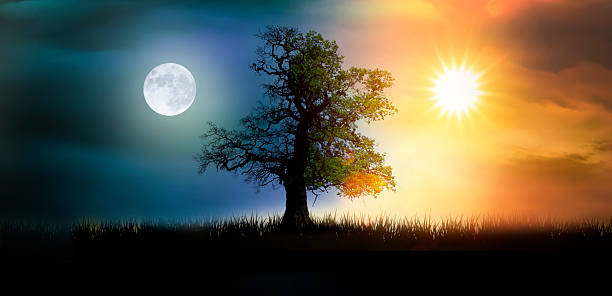
Every morning, the Sun rises in the east, bathing the landscape in light and warmth. Hours later, it sinks below the horizon, and darkness slowly takes its place. This daily rhythm has shaped life on Earth for billions of years. It determines when we wake up, work, rest, and sleep. It influences weather, animal behavior, and even the biological clocks inside every living organism.
For thousands of years, people wondered why day and night occur. Ancient civilizations often believed that the Sun traveled across the sky in a divine chariot or that supernatural forces controlled the cycle of light and darkness. Today, science provides a far simpler and far more fascinating explanation.
Day and night are not caused by the Sun moving around Earth. Instead, they happen because our planet spins continuously on its axis. As Earth rotates, different parts of the planet face the Sun or turn away from it, creating the alternating cycle of daylight and darkness that every place on Earth experiences.
Understanding this simple but profound movement helps us understand not only day and night but also time zones, sunrise and sunset, the apparent motion of the stars, and many other natural phenomena.
Earth Is Constantly Rotating
The primary cause of day and night is Earth’s rotation.
Earth spins around an imaginary line called its axis, which passes through the North Pole and the South Pole. This axis is not a physical object but an imaginary line around which the planet rotates.
Earth completes one full rotation in approximately 23 hours, 56 minutes, and 4 seconds relative to distant stars, a period known as a sidereal day. However, because Earth is also moving around the Sun, it takes about 24 hours for the Sun to return to the same position in the sky, producing the familiar solar day that we use in everyday life.
This rotation occurs continuously, day and night, without stopping.
Even though we cannot feel Earth spinning, every person, mountain, ocean, and city is moving with the planet.
How Earth’s Rotation Creates Day and Night
Imagine shining a flashlight on a spinning globe.
Only the half facing the flashlight is illuminated, while the opposite half remains in darkness.
Earth behaves in exactly the same way.
The Sun continuously shines in all directions, but because Earth is a sphere, sunlight can illuminate only one hemisphere at a time.
The side facing the Sun experiences daylight.
The side facing away from the Sun experiences nighttime.
As Earth rotates, every location gradually moves from darkness into sunlight and later back into darkness.
This continuous spinning creates the familiar cycle of sunrise, daytime, sunset, and night.
Without Earth’s rotation, one side of the planet would experience permanent daylight while the opposite side would remain in endless darkness.
Why the Sun Appears to Move Across the Sky
When we watch the sky, it looks as though the Sun rises, travels across the heavens, and sets in the evening.
In reality, the opposite is happening.
The Sun remains nearly stationary relative to Earth’s daily rotation, while Earth spins from west to east.
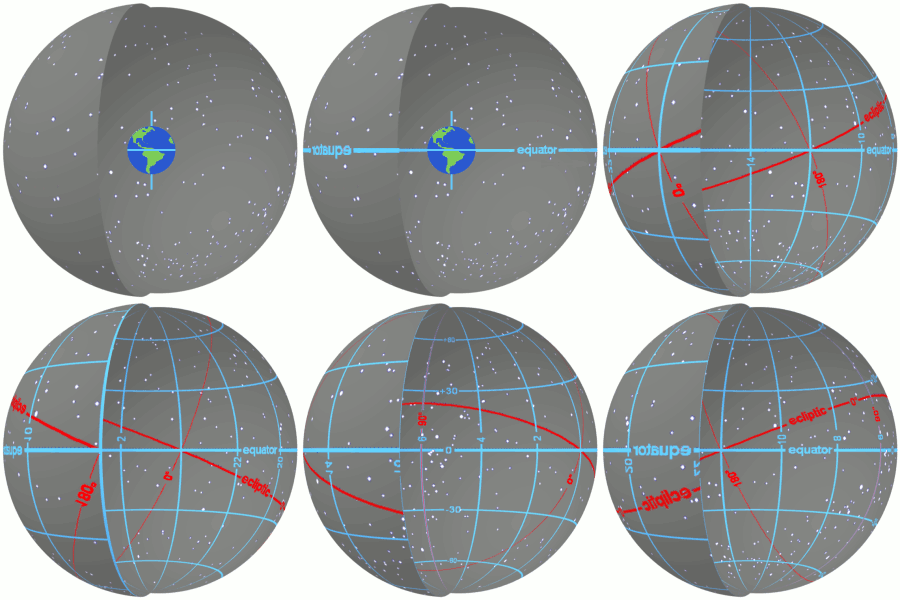
Because of this eastward rotation, celestial objects—including the Sun, Moon, planets, and stars—appear to move from east to west across the sky.
This apparent motion is similar to what you experience when riding in a moving train. Trees outside may seem to move backward, even though it is actually the train that is moving.
Likewise, the Sun only appears to travel across the sky because Earth is rotating beneath it.
Why We Cannot Feel Earth Spinning
One of the most common questions about Earth’s rotation is simple: if Earth spins so fast, why don’t we feel it?
The answer lies in the fact that everything around us rotates together.
The ground, oceans, atmosphere, buildings, animals, and people all move at the same constant speed as Earth.
A passenger inside a smoothly moving airplane usually does not feel the plane’s speed unless it accelerates, slows down, or changes direction.
Similarly, Earth’s rotation is extremely steady.
Because there is almost no sudden acceleration or deceleration, we do not sense the motion directly.
Instead, we notice its effects through the changing position of the Sun, stars, and shadows.
How Fast Is Earth Rotating?
Earth rotates surprisingly quickly.
At the equator, a point on Earth’s surface moves at roughly 1,670 kilometers per hour (about 1,037 miles per hour).
This speed decreases toward the poles because those regions travel around a much smaller circle during each rotation.
At the North Pole and South Pole, the rotational speed is effectively zero because those points lie directly on Earth’s axis.
Although these speeds seem enormous, Earth’s circumference is also enormous, making one complete rotation take about 24 hours.
Sunrise, Noon, Sunset, and Midnight
Earth’s rotation explains the daily progression of time.
As a location first rotates into sunlight, people experience sunrise.
As Earth continues turning, the Sun appears to climb higher in the sky.
When the Sun reaches its highest point above the horizon, it is approximately local solar noon.
Afterward, the Sun appears to descend toward the western horizon.
Eventually, the location rotates out of the illuminated half of Earth, producing sunset.
The hours after sunset are nighttime, culminating around local midnight, when the location faces most directly away from the Sun.
The cycle then repeats with the next sunrise.
Why Different Places Have Day and Night at Different Times
If Earth rotates as one planet, why isn’t it daytime everywhere at once?
The answer lies in Earth’s spherical shape.
Only half of the planet is illuminated at any given moment.
Because Earth rotates continuously, different longitudes face the Sun at different times.
When it is midday in one country, another country on the opposite side of Earth may be experiencing midnight.
This is why people in different parts of the world live according to different local times.
Time Zones and Earth’s Rotation
The system of time zones is based directly on Earth’s rotation.
Since Earth rotates approximately 360 degrees in about 24 hours, it turns about 15 degrees every hour.
To make timekeeping practical, the world is divided into multiple time zones.
As Earth rotates eastward, locations farther east experience sunrise earlier than places farther west.
This explains why the Sun rises first in eastern regions before reaching western areas.
Although political boundaries sometimes alter the exact shape of time zones, their underlying reason is Earth’s daily rotation.
Why Day and Night Are Nearly Equal During the Equinoxes
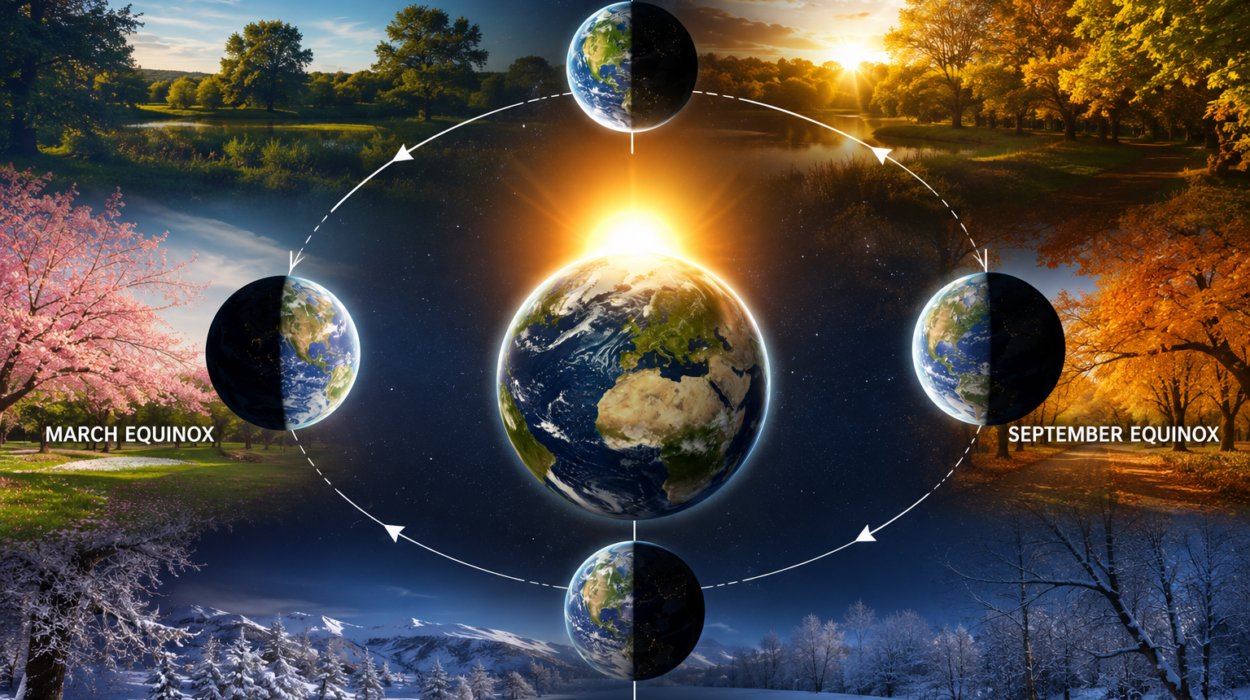
Twice each year, Earth reaches positions in its orbit called the equinoxes.
During these times, Earth’s axis is positioned so that neither hemisphere is tilted toward or away from the Sun.
As a result, most places on Earth experience nearly equal lengths of day and night, close to 12 hours each.
The March equinox marks the beginning of spring in the Northern Hemisphere and autumn in the Southern Hemisphere.
The September equinox marks autumn in the Northern Hemisphere and spring in the Southern Hemisphere.
These events beautifully demonstrate how Earth’s rotation and its orbit work together.
Why the Length of Day Changes Throughout the Year
Although Earth’s rotation always produces day and night, the length of daylight is not constant.
The reason is Earth’s 23.5-degree axial tilt.
As Earth orbits the Sun, this tilt causes different parts of the planet to receive varying amounts of sunlight during different seasons.
During summer in one hemisphere, that hemisphere is tilted toward the Sun.
The Sun follows a higher path across the sky and remains above the horizon longer, creating longer days and shorter nights.
During winter, the same hemisphere tilts away from the Sun.
The Sun takes a lower path across the sky, leading to shorter days and longer nights.
Thus, Earth’s rotation creates the daily cycle, while its tilted axis determines how long daylight lasts.
The Midnight Sun and Polar Night
Near Earth’s poles, the interaction between rotation and axial tilt produces extraordinary phenomena.
During summer, regions inside the Arctic Circle or Antarctic Circle can experience continuous daylight for weeks or even months.
This phenomenon is known as the Midnight Sun.
Even at midnight, the Sun remains above the horizon.
During winter, the opposite occurs.
These regions experience Polar Night, during which the Sun never rises above the horizon for extended periods.
Even though Earth continues rotating normally, the tilt of its axis prevents sunlight from reaching these areas.
These remarkable events illustrate that day and night are influenced not only by Earth’s rotation but also by the orientation of its axis.
Does the Sun Ever Stop Shining?
It may seem as though the Sun disappears every evening, but this is only an illusion caused by Earth’s rotation.
The Sun shines continuously.
It produces enormous amounts of energy through nuclear fusion in its core, where hydrogen atoms combine to form helium.
This process releases vast quantities of light and heat that travel across approximately 150 million kilometers (93 million miles) of space before reaching Earth.
Night occurs not because the Sun turns off but because our part of Earth rotates away from its light.
How Scientists Proved Earth Rotates
Today, Earth’s rotation is supported by overwhelming scientific evidence.
One famous demonstration is the Foucault pendulum, invented by French physicist Léon Foucault in 1851.
A freely swinging pendulum appears to change its direction over time because Earth rotates beneath it.
This simple yet elegant experiment provides direct evidence that Earth is spinning.
Additional confirmation comes from satellites, spacecraft, weather systems, astronomical observations, and the precise operation of technologies such as the Global Positioning System (GPS).
Modern science leaves no doubt that Earth’s rotation is the true cause of day and night.
How Day and Night Affect Life on Earth
The daily alternation between light and darkness is essential for life.
Plants use daylight to perform photosynthesis, converting sunlight into chemical energy that supports nearly all ecosystems.
Animals have evolved behaviors that match the cycle.
Some species are active during the day and are known as diurnal animals.
Others, such as owls and many bats, are nocturnal, hunting and exploring under the cover of darkness.
Still others are most active at dawn and dusk.
Humans also possess an internal biological clock known as the circadian rhythm.
This natural timing system helps regulate sleep, hormone production, body temperature, metabolism, and many other physiological processes.
Exposure to daylight helps synchronize this internal clock, promoting healthy sleep patterns and overall well-being.
What Would Happen If Earth Stopped Rotating?
Imagining a motionless Earth reveals just how important rotation is.
If Earth suddenly stopped rotating—a scenario that is physically unrealistic—the consequences would be catastrophic.
Objects on the surface would continue moving eastward at tremendous speeds because of inertia.
Powerful winds, massive ocean waves, and widespread destruction would result.
Even if Earth somehow became stationary gradually, one side of the planet would face constant sunlight while the other remained in perpetual darkness.
The sunlit side would become extremely hot, while the dark side would become intensely cold.
Weather patterns, ecosystems, and human life would be dramatically altered.
Fortunately, there is no evidence that Earth will stop rotating in any foreseeable future.
Its rotation changes only very slightly over extremely long timescales due to gravitational interactions, particularly with the Moon.
A Simple Motion That Shapes Our World
The cycle of day and night is one of nature’s most familiar experiences, yet it is also one of its greatest demonstrations of the elegance of physics. Every sunrise, every sunset, and every star-filled night sky is a reminder that Earth is constantly turning through space.
Our planet rotates steadily on its axis, carrying every ocean, mountain, forest, and city with it. As different regions face the Sun or turn away from it, they alternate between daylight and darkness. This simple rotation governs our clocks, influences our climate, regulates the rhythms of life, and connects every place on Earth through a shared cosmic dance.
The next time you watch the Sun rise above the horizon or admire the colors of an evening sunset, remember that the spectacle is not created by the Sun circling Earth. Instead, it is our own planet—spinning silently and faithfully through space—that creates the beautiful rhythm of day and night, a rhythm that has guided life on Earth for billions of years.