The universe has always inspired wonder. For thousands of years, people looked up at the night sky and imagined what lay beyond the stars. Early astronomers observed the heavens with their eyes alone. Later, telescopes revealed planets, moons, galaxies, and nebulae that had never been seen before. Yet even the largest ground-based telescopes faced one stubborn obstacle—the Earth’s atmosphere. It blurs starlight, making distant objects appear less sharp than they truly are.
The launch of the Hubble Space Telescope changed everything.
For more than three decades, Hubble has given humanity an incredibly clear view of the universe from its home above Earth’s atmosphere. It has captured breathtaking images that have become icons of modern science, but its greatest achievement goes far beyond beautiful photographs. Hubble has transformed our understanding of the cosmos, answered some of astronomy’s biggest questions, and raised many new ones. It has helped scientists measure the age of the universe, discover the existence of supermassive black holes, study the birth and death of stars, observe planets around other stars, and reveal galaxies from the earliest chapters of cosmic history.
Few scientific instruments have changed astronomy as profoundly as the Hubble Space Telescope.
The Dream of a Telescope in Space
Long before Hubble was launched, astronomers knew that Earth’s atmosphere limited what telescopes could see. As light from distant stars and galaxies passes through layers of moving air, it becomes distorted. This effect causes stars to twinkle, but it also reduces the sharpness of astronomical observations.
In the early twentieth century, astronomers began imagining a telescope placed above the atmosphere, where nothing would interfere with its view of the universe. One of the strongest supporters of this idea was astronomer Lyman Spitzer, who argued that a space telescope could make discoveries impossible from Earth.
Turning this vision into reality took decades of planning, technological development, and international cooperation. Eventually, NASA partnered with the European Space Agency (ESA) to build one of the most ambitious scientific instruments ever created.
The Launch of Hubble
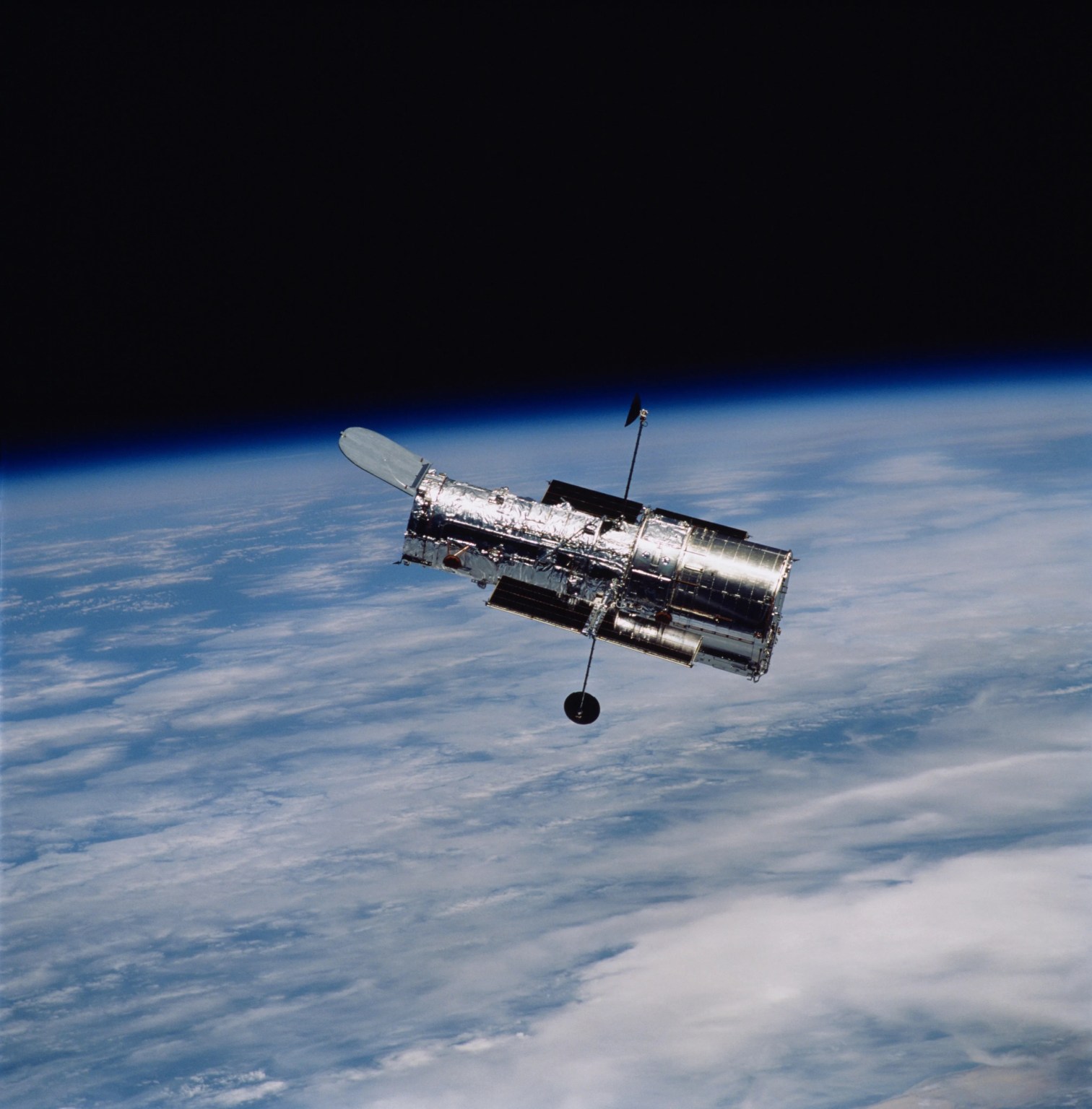
The Hubble Space Telescope was launched aboard the Space Shuttle Discovery on April 24, 1990. Orbiting about 540 kilometers (roughly 335 miles) above Earth’s surface, Hubble circles our planet approximately every 95 minutes.
Unlike telescopes on the ground, Hubble operates above clouds, weather, air pollution, and atmospheric turbulence. This allows it to observe the universe with extraordinary clarity.
Named after the famous American astronomer Edwin Hubble, the telescope honors the scientist whose discoveries showed that the universe extends far beyond the Milky Way and is expanding over time.
The launch marked the beginning of a new era in astronomy.
An Unexpected Problem
Soon after Hubble began sending images back to Earth, astronomers were disappointed. Instead of producing perfectly sharp pictures, the telescope’s images appeared blurry.
The problem turned out to be a tiny flaw in Hubble’s primary mirror. The mirror had been polished with an error measuring only about two micrometers—roughly one-fiftieth the width of a human hair. Although incredibly small, the mistake prevented the telescope from focusing light correctly.
For many people, the mission seemed like a costly failure.
Fortunately, Hubble had been designed with servicing missions in mind. In 1993, astronauts aboard the Space Shuttle Endeavour installed corrective optics that worked much like eyeglasses for the telescope. They also upgraded several scientific instruments.
The repair was a spectacular success.
When the first corrected images arrived, they were sharper than astronomers had ever imagined. Hubble immediately became one of the most powerful scientific observatories in history.
Seeing the Universe with Unprecedented Clarity
One of Hubble’s greatest strengths is its ability to capture incredibly detailed images.
Its observations revealed delicate structures inside galaxies, glowing clouds of gas where stars are born, enormous explosions caused by dying stars, and distant objects that had previously appeared only as faint smudges.
These images were not merely beautiful. Every photograph contained valuable scientific information that allowed researchers to investigate the physical processes shaping the universe.
Hubble transformed astronomy from a field often limited by blurry observations into one capable of examining the cosmos in extraordinary detail.
Measuring the Age of the Universe More Accurately
One of Hubble’s most important achievements was improving measurements of the universe’s age.
Astronomers determine cosmic distances using objects known as Cepheid variable stars, whose brightness changes in a predictable way. Edwin Hubble originally used these stars to show that galaxies exist beyond the Milky Way.
The Hubble Space Telescope observed Cepheid stars in distant galaxies with much greater precision than was possible from Earth.
These observations helped scientists refine the value of the Hubble constant, which describes how fast the universe is expanding.
Combining Hubble’s data with other observations allowed astronomers to estimate that the universe is approximately 13.8 billion years old.
This represented one of the most important milestones in modern cosmology.
Revealing the Expansion of the Universe
The universe has been expanding ever since the Big Bang.
Hubble played a major role in improving measurements of this expansion by observing galaxies at different distances.
Perhaps even more surprising, Hubble helped provide evidence that the expansion of the universe is accelerating rather than slowing down.
This unexpected discovery suggested the existence of an unknown phenomenon now called dark energy.
Dark energy remains one of the greatest mysteries in science. Although scientists do not yet understand its true nature, observations from Hubble have been essential in studying its effects on cosmic expansion.
Looking Back in Time
Light travels at a finite speed.
When we observe distant galaxies, we see them not as they are today but as they appeared when their light first began its journey toward Earth.
This means Hubble functions as a kind of time machine.
By observing galaxies billions of light-years away, Hubble has allowed astronomers to study the universe when it was only a small fraction of its current age.
Some of Hubble’s deepest observations reveal galaxies whose light has traveled for more than 13 billion years.
These images provide valuable clues about how the first galaxies formed after the Big Bang.
The Famous Hubble Deep Field
In 1995, astronomers pointed Hubble toward what appeared to be an almost empty region of the sky.
Many wondered whether this would waste valuable observing time.
Instead, the telescope revealed something astonishing.
The tiny patch of sky, previously thought to contain almost nothing, was filled with thousands of galaxies.
Each galaxy contained millions or even billions of stars.
This observation became known as the Hubble Deep Field.
Later projects, including the Hubble Ultra Deep Field and Hubble eXtreme Deep Field, looked even farther into space.
These observations dramatically changed our understanding of the universe by showing that galaxies are far more numerous than previously imagined.
Discovering How Galaxies Grow
Before Hubble, astronomers had only a limited understanding of how galaxies evolve.
Hubble observed galaxies of many different shapes, sizes, and ages.
Its images showed galaxies colliding, merging, and interacting with one another.
These observations revealed that galaxy collisions are a normal part of cosmic evolution.
The Milky Way itself is expected to merge with the neighboring Andromeda Galaxy billions of years from now.
Hubble’s observations have helped scientists reconstruct the life stories of galaxies across cosmic time.
Uncovering the Birthplaces of Stars
Stars are born inside enormous clouds of gas and dust called molecular clouds.
Hubble has photographed these stellar nurseries in remarkable detail.
One of its most famous images, known as the Pillars of Creation, shows towering columns of gas inside the Eagle Nebula.
These pillars contain dense regions where new stars are forming.
Hubble revealed that star formation is a dynamic process involving gravity, radiation, stellar winds, and complex interactions between gas and dust.
These observations greatly expanded our understanding of how stars like our Sun are born.
Watching Stars Die
Every star eventually reaches the end of its life.
Some quietly become white dwarfs.
Others explode as supernovae.
The most massive stars collapse into neutron stars or black holes.
Hubble has observed many of these dramatic events.
Its images of planetary nebulae revealed beautiful shells of gas expelled by dying stars.
It has also studied the expanding remnants of supernova explosions, helping astronomers understand how heavy elements such as oxygen, carbon, iron, and calcium are created and spread throughout galaxies.
These elements later become part of new stars, planets, and even living organisms.
In this way, Hubble has shown that the material making up our own bodies was forged inside ancient stars.
Finding Evidence for Supermassive Black Holes
Nearly every large galaxy appears to contain a supermassive black hole at its center.
Before Hubble, evidence for these enormous objects was limited.
Hubble measured the rapid motion of stars orbiting galactic centers.
These observations demonstrated that invisible objects containing millions or even billions of times the Sun’s mass must exist there.
The simplest explanation is the presence of supermassive black holes.
Today, astronomers recognize these giant black holes as essential components of galaxy evolution.
Studying Planets Beyond Our Solar System
Although Hubble was not designed primarily to search for exoplanets, it has made important contributions to their study.
The telescope has analyzed the atmospheres of planets orbiting distant stars.
As some exoplanets pass in front of their stars, a small amount of starlight passes through their atmospheres.
Hubble can examine this light to identify certain gases.
It has detected water vapor, sodium, carbon-containing molecules, and other atmospheric components on several exoplanets.
These observations have helped launch the growing field of exoplanet atmospheric science.
Exploring Our Own Solar System
Hubble has also transformed our understanding of nearby worlds.
It has monitored storms on Jupiter, including changes in the Great Red Spot.
It has observed seasonal changes on Mars.
It has studied Saturn’s rings, Uranus, Neptune, comets, dwarf planets, and icy moons.
Because Hubble has operated for decades, scientists can compare observations taken years apart, allowing them to track long-term changes across the Solar System.
Capturing Some of the Most Famous Images in History
Many of Hubble’s photographs have become instantly recognizable around the world.
Images such as the Pillars of Creation, the Sombrero Galaxy, the Butterfly Nebula, the Carina Nebula, and countless colorful galaxies have inspired millions of people to appreciate astronomy.
These pictures are not artistic creations. The colors often represent real wavelengths of light collected by scientific instruments, although some images combine invisible wavelengths into colors that help reveal physical structures.
Hubble has shown that scientific discovery can also be visually breathtaking.
Constant Upgrades Kept Hubble Young
Unlike most spacecraft, Hubble was designed to be repaired and upgraded.
Between 1993 and 2009, astronauts visited the telescope five times.
During these servicing missions, they replaced worn components, installed new scientific instruments, upgraded computers, repaired gyroscopes, and improved the telescope’s capabilities.
Each mission extended Hubble’s life and allowed it to continue making discoveries that had not even been imagined when it was first launched.
These servicing missions remain among the most challenging and successful achievements of the Space Shuttle program.
Hubble and the James Webb Space Telescope
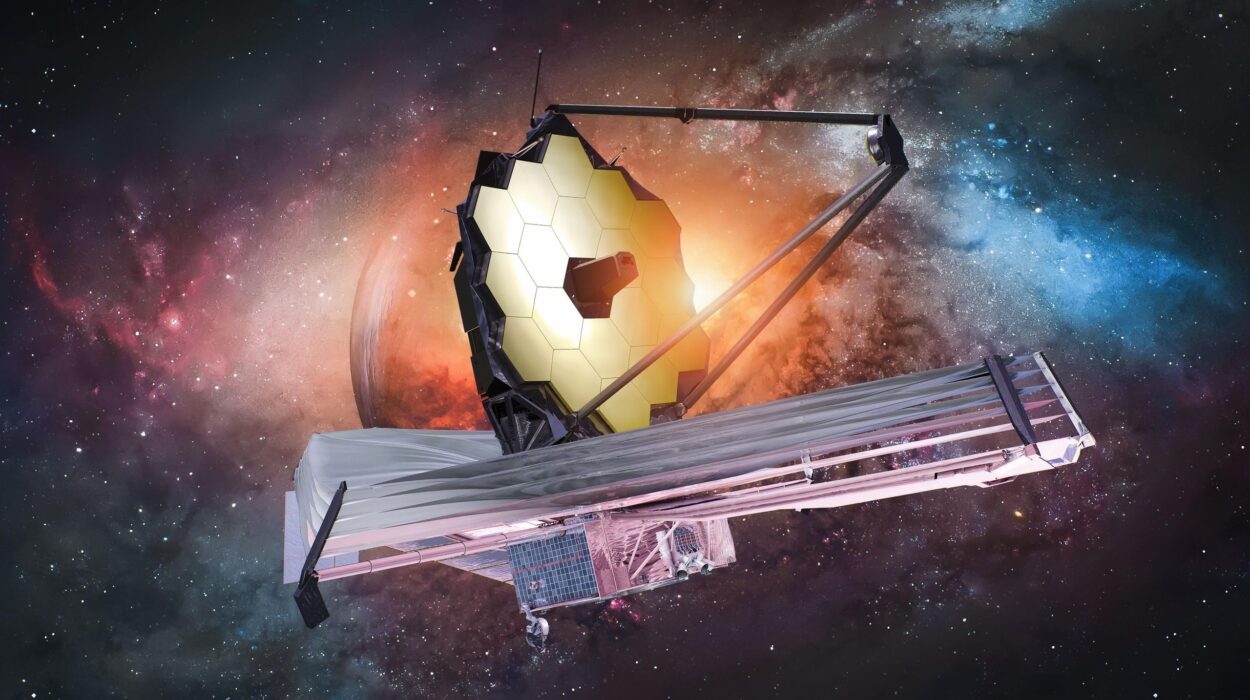
The launch of the James Webb Space Telescope in 2021 marked another major milestone in astronomy.
Rather than replacing Hubble, Webb complements it.
Hubble mainly observes visible light and ultraviolet wavelengths, while Webb specializes in infrared observations.
Together, the two telescopes provide a much more complete picture of the universe.
Hubble continues to observe nearby galaxies, star-forming regions, planets, and many other targets while Webb explores some of the earliest galaxies ever formed.
Their combined observations are helping scientists answer questions that neither telescope could solve alone.
Hubble’s Lasting Legacy
The influence of the Hubble Space Telescope reaches far beyond professional astronomy.
Its discoveries appear in textbooks, classrooms, museums, documentaries, and scientific journals around the world.
Thousands of scientific papers have relied on Hubble data, covering subjects from planetary science to cosmology.
Perhaps equally important, Hubble has inspired generations of students to pursue careers in science, engineering, mathematics, and space exploration.
Its remarkable images have brought the distant universe into homes, schools, and classrooms, reminding people everywhere that scientific discovery belongs to all humanity.
Why Hubble Changed Astronomy Forever
Before Hubble, many of the universe’s greatest mysteries remained hidden behind Earth’s atmosphere or beyond the reach of existing technology. Hubble removed that barrier, allowing astronomers to study the cosmos with a level of detail that had never before been possible. It refined measurements of the universe’s age, revealed galaxies from the dawn of cosmic history, uncovered evidence for supermassive black holes, explored the life cycles of stars, improved our understanding of exoplanets, and helped reveal the accelerating expansion of the universe.
Its discoveries have rewritten textbooks, challenged long-held ideas, and opened entirely new fields of research. More than just a telescope, Hubble became one of humanity’s greatest scientific achievements—a symbol of curiosity, innovation, and our desire to understand the universe.
Even after decades in space, Hubble continues to make valuable discoveries. Every new observation reminds us that the universe is far larger, older, and more fascinating than we once imagined. Its legacy is not only the extraordinary knowledge it has given us but also the enduring inspiration to keep exploring the cosmos, always searching for the next great discovery beyond the stars.