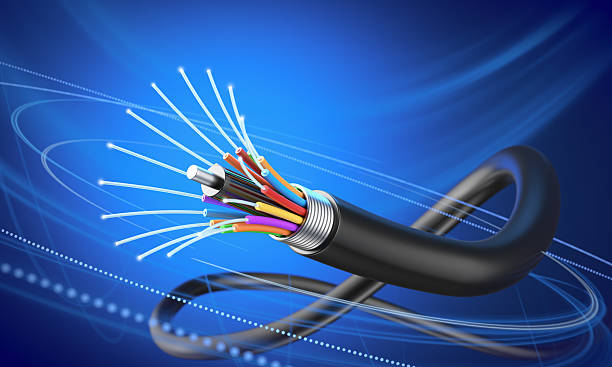
Every time you stream a movie in stunning 4K, join a crystal-clear video call, upload photos to the cloud, or play an online game with almost no delay, there is a good chance your data is traveling through fiber-optic cables. These incredibly thin strands of glass carry enormous amounts of information at nearly the speed of light, forming the backbone of the modern internet.
It may seem almost magical that a strand of glass, often thinner than a human hair, can transport millions of emails, videos, phone calls, and website requests every second. Yet the explanation lies in one of the most fascinating applications of physics and engineering. Fiber-optic communication uses light instead of electricity to carry information, making it one of the fastest, most reliable, and most efficient methods of data transmission ever developed.
Understanding how fiber-optic cables work reveals not only the remarkable technology behind the internet but also how scientific discoveries about light have transformed the way humanity communicates.
What Is a Fiber-Optic Cable?
A fiber-optic cable is a communication cable designed to transmit information using pulses of light rather than electrical signals. Unlike traditional copper cables, which carry electricity, fiber-optic cables guide tiny flashes of light over long distances with very little loss of signal.
Although these cables may appear ordinary from the outside, they contain highly engineered optical fibers made from extremely pure glass or, in some cases, special types of plastic. The glass used is far purer than ordinary window glass, allowing light to travel through it with exceptionally low loss.
A single fiber can transmit enormous amounts of digital information, and many fiber-optic cables contain dozens or even hundreds of individual fibers bundled together.
Why Light Is Used Instead of Electricity
For many decades, telephone and internet networks relied on copper wires. Electrical signals travel well through copper, but they face several limitations.
Electrical signals gradually weaken over distance, requiring frequent amplification. Copper cables are also vulnerable to electromagnetic interference from nearby electrical equipment, lightning, and radio waves. As internet usage grew dramatically, these limitations became increasingly significant.
Light offers remarkable advantages.
Light travels incredibly fast.
It can carry far more information than electrical signals.
It experiences much lower signal loss inside optical fibers.
It is immune to electromagnetic interference.
These properties make light the ideal carrier for modern digital communication.
The Structure of a Fiber-Optic Cable
Although fiber-optic cables look simple from the outside, each optical fiber contains several carefully engineered layers that work together to guide light.
At the center is the core, an extremely thin strand of glass where the light actually travels. Depending on the cable type, the core may be only a few micrometers wide or slightly larger.
Surrounding the core is another glass layer called the cladding. The cladding has a slightly lower refractive index than the core, an important difference that keeps light trapped inside the fiber.
Outside the cladding is a protective coating that shields the delicate glass from moisture, scratches, and mechanical stress.
Additional protective layers, strength members, and an outer jacket protect the cable from environmental damage during installation and use.
Despite these protective layers, the heart of the cable remains an astonishingly thin glass pathway designed specifically for light.
Everything Starts with Digital Data
Computers, smartphones, and servers all process information digitally.
Everything you send online eventually becomes a series of binary digits, known as bits.
Each bit has only two possible values:
Zero
One
Whether you are sending a text message, watching a movie, downloading software, or browsing a website, all of that information is represented by long sequences of zeros and ones.
The challenge is transporting these bits quickly from one place to another.
Fiber-optic communication solves this by converting digital information into carefully controlled flashes of light.
Turning Electrical Signals into Light
Computers naturally generate electrical signals.
However, optical fibers require light instead.
This conversion occurs inside a device called an optical transmitter.
The transmitter contains either a tiny laser or a light-emitting diode (LED). In high-speed internet systems, lasers are usually preferred because they produce extremely focused, powerful, and precise beams of light.
As digital information arrives, the laser rapidly switches on and off.
Each pulse of light represents digital information.
The switching happens incredibly fast—millions or even billions of times every second.
Although our eyes cannot perceive these rapid flashes, each pulse carries part of the data traveling across the network.
Light Travels Through Glass
At first glance, sending light through glass may seem straightforward.
However, light would normally escape through the sides of a glass strand.
The secret behind fiber optics lies in a phenomenon called total internal reflection.
This is one of the most elegant principles in physics.
Understanding Total Internal Reflection
When light moves from one material to another, it usually bends. This bending occurs because light travels at different speeds in different materials, a phenomenon known as refraction.
Fiber-optic cables take advantage of this behavior.
The glass core has a slightly higher refractive index than the surrounding cladding.
When light traveling inside the core strikes the boundary between the core and cladding at a sufficiently large angle, it does not escape.
Instead, it reflects completely back into the core.
This process is called total internal reflection.
As a result, the light continually bounces along the inside of the fiber while remaining trapped within it.
Although the light repeatedly reflects from the sides, it continues moving forward toward its destination.
This clever design allows light to travel over tremendous distances without leaving the fiber.
Light Does Not Travel Perfectly Straight
People often imagine light traveling through a fiber like a perfectly straight laser beam.
In reality, many light rays bounce repeatedly from side to side while moving forward.
These countless reflections occur extremely quickly.
Even though the path zigzags slightly, the overall direction remains toward the receiving end of the cable.
Because total internal reflection is highly efficient, very little light escapes during this journey.
The Speed of Data Transmission
Light travels through a vacuum at approximately 299,792 kilometers (186,282 miles) per second, the fastest speed possible in nature.
Inside glass, light slows slightly because it interacts with the material.
Even so, it still travels at roughly two-thirds of its speed in a vacuum.
This means information can travel around the Earth in only fractions of a second.
The remarkable speed of light allows internet users to communicate almost instantly across continents.
Although network equipment, routers, servers, and processing delays contribute additional latency, the optical fibers themselves transmit data extraordinarily quickly.
Carrying Massive Amounts of Information
One of fiber optics’ greatest strengths is its enormous capacity.
Instead of sending only a single stream of information, modern fiber-optic systems often transmit many separate streams simultaneously.
This is achieved using different colors, or wavelengths, of light.
Each wavelength carries an independent data channel.
Special equipment combines these wavelengths into one optical fiber before transmission.
At the receiving end, another device separates them again.
This technology, known as wavelength-division multiplexing (WDM), dramatically increases the amount of information a single fiber can carry.
Instead of laying hundreds of separate cables, engineers can send multiple channels through one tiny strand of glass.
Receiving the Light
Eventually, the light reaches its destination.
However, computers cannot directly understand light pulses.
A receiver performs the opposite process of the transmitter.
Inside the receiver is a highly sensitive electronic device called a photodetector.
The photodetector converts incoming light pulses back into electrical signals.
Electronic circuits then interpret these signals as zeros and ones.
Finally, your computer, smartphone, television, or server reconstructs the original data.
Whether that data is a movie, a webpage, or a voice call, it appears exactly as it was sent.
Why Fiber Optics Are So Fast
Several scientific factors contribute to fiber optics’ remarkable speed.
Light can be switched on and off extremely rapidly.
Optical signals suffer much less attenuation, or weakening, than electrical signals.
Fibers support very high frequencies, allowing them to carry enormous amounts of information.
Modern lasers produce highly stable signals with exceptional precision.
Advanced modulation techniques allow each light pulse to represent multiple bits of information.
Together, these advantages enable fiber-optic systems to deliver internet speeds measured in gigabits or even terabits per second.
Single-Mode and Multi-Mode Fibers
Not all fiber-optic cables are identical.
Single-mode fibers have extremely narrow cores that allow only one primary path for light.
Because there is little signal spreading, they are ideal for long-distance communication.
Most internet backbone networks use single-mode fiber.
Multi-mode fibers have wider cores.
Multiple light paths can travel simultaneously inside them.
These fibers are generally used for shorter distances, such as within buildings, campuses, or data centers.
Although both types operate using total internal reflection, they serve different communication needs.
Signal Loss Over Distance
No communication system is perfect.
Even optical fibers experience small losses as light travels.
Tiny amounts of light are absorbed by the glass.
Some light scatters because of microscopic imperfections.
Bends in the cable can also allow small amounts of light to escape if they become too sharp.
Fortunately, modern optical fibers are extraordinarily efficient.
High-quality fibers may lose only a tiny fraction of their signal over many kilometers.
To maintain signal strength over extremely long distances, communication networks use optical amplifiers or repeaters.
These devices boost weakened signals before they continue their journey.
Crossing Oceans with Fiber
One of the greatest engineering achievements of modern civilization is the global network of submarine fiber-optic cables.
These cables stretch across the floors of oceans, connecting continents.
Thousands of kilometers of optical fiber lie beneath the Atlantic, Pacific, Indian, and Arctic Oceans.
Protected by multiple layers of insulation and armor, these cables carry the vast majority of international internet traffic.
Every day, billions of emails, financial transactions, video streams, and phone calls travel through these underwater highways of light.
Without submarine fiber-optic cables, the global internet would function very differently.
Fiber Optics and the Internet Backbone
When people think of the internet, they often imagine satellites floating in space.
Although satellites play important roles in certain situations, most internet traffic actually travels through fiber-optic cables.
These cables connect homes, businesses, data centers, internet service providers, and cloud computing facilities.
Major internet companies operate enormous fiber networks linking cities, countries, and continents.
Every website you visit likely sends information across numerous fiber-optic links before reaching your device.
In many ways, fiber optics serve as the nervous system of the modern digital world.
Why Fiber Is More Reliable Than Copper
Fiber-optic communication offers several important advantages over traditional copper wiring.
Because fibers carry light instead of electricity, they cannot be disrupted by electromagnetic interference.
Lightning strikes, nearby electrical equipment, and radio signals have little effect on optical communication.
Fiber cables are also much more difficult to tap without detection, making them attractive for secure communications.
Their high bandwidth supports growing internet demands, including cloud computing, artificial intelligence, virtual reality, and future communication technologies.
Additionally, fiber cables experience lower energy losses, reducing the need for frequent signal amplification.
Fiber Optics Beyond the Internet
Fiber optics are used in many fields besides telecommunications.
Doctors use flexible fiber-optic endoscopes to examine internal organs with minimal surgery.
Scientists use optical fibers in precision sensors capable of detecting tiny changes in temperature, pressure, and strain.
Military organizations employ fiber optics for secure communication systems.
Industrial facilities use optical fibers to monitor machinery and infrastructure.
Astronomers use advanced optical technologies in telescopes to study distant objects across the universe.
Fiber optics have become essential in medicine, engineering, scientific research, manufacturing, and transportation.
The Science Behind Optical Communication
Fiber-optic technology combines several branches of science.
Physics explains how light behaves and why total internal reflection keeps it trapped inside the fiber.
Materials science enables the production of glass pure enough for long-distance transmission.
Electrical engineering develops lasers, receivers, amplifiers, and communication equipment.
Computer science creates protocols that organize digital information into packets for efficient transmission.
Together, these scientific disciplines create one of humanity’s most sophisticated communication systems.
The Future of Fiber-Optic Technology
As internet demand continues growing, researchers are constantly improving fiber-optic communication.
Scientists are developing fibers with even lower signal loss.
Engineers are creating faster lasers and more sensitive receivers.
New modulation techniques allow more information to be packed into each light pulse.
Researchers are exploring hollow-core fibers, in which light travels mostly through air rather than solid glass, potentially reducing delays even further.
Advances in quantum communication may also use optical fibers to transmit quantum information securely over long distances.
These innovations promise even faster, more reliable global communication in the years ahead.
A World Connected by Light
It is remarkable to realize that much of the world’s digital life depends on invisible flashes of light racing through strands of glass thinner than a human hair. Every video streamed, every online class attended, every message sent, and every cloud file downloaded relies on the extraordinary ability of fiber-optic cables to guide light with incredible precision.
What began as a scientific understanding of how light behaves has evolved into one of the greatest technological achievements in human history. By converting digital information into pulses of light and guiding those pulses through carefully engineered glass fibers using total internal reflection, fiber-optic technology has made global communication faster, more reliable, and more capable than ever before.
As new discoveries continue to push the limits of optical communication, fiber-optic cables will remain at the heart of the internet, quietly carrying the world’s knowledge, conversations, and ideas at nearly the speed of light.