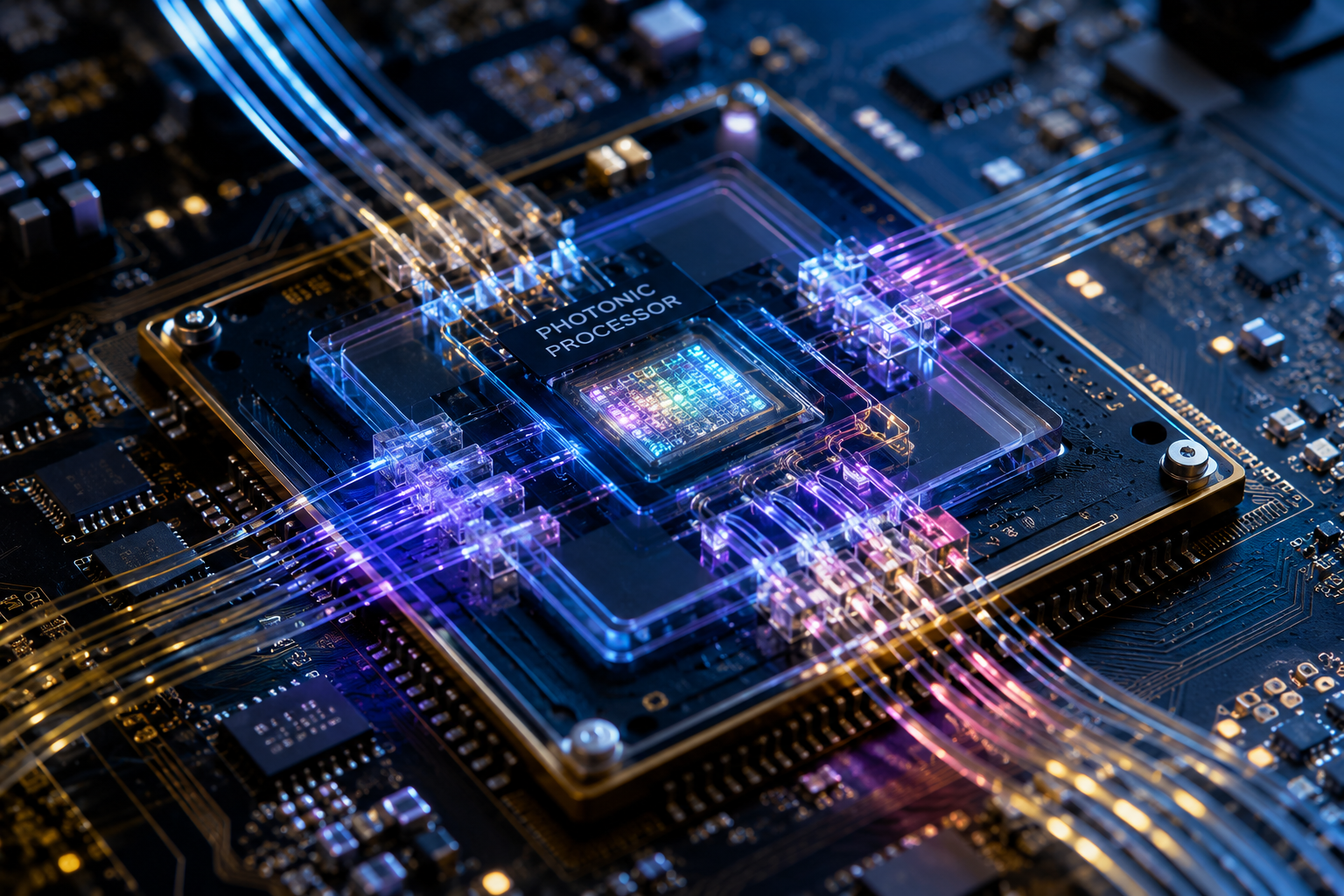
Imagine a computer that performs calculations not by moving billions of tiny electrical signals through metal wires, but by guiding beams of light through microscopic pathways. It may sound like science fiction, yet this is exactly the idea behind photonic processors. These remarkable chips represent one of the most exciting frontiers in computing, offering the possibility of dramatically faster calculations while using far less energy than today’s conventional processors.
As artificial intelligence grows more powerful, scientific simulations become more demanding, and the world’s appetite for computing continues to increase, engineers are searching for technologies that can overcome the limitations of traditional electronics. Photonic processors have emerged as one of the strongest candidates for the next generation of computing.
Although the technology is still developing, researchers and technology companies around the world are making rapid progress. In the coming years, photonic processors could transform everything from AI data centers and telecommunications to medical research and autonomous vehicles.
Understanding Photonic Processors
A photonic processor is a type of computer chip that uses light, rather than electrical current, to process or transmit information. Instead of relying mainly on electrons moving through tiny transistors and metal connections, photonic processors manipulate particles of light, known as photons.
Photons are the fundamental particles that make up light. Unlike electrons, photons have no electric charge and can travel extremely quickly with very little resistance. Because of these unique properties, they can carry enormous amounts of information while generating much less heat.
In a traditional processor, billions of transistors switch electrical signals on and off to represent binary information. A photonic processor performs many operations using carefully controlled beams of light that travel through microscopic optical structures built directly into the chip.
This change may seem simple, but it represents a fundamentally different approach to computing.
Why Traditional Processors Face New Challenges
For decades, computer processors became faster by shrinking transistors. Every new generation packed more transistors into the same area, allowing chips to perform more calculations while becoming increasingly powerful.
This trend, often associated with Moore’s Law, drove the rapid growth of modern computing.
However, shrinking transistors indefinitely is becoming increasingly difficult. As components become incredibly small, several problems begin to emerge.
Electrical resistance produces heat.
Power consumption continues to rise.
Signals slow as they travel through densely packed circuits.
Cooling systems become more expensive and complicated.
Modern AI systems require enormous amounts of computation, pushing conventional processors close to their practical limits.
These challenges have encouraged researchers to explore entirely new computing technologies, including photonic computing.
Why Light Is Such an Attractive Computing Medium
Light possesses several characteristics that make it exceptionally useful for computing.
Photons travel incredibly fast. In a vacuum, light moves at nearly 300,000 kilometers per second. Even inside optical materials used in chips, light still travels remarkably quickly.
Light also produces very little heat compared with electrical current. Since photons carry no electric charge, they do not experience electrical resistance in the same way electrons do.
Another important advantage is that multiple beams of light can travel through the same optical pathway without interfering significantly if they have different wavelengths. This property, called wavelength-division multiplexing, allows enormous amounts of information to move simultaneously.
These features make light an ideal candidate for handling today’s rapidly growing computing demands.
How Photonic Processors Work
Inside a photonic processor, information is carried by light traveling through tiny optical structures called waveguides. These microscopic pathways function similarly to electrical wires, except they guide light instead of electricity.
A laser usually generates the light entering the chip.
The processor then manipulates the light using extremely small optical components. These include devices that split light beams, combine them, change their direction, adjust their intensity, or modify their phase.
As the light passes through these structures, mathematical operations are performed.
Some photonic processors eventually convert the light back into electrical signals so conventional computers can interpret the results. Others combine both optical and electronic components into a hybrid system.
Rather than replacing electronics entirely, many current designs allow light and electricity to work together.
The Building Blocks of Photonic Chips
Although photonic processors differ from conventional processors, they contain their own specialized components.
Waveguides act as tiny highways that direct light across the chip with remarkable precision.
Optical modulators encode information onto beams of light by changing properties such as intensity or phase.
Beam splitters divide light into multiple paths so calculations can occur simultaneously.
Optical interferometers allow different light waves to interact in carefully controlled ways, enabling complex mathematical operations.
Photodetectors convert optical signals back into electrical signals whenever needed.
Lasers provide stable sources of light that drive the processor.
Together, these components create a sophisticated optical computing system capable of performing many operations at extraordinary speed.
Photonic Computing Is Different From Fiber-Optic Communication
Many people associate light with fiber-optic internet cables, but photonic processors are something quite different.
Fiber-optic communication uses light primarily to transport information over long distances.
Photonic processors use light to perform actual computations.
In other words, fiber optics move information from one place to another, while photonic processors manipulate information to solve problems.
The two technologies complement each other and often share similar optical principles.
Why Artificial Intelligence Needs Photonic Processors
Artificial intelligence has become one of the strongest driving forces behind photonic computing.
Training modern AI models requires trillions of mathematical operations. These calculations consume enormous amounts of electricity and generate significant heat inside data centers.
Many AI workloads rely heavily on matrix multiplication, a mathematical operation that photonic systems can perform extremely efficiently.
Because light naturally combines and interferes in predictable ways, certain mathematical operations can be executed directly through optical interactions rather than by performing millions of separate electrical calculations.
This could allow future AI hardware to process information much faster while dramatically reducing energy consumption.
As AI models continue growing larger, energy-efficient computing becomes increasingly important.
Energy Efficiency Could Be a Major Advantage
Today’s largest data centers consume vast amounts of electricity.
A significant portion of that energy is spent moving information between processors and memory rather than performing calculations themselves.
Photonic processors have the potential to reduce these energy costs.
Since photons generate much less heat than moving electrical current, cooling requirements may also decrease.
Lower power consumption would benefit not only large cloud computing facilities but also scientific supercomputers and potentially future personal devices.
Reducing energy usage is becoming increasingly important as computing demand continues expanding worldwide.
Extraordinary Computing Speed
One of the greatest promises of photonic processors is speed.
Light travels much faster than electrical signals through conventional circuits.
Moreover, multiple optical signals can often operate simultaneously.
This parallel processing capability enables enormous amounts of information to flow through a photonic chip at the same time.
Instead of waiting for calculations to occur one after another, many optical operations can happen simultaneously, significantly increasing computational throughput.
For certain specialized tasks, this could produce dramatic performance improvements.
Hybrid Chips: Combining Electronics and Photonics
Despite their exciting potential, most experts do not expect photonic processors to completely replace electronic processors anytime soon.
Instead, many future systems will likely combine both technologies.
Electronic circuits remain exceptionally good at general-purpose computing, memory management, logical decision-making, and software execution.
Photonic circuits excel at moving information rapidly and performing specific mathematical operations with outstanding efficiency.
Hybrid processors allow each technology to perform the tasks it handles best.
This practical approach is already attracting considerable attention across the semiconductor industry.
Materials Used in Photonic Processors
Building chips that manipulate light requires specialized materials.
Silicon remains one of the most important because existing semiconductor manufacturing techniques can often be adapted for silicon photonics.
Other materials include silicon nitride, indium phosphide, lithium niobate, and gallium arsenide.
Each material offers unique optical properties suitable for different applications.
Researchers continue developing new fabrication methods that improve efficiency while reducing manufacturing costs.
Silicon Photonics
Silicon photonics is one of the fastest-growing areas of semiconductor research.
It combines traditional silicon chip manufacturing with miniature optical components.
Because the semiconductor industry already possesses decades of experience producing silicon chips at enormous scale, silicon photonics provides a promising path toward commercial production.
Many technology companies are investing heavily in silicon photonics for data centers, telecommunications, and artificial intelligence infrastructure.
The technology is gradually moving from research laboratories into real-world products.
Photonic Neural Networks
Scientists are also exploring photonic neural networks.
These systems mimic certain mathematical operations used in artificial neural networks but perform them using light.
Optical interference naturally performs calculations that resemble the matrix operations underlying modern machine learning algorithms.
As a result, photonic neural networks may eventually process AI workloads significantly faster while requiring much less energy.
Although still under active development, this field has attracted intense interest from researchers worldwide.
Applications Beyond Artificial Intelligence
Photonic processors could transform many scientific and industrial fields.
Scientific researchers may use them to accelerate climate modeling, molecular simulations, and astrophysical calculations.
Medical scientists could analyze enormous biological datasets more quickly, supporting drug discovery and personalized medicine.
Financial institutions might process complex market simulations faster.
Telecommunications companies could improve network performance by integrating photonic technologies into communication infrastructure.
Autonomous vehicles could benefit from faster sensor processing and decision-making systems.
Quantum technologies may also incorporate photonic components for communication and information processing.
The possibilities continue expanding as research advances.
Challenges Facing Photonic Computing
Despite impressive progress, photonic processors still face important engineering challenges.
Manufacturing optical components with extreme precision remains difficult.
Integrating lasers directly onto silicon chips can be technically demanding.
Some computing operations are naturally easier to perform electronically than optically.
Memory technologies also remain largely electronic, meaning efficient communication between optical processors and electronic memory is essential.
Developing programming tools and software optimized for photonic hardware presents another challenge.
Finally, manufacturing costs must decrease before widespread commercial adoption becomes practical.
Researchers around the world are actively working to overcome these obstacles.
Photonic Processors Versus Electronic Processors
Traditional processors rely on billions of transistors switching electrical signals.
Photonic processors manipulate light waves.
Electronic processors are highly flexible and excellent for general-purpose computing.
Photonic processors appear especially powerful for mathematical operations involving massive parallel computation.
Rather than competing directly, the two technologies are increasingly viewed as complementary.
Future computers may use electronic processors for operating systems, software control, and decision-making while photonic processors accelerate demanding computational workloads.
Are Photonic Processors Related to Quantum Computers?
Although both technologies are advanced and often discussed together, they are fundamentally different.
Photonic processors use classical light to perform computations.
Quantum computers use quantum mechanical effects, such as superposition and entanglement, to solve certain classes of problems in entirely different ways.
Some quantum computing systems use photons as quantum bits, but this should not be confused with classical photonic processors.
A photonic processor is not automatically a quantum computer.
They belong to different branches of computing research.
Research Around the World
Universities, national laboratories, and technology companies are investing heavily in photonic computing.
Researchers continue improving optical materials, chip manufacturing techniques, integrated lasers, optical memory interfaces, and photonic circuit architectures.
Advances in nanofabrication are allowing increasingly sophisticated optical components to fit onto tiny semiconductor chips.
As manufacturing methods mature, commercial adoption is expected to expand across multiple industries.
The Future of Photonic Processors
The coming decades may witness one of the biggest shifts in computing since the invention of the transistor.
Artificial intelligence continues demanding ever greater computational power.
Scientific research generates increasingly massive datasets.
Cloud computing infrastructure must become more energy efficient.
Photonic processors offer a compelling path toward meeting these challenges.
While they are unlikely to replace conventional CPUs overnight, they are expected to become powerful accelerators for specialized tasks where speed and energy efficiency are especially important.
As engineers refine the technology and manufacturing becomes more economical, photonic processors may gradually become a common part of high-performance computing systems.
A New Era of Computing With Light
For more than seventy years, modern computing has been built upon the movement of electrons through semiconductor circuits. That foundation has transformed human civilization, enabling everything from smartphones and satellites to artificial intelligence and space exploration.
Now, researchers are exploring a new way forward—one that replaces many electrical signals with beams of light. Photonic processors harness the unique properties of photons to perform calculations with remarkable speed and potentially far greater energy efficiency.
Although significant technical challenges remain, the progress achieved so far suggests that computing with light is no longer a distant dream. As the demand for faster, more sustainable computing continues to grow, photonic processors could play a central role in shaping the next generation of technology, opening the door to computers that are faster, cooler, and capable of tackling problems that today’s machines struggle to solve.