Every time you open an app, play a game, edit a photo, browse the internet, or ask an AI assistant a question, your computer is constantly reading and writing data at incredible speeds. Behind this seamless experience lies one of the most important technologies in modern computing: memory.
Not all memory is the same. Two of the most essential types of memory inside computers and electronic devices are Dynamic Random Access Memory (DRAM) and Static Random Access Memory (SRAM). Although both temporarily store data while a device is running, they are designed for very different purposes.
One is built to provide large amounts of affordable memory for everyday computing. The other is engineered for extreme speed, allowing processors to access critical information almost instantly.
Understanding the difference between DRAM and SRAM helps explain why computers perform the way they do, why processors include cache memory, and why increasing RAM can improve system performance. More importantly, it reveals how engineers carefully balance speed, cost, power consumption, and storage capacity to create the electronic devices we rely on every day.
What Is Computer Memory?
Before comparing DRAM and SRAM, it is helpful to understand what computer memory actually does.
Computer memory temporarily stores information that the processor needs while performing tasks. Unlike long-term storage devices such as solid-state drives (SSDs) or hard disk drives (HDDs), memory is designed for rapid access.
Whenever you launch an application, open a document, or stream a video, the operating system loads the necessary data from permanent storage into memory because memory is much faster than storage devices.
The processor can then access this information quickly without repeatedly reading slower storage media.
This temporary memory is called volatile memory, meaning it loses its contents when power is turned off.
Both DRAM and SRAM belong to this category.
What Is DRAM?
Dynamic Random Access Memory, commonly known as DRAM, is the main memory used in nearly every desktop computer, laptop, smartphone, gaming console, and server.
Its primary purpose is to provide large amounts of temporary storage where applications, operating systems, and active files can be quickly accessed by the processor.
The word “dynamic” refers to the way DRAM stores information.
Each bit of data is stored as an electrical charge inside a tiny capacitor.
Unfortunately, capacitors cannot hold their electrical charge forever.
They slowly leak electricity over time.
To prevent data from disappearing, the memory controller must continuously refresh every memory cell many times each second.
This constant refreshing gives DRAM its name.
Although this refresh process consumes energy and slightly slows access compared with SRAM, it allows engineers to build memory chips that are both compact and relatively inexpensive.
As a result, DRAM has become the standard memory technology for systems requiring large memory capacity.
How DRAM Stores Data
Inside a DRAM chip are billions of microscopic memory cells.
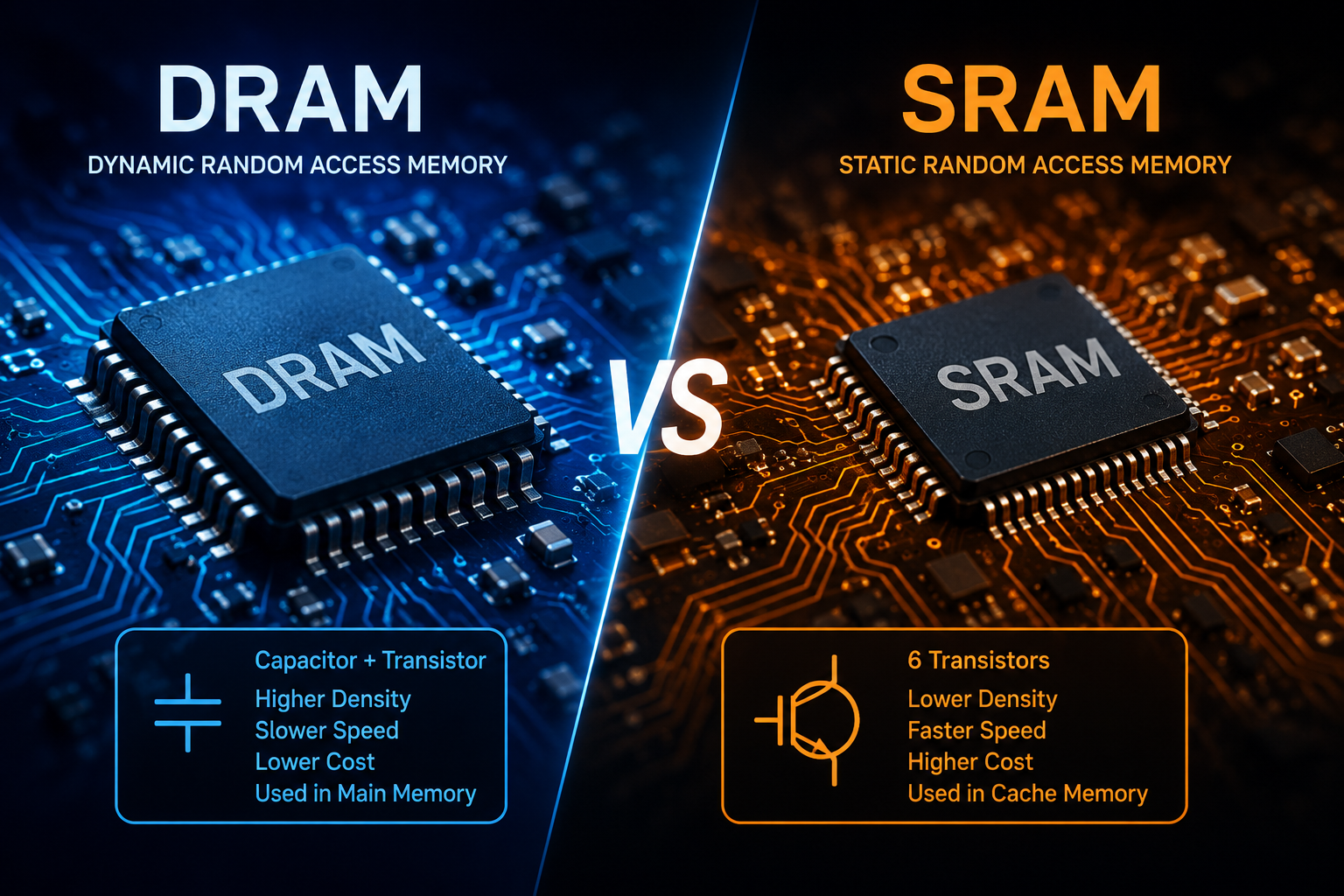
Each memory cell typically consists of one transistor and one capacitor.
The capacitor stores either a charged or uncharged state, representing binary data.
Because these charges naturally fade, every memory cell must be refreshed periodically.
Modern DRAM modules perform these refresh operations automatically without users noticing.
This clever engineering allows computers to maintain billions of stored bits while remaining affordable.
What Is SRAM?
Static Random Access Memory, or SRAM, takes a very different approach.
Instead of storing data inside capacitors, SRAM stores each bit using a small circuit made of multiple transistors.
The most common SRAM design uses six transistors to create a tiny electronic flip-flop.
As long as electrical power remains available, the circuit continuously holds either a binary 0 or binary 1 without needing periodic refresh.
Because the stored value remains stable, SRAM is called static memory.
This eliminates refresh delays and allows data to be accessed much faster.
However, this speed comes at a cost.
Using several transistors for every stored bit requires significantly more silicon area than DRAM.
Consequently, SRAM chips are larger, more expensive, and provide much lower storage capacity for the same chip size.
How SRAM Stores Information
Each SRAM cell functions like a miniature electronic switch.
Once it stores a value, the interconnected transistors continuously reinforce that value.
No refresh operations are required.
The processor can therefore read or write data extremely quickly.
This rapid access makes SRAM ideal for situations where every billionth of a second matters.
The Biggest Difference Between DRAM and SRAM
Although both technologies temporarily store digital information, their internal designs create very different strengths.
DRAM prioritizes capacity and affordability.
SRAM prioritizes speed and low latency.
DRAM sacrifices some speed because memory cells require refreshing.
SRAM eliminates refresh operations, allowing much faster access.
Engineers choose between them based on the requirements of each part of a computer.
Large system memory benefits from DRAM’s lower cost.
Processor cache benefits from SRAM’s exceptional speed.
Speed Comparison
One of SRAM’s greatest advantages is its speed.
Because data remains immediately available without refresh cycles, SRAM can respond much more quickly than DRAM.
Modern processors execute billions of instructions every second.
Waiting even a few additional nanoseconds for memory can reduce performance significantly.
To minimize these delays, processors store frequently used instructions and data inside SRAM-based cache memory.
DRAM remains extremely fast compared with storage devices like SSDs, but SRAM operates even faster.
This difference explains why cache memory dramatically improves processor performance.
Capacity Comparison
DRAM excels when large memory capacity is needed.
Because each memory cell requires only one transistor and one capacitor, billions of cells can fit onto relatively small chips.
This allows modern computers to include 8 GB, 16 GB, 32 GB, or even hundreds of gigabytes of DRAM.
SRAM cannot compete in this area.
Its larger transistor-based cells consume much more space.
As a result, processor caches usually contain only a few megabytes or tens of megabytes of SRAM.
Although tiny compared with system memory, this cache is carefully optimized for maximum speed.
Cost Differences
Manufacturing cost strongly influences memory design.
DRAM’s simple cell structure allows manufacturers to produce enormous memory chips at relatively low cost.
This makes it economically practical for computers to include large amounts of RAM.
SRAM requires far more transistors per stored bit.
More transistors mean larger chips, more silicon, more manufacturing complexity, and higher cost.
If manufacturers attempted to build an entire computer’s main memory using SRAM, the cost would become prohibitively expensive.
Therefore, engineers reserve SRAM only for the most performance-critical applications.
Power Consumption
Power consumption is another important difference.
DRAM requires continuous refresh operations, consuming energy even when stored data remains unchanged.
However, because its memory cells are extremely compact, DRAM generally provides better energy efficiency per stored bit.
SRAM avoids refresh operations but uses multiple continuously active transistors to maintain stored values.
This can increase power usage per memory cell.
Modern chip designers carefully optimize both technologies to balance performance with energy efficiency, especially in smartphones and laptops where battery life matters.
Physical Size
Memory density refers to how much information can fit into a given chip area.
DRAM achieves much higher density because each memory cell contains very few components.
SRAM cells occupy considerably more space.
This size difference explains why a processor may contain only a few megabytes of SRAM while a memory module can contain tens of gigabytes of DRAM.
Reliability
Both DRAM and SRAM are highly reliable when properly designed.
However, their operating characteristics differ.
Because DRAM relies on tiny electrical charges, it requires precise timing for refresh operations.
Modern memory controllers manage these refresh cycles automatically.
SRAM avoids refresh entirely, simplifying data retention while power remains available.
Both memory types lose stored information when electrical power is removed, making them volatile memories.
Why Computers Use Both DRAM and SRAM
Modern computers combine both technologies because each solves a different problem.
Processors require incredibly fast access to frequently used information.
SRAM provides this speed.
Applications require large memory capacity to store operating systems, documents, games, videos, and active programs.
DRAM provides this capacity.
Using only DRAM would slow processor performance.
Using only SRAM would make computers extremely expensive and severely limit memory capacity.
The combination creates an excellent balance between speed, capacity, and affordability.
SRAM Inside Processor Cache
Perhaps the most important application of SRAM is processor cache.
Modern CPUs include several layers of cache memory known as L1, L2, and L3 cache.
These caches store instructions and data the processor expects to use repeatedly.
Instead of retrieving information from slower DRAM every time, the processor first checks its cache.
If the required data is already there—a situation known as a cache hit—the processor continues working almost immediately.
This dramatically increases computing performance.
The extremely low latency of SRAM makes this possible.
DRAM as Main System Memory
Whenever you install more RAM in your computer, you are almost certainly adding DRAM.
Operating systems continuously move active programs into DRAM because it offers enough capacity for multitasking while remaining affordable.
Whether editing videos, playing games, browsing dozens of websites, or running artificial intelligence applications, DRAM serves as the computer’s primary workspace.
The larger the available DRAM, the more information can remain immediately accessible without relying on slower storage devices.
DRAM Generations
DRAM technology has evolved enormously over the decades.
Modern computers use advanced versions called Double Data Rate (DDR) memory.
Each generation improves speed, efficiency, and bandwidth.
DDR3 served millions of computers for many years.
DDR4 greatly increased performance while reducing power consumption.
DDR5 offers even higher bandwidth, supporting modern processors with many cores and demanding AI workloads.
Graphics cards also use specialized forms of DRAM such as GDDR memory, optimized for handling massive amounts of graphical data.
SRAM in Modern Processors
SRAM has also advanced considerably.
Today’s processors contain sophisticated cache hierarchies with multiple cache levels.
Engineers carefully position SRAM close to processing cores to minimize electrical signal travel time.
Advanced manufacturing technologies allow billions of transistors to fit onto tiny chips, enabling larger caches than ever before.
As processors become more powerful, SRAM cache remains essential for maintaining high performance.
DRAM and Gaming
Gamers often notice the importance of DRAM.
Modern games load enormous worlds, detailed textures, realistic physics simulations, and complex artificial intelligence.
Having sufficient DRAM allows more game data to remain in memory, reducing loading times and improving smooth gameplay.
Meanwhile, SRAM inside the CPU helps process game logic rapidly by supplying frequently used instructions with minimal delay.
Together, both memory technologies contribute to a responsive gaming experience.
DRAM and Artificial Intelligence
Artificial intelligence places tremendous demands on memory systems.
Training large AI models requires enormous amounts of DRAM to store datasets, neural network parameters, and intermediate calculations.
AI accelerators and modern processors also depend heavily on SRAM caches to feed computational units with data fast enough to avoid bottlenecks.
Without efficient cooperation between DRAM and SRAM, today’s advanced AI systems would perform much more slowly.
DRAM and Smartphones
Smartphones rely heavily on DRAM despite their compact size.
Every app you switch between occupies system memory.
The operating system carefully manages DRAM so users can quickly return to recently opened applications.
Processors inside smartphones also contain SRAM caches, ensuring responsive touch controls, smooth animations, and efficient application performance.
Although invisible to users, these memory technologies are constantly working together.
Why SRAM Is Not Used as Main RAM
At first glance, SRAM seems like the obvious choice because it is faster.
However, practical engineering tells a different story.
Building dozens of gigabytes of SRAM would require enormous chip area.
Manufacturing costs would increase dramatically.
Power consumption would rise.
Computer prices would become far higher than consumers could reasonably afford.
Instead, engineers use a small amount of expensive SRAM where maximum performance matters most and rely on larger amounts of affordable DRAM for everything else.
This hybrid design delivers excellent overall performance.
Which Memory Is Better?
The answer depends entirely on the application.
If maximum speed is the goal, SRAM is superior.
Its low latency and rapid access make it ideal for processor caches and high-performance electronics.
If large storage capacity at reasonable cost is the priority, DRAM is the better solution.
It provides the large working memory required by modern operating systems and applications.
Neither technology replaces the other.
Instead, they complement one another.
Modern computing depends on both.
The Future of Memory Technology
Researchers continue searching for memory technologies that combine the strengths of both DRAM and SRAM.
Emerging technologies such as Magnetoresistive RAM (MRAM), Resistive RAM (ReRAM), Ferroelectric RAM (FeRAM), and Phase-Change Memory (PCM) aim to provide higher speed, lower power consumption, greater durability, and even non-volatile operation.
Scientists are also developing advanced packaging techniques that place memory closer to processors, reducing communication delays and improving efficiency.
While these emerging technologies show great promise, DRAM and SRAM remain the backbone of modern computing because of their proven performance, mature manufacturing processes, and widespread compatibility.
Conclusion
DRAM and SRAM are two of the most important technologies in the digital world, quietly enabling everything from smartphones and laptops to data centers, gaming systems, scientific supercomputers, and artificial intelligence. Although they both serve as volatile memory, their designs reflect different engineering priorities.
DRAM delivers large memory capacity at an affordable cost, making it the ideal choice for a computer’s main system memory. SRAM, on the other hand, provides exceptional speed with extremely low latency, making it indispensable for processor cache and other performance-critical components.
Rather than competing against each other, DRAM and SRAM work together in carefully designed memory hierarchies. This partnership allows modern computers to balance speed, capacity, efficiency, and cost, enabling the remarkable performance we often take for granted. Every time a program launches instantly, a webpage loads smoothly, or an AI model processes information in real time, the combined strengths of DRAM and SRAM are helping make it possible.