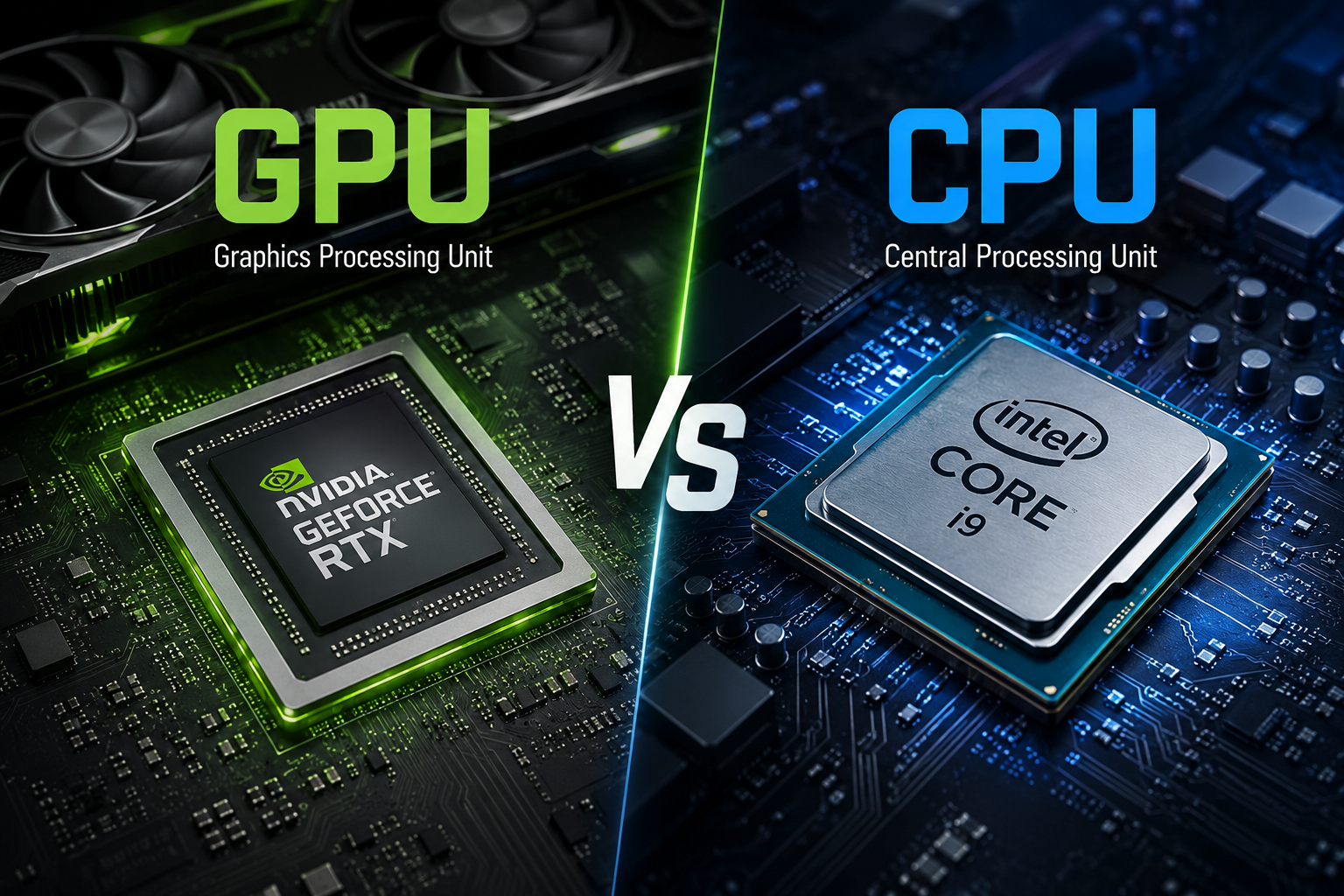
Every time you open a website, edit a photo, watch a 4K movie, play a video game, or ask an AI chatbot a question, two of the most important components inside your computer may be working behind the scenes: the Central Processing Unit (CPU) and the Graphics Processing Unit (GPU).
Although they often work together, they are not the same thing. Each is designed for a different purpose, and understanding the difference between them reveals why modern computers are so incredibly powerful. The CPU is often called the “brain” of the computer because it handles the broad range of tasks required to run an operating system and applications. The GPU, on the other hand, is a specialist built to perform thousands of similar calculations simultaneously, making it exceptionally good at graphics rendering, scientific computing, and artificial intelligence.
Today, GPUs are no longer just for gamers. They have become essential for AI, machine learning, video editing, engineering, scientific research, cryptocurrency mining, and even weather forecasting. Meanwhile, CPUs remain the indispensable command center that keeps everything running smoothly.
Understanding how these two processors differ—and how they complement each other—can help you choose the right computer, appreciate modern technology, and better understand how today’s digital world operates.
What Is a CPU?
A Central Processing Unit (CPU) is the primary processor that executes instructions for virtually every task a computer performs. It interprets software instructions, performs calculations, makes logical decisions, and coordinates communication among hardware components.
You can think of the CPU as the chief executive of a company. Rather than doing every job itself, it manages the flow of information, assigns work, and ensures everything happens in the correct order.
Whenever you launch an application, save a document, browse the internet, or install software, the CPU is heavily involved. It processes instructions one after another with remarkable speed while constantly switching between tasks.
Modern CPUs typically contain a relatively small number of highly sophisticated processing cores. Consumer processors commonly have anywhere from four to twenty-four cores, while workstation and server CPUs may have dozens or even hundreds. Each core is designed to handle a wide variety of instructions efficiently, making CPUs excellent at complex decision-making and sequential computing.
What Is a GPU?
A Graphics Processing Unit (GPU) is a specialized processor originally developed to accelerate graphics rendering. Instead of focusing on one task at a time, it performs thousands of calculations simultaneously.
Imagine painting a gigantic mural.
A CPU might carefully assign one artist to paint every section one after another.
A GPU, however, sends thousands of artists to paint different parts of the mural at the same time.
This ability to perform massive numbers of parallel calculations makes GPUs extraordinarily efficient for workloads where the same mathematical operation must be repeated millions or billions of times.
Originally, GPUs existed almost exclusively to render images, animations, and video games. Today, they have evolved into general-purpose computing devices capable of accelerating scientific simulations, artificial intelligence, image processing, medical research, and countless other applications.
Why Computers Need Both
It may seem logical to ask why computers don’t simply replace CPUs with GPUs.
The answer lies in their fundamentally different designs.
The CPU excels at handling diverse tasks that require flexibility, decision-making, branching logic, and rapid switching between different operations.
The GPU excels when enormous amounts of similar work can be divided into thousands of independent calculations.
Rather than competing, they cooperate.
The CPU manages the operating system, applications, storage, memory, and input devices while assigning highly parallel tasks to the GPU.
Together they create a balanced computing system.
The Biggest Difference Between CPU and GPU
The primary difference is how they process information.
A CPU is optimized for low latency, meaning it completes individual tasks quickly and efficiently.
A GPU is optimized for high throughput, meaning it processes huge amounts of data simultaneously.
Suppose you need to solve one hundred million simple math problems.
A CPU can solve them rapidly, but largely one after another or across a limited number of powerful cores.
A GPU distributes the workload across thousands of smaller processing units that solve many problems simultaneously.
This architectural difference explains why GPUs dominate tasks involving graphics, AI, and scientific simulations.
CPU Architecture
Modern CPUs contain relatively few cores, but each core is extremely sophisticated.
Each CPU core includes advanced features such as branch prediction, large caches, out-of-order execution, speculative execution, and complex control logic.
These technologies allow CPUs to adapt quickly to unpredictable workloads.
Programs such as web browsers, operating systems, office software, programming tools, and databases constantly change what they are doing.
The CPU handles these changing instructions exceptionally well.
GPU Architecture
GPUs contain hundreds, thousands, or even tens of thousands of smaller arithmetic units organized into many parallel processing groups. Instead of emphasizing complex decision-making, they focus on executing the same operation across large amounts of data at once.
For example, rendering a 4K image requires calculating the color, lighting, and shading of more than eight million pixels. Because many of these calculations are similar and independent, a GPU can process countless pixels simultaneously.
This massively parallel architecture also makes GPUs highly effective for training neural networks, simulating physical systems, and processing large scientific datasets.
Understanding Parallel Processing
Parallel processing is the defining strength of a GPU.
Imagine a library with one thousand books that need to be scanned.
A CPU resembles one extremely fast worker scanning books individually.
A GPU resembles one thousand workers each scanning one book simultaneously.
When the work can be divided into many independent pieces, the GPU finishes dramatically faster.
However, not every problem can be divided this way.
Many computing tasks depend on previous results before continuing, making them better suited for CPUs.
Clock Speed Is Not the Whole Story
People often compare processors by looking only at clock speed, measured in gigahertz (GHz).
Although clock speed matters, it does not tell the whole story.
A CPU running at 5 GHz is not automatically faster than a GPU running at a lower frequency.
The reason is simple.
Performance depends on architecture, workload, memory systems, software optimization, instruction design, and the number of operations completed per clock cycle.
Because CPUs and GPUs are built differently, comparing clock speeds directly is misleading.
How CPUs Handle Everyday Computing
Most everyday computer activities rely primarily on the CPU.
Opening programs.
Running the operating system.
Managing files.
Browsing websites.
Typing documents.
Running spreadsheets.
Handling network communication.
Executing programming code.
Managing system security.
These tasks involve many different instructions, frequent decision-making, and constant switching between operations.
CPUs are specifically designed for this type of work.
How GPUs Create Stunning Graphics
Every modern video game contains millions of polygons, textures, lighting effects, shadows, reflections, and animations.
Calculating every pixel individually would overwhelm even the fastest CPU.
Instead, GPUs process enormous numbers of pixels simultaneously.
They calculate lighting.
They simulate reflections.
They apply textures.
They generate shadows.
They create realistic environments.
The result is smooth, high-resolution graphics displayed dozens or even hundreds of times every second.
Without GPUs, modern gaming would look dramatically different.
GPUs and Artificial Intelligence
Artificial intelligence has transformed the importance of GPUs.
Training large AI models involves performing trillions of mathematical operations on enormous datasets.
Neural networks repeatedly multiply huge matrices of numbers.
These calculations can be distributed efficiently across thousands of GPU cores.
This is why AI researchers, universities, cloud computing providers, and technology companies rely heavily on powerful GPUs.
Even many AI applications running on smartphones now use specialized graphics or AI accelerators derived from GPU technology.
Scientific Research Depends on GPUs
Many scientific problems require enormous computational power.
Climate models simulate Earth’s atmosphere.
Astronomers analyze telescope observations.
Biologists model protein folding.
Physicists simulate particle interactions.
Engineers test aircraft designs.
Medical researchers analyze genomic data.
Many of these calculations can be parallelized, making GPUs indispensable tools for modern science.
Supercomputers increasingly combine powerful CPUs with thousands of GPUs to achieve extraordinary performance.
Video Editing and Content Creation
Modern creative software also benefits greatly from GPUs.
Video editing programs accelerate playback and rendering.
Photo editors process high-resolution images.
Animation software renders complex scenes.
Three-dimensional modeling applications generate realistic visual effects.
Professional filmmakers, photographers, architects, engineers, and designers often invest in powerful GPUs because they significantly reduce rendering times.
Gaming Performance
For gaming, the GPU usually has the greatest influence on performance.
High-resolution textures.
Realistic lighting.
Ray tracing.
Particle effects.
Complex environments.
All depend heavily on graphics processing power.
The CPU remains important because it manages game logic, artificial intelligence, player interactions, physics calculations, and communication with the operating system.
A balanced combination of CPU and GPU provides the best gaming experience.
CPUs Still Matter for Gaming
Many people assume the GPU alone determines gaming performance.
In reality, games require constant cooperation between both processors.
The CPU calculates character behavior, enemy AI, physics interactions, networking, and game rules.
The GPU transforms those calculations into the images displayed on your monitor.
If either processor becomes a bottleneck, overall performance suffers.
Integrated Graphics vs Dedicated GPUs
Some CPUs include integrated graphics, meaning a basic GPU is built directly into the processor.
Integrated graphics are sufficient for web browsing, office work, streaming videos, and light gaming.
Dedicated GPUs are separate hardware components with their own processors and high-speed memory.
They offer dramatically higher performance for gaming, professional content creation, AI workloads, and scientific computing.
Because dedicated GPUs are designed solely for graphics and parallel processing, they typically deliver much greater computational power than integrated solutions.
Memory Differences
CPUs and GPUs also use memory differently.
CPUs rely heavily on several levels of very fast cache memory to minimize delays when accessing frequently used data. They then communicate with the system’s main memory (RAM) for additional information.
Dedicated GPUs usually include their own high-bandwidth video memory, commonly called VRAM. This specialized memory is designed to move large amounts of graphics and computational data rapidly, helping the GPU keep thousands of processing units busy.
The way these memories are organized reflects the distinct goals of each processor.
Power Consumption
Powerful GPUs often consume significantly more electricity than CPUs.
High-end gaming and AI GPUs can require several hundred watts of power during demanding workloads.
CPUs generally consume less power, although high-performance desktop and server processors can also draw substantial amounts of energy.
Laptop manufacturers carefully balance CPU and GPU performance to maximize battery life while maintaining acceptable performance.
Can a GPU Replace a CPU?
No.
Although GPUs are exceptionally powerful, they cannot replace CPUs in general-purpose computing.
GPUs are highly specialized.
They depend on the CPU to manage operating systems, coordinate hardware resources, schedule tasks, handle input and output, and perform many forms of sequential processing.
Without a CPU, a modern computer cannot function normally.
Likewise, without a GPU, many graphics-intensive and parallel workloads become dramatically slower.
Can a CPU Replace a GPU?
Technically, yes—but with significant limitations.
A CPU can render graphics using software alone.
Early computers relied entirely on CPUs for graphics processing.
However, modern games, video editing software, AI applications, and scientific simulations demand computational power far beyond what CPUs can efficiently provide alone.
For these workloads, GPUs are vastly faster because of their massively parallel architecture.
The Rise of Heterogeneous Computing
Modern computing increasingly combines different types of processors.
Rather than relying on a single processor for everything, computers now use specialized hardware working together.
The CPU manages general-purpose computing.
The GPU accelerates parallel computation.
Many systems also include dedicated AI accelerators, digital signal processors, video encoders, and security processors.
This approach, known as heterogeneous computing, improves both performance and energy efficiency by assigning each task to the hardware best suited for it.
CPU and GPU Manufacturers
Several companies dominate CPU and GPU development.
Intel and AMD produce CPUs for personal computers, while AMD also designs high-performance GPUs. NVIDIA is the leading manufacturer of dedicated GPUs used in gaming, artificial intelligence, and scientific computing. Apple develops custom chips that integrate CPUs, GPUs, and other specialized processors into a single system-on-a-chip for its devices.
Competition among these companies continues to drive rapid improvements in computing performance and energy efficiency.
The Future of CPUs and GPUs
Both CPUs and GPUs continue to evolve rapidly.
CPUs are gaining more cores, larger caches, improved efficiency, and better integration with specialized accelerators.
GPUs are becoming even more powerful for artificial intelligence, scientific computing, and realistic graphics. New technologies such as hardware-accelerated ray tracing, advanced tensor processing, and increasingly sophisticated memory architectures are expanding what GPUs can accomplish.
Future processors will likely integrate CPUs, GPUs, AI engines, and other specialized hardware even more closely, delivering greater performance while reducing energy consumption.
Which One Is More Important?
This question has no universal answer because it depends entirely on the task.
For general computing, web browsing, programming, office work, and operating system management, the CPU remains the most important processor.
For gaming, professional graphics, video production, scientific simulations, and artificial intelligence, the GPU often has the greatest impact on performance.
The most capable computers are not built around one processor alone. Instead, they rely on the strengths of both.
Final Thoughts
The CPU and GPU are not rivals competing for the same role—they are partners designed for different kinds of work. The CPU serves as the versatile decision-maker, handling the countless instructions that keep a computer responsive and organized. The GPU is the high-speed specialist, performing vast numbers of calculations in parallel to create stunning graphics, accelerate scientific discoveries, and power today’s artificial intelligence revolution.
As technology advances, the collaboration between these processors is becoming even more important. Whether you are sending an email, exploring an immersive virtual world, editing a feature-length film, or using an AI assistant, chances are that both the CPU and GPU are working together behind the scenes. Understanding how each contributes offers a deeper appreciation of the remarkable engineering inside modern computers—and of the invisible teamwork that makes our digital lives possible.