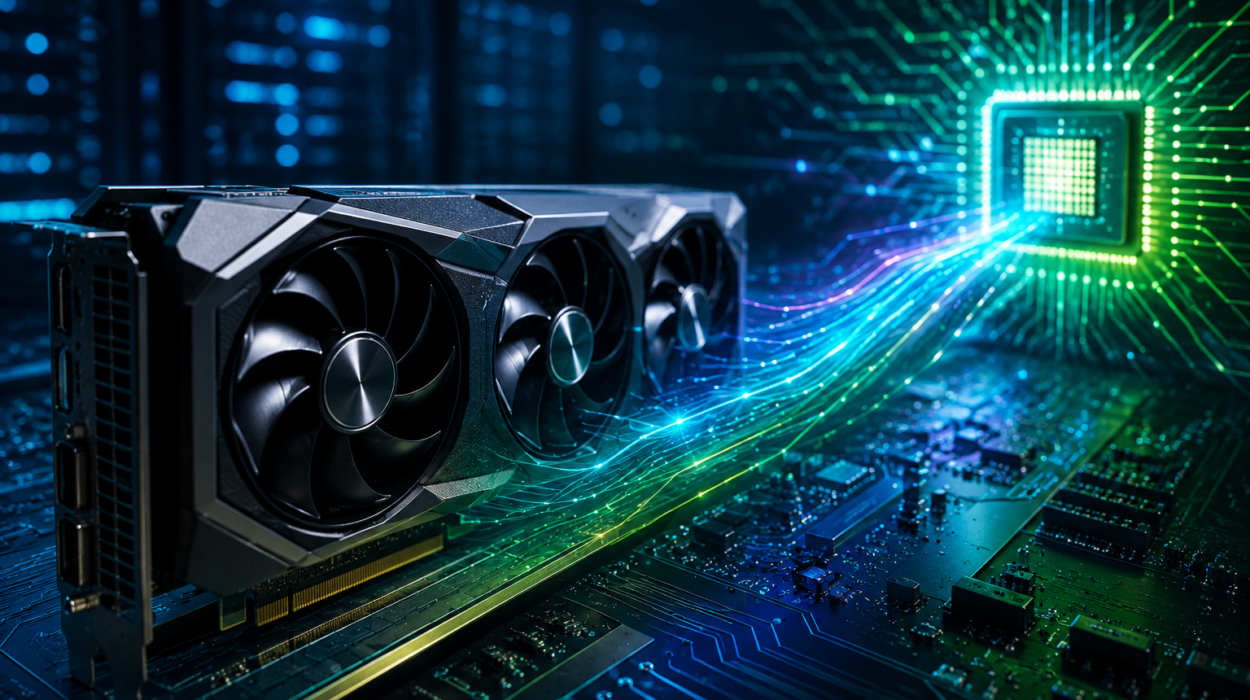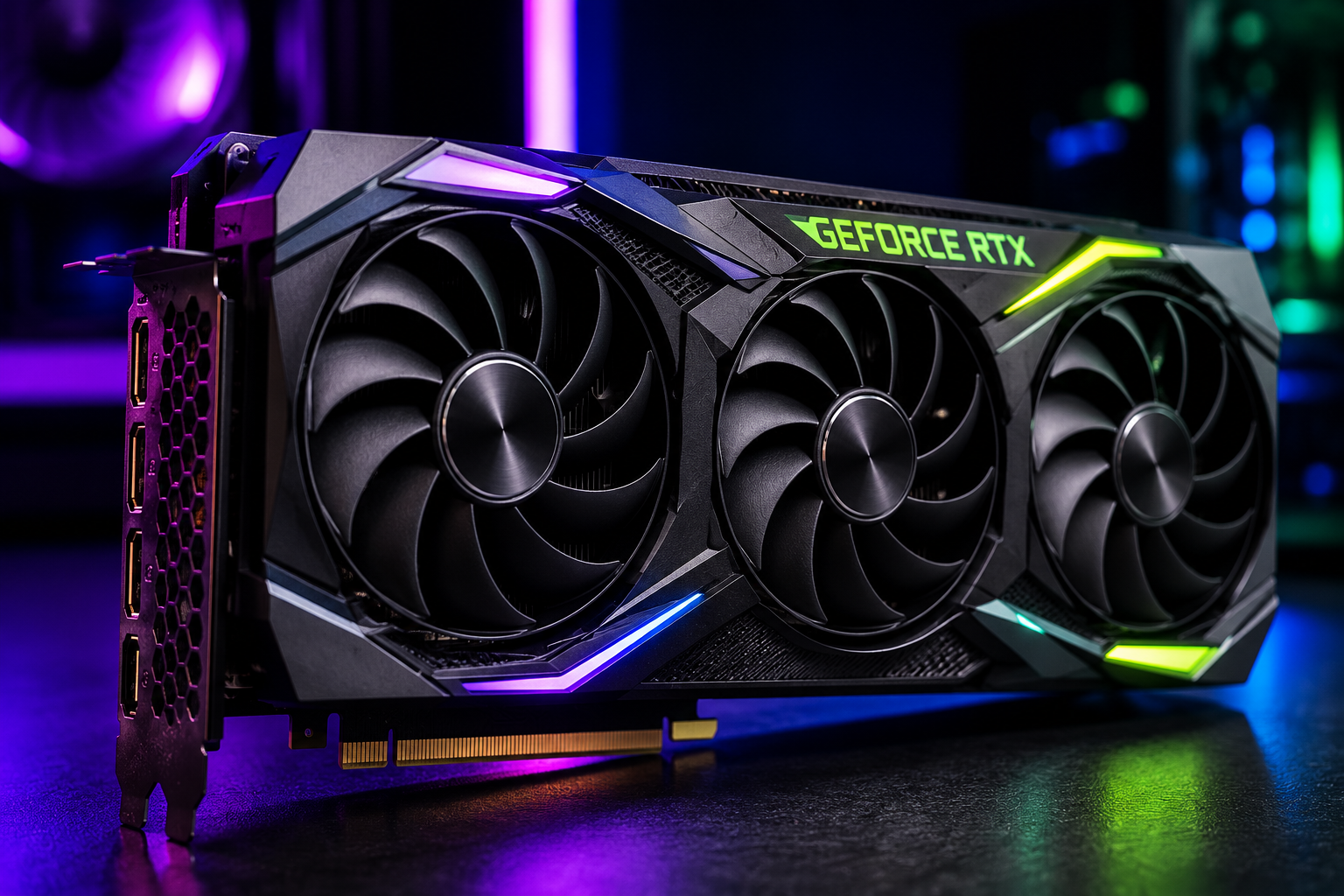
Have you ever wondered how a video game creates breathtaking landscapes, how a movie displays stunning visual effects, or how artificial intelligence can generate realistic images in seconds? Behind these incredible achievements is a remarkable piece of technology known as the Graphics Processing Unit, or GPU.
Once designed primarily to draw images on computer screens, GPUs have evolved into some of the most powerful processors ever built. Today, they power everything from gaming PCs and smartphones to self-driving cars, scientific research, supercomputers, and advanced AI systems like ChatGPT.
Although the name “Graphics Processing Unit” suggests that it is only for graphics, the modern GPU has become much more. It is now one of the most important computing technologies of the 21st century.
Understanding what a GPU is and how it works helps explain why today’s computers can perform tasks that seemed impossible just a few decades ago.
What Is a GPU?
A Graphics Processing Unit (GPU) is a specialized computer processor designed to perform many calculations at the same time. Its original purpose was to create and display images, videos, animations, and three-dimensional graphics quickly and efficiently.
Unlike a general-purpose processor, the GPU is built to handle thousands of similar operations simultaneously. This ability makes it exceptionally good at tasks that require massive parallel processing.
Whenever you play a modern video game, watch a high-resolution movie, edit a video, create digital artwork, train an artificial intelligence model, or perform complex scientific simulations, a GPU is often doing much of the heavy computational work.
Today, GPUs are found in desktop computers, laptops, smartphones, gaming consoles, workstations, data centers, and even some cars.
Why Was the GPU Created?
In the early days of computing, the Central Processing Unit (CPU) handled almost every task, including graphics.
As computer graphics became more detailed during the 1980s and 1990s, the CPU struggled to keep up. Drawing millions of pixels dozens of times every second required enormous computing power.
Engineers realized that graphics processing involved repeating many similar calculations. Instead of making the CPU do everything, they designed a separate processor specifically optimized for graphics.
This specialized chip became the GPU.
The first GPUs dramatically improved gaming performance and visual quality. Over time, researchers discovered that the same architecture could solve many non-graphics problems much faster than traditional CPUs.
That discovery transformed the GPU into a revolutionary computing platform.
What Does a GPU Actually Do?
Every image displayed on your screen consists of tiny dots called pixels.
A Full HD display contains over two million pixels.
A 4K display contains more than eight million pixels.
For every frame shown on the screen, the GPU must determine the color, brightness, shadows, reflections, textures, lighting, and position of millions of pixels.
If your monitor refreshes 60 times per second, the GPU performs this enormous task sixty times every second.
For competitive gaming at 144 or 240 frames per second, the workload becomes even greater.
The GPU performs these calculations so quickly that the images appear smooth and realistic to the human eye.
How Does a GPU Work?
At its core, a GPU works by dividing a large problem into thousands of smaller tasks that can be processed simultaneously.
Imagine painting a giant mural.
If only one artist works on it, the project takes a long time.
Now imagine thousands of artists each painting a tiny section at the same time.
The mural is completed much faster.
This is essentially how a GPU works.
Instead of solving calculations one after another, the GPU solves many of them in parallel.
Each small processing unit performs simple mathematical operations independently, allowing the entire system to complete enormous workloads in a fraction of the time required by a traditional processor.
This parallel architecture is the defining feature of modern GPUs.
Understanding Parallel Processing
One of the GPU’s greatest strengths is parallel processing.
A CPU typically has a relatively small number of highly powerful cores designed to execute different kinds of instructions quickly.
A GPU, in contrast, contains hundreds, thousands, or even tens of thousands of smaller processing cores, depending on the architecture and how manufacturers define those cores.
These cores are designed to perform many similar calculations simultaneously.
This makes GPUs ideal for workloads where the same operation must be repeated millions of times.
Examples include:
Rendering computer graphics.
Applying image filters.
Training neural networks.
Scientific simulations.
Weather forecasting.
Protein folding.
Cryptographic calculations.
Because these tasks can be divided into many smaller pieces, GPUs can often complete them dramatically faster than CPUs.
GPU vs CPU
Although both are processors, CPUs and GPUs are designed for different purposes.
The CPU serves as the computer’s general manager.
It runs the operating system, manages applications, processes user input, handles file operations, and coordinates communication between hardware components.
It excels at performing a wide variety of tasks quickly, especially those requiring complex decision-making and sequential processing.
The GPU acts more like a massive team of specialists.
Instead of handling many different jobs, it performs enormous numbers of similar calculations simultaneously.
This difference explains why computers usually contain both a CPU and a GPU.
Rather than replacing one another, they work together.
The Main Parts of a GPU
Inside a GPU are several important components that work together to process graphics and computational tasks.
The processing cores perform mathematical calculations.
Memory controllers manage communication between the GPU and its memory.
Dedicated graphics memory stores textures, images, geometry, and other data needed for rendering.
Rasterization hardware converts three-dimensional models into pixels that can appear on the display.
Texture units apply detailed surface patterns to objects.
Modern GPUs also include specialized hardware for advanced technologies such as ray tracing and artificial intelligence acceleration.
All these components operate together with extraordinary speed.
What Happens When You Play a Video Game?
When you start a video game, the CPU and GPU immediately begin working together.
The CPU handles game logic.
It calculates character movements, player input, physics rules, sound, networking, and artificial intelligence behavior.
The GPU receives instructions describing the virtual world.
It determines where every object appears.
It calculates lighting and shadows.
It applies textures.
It simulates reflections.
It creates realistic water, smoke, clouds, and special effects.
Finally, it converts all this information into millions of colored pixels that appear on your screen.
This entire process repeats dozens or even hundreds of times every second.
Rendering Three-Dimensional Graphics
Modern games and animated movies use three-dimensional models.
These models are built from thousands or millions of tiny polygons, usually triangles.
The GPU transforms these mathematical models into realistic images through a process called rendering.
It calculates how objects appear from the camera’s viewpoint.
It determines which surfaces are visible.
It applies textures to give objects realistic appearances.
It calculates lighting and shadows.
It blends colors.
Finally, it generates the finished image displayed on the monitor.
This process happens incredibly quickly, often many times every second.
What Is Ray Tracing?
One of the biggest advances in modern graphics is ray tracing.
Traditional graphics techniques estimate how light behaves.
Ray tracing instead simulates the paths that light rays take through a scene.
Light reflects from mirrors.
It bends through glass.
It creates realistic shadows.
It scatters across surfaces.
By calculating these interactions, ray tracing produces remarkably lifelike images.
The downside is that these calculations are extremely demanding.
Modern GPUs include dedicated hardware specifically designed to accelerate ray tracing.
Why Is GPU Memory Important?
A GPU needs extremely fast memory to keep up with its processing power.
This memory is called Video RAM (VRAM).
VRAM stores textures, frame buffers, geometry data, lighting information, and other graphical assets.
High-resolution games require large amounts of VRAM because they must store enormous textures and detailed environments.
Professional video editing, 3D rendering, and AI applications also benefit from larger VRAM capacities.
Without enough VRAM, performance may decrease because data must be transferred more frequently between the GPU and the computer’s main memory.
Integrated GPU vs Dedicated GPU
Not all GPUs are the same.
Many laptops and budget computers include an integrated GPU.
An integrated GPU is built into the CPU or the same processor package and shares the system’s main memory.
It consumes less power and generates less heat.
Integrated GPUs are excellent for web browsing, office work, streaming videos, and light gaming.
A dedicated GPU, also called a discrete GPU, is a separate processor with its own VRAM.
Dedicated GPUs offer significantly higher performance for gaming, professional design, engineering, video editing, scientific computing, and artificial intelligence.
They are commonly found in gaming desktops, workstations, and high-performance laptops.
GPUs and Artificial Intelligence
One of the most exciting developments in computing is the use of GPUs for artificial intelligence.
Training an AI model requires performing billions or even trillions of mathematical operations.
Because GPUs can process many calculations simultaneously, they dramatically reduce training time.
Modern AI systems rely heavily on GPUs for tasks such as image recognition, speech recognition, language translation, recommendation systems, robotics, and generative AI.
Many advanced AI chips also include specialized processing units alongside GPUs, but GPUs remain central to many machine learning workflows.
Without GPU technology, today’s rapid progress in AI would have been much slower.
GPUs in Scientific Research
Scientists use GPUs for much more than graphics.
Researchers simulate climate systems.
They study earthquakes.
They model galaxies.
They analyze DNA.
They investigate protein folding.
They search for new medicines.
They simulate nuclear reactions.
They process enormous amounts of astronomical data collected by telescopes.
The ability to perform parallel calculations makes GPUs invaluable in modern scientific computing.
GPUs in Everyday Technology
Even if you never play video games, you probably use a GPU every day.
Smartphones use GPUs to display smooth animations and high-resolution graphics.
Streaming services use GPUs to process video.
Photo editing software accelerates image enhancement using GPU computing.
Video conferencing applications use GPUs for background blur and visual effects.
Navigation apps render maps.
Social media filters rely on GPU processing.
Modern web browsers also use GPUs to display complex websites smoothly.
The GPU has quietly become one of the most widely used processors in everyday life.
How GPUs Help Video Editing
Professional video editing requires processing enormous amounts of visual data.
A GPU accelerates tasks such as playback, color correction, visual effects, transitions, encoding, decoding, and rendering.
Instead of waiting hours to export a video, editors can often complete the process much faster using GPU acceleration.
Many professional creative applications are specifically optimized to take advantage of GPU computing.
The Companies That Build GPUs
Several companies play major roles in GPU development.
NVIDIA is widely recognized for high-performance gaming, AI, scientific computing, and professional graphics processors.
AMD develops GPUs for gaming, workstations, and data centers while also supplying graphics technology for many gaming consoles.
Intel has expanded its graphics offerings with integrated and dedicated GPUs for consumers and professionals.
Apple designs custom graphics processors integrated into its own silicon for Macs, iPads, and iPhones.
Each company develops unique architectures optimized for different kinds of workloads.
The Future of GPUs
GPU technology continues to evolve rapidly.
Future GPUs are expected to become faster, more energy efficient, and more specialized for artificial intelligence and advanced graphics.
Researchers are developing new methods to improve real-time ray tracing, machine learning acceleration, scientific computing, and virtual reality.
Cloud computing is also changing how GPUs are used.
Instead of owning powerful hardware, users can access remote GPU clusters through the internet to perform demanding tasks.
As AI becomes increasingly integrated into everyday life, GPUs will likely remain among the most important computing technologies driving innovation.
Common Misconceptions About GPUs
Many people believe that GPUs are useful only for gaming.
In reality, gaming is just one application.
Today, GPUs accelerate medical research, weather prediction, financial modeling, engineering simulations, robotics, cybersecurity, autonomous vehicles, scientific discovery, and artificial intelligence.
Another common misconception is that a GPU replaces the CPU.
In fact, both processors perform different roles and complement each other. A computer still needs a CPU to manage the operating system, applications, and many sequential tasks, while the GPU excels at highly parallel workloads.
Why GPUs Have Become Essential
The modern digital world demands enormous computing power.
People expect realistic games, high-resolution videos, instant photo editing, intelligent virtual assistants, accurate navigation, immersive virtual reality, and increasingly capable AI systems.
Meeting these expectations requires processors that can perform billions of calculations every second.
The GPU was designed precisely for this challenge.
Its ability to process thousands of operations simultaneously has transformed not only computer graphics but also scientific research, engineering, medicine, and artificial intelligence.
What began as a specialized graphics chip has become one of the most influential inventions in modern computing, enabling technologies that continue to redefine how we work, learn, create, communicate, and explore the universe.