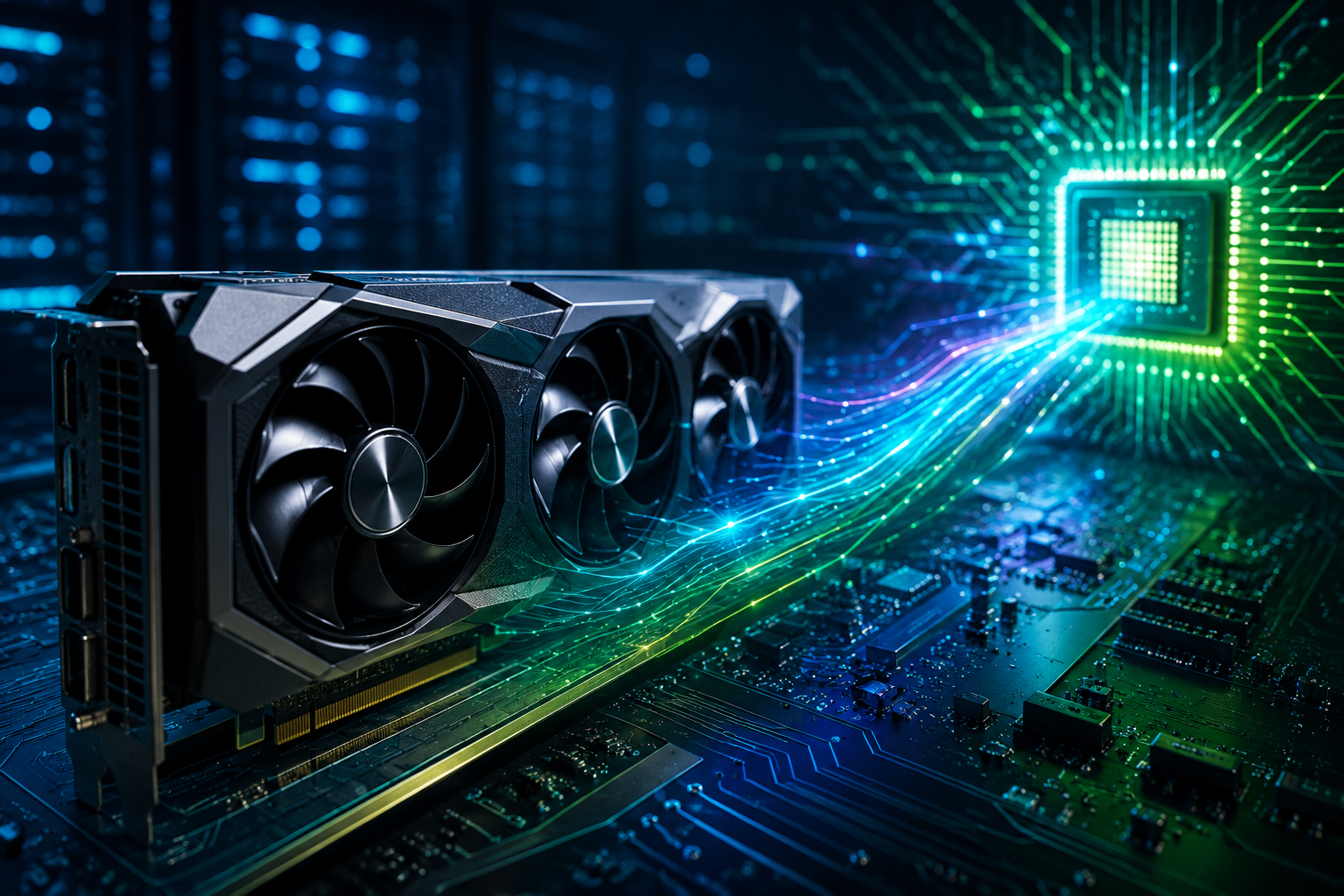
Every time you play a video game, watch a high-resolution video, generate an image with artificial intelligence, or train a powerful AI model, there is a good chance a Graphics Processing Unit (GPU) is doing much of the heavy lifting behind the scenes. What began as specialized hardware designed to draw images on a screen has evolved into one of the most important technologies of the modern digital era.
Today, GPU computing powers everything from scientific research and medical imaging to self-driving cars, weather forecasting, financial modeling, robotics, and generative artificial intelligence. In many of the world’s fastest supercomputers, GPUs now perform the majority of the calculations, enabling discoveries that would have been impossible just a few decades ago.
GPU computing is transforming the way computers solve problems. By processing thousands of tasks simultaneously, GPUs can complete certain types of calculations dramatically faster than traditional processors. As the demand for artificial intelligence, big data, and complex simulations continues to grow, GPU computing has become one of the cornerstones of modern computing.
What Is GPU Computing?
GPU computing is the use of a Graphics Processing Unit (GPU) to perform general-purpose computing tasks that go far beyond rendering graphics.
Traditionally, computers relied almost entirely on the Central Processing Unit (CPU) to execute software. CPUs remain essential because they are designed to handle a wide variety of tasks efficiently, making decisions, managing operating systems, and running applications.
A GPU, however, is built differently. Instead of focusing on a small number of powerful processing cores, a GPU contains hundreds, thousands, or even tens of thousands of smaller processing units that can work simultaneously on many calculations.
GPU computing takes advantage of this massive parallel processing capability to solve problems much faster than a CPU alone can for workloads that can be divided into many independent operations.
Rather than replacing the CPU, GPU computing allows the CPU and GPU to work together, each handling the tasks they perform best.
Understanding the Difference Between a CPU and a GPU
To understand GPU computing, it helps to imagine two very different work teams.
A CPU is like a small group of highly skilled experts. Each member can solve complicated problems, switch quickly between different tasks, and make important decisions. This makes CPUs excellent at running operating systems, managing software, and handling complex instructions that require flexibility.
A GPU is more like a massive workforce made up of thousands of workers performing similar tasks at the same time. Each individual worker is less versatile than a CPU core, but together they can process enormous amounts of data incredibly quickly.
This design makes GPUs exceptionally efficient for problems involving repeated mathematical calculations performed on large datasets.
Why Were GPUs Originally Created?
The first GPUs were developed to accelerate computer graphics.
Displaying realistic video games and graphical interfaces requires millions of pixels to be calculated dozens or even hundreds of times every second. Every object on the screen needs lighting, shadows, textures, colors, and geometry processed almost simultaneously.
These calculations are highly repetitive, making them ideal for parallel processing.
As GPU hardware became more powerful, researchers realized the same architecture could accelerate many scientific and engineering calculations that had nothing to do with graphics.
This insight gave birth to GPU computing.
The Rise of General-Purpose GPU Computing
During the early 2000s, programmers began using GPUs for calculations beyond graphics rendering.
This approach became known as General-Purpose Computing on Graphics Processing Units (GPGPU).
Instead of drawing images, GPUs started solving mathematical equations, processing scientific simulations, analyzing enormous datasets, and training artificial intelligence models.
Software platforms such as CUDA and OpenCL made it possible for developers to write programs that directly used GPU hardware for general computing tasks.
Today, GPU computing is a standard technology across research laboratories, cloud computing platforms, universities, and technology companies worldwide.
How GPU Computing Works
At its core, GPU computing relies on parallel processing.
Many computational problems can be divided into thousands or millions of smaller calculations that do not depend on one another.
Rather than solving these tasks one at a time, a GPU distributes them across thousands of processing cores.
Each core performs its calculation simultaneously with many others.
Once all the calculations are complete, the results are combined into a final solution.
This parallel execution allows GPUs to complete certain workloads dramatically faster than sequential processing on a CPU.
The exact performance advantage depends on the type of problem. Some applications may see only modest improvements, while highly parallel workloads can experience speedups that are many times greater than CPU-only execution.
Parallel Processing Explained
Imagine needing to count every grain of sand on a large beach.
If one person performs the job alone, it could take years.
Now imagine ten thousand people each counting a small section simultaneously.
The task finishes much sooner because the work is shared.
GPU computing follows this same principle.
Whenever a problem can be broken into many independent pieces, GPUs excel.
However, not every problem works this way. Tasks requiring constant decision-making or heavy dependence between calculations often remain better suited for CPUs.
GPU Architecture
A modern GPU contains several major components working together.
The processing cores perform mathematical calculations.
High-speed memory stores data that the GPU needs during computation.
Memory controllers move information efficiently between different parts of the chip.
Scheduling hardware coordinates the thousands of calculations happening simultaneously.
Specialized processing units accelerate particular operations such as ray tracing for realistic lighting or tensor operations used in artificial intelligence.
Although different GPU manufacturers use different architectures, the overall goal remains the same: maximize parallel computation while efficiently moving data.
Why GPUs Are So Fast
The remarkable speed of GPUs comes from their design philosophy.
Instead of optimizing for many different types of tasks, GPUs dedicate much of their hardware to performing mathematical operations simultaneously.
Because many scientific and AI workloads involve repeating similar calculations across enormous datasets, this architecture delivers outstanding performance.
Modern GPUs also provide extremely high memory bandwidth, allowing vast amounts of information to move quickly between memory and processing cores.
This combination of parallel execution and rapid data transfer enables GPUs to solve many computational problems with exceptional efficiency.
GPU Computing and Artificial Intelligence
One of the most important applications of GPU computing is artificial intelligence.
Training deep neural networks requires enormous numbers of mathematical operations involving matrices and tensors.
These operations can be performed in parallel extremely efficiently on GPUs.
Without GPU computing, many of today’s largest AI systems would require impractically long training times.
Large language models, image generators, speech recognition systems, recommendation engines, and autonomous vehicles all benefit from GPU acceleration.
Even after AI models are trained, GPUs often continue accelerating inference—the process of using trained models to make predictions or generate responses.
Machine Learning and Deep Learning
Machine learning involves teaching computers to recognize patterns in data.
Deep learning is a specialized branch of machine learning inspired by the structure of biological neural networks.
Training these systems requires repeatedly adjusting millions or even billions of parameters through mathematical optimization.
GPU computing dramatically speeds up this process by performing many calculations simultaneously.
As AI models continue growing in size and complexity, GPUs have become indispensable tools for researchers and developers.
Scientific Research
Scientists use GPU computing to explore some of the most challenging questions in nature.
Climate researchers simulate Earth’s atmosphere to improve weather forecasts and understand climate change.
Astronomers analyze enormous datasets collected by telescopes.
Particle physicists process collisions generated by powerful accelerators.
Biologists simulate protein folding to better understand diseases.
Chemists model molecular interactions for drug discovery.
Geophysicists study earthquakes and Earth’s interior.
Because these simulations involve billions or trillions of calculations, GPU acceleration often reduces computation times from weeks to days—or even hours.
Medical Applications
Healthcare increasingly relies on GPU computing.
Medical imaging systems use GPUs to reconstruct detailed images from MRI, CT, and PET scanners.
Researchers analyze genetic data much faster using GPU-accelerated algorithms.
Artificial intelligence systems assist doctors by identifying patterns in medical images that may indicate disease.
Drug discovery benefits from molecular simulations accelerated by GPUs.
These technologies help researchers investigate diseases more efficiently while supporting clinicians with faster analysis of complex medical data.
Weather Forecasting
Weather prediction involves solving mathematical equations describing Earth’s atmosphere.
The atmosphere is extraordinarily complex, requiring calculations across millions of grid points.
GPU computing allows meteorologists to process these models much more rapidly.
Faster calculations enable more timely forecasts and support improved modeling of severe weather events such as hurricanes, cyclones, and thunderstorms.
Engineering and Design
Engineers depend heavily on GPU computing.
Aircraft designers simulate airflow around wings.
Automotive engineers analyze crash safety.
Architects visualize buildings before construction begins.
Mechanical engineers optimize machine performance.
Civil engineers evaluate bridges under varying loads.
GPU acceleration allows these simulations to be completed faster, enabling engineers to test more designs while reducing development time.
Computer Graphics and Gaming
Although GPUs now perform much more than graphics rendering, gaming remains one of their most visible applications.
Modern video games generate highly realistic worlds with detailed lighting, reflections, shadows, and complex physics.
GPUs process millions of graphical calculations every second to create smooth, immersive experiences.
Advanced technologies such as ray tracing simulate the behavior of light with remarkable realism, producing reflections, shadows, and lighting effects that closely resemble those found in the real world.
Video Editing and Content Creation
Creative professionals benefit enormously from GPU computing.
Video editing software uses GPUs to accelerate playback, rendering, color correction, and visual effects.
Photographers process high-resolution images more quickly.
Three-dimensional animation software renders realistic scenes faster.
Digital artists use GPUs for complex visual effects and interactive design.
As image resolutions continue increasing, GPU acceleration has become an essential part of professional creative workflows.
Cryptocurrency Mining
Some cryptocurrencies have historically relied on GPU computing.
Mining involves solving mathematical problems that validate transactions and secure blockchain networks.
Because many of these calculations can be parallelized, GPUs proved well suited for certain mining algorithms.
However, not all cryptocurrencies use GPU mining, and many blockchain networks have adopted alternative consensus mechanisms that significantly reduce or eliminate this requirement.
Supercomputers
Many of the world’s fastest supercomputers rely heavily on GPUs.
Instead of using CPUs alone, these systems combine large numbers of CPUs with thousands of GPUs working together.
This hybrid architecture dramatically increases computational performance while improving energy efficiency for many scientific workloads.
GPU-powered supercomputers contribute to research in astronomy, medicine, materials science, nuclear physics, artificial intelligence, and numerous other fields.
Programming for GPU Computing
Developers cannot automatically expect software to run faster simply because a GPU is present.
Applications must be designed to take advantage of parallel execution.
Programmers identify sections of code that can be divided into many simultaneous operations and rewrite those portions for GPU execution.
The CPU continues managing overall program flow while delegating highly parallel tasks to the GPU.
This cooperation between CPU and GPU forms the foundation of modern heterogeneous computing.
Challenges of GPU Computing
Despite its impressive capabilities, GPU computing is not suitable for every workload.
Some problems contain many sequential steps that must occur in a specific order. These tasks gain little benefit from parallel execution.
Moving data between CPU memory and GPU memory can also introduce delays if not managed efficiently.
Developing GPU software often requires specialized programming knowledge and careful optimization.
Power consumption is another important consideration. High-performance GPUs can require substantial electrical power and advanced cooling systems, particularly in data centers and supercomputers.
Researchers continue developing more efficient architectures and software tools to address these challenges.
The Future of GPU Computing
GPU computing continues evolving rapidly.
Artificial intelligence is driving demand for increasingly powerful processors capable of handling enormous machine learning models.
Researchers are developing GPUs with improved energy efficiency, faster memory, and specialized hardware for AI, scientific simulations, and advanced graphics.
Cloud computing has also expanded access to GPU technology. Instead of purchasing expensive hardware, organizations can rent powerful GPU resources on demand through cloud providers, making advanced computing accessible to researchers, startups, and students around the world.
As workloads become larger and more data-intensive, GPU computing will likely remain a central technology supporting innovation across science, medicine, engineering, entertainment, and industry.
GPU Computing Is Changing the World
GPU computing has transformed the Graphics Processing Unit from a device built primarily for displaying images into one of the most powerful engines of modern computation. By performing thousands of calculations simultaneously, GPUs accelerate tasks that once required enormous amounts of time, enabling breakthroughs in artificial intelligence, scientific discovery, engineering, healthcare, and digital creativity.
Yet GPUs do not replace traditional processors. Instead, they complement CPUs, with each handling the types of work they are best designed to perform. This partnership has reshaped computing, allowing researchers, engineers, and developers to solve problems that were once beyond reach.
As technology continues advancing and the world’s appetite for data and AI grows, GPU computing will play an increasingly vital role in expanding the frontiers of knowledge, innovation, and human achievement.