Every time you visit a website, stream a video, send a message, or open an app connected to the internet, an invisible process takes place within milliseconds. Before your device can reach a website like example.com, it first needs to discover the server’s numerical IP address. This seemingly simple task is handled by the Domain Name System, better known as DNS.
For decades, DNS has acted as the internet’s phonebook, translating human-friendly domain names into machine-readable IP addresses. However, traditional DNS has long suffered from a major privacy problem. Most DNS requests travel across the internet without encryption, making them visible to internet service providers, network administrators, and sometimes attackers.
To solve this weakness, engineers developed DNS over TLS, commonly known as DoT. This technology encrypts DNS requests before they leave your device, preventing others from easily seeing which websites you are trying to visit.
Although DNS over TLS works quietly in the background, it has become an important part of modern internet privacy and security. Understanding how it works can help you make better decisions about protecting your online activity.
What Is DNS over TLS (DoT)?
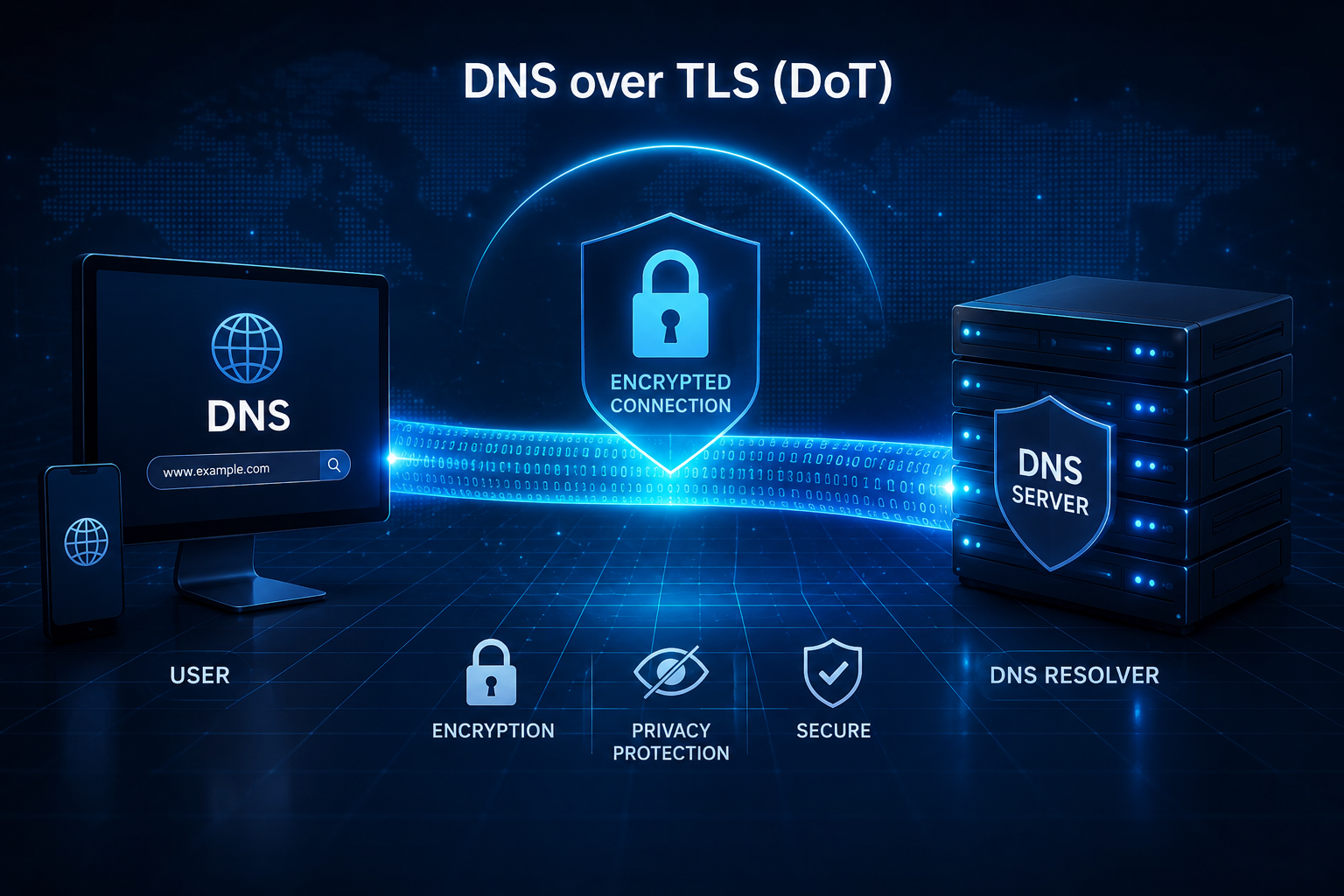
DNS over TLS (DoT) is a security protocol that encrypts DNS queries using Transport Layer Security (TLS), the same encryption technology that protects online banking, shopping websites, email services, and many other secure internet connections.
Instead of sending DNS requests in plain text, DoT creates an encrypted connection between your device and a DNS resolver. Once this secure connection is established, every DNS request is encrypted while traveling across the network.
Anyone monitoring the connection can still see that your device is communicating with a DNS server, but they cannot easily read the actual domain names contained within the encrypted requests.
The Internet Engineering Task Force (IETF) standardized DNS over TLS in RFC 7858, making it an open and widely supported internet standard.
Why Traditional DNS Is Not Private
To appreciate the value of DNS over TLS, it helps to understand how traditional DNS works.
Imagine typing “www.example.com” into your browser.
Your computer sends a DNS query asking, “What is the IP address for this website?”
With traditional DNS, this request is usually sent without encryption using the User Datagram Protocol (UDP) on port 53. Because the request is unencrypted, anyone positioned along the network path may be able to observe it.
Depending on the network, this could include your internet service provider, the administrator of a public Wi-Fi network, or, in some cases, attackers performing network surveillance.
Although HTTPS encrypts the content of the website after you connect, the initial DNS lookup may still reveal which website you intended to visit.
This has long been considered one of the internet’s major privacy weaknesses.
How DNS over TLS Works
DNS over TLS improves this process by wrapping DNS communication inside an encrypted TLS session.
When your device first contacts a DoT-enabled DNS resolver, it performs a TLS handshake. During this handshake, both sides negotiate encryption methods, verify digital certificates, and establish secure cryptographic keys.
Once this encrypted tunnel exists, every DNS query passes safely through it.
Instead of exposing the requested domain name in plain text, the encrypted connection protects the information from unauthorized viewing while it travels across the internet.
The DNS resolver decrypts the request, finds the correct IP address, and returns the answer through the same encrypted connection.
To your browser, the entire process feels nearly instantaneous.
What Is TLS?
TLS stands for Transport Layer Security.
It is the successor to Secure Sockets Layer (SSL), although people still commonly use the term “SSL” informally.
TLS is one of the most important security technologies on the internet. It protects sensitive information such as passwords, financial transactions, private messages, and online accounts.
Whenever you see “https://” in your browser or a padlock icon beside a website address, TLS is usually responsible for encrypting that connection.
DNS over TLS simply applies this trusted encryption technology to DNS traffic.
Why DNS Encryption Matters
Many people assume that HTTPS already hides everything they do online.
In reality, HTTPS mainly encrypts communication between your browser and the website after the connection has been established.
Before that connection can happen, your device usually performs a DNS lookup.
If the DNS request is unencrypted, observers may still learn which websites you are trying to access, even if they cannot read the website’s content.
Encrypting DNS reduces this information leakage and improves online privacy.
How DNS over TLS Protects Privacy
One of DoT’s greatest strengths is that it keeps DNS requests confidential during transmission.
Suppose you connect to public Wi-Fi at an airport.
Without encrypted DNS, the network operator may be able to observe your DNS queries.
With DNS over TLS enabled, the DNS requests become encrypted, making it much more difficult for others on the network to determine exactly which domains you are requesting.
This extra layer of privacy is especially valuable on shared, public, or untrusted networks.
Protection Against DNS Manipulation
Privacy is only one benefit.
Traditional DNS traffic can sometimes be intercepted or modified.
In certain attacks, malicious actors attempt to redirect users toward fake websites by altering DNS responses.
Because DNS over TLS authenticates the encrypted connection with digital certificates, it becomes significantly harder for attackers to tamper with DNS communication while it is in transit.
Although no security technology is perfect, DoT reduces several important attack opportunities.
Does DNS over TLS Hide Everything?
No.
DNS over TLS improves privacy, but it does not make users anonymous.
Your internet service provider can still see that your device is connected to a DNS server.
It can also observe the IP addresses your device communicates with after DNS resolution.
Other internet technologies may also reveal information about your browsing activity.
For example, website traffic itself, browser fingerprinting, cookies, account logins, and IP addresses remain outside the scope of DNS over TLS.
DoT protects DNS requests—not every aspect of internet communication.
DNS over TLS Versus Traditional DNS
The biggest difference lies in encryption.
Traditional DNS sends queries in plain text, allowing them to be viewed by others on the network.
DNS over TLS encrypts these queries before transmission, preventing casual observation and many forms of interception.
From the user’s perspective, both systems perform the same basic task: converting domain names into IP addresses.
The difference is that one protects this information while the other does not.
DNS over TLS Versus DNS over HTTPS (DoH)
DNS over TLS and DNS over HTTPS both encrypt DNS requests, but they do so differently.
DNS over TLS uses a dedicated encrypted connection designed specifically for DNS traffic. It generally communicates over TCP port 853, which has been assigned specifically for DoT.
DNS over HTTPS, commonly called DoH, sends DNS requests inside standard HTTPS traffic, typically using port 443.
Because HTTPS is already used by most websites, DoH traffic blends in with ordinary web traffic, making it more difficult for networks to distinguish DNS requests.
DNS over TLS, by contrast, uses its own dedicated communication channel, making network management simpler in some environments.
Both technologies significantly improve DNS privacy compared with traditional DNS.
Neither is universally “better.” Their suitability depends on network policies, operating systems, administrative preferences, and privacy goals.
DNS over TLS Versus DNS over QUIC (DoQ)
A newer encrypted DNS protocol is DNS over QUIC, or DoQ.
Instead of relying on TCP like DoT, DoQ uses the QUIC transport protocol.
QUIC can reduce connection latency and improve performance during network changes, especially on mobile devices switching between Wi-Fi and cellular networks.
Although DoQ is gaining support, DNS over TLS remains one of the most widely deployed encrypted DNS standards.
Does DNS over TLS Slow Down Internet Browsing?
Many people worry that encryption always reduces speed.
In practice, the impact is usually very small.
The initial TLS handshake requires a little extra work when establishing the secure connection.
However, modern devices and DNS resolvers are highly optimized.
Once the encrypted session is established, multiple DNS requests can often reuse the same secure connection, minimizing additional overhead.
For most users, the performance difference is nearly impossible to notice.
In some situations, faster public DNS providers may even improve browsing performance compared with slower default DNS servers.
Which Devices Support DNS over TLS?
Support for DNS over TLS has grown steadily over the years.
Many Android devices include built-in support through a feature commonly called “Private DNS.”
Numerous Linux distributions support DoT through modern DNS software.
Several network routers can also use DNS over TLS for every device connected to the home network.
Some desktop operating systems support DoT directly, while others require third-party DNS software or applications.
Many modern public DNS providers also offer DoT services.
Public DNS Providers That Support DNS over TLS
Several well-known DNS providers support encrypted DNS connections using DoT.
Examples include Cloudflare, Google Public DNS, Quad9, NextDNS, AdGuard DNS, and others.
Each provider has its own privacy policies, filtering options, performance characteristics, logging practices, and security features.
Choosing a DNS provider therefore involves more than simply selecting one that supports encryption.
Privacy policies and trustworthiness remain important considerations.
Can Internet Providers Still See Your Activity?
DNS over TLS limits what internet service providers can observe, but it does not completely hide online activity.
ISPs may still see the destination IP addresses your device connects to after DNS resolution.
Depending on the website and network conditions, additional metadata may also remain visible.
However, encrypting DNS removes one important source of browsing information that would otherwise be transmitted in plain text.
DNS over TLS and Public Wi-Fi
Public wireless networks are convenient but often less trustworthy than home networks.
Whether you are in an airport, hotel, café, university, or shopping mall, the local network operator may have opportunities to observe unencrypted DNS traffic.
DNS over TLS significantly improves privacy in these environments by encrypting DNS communication before it leaves your device.
Although it cannot eliminate every security risk associated with public Wi-Fi, it provides meaningful protection against passive monitoring of DNS requests.
Is DNS over TLS Safe?
Yes.
When properly implemented, DNS over TLS is considered a secure and reliable protocol.
It uses the same well-established TLS encryption technology that protects billions of secure internet connections every day.
Its security depends on correctly validating server certificates, using trusted DNS resolvers, and keeping software updated.
Like any security technology, DoT works best as part of a broader cybersecurity strategy that includes HTTPS, strong passwords, software updates, multi-factor authentication, and safe browsing habits.
Can DNS over TLS Prevent Malware?
DNS over TLS itself does not block malware.
Its primary purpose is encrypting DNS traffic.
However, some DNS providers combine encrypted DNS with security features that block known malicious domains, phishing websites, command-and-control servers, and other threats.
In these cases, the additional protection comes from the DNS provider’s filtering service rather than from the DoT protocol itself.
Why Businesses Use DNS over TLS
Organizations increasingly deploy DNS over TLS to improve both privacy and security.
Encrypted DNS helps protect employees working remotely, reduces opportunities for network-based attacks, and prevents sensitive DNS traffic from being exposed across corporate networks.
Businesses handling confidential information often view encrypted DNS as one important component of modern cybersecurity architecture.
The Future of Encrypted DNS
As concerns about online privacy continue to grow, encrypted DNS technologies are becoming increasingly common.
Operating systems, browsers, routers, and internet service providers are gradually expanding support for secure DNS protocols.
DNS over TLS, DNS over HTTPS, and DNS over QUIC each represent different approaches to solving the long-standing privacy weaknesses of traditional DNS.
Together, these technologies are helping transform DNS from an open, easily observed protocol into one that better reflects modern expectations for internet security.
Final Thoughts
DNS over TLS may work silently behind the scenes, but its impact on internet privacy is significant. By encrypting the DNS requests that connect users to websites, it closes one of the internet’s oldest security gaps and helps prevent others from easily observing browsing destinations.
While DNS over TLS does not provide complete anonymity or replace other security technologies, it offers an important layer of protection for everyday internet use. Combined with HTTPS, trusted DNS providers, secure devices, and good cybersecurity practices, DNS over TLS helps create a safer and more private online experience for individuals, businesses, and organizations around the world.