Imagine leaving your front door unlocked simply because everyone in your neighborhood seems friendly. Most people would never do that. Yet for many years, computer networks operated in a surprisingly similar way. Once a user successfully logged in, they were often trusted to move freely through the system. If an attacker managed to steal a password or break into the network, they could sometimes access far more information than they should.
As cyberattacks have become more sophisticated, this traditional approach is no longer enough. Today’s organizations face threats from phishing emails, ransomware, stolen credentials, compromised devices, insider threats, and attackers who constantly search for weak points. A single successful login should not automatically open every digital door.
This challenge has led to one of the most important shifts in modern cybersecurity: Zero Trust. Rather than assuming that anyone or anything inside a network is safe, Zero Trust starts with a simple but powerful idea—trust should never be automatic. Every request to access data, applications, or systems must be verified, regardless of where it comes from.
Zero Trust is transforming how businesses, governments, hospitals, schools, and even individuals protect sensitive information. It is not a single product or software application but a cybersecurity strategy designed for today’s connected world.
What Is Zero Trust?
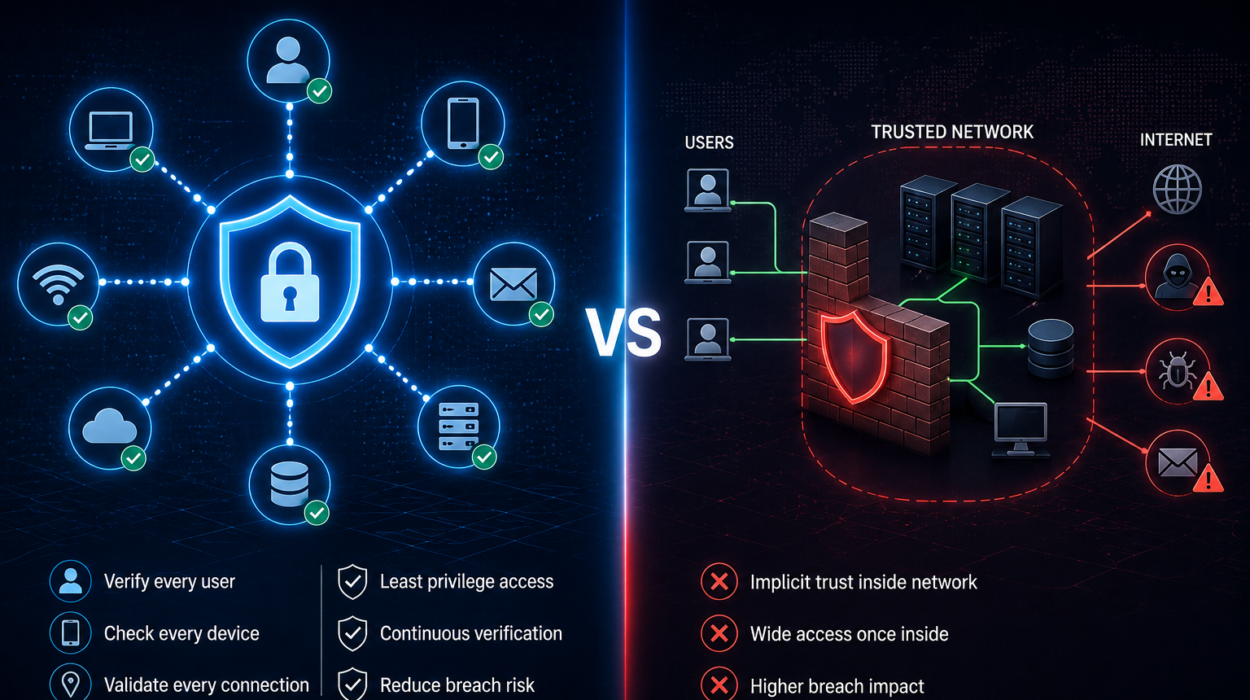
Zero Trust is a cybersecurity model based on the principle of “never trust, always verify.”
In traditional network security, users who successfully logged into a company’s network were often considered trustworthy. Once inside, they could frequently access many internal resources with relatively few additional security checks.
Zero Trust rejects this assumption.
Instead, every user, device, application, and connection must continuously prove that it is authorized to access a particular resource. Whether the request comes from inside the office, from an employee working remotely, or from another country, the same verification process applies.
Location alone does not determine trust.
Identity, device security, permissions, and many other factors are evaluated before access is granted.
Why Traditional Security Is No Longer Enough
For decades, organizations protected their networks much like castles surrounded by walls.
The firewall acted as the castle wall, preventing outsiders from entering. Employees working inside the network were generally trusted.
This model worked reasonably well when most employees worked in the same office using company-owned computers.
Today’s digital world is very different.
People work from home, airports, coffee shops, and hotels. They use laptops, smartphones, tablets, and cloud applications from almost anywhere. Data often lives in cloud services instead of local servers.
Cybercriminals have adapted to this changing environment.
Rather than attacking network walls directly, they often steal usernames and passwords through phishing attacks, malware, or data breaches.
If attackers successfully impersonate legitimate users, traditional security models may mistakenly allow them inside.
Zero Trust helps solve this problem by treating every access request with caution.
The Core Principle of Zero Trust
At the heart of Zero Trust is one guiding philosophy.
No user should automatically receive access simply because they successfully logged in earlier or because they are inside a corporate network.
Instead, access decisions consider many factors.
The system checks who the user is.
It evaluates whether the device is trusted.
It examines whether the device has current security updates.
It verifies the requested resource.
It determines whether the user actually needs that access.
Only after these checks are completed is access granted.
Even then, access may be limited to only the specific resources required.
Identity Becomes the New Security Perimeter
In modern cybersecurity, identity has become more important than physical location.
Zero Trust places identity at the center of every security decision.
Every user must authenticate themselves before accessing protected systems.
Authentication may involve passwords, passkeys, security keys, biometric verification, or multi-factor authentication.
This greatly reduces the chances that stolen passwords alone can give attackers unrestricted access.
Even after authentication, identity continues to be monitored.
If unusual behavior appears, additional verification may be required.
Continuous Verification
One of Zero Trust’s biggest strengths is that verification never truly ends.
Traditional systems often verify users only during login.
Zero Trust continuously evaluates whether access should remain active.
Suppose an employee logs in from their office computer during normal working hours.
Everything appears normal.
Later that same account suddenly attempts to download thousands of confidential files from another country using an unfamiliar device.
Zero Trust systems can recognize this unusual behavior and require additional verification or temporarily block access.
This continuous monitoring helps detect attacks that would otherwise remain hidden.
Least Privilege Access
Another key concept in Zero Trust is the principle of least privilege.
This means users receive only the minimum level of access necessary to perform their jobs.
A marketing employee does not need access to payroll databases.
An accountant does not require administrative control over engineering systems.
A contractor should not automatically see confidential executive documents.
Limiting permissions reduces the amount of damage that can occur if an account becomes compromised.
Even if attackers steal someone’s credentials, they can access only a limited portion of the network rather than everything.
Microsegmentation Reduces Risk
Traditional networks often allow broad communication between many systems.
If attackers gain access to one computer, they may move laterally through the network, searching for valuable data.
Zero Trust addresses this problem through microsegmentation.
Instead of treating the entire network as one large environment, it divides systems into smaller protected areas.
Each segment has its own access controls.
Moving from one area to another requires separate authorization.
This significantly slows attackers and limits how far they can spread.
Even if one part of the network is compromised, the rest remains better protected.
Device Security Matters
Zero Trust does not focus only on people.
Devices themselves must also prove they are trustworthy.
A laptop infected with malware can become an entry point for attackers.
Before granting access, Zero Trust systems may check whether a device has updated security software, current operating system patches, encrypted storage, and approved security settings.
Devices that fail these checks may receive limited access or be blocked entirely until security issues are resolved.
This approach helps prevent compromised devices from becoming gateways into sensitive systems.
Protecting Cloud Applications
Modern organizations increasingly rely on cloud services.
Email, document storage, collaboration platforms, customer databases, and business software often operate entirely in the cloud.
Traditional security designed around office networks cannot adequately protect these distributed environments.
Zero Trust works well because it focuses on verifying every connection regardless of where resources are located.
Whether data resides in a local server or a cloud platform, the same careful verification process applies.
This consistent approach improves security across hybrid environments.
Supporting Remote Work
Remote work has become common across many industries.
Employees connect from homes, hotels, airports, and shared workspaces using many different internet connections.
Traditional security often assumed that people working outside the office were less secure.
Zero Trust treats every location equally.
Whether someone works from company headquarters or their living room, their identity, device, permissions, and behavior must all be verified.
This creates stronger security without relying solely on physical office networks.
Reducing the Impact of Stolen Passwords
Passwords remain one of the most common targets for cybercriminals.
Phishing emails frequently trick users into revealing login credentials.
Data breaches can expose millions of passwords.
Malware may secretly capture passwords from infected devices.
Zero Trust recognizes that passwords alone cannot provide sufficient protection.
Many Zero Trust implementations use multi-factor authentication, passkeys, or biometric verification to strengthen identity checks.
Even if attackers steal a password, additional verification requirements make unauthorized access much more difficult.
Improving Protection Against Ransomware
Ransomware has become one of the most damaging forms of cybercrime.
Once inside a network, ransomware often attempts to spread rapidly across connected systems.
Zero Trust helps reduce this risk.
Least privilege access limits what infected accounts can reach.
Microsegmentation prevents malware from moving freely throughout the network.
Continuous monitoring can detect unusual activity before encryption spreads widely.
Although no security approach can eliminate ransomware entirely, Zero Trust can significantly reduce its impact.
Detecting Unusual Behavior
Modern Zero Trust systems often analyze behavior in addition to identity.
Suppose a user normally logs in from New York during business hours.
Suddenly the same account appears in another country only minutes later while attempting to access sensitive engineering documents.
This unusual activity may indicate stolen credentials.
Zero Trust systems can respond by requesting additional authentication, blocking access, or alerting security teams.
Behavioral analysis allows organizations to detect attacks that traditional security might overlook.
Protecting Sensitive Data
Ultimately, cybersecurity exists to protect valuable information.
Customer records.
Medical files.
Financial data.
Research.
Trade secrets.
Government information.
Zero Trust focuses on protecting this data wherever it resides.
Access decisions revolve around the sensitivity of the information being requested.
Highly confidential data typically requires stronger authentication and stricter authorization than publicly available resources.
This data-centered approach reflects the realities of modern digital environments.
Challenges of Implementing Zero Trust
Although Zero Trust offers significant security benefits, implementing it is not always simple.
Many organizations operate older computer systems that were not designed for modern identity-based security.
Updating access controls, reviewing user permissions, securing devices, and monitoring network activity require careful planning.
Organizations also need employee training.
People must understand why additional authentication steps exist and how these measures improve overall security.
Zero Trust is usually adopted gradually rather than all at once.
Many organizations begin by protecting their most valuable systems before expanding the approach across their entire infrastructure.
Zero Trust Is Not About Distrusting People
The name “Zero Trust” sometimes causes confusion.
It does not mean organizations believe employees are dishonest or untrustworthy.
Instead, it recognizes an important cybersecurity reality.
Even honest people can accidentally click malicious links.
Legitimate devices can become infected with malware.
Passwords can be stolen without a user’s knowledge.
Cybercriminals can impersonate authorized users.
Zero Trust protects everyone by verifying access rather than making assumptions.
It focuses on reducing risk rather than judging individuals.
The Future of Zero Trust
As digital technology continues to evolve, Zero Trust is becoming increasingly important.
Organizations now operate across cloud platforms, mobile devices, remote work environments, and interconnected services.
Artificial intelligence is helping both cybersecurity professionals and cybercriminals.
Attack techniques continue to grow more sophisticated.
Because of these changes, security strategies based solely on network boundaries are becoming less effective.
Zero Trust offers a flexible approach that adapts to modern computing environments by continuously verifying users, devices, applications, and data access.
Many cybersecurity experts consider it a foundational strategy for protecting future digital infrastructure.
Why Zero Trust Matters More Than Ever
The digital world grows more connected every year. Businesses, hospitals, governments, schools, and individuals all rely on computers and online services to store valuable information and perform essential tasks. As these systems become more interconnected, they also become more attractive targets for cybercriminals.
Zero Trust addresses this challenge by replacing assumptions with verification. Instead of believing that someone or something is safe simply because it has already entered a network, Zero Trust requires continuous proof of identity, device security, and authorization. By limiting unnecessary access, monitoring for unusual behavior, protecting sensitive data, and reducing opportunities for attackers to move through a network, it creates multiple layers of defense against modern cyber threats.
No cybersecurity strategy can guarantee perfect protection. However, Zero Trust significantly raises the difficulty of successful attacks and limits the damage when incidents occur. In an era where digital trust is constantly tested, the principle of “never trust automatically, always verify” has become one of the most effective ways to build stronger, smarter, and more resilient cybersecurity.