Every day, millions of people log into email accounts, social media platforms, online banking, shopping websites, and work applications. Most of us rely on a username and password to keep these accounts secure. For many years, that seemed like enough.
Today, however, the digital world has changed dramatically. Cybercriminals have become more sophisticated, phishing attacks are more convincing than ever, and stolen passwords are widely traded on underground marketplaces. Even a strong password can sometimes end up in the wrong hands through data breaches or deceptive scams.
This is why modern cybersecurity no longer depends on passwords alone. Extra layers of identity verification have become essential. Two of the most important methods are Two-Factor Authentication (2FA) and Multi-Factor Authentication (MFA).
Although these terms are often used interchangeably, they are not exactly the same. Understanding the difference can help you better protect your personal information, financial accounts, and digital identity.
Why Passwords Alone Are No Longer Enough
Passwords remain the most common method of authentication because they are simple and familiar. They belong to a category known as knowledge factors, meaning they rely on something you know.
Unfortunately, passwords have several weaknesses.
People often reuse the same password across multiple websites. If one website experiences a data breach, attackers may try that same password on many other services. This technique is known as credential stuffing.
Weak passwords can also be guessed using automated software. Cybercriminals frequently use dictionaries of common passwords, leaked credentials, and brute-force attacks to break into accounts.
Perhaps the greatest threat today is phishing. Instead of trying to crack a password, attackers trick users into revealing it themselves through fake emails, text messages, or fraudulent websites that closely resemble legitimate ones.
Once a password is stolen, a criminal can often access an account immediately—unless an additional authentication factor blocks them.
This is where 2FA and MFA become incredibly valuable.
Understanding Authentication
Authentication is the process of proving that you really are the person trying to access an account or system.
Imagine arriving at a secure office building. Simply knowing an employee’s name would not allow you to enter. Security personnel may also ask to see your ID card, scan your fingerprint, or verify your identity using facial recognition.
The online world works in much the same way.
Instead of relying on a single piece of evidence, modern security systems often require multiple forms of verification.
These different forms of verification are known as authentication factors.
The Main Types of Authentication Factors
Modern cybersecurity generally classifies authentication into several categories.
The first category is something you know. This includes passwords, PINs, and answers to security questions.
The second category is something you have. Examples include your smartphone, a security key, a smart card, or a hardware authentication token.
The third category is something you are. These are biometric characteristics such as fingerprints, facial recognition, iris scans, or voice recognition.
Some advanced systems also consider somewhere you are, such as your geographic location, or something you do, such as your typing rhythm or the way you move a mouse. These behavioral methods are becoming increasingly important in advanced cybersecurity systems.
Authentication becomes significantly stronger when factors from different categories are combined.
What Is Two-Factor Authentication?
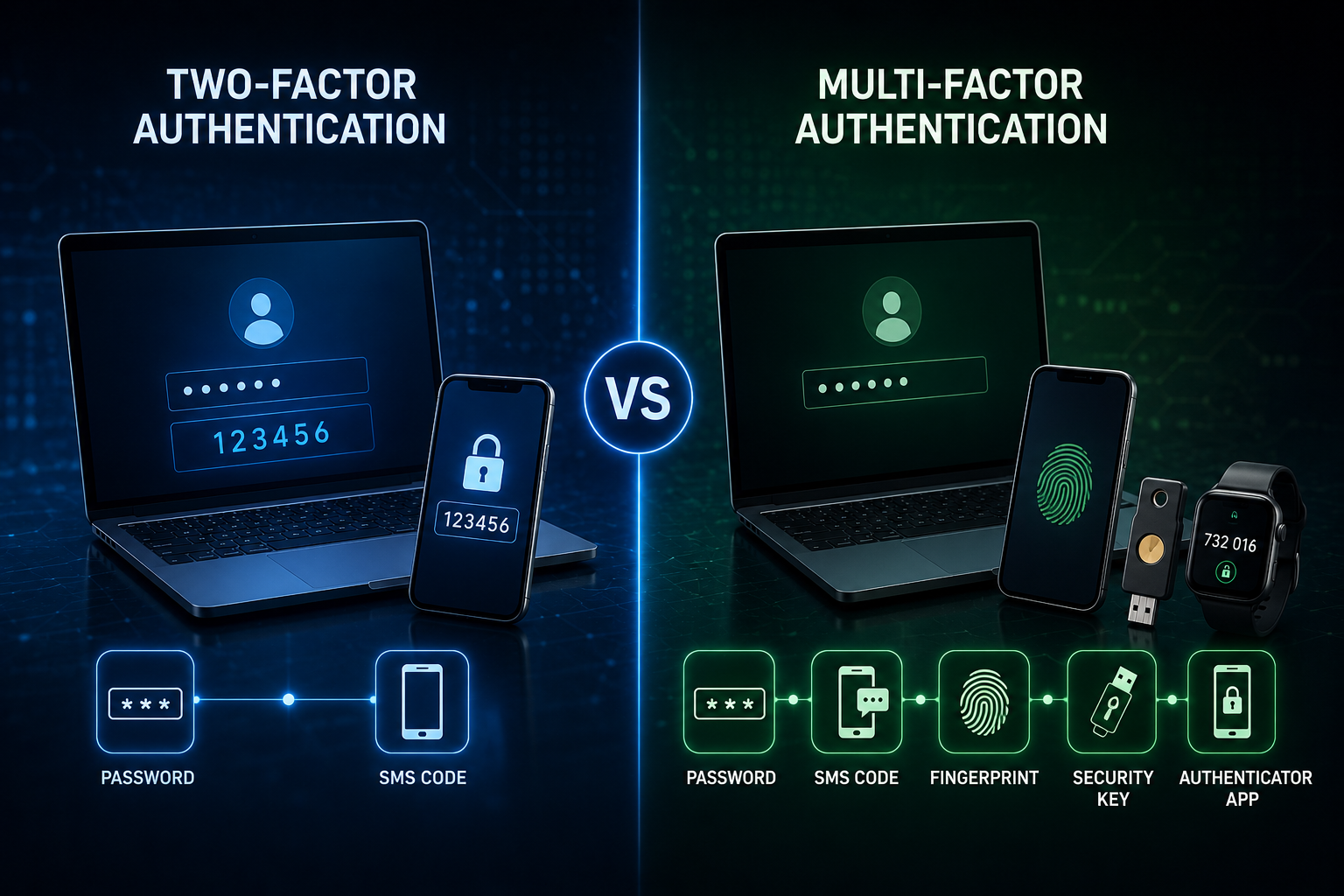
Two-Factor Authentication, commonly abbreviated as 2FA, requires exactly two separate authentication factors from different categories before granting access.
The key idea is simple.
Even if someone steals your password, they still cannot access your account unless they also possess the second factor.
A common example occurs when you sign in to your email account.
First, you enter your password.
Next, the service sends a one-time verification code to your smartphone or asks you to approve the login through an authentication app.
Only after both steps are completed are you allowed to log in.
This combination dramatically reduces the risk of unauthorized access.
How Two-Factor Authentication Works
When you enter your username and password, the service first checks whether your password is correct.
If it is, the login process does not immediately end.
Instead, the system asks for a second form of verification.
This second factor may involve entering a temporary six-digit code generated by an authentication app, approving a login notification on your smartphone, inserting a hardware security key into your computer, or using a fingerprint sensor.
Only after both authentication factors have been successfully verified does the system grant access.
Even if attackers somehow obtain your password, they usually cannot complete the second step.
Common Examples of Two-Factor Authentication
Many people use 2FA every day without realizing it.
Logging into an online bank may require both your password and a temporary code sent to your registered device.
Email services often request approval through an authentication application after entering your password.
Many social media platforms allow users to verify new logins using a smartphone notification.
Some organizations provide employees with hardware security keys that must be connected during login.
Modern smartphones also combine a PIN with fingerprint recognition or facial recognition for enhanced protection.
Although each system works differently, the underlying principle remains the same: two independent factors verify your identity.
What Is Multi-Factor Authentication?
Multi-Factor Authentication, or MFA, is a broader concept.
It refers to any authentication system that requires two or more independent authentication factors.
This means every 2FA system is technically a form of MFA.
However, not every MFA system uses only two factors.
Some organizations require three or even more layers of verification for highly sensitive systems.
For example, an employee accessing confidential government information might need to enter a password, insert a smart card, and scan a fingerprint before gaining access.
Because three different authentication factors are involved, this is considered Multi-Factor Authentication rather than simply Two-Factor Authentication.
How Multi-Factor Authentication Provides Greater Flexibility
MFA allows organizations to adjust security according to the level of risk.
A social media account may require only two authentication factors because the information is relatively less sensitive.
A hospital protecting patient records may require stronger verification.
Military systems, financial institutions, research laboratories, and critical infrastructure often employ multiple authentication layers because the consequences of unauthorized access could be severe.
Some enterprise systems even increase authentication requirements automatically when unusual behavior is detected.
If someone logs in from a new country or an unfamiliar device, the system may request additional verification before allowing access.
This approach is known as adaptive authentication or risk-based authentication.
The Difference Between Two-Factor Authentication and Multi-Factor Authentication
The distinction between 2FA and MFA is surprisingly simple.
Two-Factor Authentication always requires exactly two authentication factors.
Multi-Factor Authentication refers to any authentication process involving two or more independent factors.
Because of this definition, every 2FA system belongs to the broader MFA category.
However, MFA includes systems with three, four, or even more authentication methods.
Think of it this way.
Every square is a rectangle, but not every rectangle is a square.
Similarly, every Two-Factor Authentication system is Multi-Factor Authentication, but not every Multi-Factor Authentication system uses only two factors.
Are Two Passwords Considered Multi-Factor Authentication?
Many people assume that entering two different passwords qualifies as Multi-Factor Authentication.
It does not.
Both passwords belong to the same authentication category: something you know.
Using multiple credentials from the same factor does not provide true multi-factor protection.
A proper MFA system combines different categories.
For example, pairing a password with a fingerprint or combining a password with a hardware security key creates genuine multi-factor authentication because the factors are independent.
Authentication Apps Versus SMS Codes
Many websites offer SMS verification codes as the second authentication factor.
While SMS-based 2FA is generally much better than relying on a password alone, it has certain limitations.
Attackers have occasionally exploited weaknesses in phone networks or convinced mobile providers to transfer victims’ phone numbers to new SIM cards through fraudulent requests. This type of attack is known as SIM swapping.
Authentication apps reduce many of these risks.
Applications such as Google Authenticator, Microsoft Authenticator, Authy, and similar apps generate one-time codes directly on your device without relying on text messages.
These codes usually change every 30 seconds and are much more resistant to interception.
Hardware Security Keys
Among the strongest authentication methods available today are hardware security keys.
These small physical devices connect through USB, NFC, or Bluetooth.
Instead of typing verification codes, users simply insert the key or tap it against a compatible device.
Because the authentication process is cryptographically verified between the device and the legitimate website, hardware security keys offer excellent protection against phishing attacks.
Many cybersecurity experts consider them one of the most secure authentication methods currently available for everyday users.
Biometrics in Modern Authentication
Biometric authentication has become increasingly common.
Fingerprint readers, facial recognition, iris scanning, and voice recognition make logging in both convenient and secure.
Unlike passwords, biometric characteristics cannot easily be guessed or forgotten.
However, biometric authentication should still be implemented carefully.
Modern systems usually do not store actual fingerprint images. Instead, they store encrypted mathematical representations known as biometric templates.
Many smartphones also keep biometric information inside specialized hardware called secure enclaves, reducing the risk of theft.
How MFA Protects Against Phishing
Phishing remains one of the most successful cyberattacks worldwide.
Attackers create convincing fake websites that trick users into entering their usernames and passwords.
Without MFA, a stolen password may immediately allow unauthorized access.
With properly implemented Multi-Factor Authentication, the attacker still needs the second authentication factor.
Even if they know your password, they often cannot complete the login process.
Modern phishing-resistant authentication methods, especially hardware security keys based on open standards, provide even stronger protection because they verify that you are communicating with the legitimate website rather than an imitation.
MFA in Business and Organizations
Businesses increasingly rely on Multi-Factor Authentication to protect employees, customers, and sensitive information.
Organizations often require MFA for remote work, cloud services, email systems, virtual private networks, and administrative accounts.
Many cybersecurity incidents have shown that compromised employee credentials can lead to large-scale data breaches.
Adding multiple authentication factors significantly reduces this risk.
As cyber threats continue evolving, MFA has become one of the most effective security controls recommended by cybersecurity professionals.
Does MFA Make Accounts Impossible to Hack?
No security system is completely impossible to defeat.
Although MFA greatly improves security, no authentication method guarantees absolute protection.
Sophisticated attackers sometimes use social engineering, malware, session hijacking, or other advanced techniques to bypass certain authentication systems.
However, successful attacks become significantly more difficult when strong Multi-Factor Authentication is enabled.
In practice, MFA blocks the overwhelming majority of attacks that rely solely on stolen passwords.
The Future of Authentication
The future of digital security is gradually moving beyond traditional passwords.
Technology companies are increasingly adopting passwordless authentication systems that rely on cryptographic credentials stored securely on trusted devices.
These systems often use biometrics or hardware-based authentication while eliminating the need to remember complex passwords.
Passkeys, based on standards developed by the FIDO Alliance and the World Wide Web Consortium (W3C), are an important example of this trend. They are designed to be both easier to use and more resistant to phishing than conventional passwords.
Rather than replacing Multi-Factor Authentication, many passwordless systems incorporate multiple authentication factors behind the scenes, combining device-based security with biometric verification.
Which One Should You Choose?
For most individuals, enabling Two-Factor Authentication on every important online account is one of the simplest and most effective ways to improve digital security. Email accounts, banking services, cloud storage, password managers, and social media platforms all benefit from this additional layer of protection.
For businesses and organizations handling sensitive information, Multi-Factor Authentication offers greater flexibility and stronger security. Depending on the level of risk, additional authentication factors can be required to protect valuable systems and confidential data.
The most effective approach is not simply to add more authentication steps, but to combine independent factors that work together. A password can be forgotten or stolen, a phone can be lost, and even biometric systems have limitations. By requiring multiple forms of verification, modern authentication makes it far more difficult for unauthorized users to gain access.
In a world where cyber threats continue to evolve, strong authentication has become one of the most important defenses available. Whether you use Two-Factor Authentication or a more advanced Multi-Factor Authentication system, adding extra layers of identity verification is no longer just a technical feature—it is an essential part of protecting your digital life.