The internet has become an essential part of everyday life. We shop online, communicate with friends, manage our finances, stream entertainment, and store personal information in the cloud. While these conveniences make life easier, they also raise an important question: How private are our online activities?
Every time you visit a website, send a message, or search for information, pieces of data travel across the internet. Internet service providers (ISPs), websites, advertisers, and sometimes even governments may be able to collect information about your online activity, depending on the circumstances and the technologies involved.
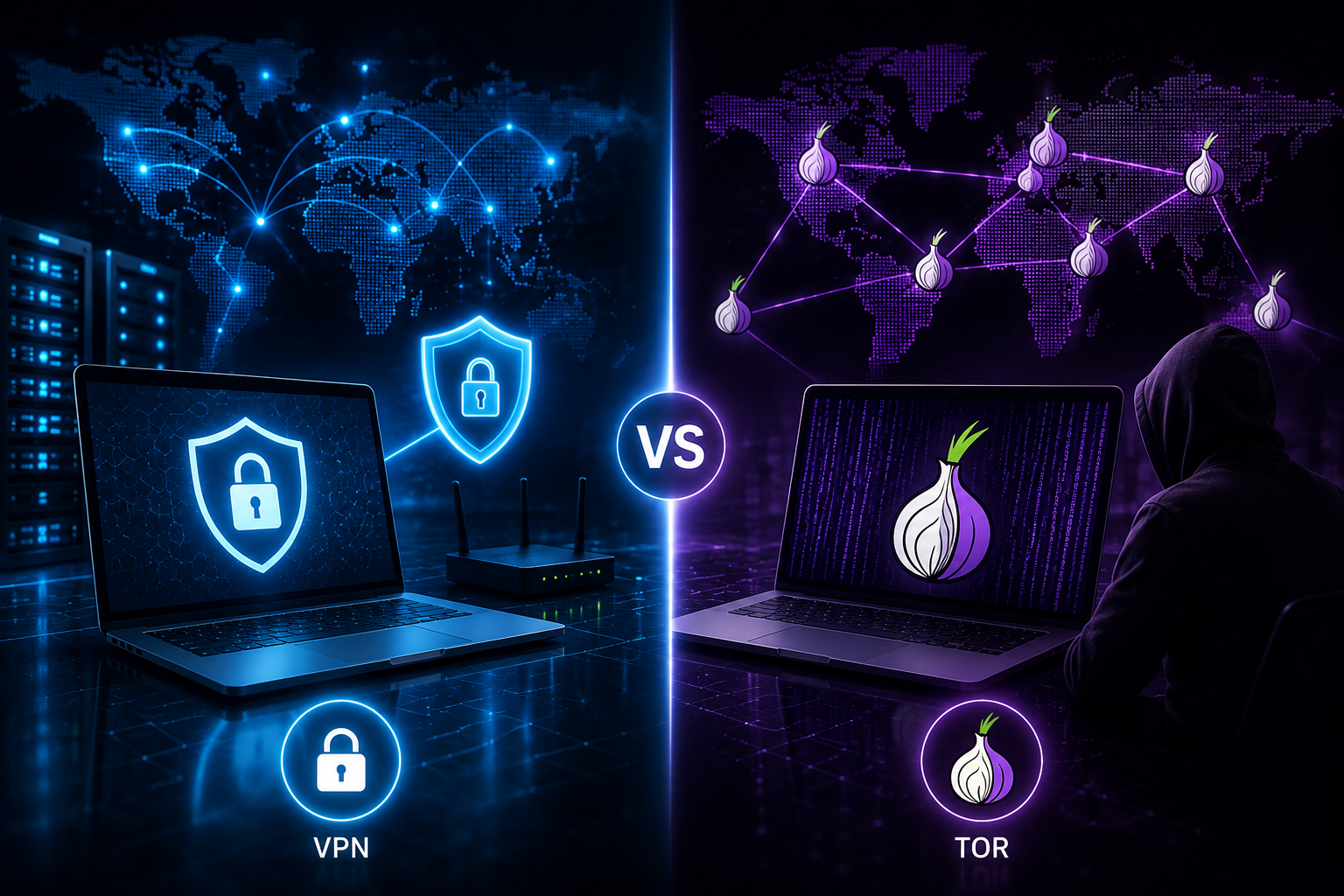
This growing concern about digital privacy has led many people to use tools such as Virtual Private Networks (VPNs) and Tor. Both are designed to improve privacy online, but they work in very different ways and serve different purposes.
Many people assume VPN and Tor are competitors, but the reality is more nuanced. Neither is universally better. Each has unique strengths, limitations, and ideal use cases. Understanding these differences is essential for making informed decisions about your online privacy.
What Is a VPN?
A Virtual Private Network (VPN) is a service that creates an encrypted connection between your device and a remote VPN server.
Normally, when you connect to the internet, your traffic travels directly from your device through your internet service provider to the websites you visit. This means your ISP can generally see which websites you connect to, even if the content itself is encrypted with HTTPS.
When you use a VPN, your internet traffic is first encrypted and sent to the VPN server. The VPN server then forwards your request to the destination website.
As a result, the website sees the VPN server’s IP address instead of your own public IP address.
This process offers several privacy and security benefits.
How a VPN Protects Your Privacy
The most important feature of a VPN is encryption.
Encryption converts your internet traffic into unreadable data while it travels between your device and the VPN server. Anyone attempting to intercept this traffic—including people on unsecured public Wi-Fi networks—would have difficulty reading it without the proper encryption keys.
A VPN also masks your public IP address.
Your IP address can often reveal your approximate geographic location and is commonly used by websites for analytics, fraud prevention, and content personalization. Replacing it with the VPN server’s IP address makes it more difficult for websites to directly identify your original network connection.
However, using a VPN does not make you completely anonymous. The VPN provider itself can potentially observe certain connection metadata, depending on its technical design and logging policies. This is why choosing a trustworthy provider is extremely important.
What Is Tor?
Tor, short for The Onion Router, is a free, open-source network designed to enhance online anonymity.
Unlike a VPN, Tor does not send your traffic through a single server.
Instead, it routes your internet connection through several volunteer-operated servers, called relays or nodes, located around the world.
Each relay only knows a limited part of the communication path.
This layered routing inspired the name “Onion Router,” because the data is protected by multiple layers of encryption, similar to the layers of an onion.
By the time your internet traffic reaches its destination, it has passed through multiple relays, making it much more difficult to trace the connection back to its original source.
How Tor Works
When you open the Tor Browser and visit a website, your data travels through three main relays.
The first relay, called the entry guard, knows your IP address but does not know your final destination.
The second relay acts as an intermediary and only knows the neighboring relays.
The final relay, known as the exit node, sends your request to the destination website. The website sees the IP address of the exit node rather than your own.
Because no single relay knows both who you are and where you are going, Tor provides a high degree of anonymity compared with ordinary internet connections.
The Main Goal of a VPN
VPN services are primarily designed to provide secure internet connections and improve privacy during everyday internet use.
Many people use VPNs while traveling, working remotely, or connecting to public Wi-Fi in places like airports, hotels, or coffee shops.
VPNs are also commonly used to protect data from local network monitoring and to reduce exposure of a user’s public IP address to websites.
Most VPN services aim to balance privacy, security, and performance.
The Main Goal of Tor
Tor has a different objective.
Its primary purpose is anonymity rather than speed or convenience.
The Tor network was specifically designed to make it much harder for observers to connect online activities with a user’s identity or location.
Because of this design, Tor is widely used by journalists, researchers, activists, whistleblowers, and privacy-conscious individuals who require stronger anonymity protections.
It also provides access to websites with the “.onion” domain, which are available only through the Tor network.
VPN vs Tor: Privacy
When discussing privacy, the answer depends on what kind of privacy you need.
A VPN hides your traffic from your local network and your ISP during the encrypted connection to the VPN server. However, because the VPN provider routes your traffic, you must trust that provider to handle your data responsibly.
Tor reduces reliance on a single trusted intermediary by distributing traffic across multiple independently operated relays. This architecture generally offers stronger anonymity against many forms of network observation, though it is not a guarantee of complete anonymity in every situation.
If your highest priority is anonymity, Tor is generally the stronger choice.
If your priority is protecting your connection during normal browsing while maintaining good performance, a VPN is often the more practical solution.
VPN vs Tor: Speed
Speed is one of the biggest differences between these technologies.
A VPN usually introduces only a modest reduction in internet speed because your traffic passes through a single encrypted tunnel.
Modern VPN services often support high-speed protocols that allow streaming, video calls, online gaming, and large downloads with relatively little performance loss, depending on network conditions.
Tor, by contrast, routes traffic through multiple relays operated by volunteers around the world.
Every additional relay adds latency.
As a result, Tor browsing is usually much slower than using a VPN.
Streaming high-definition video, downloading large files, or participating in real-time online gaming is generally not an ideal experience over Tor.
VPN vs Tor: Security
Both technologies improve security, but in different ways.
VPNs excel at protecting internet traffic on untrusted networks.
For example, if you connect to free public Wi-Fi at a café or airport, a VPN encrypts your traffic between your device and the VPN server, reducing the risk of local interception.
Tor also encrypts traffic within its network. However, traffic leaving the exit node toward a destination website is not additionally protected by Tor itself. If the destination site does not use HTTPS encryption, information transmitted beyond the exit node could potentially be exposed.
Fortunately, today most reputable websites use HTTPS, providing an additional layer of protection.
VPN vs Tor: Anonymity
Anonymity is where Tor has a significant advantage.
A VPN hides your IP address from websites, but your VPN provider generally knows your original IP address because it establishes the encrypted connection with your device.
Tor is specifically designed so that no single relay has complete knowledge of both your identity and your destination, making it much more difficult to associate your online activity with your original IP address.
That said, anonymity also depends on user behavior. Logging into personal accounts, revealing identifying information, downloading unsafe files, or installing insecure browser extensions can reduce anonymity regardless of whether you use Tor or a VPN.
VPN vs Tor: Ease of Use
VPNs are extremely easy to use.
Most commercial VPN applications require only a few clicks.
You install the software, sign in, choose a server, and connect.
Tor is also straightforward to install through the Tor Browser, but browsing habits often need to change. Some websites may block Tor exit nodes, request additional verification, or function less reliably over the Tor network.
Users must also avoid actions that could undermine anonymity.
VPN vs Tor: Streaming
Many people use VPNs to stream videos while traveling or to protect their privacy during streaming sessions.
Because VPNs are generally much faster than Tor, they are better suited for watching high-quality video.
Tor is not designed for media streaming.
The slower connection speeds and higher latency usually make streaming inconvenient.
VPN vs Tor: Gaming
Online gaming requires low latency and fast response times.
VPNs may introduce a small amount of additional latency, but many users still enjoy acceptable gaming performance, depending on server choice and network quality.
Tor’s multi-hop routing creates much higher latency.
This makes Tor unsuitable for most online games.
VPN vs Tor: Downloading Files
VPNs are commonly used while downloading large files because they typically offer much higher speeds.
Tor can technically download files, but doing so may be slow. Additionally, downloading certain document types and opening them outside the Tor Browser without appropriate precautions can affect anonymity.
VPN vs Tor: Cost
Tor is completely free.
The software is open source, and the network is maintained by volunteers and supporting organizations.
VPNs are available in both free and paid versions.
Free VPN services often come with limitations such as slower speeds, fewer server locations, bandwidth caps, or reduced features.
Many privacy experts recommend carefully evaluating any VPN provider’s transparency, independent security audits, and privacy policies before choosing a service.
Can You Use VPN and Tor Together?
Yes.
Some users combine both technologies.
One approach is connecting to a VPN first and then using the Tor Browser. In this setup, your ISP sees that you are connected to a VPN but does not directly observe a connection to the Tor network.
Another, less common configuration routes traffic through Tor before reaching a VPN, though this typically requires specialized setups and is not how most users operate.
Combining VPN and Tor may provide additional privacy in certain situations, but it can also increase complexity and reduce speed.
Common Misconceptions
One of the biggest misconceptions is that a VPN makes you completely anonymous.
It does not.
A VPN improves privacy and secures your connection, but complete anonymity depends on many factors, including the VPN provider, browser fingerprinting, account logins, cookies, and user behavior.
Another misconception is that Tor is only used for illegal activities.
This is inaccurate.
Tor is a legitimate privacy tool used by journalists, researchers, human rights organizations, security professionals, and ordinary people who wish to protect their online anonymity.
Like many technologies, its ethical use depends on how individuals choose to use it.
Which One Is Better for Everyday Privacy?
For most people, a reputable VPN provides an excellent balance between privacy, security, speed, and convenience.
It protects internet traffic on public Wi-Fi, masks your public IP address from websites, and generally offers a smooth browsing experience without requiring major changes in how you use the internet.
For everyday activities such as online banking, shopping, remote work, video conferencing, and general browsing, a VPN is often the more practical choice.
Which One Is Better for Maximum Anonymity?
If your primary concern is minimizing the connection between your identity and your online activity, Tor is generally the stronger option.
Its multi-hop routing architecture is specifically designed to enhance anonymity rather than speed.
However, achieving meaningful anonymity also requires careful browsing habits and an understanding of Tor’s limitations.
The Future of Online Privacy
Digital privacy is becoming increasingly important as online services continue to grow.
Governments, technology companies, cybersecurity researchers, and privacy advocates continue developing new technologies that improve internet security while balancing usability and legal requirements.
VPN protocols continue to evolve with faster encryption and improved efficiency.
The Tor Project continues strengthening its network and browser to improve both privacy and usability.
At the same time, websites increasingly adopt HTTPS encryption, secure authentication methods, and stronger cybersecurity practices, helping make the internet safer for everyone.
Final Thoughts
VPN and Tor are both valuable privacy tools, but they are designed for different purposes. A VPN focuses on securing your internet connection, protecting your data on untrusted networks, and providing fast, convenient privacy for everyday use. Tor, on the other hand, prioritizes anonymity by routing your traffic through multiple encrypted relays, making it much more difficult to trace your online activity.
Neither technology is universally “better.” The right choice depends on your goals. If you want fast, secure browsing for daily activities, a trustworthy VPN is usually the better fit. If your highest priority is preserving anonymity and reducing the link between your identity and your online actions, Tor offers stronger protection, though with slower speeds and greater complexity.
Understanding the strengths and limitations of both tools allows you to make informed decisions about your digital privacy. In an increasingly connected world, protecting your personal information is no longer just a technical concern—it is an important part of staying safe and maintaining control over your online life.