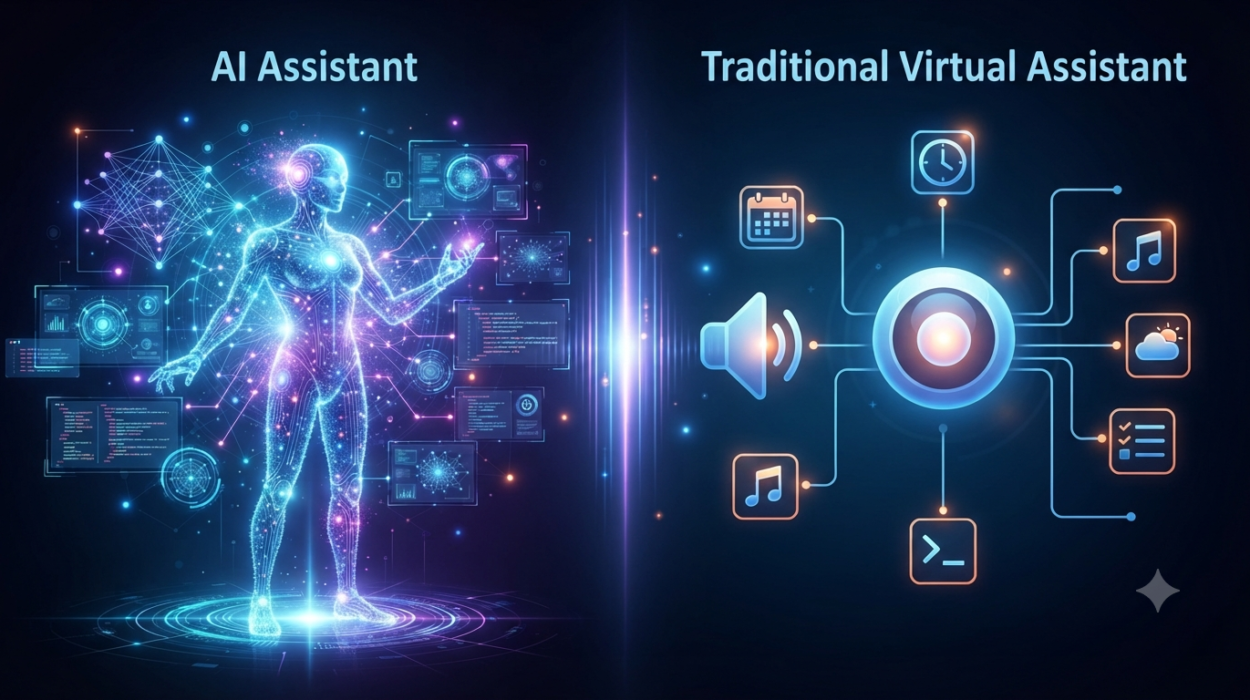
Artificial intelligence often seems almost magical. It can recognize faces in photos, recommend movies you might enjoy, translate languages in seconds, answer questions, generate artwork, and even help scientists discover new medicines. Watching these abilities in action, it is easy to wonder whether AI actually “thinks” like a human.
The truth is both fascinating and surprisingly different.
Artificial intelligence does not learn the way people do. It does not understand the world through personal experiences, emotions, or intuition. Instead, AI learns by finding patterns in data. Every prediction it makes, every image it generates, and every sentence it writes is built upon mathematical relationships discovered during a learning process.
Data is the fuel that powers modern AI. Without data, even the most advanced AI system would know nothing. With enough carefully prepared data and powerful learning algorithms, however, AI can perform tasks that once seemed impossible.
Understanding how AI learns from data is one of the best ways to understand what artificial intelligence truly is—and what it is not.
What Does It Mean for AI to Learn?
When people learn, they combine observation, memory, reasoning, and experience. A child learns that fire is hot after feeling its warmth or being warned by adults. Over time, the child develops an understanding of heat and danger.
AI learning is different.
For an AI system, learning means adjusting its internal mathematical parameters so it can make better predictions or decisions. Instead of gaining understanding in the human sense, AI gradually becomes better at recognizing patterns that exist in data.
Imagine showing a computer thousands of pictures of cats and dogs. At first, it cannot tell them apart. Every image looks like a collection of colored pixels.
But after analyzing many examples, the AI begins noticing patterns. Cats often have certain ear shapes, facial structures, body proportions, or fur textures that differ from dogs. These patterns are not programmed by a human one rule at a time. Instead, the AI discovers statistical relationships during training.
This process is what scientists call machine learning.
Why Data Is So Important
Data is the foundation of artificial intelligence.
Data includes every piece of information an AI system can analyze. It may consist of photographs, videos, written text, spoken language, medical records, weather measurements, financial transactions, satellite images, or countless other forms of information.
The quality of an AI system depends heavily on the quality of its data.
Imagine trying to learn a new language from a book filled with spelling mistakes and missing pages. Learning would be difficult and confusing.
AI faces the same challenge.
If its training data contains errors, missing information, or biases, the AI may learn incorrect patterns. On the other hand, diverse, accurate, and well-organized data helps AI make better predictions.
This is why scientists spend enormous amounts of time collecting, cleaning, and organizing data before training AI models.
Turning Information into Numbers
Although humans see photographs, hear music, and read words, computers understand numbers.
Before AI can learn from data, information must be converted into numerical form.
A digital image is represented as millions of tiny pixels, each assigned numerical values describing brightness and color.
Written language is transformed into numerical representations that capture relationships between words.
Audio recordings become sequences of sound measurements.
Even videos become collections of individual images shown in rapid succession.
Once everything becomes numbers, mathematical algorithms can begin searching for meaningful patterns.
This numerical representation allows AI to work with many different types of information using similar learning methods.
Finding Patterns Instead of Memorizing
One common misconception is that AI simply memorizes everything it sees.
In reality, effective AI learning involves discovering patterns rather than remembering individual examples.
Suppose an AI studies thousands of handwritten numbers.
If it merely memorized every image, it would struggle whenever it encountered a new person’s handwriting.
Instead, the AI learns common features shared by each number despite differences in writing style.
This ability to generalize allows AI to recognize new examples it has never seen before.
Generalization is one of the most important goals in machine learning.
An AI that only memorizes its training data performs poorly in the real world.
Training an AI Model
Learning begins with a process called training.
During training, an AI model examines enormous amounts of data repeatedly.
Initially, its predictions are mostly wrong.
Each mistake provides valuable information.
The AI compares its prediction with the correct answer, calculates how large the error is, and then slightly adjusts its internal mathematical parameters.
This cycle repeats millions or even billions of times.
Gradually, the model becomes more accurate.
Rather than making random guesses, it begins identifying reliable patterns hidden within the data.
Training is often computationally demanding and may require powerful computers working continuously for days, weeks, or even months.
Learning Through Examples
Many AI systems learn by studying labeled examples.
Imagine thousands of photographs.
Each image includes a label describing its contents.
One image says “cat.”
Another says “dog.”
Another says “bird.”
The AI studies both the images and their correct labels.
Whenever it predicts incorrectly, it adjusts itself to improve future predictions.
Over time, the AI becomes increasingly successful at identifying animals it has never seen before.
This learning approach is called supervised learning because correct answers guide the training process.
Many modern applications—including medical image analysis, email spam detection, and speech recognition—use supervised learning.
Learning Without Labels
Not all data comes with correct answers.
Scientists have developed methods that allow AI to learn even when labels are unavailable.
Instead of being told what everything is, AI searches for natural patterns and similarities within the data.
It may discover groups of similar objects, detect unusual events, or identify hidden relationships.
This approach is known as unsupervised learning.
For example, an AI analyzing customer purchasing behavior might discover groups of people with similar shopping habits without anyone telling it which groups exist.
Unsupervised learning helps researchers uncover structures that humans may not have noticed.
Learning Through Trial and Error
Some AI systems improve by interacting directly with their environment.
Imagine teaching a robot to walk.
Instead of giving detailed instructions for every movement, researchers allow the robot to experiment.
At first, it falls repeatedly.
Whenever it takes a successful step, it receives a positive reward.
When it loses balance, it receives little or no reward.
Over countless attempts, the robot gradually discovers movements that maximize success.
This learning process resembles trial and error.
Scientists call it reinforcement learning.
Reinforcement learning has helped AI master complex games, control robots, and optimize decision-making in many situations.
Neural Networks Inspired by the Brain
Many of today’s most powerful AI systems use artificial neural networks.
Although inspired by the human brain, these networks are much simpler than real biological neurons.
Artificial neural networks consist of many interconnected mathematical units.
Each unit receives numerical inputs, performs calculations, and passes information to other units.
As learning progresses, the strength of these connections changes.
Some become more important.
Others become less influential.
With enough layers and training, neural networks can learn highly complex patterns.
They recognize faces, understand speech, translate languages, generate realistic images, and perform many other remarkable tasks.
Deep Learning Opens New Possibilities
When neural networks contain many processing layers, the approach is called deep learning.
Each layer gradually extracts increasingly complex information.
For example, when analyzing an image, the first layer might detect simple edges.
The next layer recognizes shapes.
Later layers identify eyes, noses, ears, or wheels.
Eventually, deeper layers recognize complete objects such as cars, people, or animals.
This layered learning allows deep learning systems to solve problems that once seemed far beyond the reach of computers.
Deep learning has transformed computer vision, natural language processing, speech recognition, and scientific research.
Why More Data Often Helps
In many situations, larger and more diverse datasets improve AI performance.
Imagine learning about birds after seeing only three species.
Your understanding would be limited.
Now imagine observing thousands of species from every continent.
You would recognize many more patterns.
AI benefits in much the same way.
More examples expose the model to greater variation.
It learns to handle different lighting conditions, accents, writing styles, weather patterns, or medical conditions.
However, more data alone is not enough.
The data must also be accurate, representative, and relevant.
Poor-quality data can reduce performance regardless of quantity.
The Role of Computing Power
Learning from enormous datasets requires tremendous computing resources.
Modern AI training often relies on specialized processors capable of performing billions or even trillions of mathematical calculations every second.
These processors repeatedly adjust millions or billions of parameters while searching for patterns.
Training some of the largest AI models consumes significant amounts of electricity and computational time.
Researchers continue developing more efficient algorithms and hardware to reduce these requirements while improving performance.
Testing What AI Has Learned
Training alone does not guarantee success.
Scientists must determine whether an AI has truly learned useful patterns.
To do this, they evaluate the AI using new data it has never encountered before.
If the model performs well on unfamiliar examples, it demonstrates good generalization.
If it performs well only on training data but poorly on new examples, it has likely memorized too much instead of learning meaningful patterns.
This problem is called overfitting.
Avoiding overfitting is one of the central challenges in machine learning research.
Mistakes Help AI Improve
Human learners often become discouraged by mistakes.
For AI, mistakes are essential.
Every incorrect prediction provides information about how the model should change.
Training algorithms calculate how far each prediction differs from the correct answer.
Using advanced mathematical optimization techniques, the model gradually reduces these errors.
Over many training cycles, predictions become increasingly accurate.
In this sense, mistakes are not failures.
They are opportunities for improvement.
Can AI Learn Forever?
Unlike humans, AI does not automatically continue learning after deployment.
Many AI systems stop learning once training is complete.
Researchers may later retrain them using newer data to improve performance.
Some specialized systems continue adapting while operating.
These systems are designed carefully to avoid learning incorrect information.
Continuous learning remains an active area of research because scientists want AI systems that adapt safely as the world changes.
Why Bias Can Enter AI
AI learns from data created by humans and collected from the real world.
If the data reflects historical inequalities, missing information, or unbalanced representation, AI may also learn biased patterns.
For example, if certain groups appear less frequently in training data, predictions for those groups may become less accurate.
This challenge does not arise because AI has personal opinions.
Instead, it reflects patterns present within the training data.
Researchers work continuously to identify, measure, and reduce bias by improving datasets, evaluation methods, and training techniques.
Building fair and reliable AI is one of the field’s most important goals.
AI Does Not Truly Understand Like Humans
Modern AI can generate convincing conversations, write stories, recognize objects, and answer questions.
These abilities sometimes create the impression that AI understands the world exactly as people do.
Current scientific understanding suggests otherwise.
AI identifies statistical relationships between pieces of information.
It does not possess human consciousness, emotions, self-awareness, or personal experiences.
When an AI generates text, it predicts sequences of words based on patterns learned during training.
Its impressive abilities emerge from mathematical learning rather than human-like understanding.
Recognizing this difference helps us appreciate both the remarkable strengths and important limitations of artificial intelligence.
How AI Continues Improving
Artificial intelligence has advanced rapidly because researchers continually improve every stage of learning.
New algorithms become more efficient.
Larger and more diverse datasets become available.
Computing hardware grows increasingly powerful.
Scientists develop better methods for reducing errors, improving safety, increasing transparency, and making AI more reliable.
These advances allow AI systems to solve increasingly complex scientific, medical, industrial, and educational problems.
Yet every improvement still depends on the same basic principle.
AI learns by discovering patterns hidden within data.
The Future of Learning Machines
As artificial intelligence continues evolving, its ability to learn from data will become even more sophisticated.
Future AI systems may help doctors diagnose diseases earlier, predict extreme weather more accurately, accelerate scientific discoveries, improve education, design sustainable technologies, and assist people in countless everyday tasks.
Researchers are also exploring ways to make AI require less data, learn more efficiently, explain its decisions more clearly, and cooperate more naturally with humans.
These goals could make AI both more capable and more trustworthy.
Understanding the Heart of Artificial Intelligence
At its core, artificial intelligence is not built on magic, intuition, or mysterious thinking. It is built on mathematics, computation, and data.
Every recommendation on a streaming service, every voice assistant response, every language translation, and every image recognized by AI begins with a learning process powered by patterns hidden within enormous amounts of information.
Data teaches AI what to look for. Algorithms help it discover relationships. Computing power allows it to perform billions of calculations. Careful testing ensures that what it learns can be applied to new situations.
Although AI continues to grow more capable every year, its learning remains fundamentally different from human learning. People understand the world through experience, reasoning, emotions, and consciousness. AI learns by identifying statistical patterns and using them to make predictions.
This distinction is important because it reminds us that artificial intelligence is a powerful scientific tool, not a replacement for human curiosity, creativity, or wisdom.
As researchers continue improving AI, one principle will remain unchanged: the quality of what AI learns will always depend on the quality of the data from which it learns. In that simple idea lies one of the greatest truths about modern artificial intelligence—and one of the reasons data has become one of the most valuable resources in the digital age.