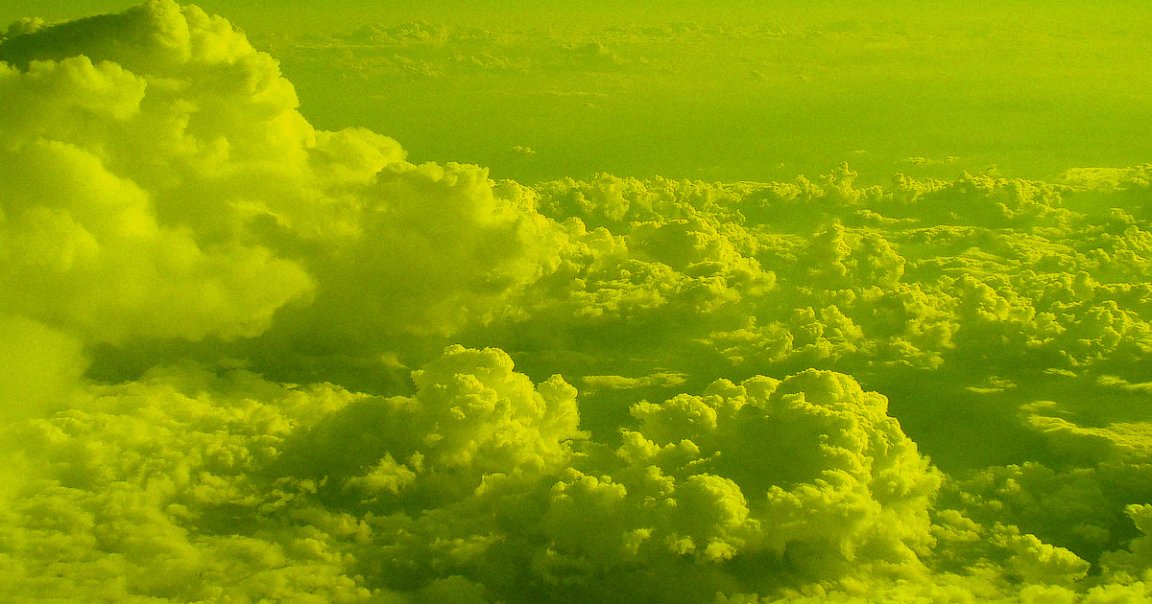
If you could somehow stand on the surface of Venus and look up, the sky would not greet you with the familiar blue color we see on Earth. Instead, it would appear as a dim, hazy yellowish-orange canopy stretching across the horizon. It would be unlike any sky humans have ever experienced.
The color of a planet’s sky tells an important scientific story. It reveals what the atmosphere is made of, how sunlight travels through it, and what physical and chemical processes are taking place above the surface. On Venus, the yellow sky is the result of one of the thickest and most extreme atmospheres in the Solar System.
Understanding why Venus’s sky looks yellow takes us into the fascinating worlds of atmospheric physics, chemistry, and planetary science. It also helps scientists compare Venus with Earth and understand how two neighboring planets evolved so differently.
Venus: Earth’s Mysterious Neighbor
Venus is often called Earth’s “sister planet” because it is remarkably similar to Earth in size, mass, and overall composition. Both planets are rocky worlds that formed from the same cloud of gas and dust about 4.5 billion years ago.
Yet despite these similarities, Venus has become one of the most hostile places in the Solar System.
The planet is covered by an incredibly dense atmosphere that traps enormous amounts of heat. Surface temperatures reach around 465°C (869°F)—hot enough to melt lead. Atmospheric pressure is about 92 times greater than the pressure at Earth’s sea level, similar to the pressure found nearly one kilometer beneath Earth’s oceans.
Instead of blue skies, oceans, and rain made of water, Venus is wrapped in thick clouds composed mainly of sulfuric acid droplets.
These extraordinary conditions are responsible for the planet’s unusual sky.
What Determines the Color of a Sky?
Before understanding Venus, it helps to understand why skies have colors in the first place.
Sunlight may appear white, but it actually contains all the colors of the visible spectrum, from violet to red. When sunlight enters a planet’s atmosphere, it interacts with gas molecules, tiny particles, and cloud droplets.
Some colors are scattered more strongly than others.
The balance between scattering, absorption, reflection, and the composition of the atmosphere determines the color that reaches an observer’s eyes.
Different planets have different atmospheres, so their skies can look dramatically different.
Earth has a blue sky.
Mars often has a butterscotch or reddish sky.
Titan, Saturn’s largest moon, has a deep orange sky.
Venus has a yellowish sky.
Each color reflects the unique chemistry and physics of that world.
Venus Has an Extremely Thick Atmosphere
One of the biggest reasons Venus has a yellow sky is the enormous thickness of its atmosphere.
Unlike Earth’s atmosphere, which is mostly nitrogen and oxygen, Venus’s atmosphere is composed of about 96.5% carbon dioxide, with most of the remaining gas being nitrogen. Tiny amounts of sulfur dioxide, water vapor, carbon monoxide, argon, and other gases are also present.
This atmosphere extends upward beneath an almost continuous layer of clouds.
Because the atmosphere is so dense, sunlight cannot travel through it in the same way it does on Earth.
Instead, light is repeatedly scattered, absorbed, and redirected before reaching the surface.
By the time sunlight arrives at ground level, much of its original color balance has changed.
The Thick Cloud Layer Changes Sunlight
Perhaps the most important feature of Venus’s atmosphere is its global cloud deck.
These clouds are not made of water like Earth’s clouds.
Instead, they consist mainly of tiny droplets of concentrated sulfuric acid suspended high above the surface.
The cloud layers stretch from roughly 45 to 70 kilometers (28 to 43 miles) above the ground.
These clouds are incredibly reflective.
In fact, Venus reflects about 75% of the sunlight that reaches it, making it the brightest planet visible from Earth after the Moon.
The clouds act like a gigantic filter.
As sunlight passes through them, some wavelengths are scattered more efficiently, while others are absorbed by atmospheric gases and cloud particles.
This filtering process contributes significantly to the yellowish appearance of the sky.
Sulfur Compounds Play an Important Role
Sulfur-containing chemicals are central to the appearance of Venus.
The atmosphere contains sulfur dioxide gas, and complex chemical reactions driven by sunlight produce sulfuric acid clouds.
These sulfur compounds interact with incoming sunlight in ways that differ from Earth’s atmosphere.
Scientists continue to investigate certain ultraviolet-absorbing substances in Venus’s clouds whose exact identities are still uncertain. These mysterious materials strongly absorb ultraviolet light from the Sun and influence how sunlight is distributed through the atmosphere.
Although these absorbers are invisible to human eyes, they affect the overall balance of visible light that reaches the surface, helping create the planet’s muted yellow-orange appearance.
Multiple Scattering Creates a Soft Yellow Glow
On Earth, sunlight often travels relatively directly from the Sun to the ground.
On Venus, that rarely happens.
Instead, sunlight bounces countless times between cloud particles and atmospheric molecules before reaching the surface.
This process is known as multiple scattering.
Imagine shining a flashlight through a thick fog.
The beam becomes weaker, softer, and more diffuse.
The light no longer comes from one clear direction.
Venus experiences this effect on a planetary scale.
By the time sunlight reaches the ground, it has become a gentle, scattered glow rather than bright, direct sunshine.
This diffuse illumination contributes to the planet’s distinctive yellowish sky.
The Sun Would Look Different on Venus
If you stood on Venus, you probably would not see the Sun as a bright, sharply defined disk.
The dense clouds hide the Sun almost completely.
Instead, the Sun would likely appear as a faint, blurry patch of light behind thick layers of haze.
The landscape would be illuminated much like an overcast day on Earth, but with a yellow-orange tint.
Shadows would be weak and blurry because light arrives from many directions after being scattered throughout the atmosphere.
This creates a strange, almost perpetual twilight despite Venus receiving nearly twice as much solar energy as Earth does before reflection by its clouds.
Why Isn’t Venus’s Sky Blue?
Earth’s blue sky is largely produced by Rayleigh scattering.
Air molecules scatter shorter wavelengths of visible light—especially blue—more effectively than longer wavelengths like red.
Because our atmosphere is relatively thin and transparent, scattered blue light fills the sky.
Venus is very different.
Its atmosphere is much denser and filled with thick clouds composed of microscopic liquid droplets.
In these conditions, scattering by cloud particles dominates over the Rayleigh scattering that creates Earth’s blue sky.
The sulfuric acid clouds, dense carbon dioxide atmosphere, and repeated scattering alter the color balance of sunlight before it reaches the surface.
As a result, blue light does not dominate the Venusian sky the way it does on Earth.
Why Doesn’t Venus Have a Red Sky Like Mars?
Mars has a reddish or butterscotch-colored sky because its atmosphere contains vast amounts of extremely fine dust rich in iron oxides—the same compounds that give rust its reddish color.
These dust particles scatter sunlight differently than Venus’s cloud droplets.
Venus contains almost no airborne dust compared with Mars.
Instead, its atmosphere is dominated by gases and sulfuric acid aerosols.
The result is a softer yellow or yellow-orange sky rather than the dusty reddish appearance seen on Mars.
The Surface Is Surprisingly Dim
Even though Venus is closer to the Sun than Earth, its surface is surprisingly dark.
Only a small fraction of incoming sunlight reaches the ground because the thick cloud layers reflect most sunlight back into space.
The brightness at the surface has been compared to a heavily overcast day on Earth.
It is bright enough to see the landscape clearly, but nowhere near the brilliance of a sunny afternoon on Earth.
This dim lighting reinforces the muted yellow appearance of the sky.
Images from Venus
Several spacecraft have successfully landed on Venus despite its harsh conditions.
The Soviet Venera missions during the 1970s and early 1980s transmitted the first photographs from the planet’s surface.
The original images were mostly recorded in grayscale because of engineering limitations.
Scientists later processed and colorized the data using measurements of Venus’s atmospheric properties.
The resulting images show rocky landscapes illuminated beneath a yellowish-orange sky.
Although no human has ever stood on Venus, these spacecraft have given scientists valuable clues about what the surface environment likely looks like.
Why the Sky Looks Different at Different Heights
Venus’s atmosphere changes dramatically with altitude.
High above the cloud tops, sunlight is much brighter, and space probes have captured images showing a brilliant white cloud deck beneath a dark sky.
Within the cloud layers, visibility decreases because of dense sulfuric acid droplets.
Near the surface, the thick atmosphere filters sunlight so extensively that the sky takes on its familiar yellow-orange appearance.
In other words, the sky’s color depends on where you are within Venus’s enormous atmosphere.
The Greenhouse Effect and the Yellow Sky
Although the greenhouse effect is not directly responsible for the sky’s color, it plays an important supporting role.
Venus experiences a runaway greenhouse effect because its carbon dioxide-rich atmosphere traps infrared heat extremely efficiently.
The resulting high temperatures influence atmospheric chemistry, cloud formation, and circulation patterns.
These processes help maintain the sulfuric acid cloud layers that ultimately contribute to the yellow appearance of the sky.
Without the dense atmosphere and its powerful greenhouse effect, Venus would be a very different planet.
What Scientists Learn from Venus’s Atmosphere
Studying Venus is about much more than understanding one planet.
It provides important clues about planetary evolution.
Scientists believe Venus and Earth may once have shared more similarities than they do today.
Over billions of years, their paths diverged dramatically.
By studying Venus’s atmosphere, researchers gain insights into climate systems, greenhouse effects, cloud chemistry, atmospheric circulation, and the evolution of rocky planets.
These discoveries also help astronomers interpret observations of planets orbiting distant stars.
Many exoplanets may possess thick atmospheres similar to Venus, making our neighboring planet an important natural laboratory.
Could Humans Ever See Venus’s Yellow Sky?
At present, no human mission has visited Venus.
The extreme heat, crushing atmospheric pressure, and corrosive sulfuric acid clouds make landing extraordinarily difficult.
Any future astronauts would require highly specialized spacecraft and protective systems capable of surviving one of the harshest environments in the Solar System.
Until then, scientists rely on robotic spacecraft, atmospheric probes, radar mapping, laboratory experiments, and computer models to understand what standing beneath Venus’s sky would truly be like.
A Window into an Extreme World
The yellow sky of Venus is far more than a visual curiosity. It is the visible signature of an atmosphere unlike any other among the rocky planets in our Solar System. A dense blanket of carbon dioxide, vast clouds of sulfuric acid, complex atmospheric chemistry, and the repeated scattering of sunlight work together to transform ordinary white sunlight into the planet’s distinctive yellowish glow.
Looking at Venus reminds us that a planet’s sky is more than just a backdrop. It is a record of its atmosphere, climate, chemistry, and history. While Earth’s blue sky reflects a world rich in oxygen, liquid water, and life, Venus’s yellow sky tells the story of a planet overwhelmed by thick clouds, extreme heat, and a powerful greenhouse effect.
By studying why Venus’s sky is yellow, scientists deepen their understanding not only of our neighboring planet but also of the diverse worlds scattered throughout the universe. Every new observation brings us closer to answering one of astronomy’s greatest questions: how planets evolve, and why worlds that begin with similar ingredients can end up looking so remarkably different.