Have you ever looked up at the sky on a clear day and wondered what it might look like somewhere else in the Solar System? The blue dome above Earth feels so familiar that it is easy to forget it is only one version of a planetary sky. Every planet has its own atmosphere, weather, sunlight, and environment, creating skies that are dramatically different from our own. Some worlds glow with orange haze, others are wrapped in thick clouds, and a few have almost no sky at all.
The appearance of a planet’s sky depends on several scientific factors. The composition and thickness of the atmosphere, the amount of dust, the distance from the Sun, and the way light scatters through gases all influence the colors and features we would see. Some planets have colorful sunsets unlike anything on Earth, while others hide the Sun behind endless clouds.
Let us take a journey across the Solar System and discover what the sky would look like if you could stand safely on every planet.
Why Earth’s Sky Is Blue
Before exploring other planets, it helps to understand why Earth’s sky looks the way it does.
Earth’s atmosphere is mostly made of nitrogen and oxygen. When sunlight enters the atmosphere, tiny gas molecules scatter the shorter wavelengths of light, especially blue light, much more effectively than longer wavelengths like red. This process, known as Rayleigh scattering, fills the sky with blue light during the day.
At sunrise and sunset, sunlight travels through much more of the atmosphere before reaching our eyes. Most of the blue light has already been scattered away, leaving the reds, oranges, and pinks that often paint the horizon.
Other planets have different atmospheres, which means they scatter sunlight in different ways, creating completely different skies.
Mercury’s Sky: A Black Universe Even at Noon
Mercury, the closest planet to the Sun, has almost no atmosphere. Instead, it possesses an extremely thin layer of particles called an exosphere, which is far too sparse to scatter sunlight the way Earth’s atmosphere does.
If you stood on Mercury during the daytime, the sky would not appear blue. Instead, it would remain completely black, just as space appears from the Moon.
The Sun would look enormous—more than three times wider than it appears from Earth—and its light would be intensely bright. Against the black background, countless stars would exist, although the Sun’s glare would make many difficult to see.
The landscape would be covered in craters resembling those on the Moon, and there would be no clouds, no rain, and no weather.
Because Mercury rotates slowly, daylight can last for months before darkness finally arrives.
Venus’ Sky: A World Hidden Behind Thick Clouds
If there is one planet whose sky is almost impossible to imagine, it is Venus.
Venus has the thickest atmosphere of any rocky planet. It is composed mainly of carbon dioxide, with clouds made of sulfuric acid droplets completely covering the planet.
From space, Venus looks pale yellow or creamy white because its clouds reflect most incoming sunlight.
Standing on the surface would be a very different experience.
The sky would appear yellowish-orange or brown rather than blue. The thick atmosphere would scatter sunlight so strongly that shadows would be faint and blurry.
You would never see a blue sky.
You would never see stars.
You would probably never see the Sun itself. Instead, sunlight would appear as a dim glow shining through the dense cloud layers high above.
The atmosphere is so thick that the horizon would appear hazy, giving the world an almost dreamlike appearance.
Even during daytime, the lighting would resemble a cloudy afternoon on Earth.
Earth’s Sky: A Dynamic Masterpiece
Earth’s sky constantly changes.
Morning begins with soft oranges and pinks.
Midday brings bright blue skies.
Clouds drift across the atmosphere, creating endless patterns.
Storms produce towering thunderclouds.
Rainbows appear after rain as sunlight passes through water droplets.
At night, the stars emerge, joined by planets, satellites, meteors, and sometimes the glowing band of the Milky Way.
Near the poles, colorful auroras dance across the sky as charged particles from the Sun interact with Earth’s magnetic field.
Earth’s atmosphere makes our sky one of the most visually diverse in the Solar System.
Mars’ Sky: The Planet with Blue Sunsets
Mars offers one of the most fascinating skies among all the planets.
Its atmosphere is much thinner than Earth’s and consists mostly of carbon dioxide. Fine dust rich in iron oxide—the same material that gives Mars its reddish color—fills the atmosphere.
During the day, the Martian sky usually appears butterscotch, dusty orange, or reddish-brown rather than blue.
Dust storms are common and can sometimes grow large enough to cover the entire planet for weeks.
One of the greatest surprises on Mars appears at sunset.
Unlike Earth, where sunsets are red, Martian sunsets are often blue near the setting Sun.
This happens because fine Martian dust scatters red light differently while allowing blue light to remain concentrated around the Sun.
The result is an otherworldly blue glow surrounding the sunset, while the rest of the sky remains reddish.
NASA’s Mars rovers have photographed these unusual sunsets, confirming what scientists predicted decades earlier.
Jupiter’s Sky: A World Without Solid Ground
Jupiter does not have a solid surface like Earth.
Instead, it is a giant planet made mostly of hydrogen and helium. As you descend through its atmosphere, pressure and temperature increase enormously until gases gradually become liquid-like deep inside.
If humans could somehow float safely within Jupiter’s upper atmosphere, the sky would appear unlike any seen on rocky planets.
Massive cloud layers made of ammonia, ammonium hydrosulfide, and water stretch across the planet.
The clouds form colorful bands of white, brown, orange, and reddish shades.
Enormous storms, including the famous Great Red Spot, churn continuously.
The Sun would appear much smaller than it does from Earth because Jupiter is over five times farther away.
Despite the reduced sunlight, the upper atmosphere would still be illuminated, though more softly than on Earth.
Lightning flashes inside giant storms are believed to be far more powerful than most lightning on our planet.
Saturn’s Sky: Soft Gold Above Endless Clouds
Saturn shares many similarities with Jupiter but has a calmer appearance.
Its atmosphere also consists mainly of hydrogen and helium, with clouds containing ammonia crystals.
If you could observe the sky from Saturn’s upper cloud layers, it would likely appear pale yellow or golden.
The sunlight reaching Saturn is much weaker than on Earth because the planet is nearly ten times farther from the Sun.
The Sun itself would appear only about one-tenth as bright as it does from Earth.
Saturn’s atmosphere often contains high-altitude hazes that soften contrasts, giving the sky a smooth and muted appearance.
Above all, Saturn’s enormous ring system would dominate the heavens if viewed from locations where the rings were visible overhead.
The rings would stretch across the sky as brilliant bands of ice and rock, creating one of the most spectacular views anywhere in the Solar System.
Uranus’ Sky: A Pale Blue-Green World
Uranus is an ice giant whose atmosphere contains hydrogen, helium, and methane.
Methane absorbs red wavelengths of sunlight while reflecting blue and green wavelengths back into space.
This is why Uranus appears blue-green when viewed by spacecraft and telescopes.
If you could float high within Uranus’ atmosphere, the sky would probably appear pale cyan or blue-green.
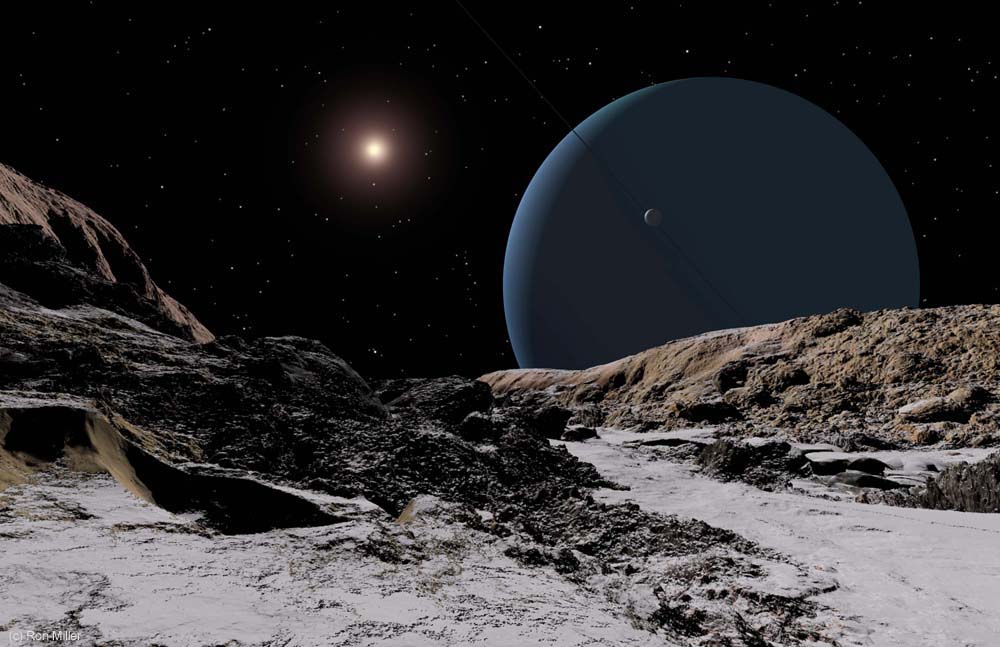
The sunlight would be much dimmer than on Earth because Uranus is about nineteen times farther from the Sun.
The Sun would resemble an exceptionally bright star rather than a large glowing disk.
Clouds made of methane ice drift through the atmosphere, although they are often subtle and difficult to distinguish.
Because Uranus rotates on its side, parts of the planet experience seasons unlike those anywhere else in the Solar System, with decades of continuous daylight followed by decades of darkness.
Neptune’s Sky: Deep Blue Under Powerful Winds
Neptune lies even farther from the Sun than Uranus.
Its atmosphere also contains methane, but its exact color is influenced by additional atmospheric processes that scientists continue to study.
The sky would likely appear a deeper blue than Uranus.
Although sunlight at Neptune is only a tiny fraction of what reaches Earth, daytime would not be completely dark. The human eye is remarkably sensitive, and the Sun would still provide enough light to create a dim but visible daytime sky.
Neptune possesses the fastest winds in the Solar System, reaching speeds greater than 2,000 kilometers per hour in some regions.
Massive storms and bright methane clouds move rapidly through the atmosphere.
The distant Sun would appear much smaller than it does from Earth, shining over a cold blue world where temperatures plunge to around −200 degrees Celsius.
Why Every Planet Has a Different Sky
No two planetary skies are identical because each planet has its own combination of atmospheric chemistry, pressure, temperature, gravity, sunlight, and weather.
Planets with thick atmospheres scatter sunlight strongly, producing colorful skies.
Planets with almost no atmosphere leave space visible even during daytime.
Cloud composition also matters. Water clouds, sulfuric acid clouds, methane clouds, and ammonia clouds each reflect and scatter light differently.
Dust plays another important role.
On Mars, microscopic dust particles give the sky its distinctive reddish appearance.
Distance from the Sun also changes how bright the sky becomes.
Mercury receives more than six times as much sunlight as Earth, while Neptune receives less than one-thousandth.
How Sunsets Change Across the Solar System
Earth’s red sunsets feel familiar because our atmosphere scatters blue light away as the Sun approaches the horizon.
On Mars, fine dust reverses this effect, producing blue sunsets around the Sun.
On Venus, the thick cloud deck would likely make sunsets nearly impossible to distinguish clearly because the Sun is hidden behind dense atmospheric layers.
Gas giants probably experience sunsets through layers of colorful clouds rather than over a solid horizon.
Every world creates its own unique masterpiece as its star rises and sets.
Could You See Stars During the Day?
The answer depends on the atmosphere.
On Mercury, with almost no atmosphere, the sky stays black even during daytime, although the Sun’s intense brightness would make many stars difficult for human eyes to notice.
On Earth, atmospheric scattering makes the daytime sky bright enough to hide stars.
Venus’ thick atmosphere would completely obscure the stars.
Mars would also hide most stars during daylight because scattered sunlight and airborne dust brighten the sky.
On the giant planets, dense atmospheres would similarly prevent daytime stargazing.
Weather Makes Every Sky Alive
A sky is more than its color.
Weather shapes what we see.
Earth has rain, snow, thunderstorms, hurricanes, and rainbows.
Mars experiences global dust storms.
Jupiter hosts gigantic storms larger than Earth.
Saturn produces lightning deep inside towering clouds.
Neptune’s atmosphere is swept by extraordinary winds.
Venus remains wrapped beneath permanent cloud layers.
Every atmosphere tells its own story through constantly changing weather.
The Future of Exploring Alien Skies
Robotic spacecraft have already shown us remarkable views from several planets.
NASA’s Viking landers first photographed the Martian sky in the 1970s.
More recent missions, including the Curiosity and Perseverance rovers, have captured stunning images of Martian clouds, dust devils, and blue sunsets.
Spacecraft have observed the colorful cloud tops of Jupiter, Saturn, Uranus, and Neptune from orbit, revealing details impossible to see from Earth.
Future missions may one day send balloons into the skies of Venus, aircraft to explore Titan, or even floating probes into the atmospheres of the giant planets.
Each mission will reveal new perspectives on skies unlike any ever seen before.
Looking Up Across the Solar System
Every planet teaches us that the sky is not simply a backdrop above our heads. It is a reflection of a world’s atmosphere, chemistry, climate, and history. Earth’s brilliant blue sky is only one possibility among many. Mercury offers the darkness of space even at noon. Venus hides beneath glowing layers of dense cloud. Mars surprises visitors with dusty orange days and blue sunsets. Jupiter and Saturn surround observers with enormous cloudscapes, while Uranus and Neptune display tranquil shades of blue-green and deep blue beneath distant sunlight.
Together, these worlds remind us that the universe is astonishingly diverse. The sky we see every day is not the universal standard—it is a beautiful consequence of Earth’s unique atmosphere. As humanity continues exploring the Solar System and discovering planets around other stars, we are learning that every world has its own sky, its own light, and its own story waiting to be understood.