Imagine sending a message that cannot be secretly copied without leaving evidence. Imagine connecting quantum computers across continents so they can work together on scientific problems that today’s technology cannot solve. Imagine a global communication network built not only on electricity and light but also on the strange and fascinating rules of quantum physics. This is the vision behind the quantum internet, one of the most ambitious technologies scientists are working to create.
Although the internet has transformed modern life, it was designed using the principles of classical physics and classical computing. The quantum internet is fundamentally different. Instead of transmitting only ordinary digital information, it is designed to send and share quantum information using the laws of quantum mechanics, the branch of physics that describes the behavior of matter and energy at the smallest scales.
The quantum internet is not intended to replace today’s internet. Instead, it will likely become a powerful companion network, adding capabilities that classical communication systems simply cannot provide. Researchers believe it could revolutionize cybersecurity, scientific research, precision measurement, and distributed quantum computing.
The technology is still in its early stages, but remarkable progress over the past two decades suggests that the quantum internet is gradually moving from theory toward reality.
Understanding the Internet We Use Today
To appreciate why the quantum internet is so revolutionary, it helps to understand how today’s internet works.
Every email, photograph, video call, website, and online purchase is broken into tiny pieces of digital information. These pieces are represented by bits, the basic units of information in classical computing.
A bit can have only one of two possible values.
It is either 0 or 1.
When you send a message, your computer converts the information into billions of these bits. They travel through fiber-optic cables, satellites, mobile networks, and routers before reaching another device, where they are reconstructed into the original message.
This system is extraordinarily successful. It supports billions of users and powers nearly every aspect of modern society.
However, classical communication also has limitations, especially in areas involving security and quantum technologies.
Why Scientists Want a Quantum Internet
As computers become more powerful, protecting digital information becomes increasingly important.
Modern encryption techniques already provide strong security for many applications, but advances in computing—including future large-scale quantum computers—could challenge some widely used encryption methods.
At the same time, scientists developing quantum computers realized something important.
Quantum computers cannot simply exchange quantum information over ordinary communication networks.
Quantum information behaves differently from classical information.
It requires an entirely new kind of communication system.
This realization inspired researchers to imagine a network built specifically for quantum information.
The result is the concept of the quantum internet.
What Is the Quantum Internet?
The quantum internet is a communication network that transmits and shares quantum states between distant locations.
Instead of sending only classical bits, it distributes qubits, the basic units of quantum information.
Unlike classical bits, qubits follow the rules of quantum mechanics.
They can exhibit properties such as superposition and entanglement, which have no direct equivalent in everyday experience.
By sharing quantum information across long distances, quantum devices can perform tasks that are impossible using classical communication alone.
What Is a Qubit?
The basic building block of the quantum internet is the qubit.
In a traditional computer, a bit is always either 0 or 1.
A qubit is different.
Its quantum state can be described as a combination of the basis states commonly labeled 0 and 1 until it is measured.
This unusual behavior allows quantum systems to process and transmit information in fundamentally different ways.
Scientists create qubits using several different physical systems.
Some use individual photons, which are particles of light.
Others use trapped ions, superconducting circuits, neutral atoms, or defects inside crystals.
Each approach has advantages and challenges, and researchers continue exploring which technologies work best for large-scale quantum networks.
The Strange Rules of Quantum Mechanics
The quantum internet depends on the unusual behavior of nature at very small scales.
Quantum mechanics often appears surprising because it does not match our everyday experiences.
Objects around us seem to have definite positions and properties.
Tiny quantum particles behave differently.
Their behavior is described by probabilities, wave functions, and quantum states rather than simple classical rules.
Although these ideas may seem mysterious, quantum mechanics has been tested through countless experiments and remains one of the most accurate scientific theories ever developed.
The quantum internet applies these well-established principles to communication technology.
Superposition in Quantum Communication
One important feature of quantum systems is superposition.
A qubit can exist in a quantum state that is mathematically described as a combination of its basis states before measurement.
This does not mean that information is duplicated in the ordinary sense. Rather, it reflects how quantum states are represented and manipulated according to quantum mechanics.
Superposition enables many quantum communication protocols and forms part of the foundation of quantum information science.
Entanglement: The Heart of the Quantum Internet
Perhaps the most remarkable feature of the quantum internet is quantum entanglement.
When two particles become entangled, their quantum states become linked in a way that cannot be fully described independently.
Even if the particles are separated by great distances, measurements performed on them show correlations predicted by quantum mechanics.
Entanglement does not allow messages to travel faster than light.
This is a common misconception.
Instead, entanglement creates unique quantum correlations that make certain communication tasks possible.
Scientists consider entanglement to be one of the most valuable resources in quantum communication.
Without it, the quantum internet would lose many of its unique capabilities.
Photons: The Messengers of the Quantum Internet
Most quantum communication systems use photons, the particles that make up light.
Photons are excellent carriers of quantum information because they can travel through optical fibers or open space while preserving their quantum properties under carefully controlled conditions.
In many experiments, scientists encode qubits into the polarization, phase, or other properties of individual photons.
These photons then carry quantum information between distant laboratories or communication stations.
Using light makes sense because today’s internet already relies heavily on fiber-optic cables.
Researchers hope to build future quantum networks alongside existing optical infrastructure whenever possible.
Quantum Key Distribution
One of the first practical applications of the quantum internet is Quantum Key Distribution, often abbreviated as QKD.
Encryption normally depends on secret keys shared between communicating parties.
Quantum Key Distribution allows two users to generate a shared secret key using quantum states.
The remarkable feature of QKD is that measuring unknown quantum states generally disturbs them.
As a result, attempts to intercept the quantum communication can introduce detectable changes.
This property allows the communicating parties to determine whether the key exchange may have been compromised.
QKD does not make communication magically unbreakable, but it offers a fundamentally different approach to secure key exchange based on the laws of physics rather than assumptions about computational difficulty.
Why Quantum Communication Is Different
Classical information can be copied perfectly.
You can duplicate a computer file thousands of times without changing the original.
Quantum information behaves differently.
According to the no-cloning theorem, it is impossible to create an exact copy of an unknown quantum state.
This principle is one of the cornerstones of quantum communication.
Because quantum states cannot simply be copied like ordinary files, quantum communication requires entirely new methods for transmitting and preserving information.
Quantum Teleportation
One of the most fascinating techniques in quantum communication is quantum teleportation.
Despite its science-fiction name, quantum teleportation does not transport people or physical objects.
Instead, it transfers the quantum state of one particle to another distant particle using previously shared entanglement together with classical communication.
The original quantum state is not duplicated during this process, consistent with the no-cloning theorem.
Quantum teleportation is expected to become an essential technology for future quantum networks because it enables quantum information to be transferred without physically sending the original quantum state through every part of the communication channel.
Quantum Repeaters
Sending quantum information across long distances presents major challenges.
Photons gradually disappear through absorption inside optical fibers.
Unlike classical communication systems, quantum signals generally cannot be amplified using ordinary repeaters because amplification would disturb unknown quantum states.
Instead, researchers are developing quantum repeaters.
These sophisticated devices use entanglement, quantum memories, and teleportation techniques to extend communication distances while preserving quantum information.
Quantum repeaters are considered one of the key technologies needed for a global quantum internet.
Quantum Memories
A successful quantum internet also requires reliable quantum memories.
These devices temporarily store quantum information without destroying its fragile quantum state.
Quantum memories allow different parts of a quantum network to synchronize their operations.
Developing long-lasting, highly reliable quantum memories remains an active area of research.
Connecting Quantum Computers
One exciting application of the quantum internet involves connecting quantum computers.
Today’s quantum processors are relatively small.
Future quantum networks may allow multiple quantum computers to cooperate as parts of a much larger distributed system.
Instead of building one enormous quantum computer, scientists could connect many smaller quantum processors using quantum communication.
Such distributed quantum computing could expand computational capabilities while improving flexibility.
Scientific Research
The quantum internet has the potential to accelerate scientific discovery.
Researchers could connect laboratories across the world, allowing them to share quantum states for experiments in physics, chemistry, and materials science.
Large scientific instruments might coordinate measurements with unprecedented precision.
Distributed quantum sensors could improve our understanding of natural phenomena.
Although many of these applications remain experimental, they illustrate the broad scientific possibilities offered by quantum networking.
Precision Measurement
Quantum technologies can also improve measurement.
Networks of quantum sensors connected through quantum communication may eventually detect extremely small changes in gravity, magnetic fields, or time.
These capabilities could support geology, environmental monitoring, astronomy, navigation, and fundamental physics research.
Scientists are actively investigating these possibilities.
Quantum Internet and Space
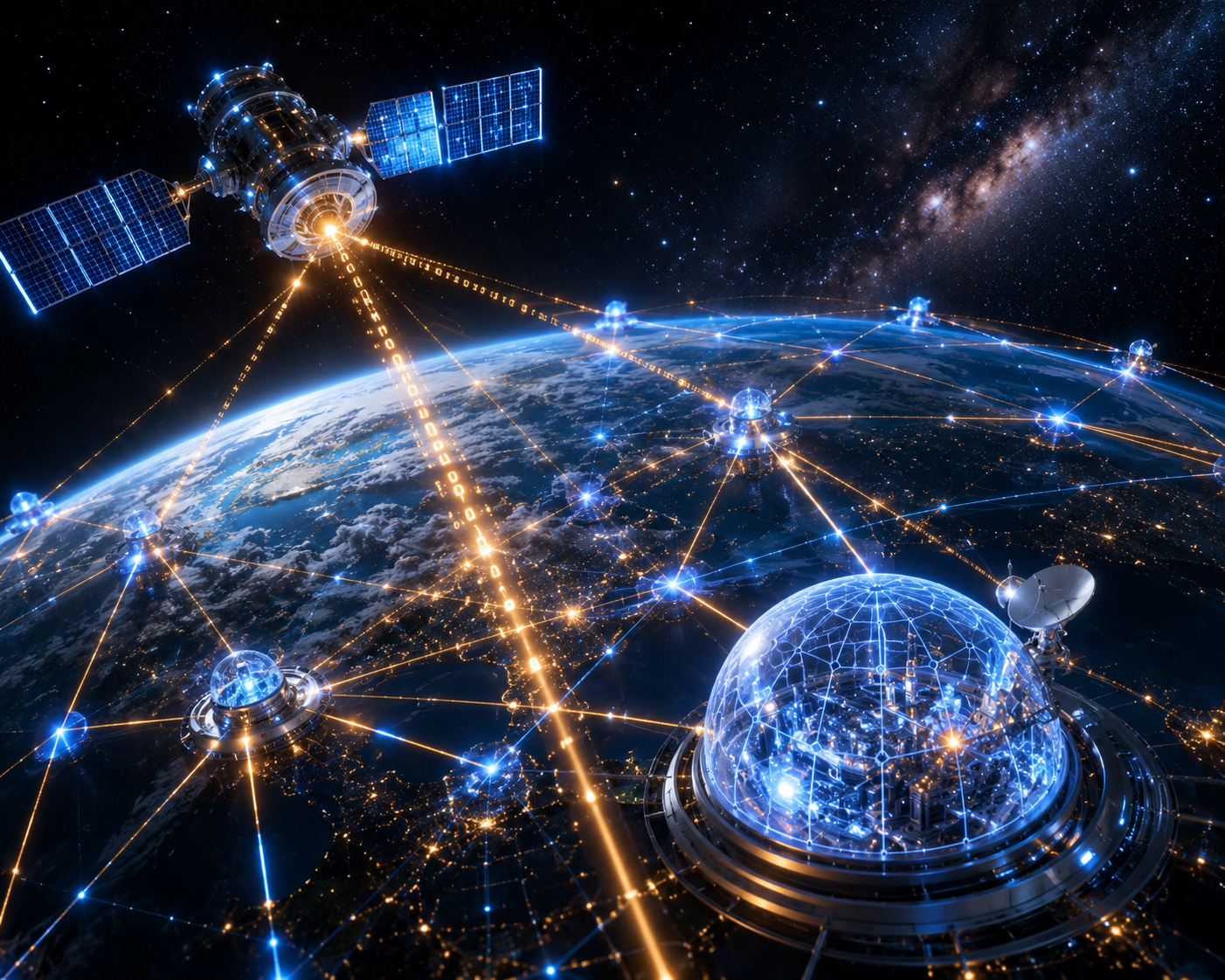
Building a worldwide quantum internet will likely require satellites.
Optical fibers work well over moderate distances, but photons gradually disappear as they travel through long fiber links.
Quantum satellites offer another solution.
Instead of sending photons entirely through optical fibers, satellites can distribute entangled photons between distant ground stations.
Several successful experiments have already demonstrated satellite-based quantum communication over thousands of kilometers.
These achievements represent important milestones toward future global quantum networks.
Can the Quantum Internet Replace Today’s Internet?
Probably not.
The quantum internet is designed for specialized tasks.
Streaming movies, browsing websites, reading news, shopping online, and sending ordinary emails will continue using classical communication networks.
Quantum communication is valuable because it provides capabilities unavailable through classical systems.
Most future communication will likely combine both technologies.
Classical networks will continue carrying everyday information.
Quantum networks will add advanced capabilities for secure communication, distributed quantum computing, and scientific applications.
Engineering Challenges
Building the quantum internet is extraordinarily difficult.
Quantum states are extremely fragile.
Small disturbances from the surrounding environment can destroy them through decoherence.
Maintaining stable quantum communication requires advanced equipment, precise timing, specialized detectors, and sophisticated control systems.
Researchers must also develop better quantum memories, more efficient photon sources, faster quantum repeaters, and improved error correction methods.
These challenges make the quantum internet one of the most demanding engineering projects in modern science.
The Current State of Quantum Internet Research
The quantum internet does not yet exist as a worldwide communication network.
Instead, researchers are building increasingly sophisticated experimental systems.
Scientists have successfully demonstrated quantum communication over optical fibers spanning hundreds of kilometers.
Quantum teleportation has been demonstrated in laboratories and across metropolitan-scale fiber networks, as well as between ground stations and satellites.
Entanglement has been distributed across increasingly long distances.
Prototype quantum networks have connected multiple quantum devices in controlled environments.
Each achievement represents another step toward larger, more practical quantum communication systems.
Common Misunderstandings
Because quantum mechanics is unfamiliar, the quantum internet is often surrounded by misconceptions.
Some people believe it will instantly replace the current internet.
Others imagine messages traveling faster than light.
Neither idea is correct.
Quantum communication always respects the fundamental speed limit established by Einstein’s theory of relativity.
Classical communication remains necessary for many quantum communication protocols, including quantum teleportation.
Another misunderstanding is that the quantum internet will make all hacking impossible.
While quantum communication offers important security advantages for certain tasks, no communication system can eliminate every cybersecurity risk.
Human error, software vulnerabilities, and hardware weaknesses will still require careful attention.
Understanding what the quantum internet can and cannot do is essential for appreciating its true scientific significance.
The Relationship Between Quantum Computing and the Quantum Internet
Quantum computing and the quantum internet are closely connected but serve different purposes.
Quantum computers perform calculations using qubits.
The quantum internet enables those qubits to be shared between distant devices.
One technology processes quantum information.
The other transports it.
Together, they could form the foundation of a future quantum information infrastructure, much as classical computers and the classical internet transformed the digital age.
Industries That May Benefit
Many industries are watching quantum communication research closely.
Financial institutions are interested in future secure communication methods.
Healthcare organizations see potential for protecting sensitive medical information.
Governments are investing in quantum technologies for national research and secure communications.
Scientific laboratories anticipate new opportunities for collaboration through distributed quantum experiments.
Telecommunications companies are exploring ways to integrate quantum technologies into existing optical networks.
Although widespread commercial applications remain in the future, interest continues to grow.
The Future of the Quantum Internet
Predicting the exact future of the quantum internet is difficult.
Scientific progress rarely follows a straight path.
Some technological breakthroughs happen quickly, while others require decades of research.
What seems clear is that quantum communication has already moved beyond theoretical speculation.
Laboratories around the world continue demonstrating increasingly sophisticated quantum networks.
As quantum computers become more capable, the demand for quantum communication will likely increase.
Future generations may eventually use quantum networks to support scientific research, secure communication, distributed computing, and technologies that have not yet been imagined.
Just as few people in the 1960s could have predicted today’s internet, we may still be only beginning to understand the possibilities of quantum networking.
Why the Quantum Internet Matters
The quantum internet represents one of humanity’s boldest attempts to harness the deepest laws of nature for communication. Rather than replacing the internet we use every day, it aims to add entirely new capabilities based on the principles of quantum mechanics. By enabling the secure exchange of quantum information, connecting quantum computers, and supporting advanced scientific research, it has the potential to reshape the future of technology.
Although many technical challenges remain, steady progress in quantum communication, quantum memories, satellite networks, and quantum repeaters continues to move the field forward. Each experiment brings researchers closer to a future in which quantum networks complement classical communication systems in ways that were once considered impossible.
The story of the quantum internet is still being written. It reminds us that even after decades of remarkable technological progress, nature continues to reveal new possibilities. By learning to communicate through the strange yet reliable rules of quantum physics, humanity is opening the door to a new era of discovery, innovation, and understanding that could transform science and technology for generations to come.