Every generation experiences technologies that redefine what is possible. For our ancestors, it was the mastery of fire, the invention of agriculture, or the creation of the wheel. Centuries later came the printing press, electricity, the steam engine, antibiotics, computers, and the internet. Each breakthrough reshaped civilization in ways that people living at the time could scarcely imagine.
Today, humanity stands at the threshold of another technological revolution. Around the world, scientists, engineers, and innovators are developing technologies that could transform medicine, transportation, manufacturing, communication, energy, agriculture, and even our understanding of intelligence itself. Some of these innovations are already moving from laboratories into the real world. Others remain experimental but are advancing rapidly through scientific research.
Unlike technologies that are already well established, emerging technologies are still evolving. Their full potential—and their limitations—are not yet completely understood. Some will become essential parts of daily life, while others may never move beyond the research stage. What makes them exciting is not certainty but possibility.
The following ten emerging technologies are among the most promising scientific and engineering developments that could significantly change the world during the coming decades.
1. Artificial General Intelligence
Artificial intelligence has already transformed industries ranging from healthcare to finance, but today’s AI systems are generally designed for specific tasks. They can generate text, recognize images, translate languages, or analyze data, yet they lack the broad reasoning abilities that characterize human intelligence.
Artificial General Intelligence, often called AGI, refers to a future form of AI capable of learning and performing a wide variety of intellectual tasks rather than excelling only within narrow domains.
Scientists continue to debate how close humanity is to achieving AGI. Some believe it could emerge within decades, while others argue that important scientific breakthroughs are still required.
If developed safely, AGI could dramatically accelerate scientific discovery by analyzing enormous datasets, designing experiments, identifying patterns that humans overlook, and helping researchers solve exceptionally complex problems.
Potential applications include climate modeling, drug discovery, advanced engineering, personalized education, and fundamental scientific research.
At the same time, AGI raises significant questions about safety, governance, accountability, employment, privacy, and ethics. Researchers increasingly emphasize that progress in AI capability must be matched by equally rigorous work on alignment, transparency, and responsible oversight.
Whether AGI arrives soon or remains distant, it represents one of the most influential emerging technologies under active discussion today.
2. Quantum Internet
Quantum computing receives considerable attention, but another equally fascinating development is the quantum internet.
Unlike today’s internet, which transmits classical information, a quantum internet would use quantum states to enable entirely new forms of communication.
One key feature is quantum entanglement, a phenomenon in which particles exhibit correlations that cannot be explained by classical physics alone. Scientists are developing methods to distribute entangled particles across communication networks.
Such systems could enable quantum communication protocols with exceptionally strong security. Any attempt to intercept certain quantum transmissions would disturb the quantum states involved, making eavesdropping detectable.
Researchers have already demonstrated quantum communication over optical fibers and satellite links. Experimental quantum networks now operate in several countries, connecting laboratories and research institutions.
Although a global quantum internet remains years away, it could eventually support distributed quantum computing, ultra-secure communications, and entirely new scientific applications.
Its development represents an important frontier in both physics and information technology.
3. Programmable Matter
Imagine materials capable of changing their shape, properties, or function in response to external commands.
This idea, known as programmable matter, remains largely experimental but has attracted growing interest from researchers in materials science, robotics, and nanotechnology.
Several different approaches are under investigation.
Some involve microscopic robotic units that cooperate to form larger structures.
Others rely on smart materials that alter stiffness, electrical conductivity, or shape when exposed to heat, light, magnetic fields, or electrical signals.
Shape-memory alloys already demonstrate limited versions of this concept by returning to predetermined forms after deformation.
Future programmable materials could revolutionize manufacturing, construction, medical devices, aerospace engineering, and consumer products.
Buildings might adapt to changing environmental conditions.
Medical implants could alter their behavior inside the body.
Spacecraft components might reconfigure themselves during missions.
Although practical programmable matter remains a long-term goal, ongoing advances in materials engineering continue bringing aspects of this vision closer to reality.
4. Cultured Meat and Cellular Agriculture
Producing food for a growing global population while reducing environmental impacts is one of the greatest challenges facing humanity.
Cellular agriculture offers an innovative approach.
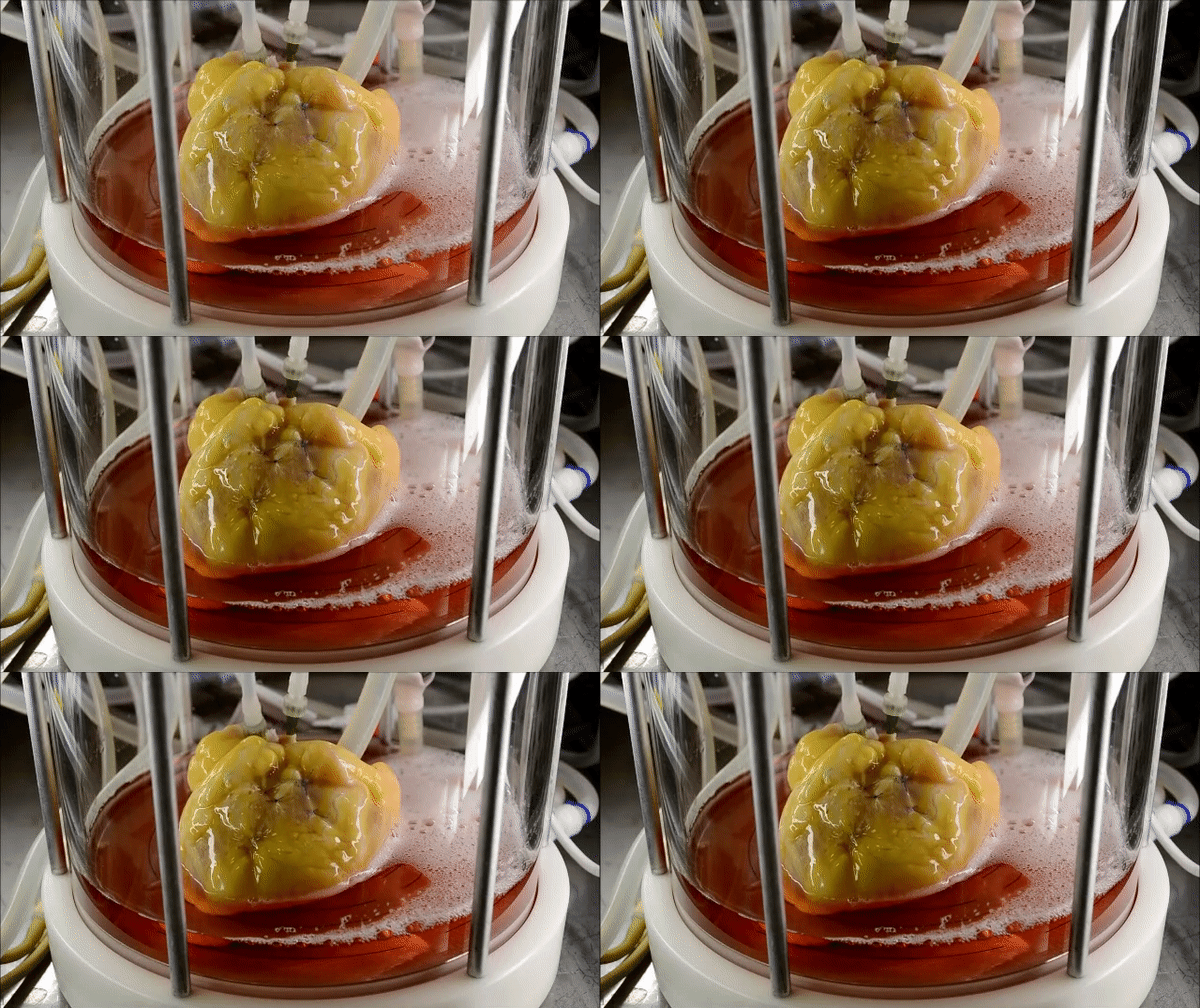
Instead of raising entire animals for meat production, scientists cultivate animal cells under carefully controlled laboratory conditions, allowing muscle tissue to grow into edible meat products.
This technology does not involve synthetic substitutes made entirely from plants. Instead, it produces genuine animal tissue through cell cultivation.
Researchers are also developing cultured milk proteins, egg proteins, leather, and other agricultural products using similar methods.
Potential advantages include reduced land use, lower water consumption, decreased reliance on antibiotics in livestock production, and greater control over food safety.
However, significant challenges remain.
Large-scale production must become more affordable.
Energy requirements must continue improving.
Consumer acceptance, regulatory approval, and nutritional optimization all require further development.
Even so, cellular agriculture represents one of the most promising emerging technologies for sustainable food production.
5. Digital Twins
Every complex system—from aircraft engines to entire cities—produces enormous amounts of data.
Digital twins combine this information into detailed virtual models that continuously update using real-world measurements.
Unlike traditional computer simulations, digital twins evolve alongside their physical counterparts.
Sensors monitor performance, temperature, pressure, wear, energy consumption, and countless other variables.
Artificial intelligence analyzes these data to predict maintenance needs, optimize efficiency, and identify potential failures before they occur.
Manufacturing companies already use digital twins to improve production systems.
Hospitals are exploring patient-specific digital models for personalized medicine.
Urban planners are creating digital twins of cities to improve transportation, infrastructure, emergency planning, and energy management.
Future digital twins may become increasingly sophisticated, integrating weather forecasts, environmental monitoring, economic data, and infrastructure networks into unified predictive systems.
This technology could fundamentally change how humans design, monitor, and maintain complex environments.
6. Self-Healing Materials
Most materials gradually weaken over time.
Cracks spread.
Corrosion develops.
Microscopic damage accumulates.
Eventually, repairs become necessary.
Scientists are now developing materials capable of repairing themselves.
Some experimental polymers contain microscopic capsules filled with healing agents.
When cracks form, these capsules rupture, releasing chemicals that seal the damage.
Other materials rely on reversible chemical bonds that reconnect after mechanical stress.
Researchers are also exploring self-healing concrete containing specialized bacteria that produce limestone when exposed to water, automatically sealing small cracks.
Potential applications extend across infrastructure, aviation, automobiles, electronics, and medical devices.
Bridges could require fewer repairs.
Aircraft components might remain safer for longer periods.
Electronic devices could become more durable.
Buildings could last decades longer while reducing maintenance costs.
Although still under active development, self-healing materials may significantly increase the longevity of future infrastructure.
7. Direct Air Carbon Capture
Reducing greenhouse gas emissions remains essential for addressing climate change.
At the same time, many climate scientists believe that removing some carbon dioxide already present in the atmosphere may also become necessary.
Direct Air Carbon Capture technologies aim to accomplish precisely that.
These systems use specialized chemical materials to extract carbon dioxide directly from ambient air.
Captured carbon dioxide can then be permanently stored underground or utilized in industrial processes such as synthetic fuel production or certain manufacturing applications.
Unlike conventional carbon capture systems installed at power plants, direct air capture removes carbon dioxide regardless of where it originated.
The technology remains relatively expensive and energy-intensive.
Researchers continue working to improve efficiency, reduce costs, and develop low-carbon energy sources for operating these facilities.
While direct air capture cannot replace emissions reductions, many experts consider it a potentially valuable component of broader climate strategies.
8. Organ Bioprinting
One of modern medicine’s greatest challenges is the shortage of donor organs.
Thousands of patients worldwide wait months or years for life-saving transplants.
Bioprinting seeks to address this challenge by using specialized three-dimensional printers capable of depositing living cells and biological materials layer by layer.
Researchers have already produced experimental skin, cartilage, miniature tissues, blood vessels, and simple organ-like structures.
More complex organs remain far more difficult because they require intricate blood vessel networks, multiple cell types, and long-term biological function.
Nevertheless, progress continues steadily.
Even before fully transplantable organs become possible, bioprinted tissues already provide valuable tools for pharmaceutical testing and disease research.
Scientists can study human tissue responses without relying solely on animal models.
Eventually, personalized organs grown from a patient’s own cells could reduce transplant rejection while increasing organ availability.
Although significant scientific challenges remain, organ bioprinting represents one of the most promising areas of regenerative medicine.
9. Autonomous Scientific Laboratories
Scientific discovery traditionally depends upon researchers designing experiments, collecting data, interpreting results, and planning subsequent investigations.
Emerging autonomous laboratories aim to accelerate this entire process.
These facilities combine robotics, artificial intelligence, automated instruments, and advanced software into systems capable of conducting experiments with minimal human intervention.
Robotic platforms prepare chemical mixtures.
Automated instruments analyze results.
Machine learning algorithms identify promising directions for future experiments.
The system then designs new experiments based on previous outcomes.
Researchers remain essential for defining scientific goals, interpreting discoveries, and ensuring quality control.
However, automation dramatically increases the speed at which hypotheses can be tested.
Autonomous laboratories are already contributing to materials science, battery development, chemistry, and drug discovery.
Future versions may become indispensable tools for accelerating scientific progress across numerous disciplines.
10. Space-Based Solar Power
Solar panels on Earth generate clean electricity but depend upon weather, seasons, and the daily cycle of daylight.
Space-based solar power proposes an ambitious alternative.
Large solar arrays positioned in orbit could collect nearly continuous sunlight without atmospheric interference or nighttime interruptions.
The harvested energy would then be transmitted to Earth using microwave or laser technologies and converted into electricity at receiving stations.
The concept has been studied for decades but remained impractical due to launch costs.
Recent advances in reusable rockets, lightweight materials, robotic assembly, and space engineering have renewed interest in the idea.
Numerous engineering challenges remain, including orbital construction, efficient energy transmission, and economic feasibility.
Nevertheless, several governments and research organizations continue investigating the technology.
If successfully developed, space-based solar power could become an important component of future global energy systems.
Why Emerging Technologies Matter
Emerging technologies differ from mature technologies because their ultimate impact remains uncertain.
Some will evolve rapidly.
Others may require decades of additional research.
A few may never become commercially practical.
Yet history repeatedly demonstrates that transformative innovations often begin as experimental ideas.
The internet once connected only a handful of research institutions.
Artificial intelligence existed primarily in academic laboratories.
Gene editing was unimaginable only a few generations ago.
Today’s experimental technologies may become tomorrow’s essential infrastructure.
The Importance of Responsible Innovation
Scientific progress alone does not determine the future.
How societies choose to develop, regulate, and apply new technologies is equally important.
Artificial intelligence requires ethical oversight.
Gene editing demands careful governance.
Carbon-removal technologies must complement emissions reductions rather than replace them.
Space technologies should promote peaceful exploration and environmental responsibility.
Public trust depends upon transparency, scientific integrity, international cooperation, and thoughtful policymaking.
Responsible innovation ensures that technological advances improve human well-being while minimizing unintended consequences.
A Future Still Being Written
Human history is a continuous story of curiosity transformed into invention. Every major technological revolution began with questions that once seemed impossible to answer. Could machines calculate? Could people fly? Could diseases be prevented with microscopic organisms? Could information travel instantly across continents?
Each generation expanded the boundaries of possibility.
Today’s emerging technologies continue that tradition. Some remain experimental. Others are steadily moving toward widespread adoption. Together, they represent humanity’s ongoing effort to solve problems, improve lives, understand nature, and explore the unknown.
No one can predict exactly which of these innovations will define the coming decades. Unexpected discoveries will undoubtedly reshape the technological landscape, just as they have throughout history. Yet one truth remains clear: the future will be built not by a single invention but by the combined power of scientific discovery, engineering creativity, and responsible human collaboration.
The technologies now taking shape in laboratories around the world are more than remarkable scientific achievements. They are the foundations of a future that is still unfolding—one experiment, one breakthrough, and one discovery at a time.