For most of human history, reaching space was one of the greatest technological challenges imaginable. Even after the first satellites and astronauts proved that space travel was possible, there was one enormous problem that made every mission incredibly expensive. Nearly every rocket was used only once.
Imagine buying a brand-new airplane, flying it across the ocean, and then throwing it away after a single trip. It would sound absurd. Yet for decades, this was essentially how rockets operated. After launching a spacecraft, most of the rocket either burned up in Earth’s atmosphere or fell into the ocean, never to be used again.
Today, that idea is rapidly changing. Engineers have developed reusable rockets that can launch into space, return safely to Earth, and fly again after inspection and maintenance. This breakthrough is transforming space exploration by making launches more frequent, reducing costs, and opening new possibilities for science, satellite technology, and even future missions to the Moon and Mars.
But how can a rocket survive such an extraordinary journey? How does a vehicle powerful enough to escape Earth’s gravity manage to land gently back on the ground? The answers lie in some of the most fascinating principles of physics and engineering.
What Is a Reusable Rocket?
A reusable rocket is a launch vehicle, or part of one, that is designed to be recovered after a mission and flown again instead of being discarded.
Traditional rockets are known as expendable launch vehicles because most of their components are used only once. After carrying a payload toward space, their stages separate and usually fall back to Earth, where they are destroyed by atmospheric heating or impact with the ocean.
Reusable rockets change this approach. Instead of becoming space debris, key parts of the rocket return under controlled conditions, allowing engineers to inspect, refurbish, and launch them on future missions.
Depending on the rocket’s design, the reusable portion may be the first stage, the booster, or in some cases additional components.
Why Were Traditional Rockets Thrown Away?
The answer lies in the enormous challenge of reaching space.
A rocket must accelerate from rest to speeds of several kilometers per second while carrying fuel, engines, guidance systems, and cargo. To make this possible, rockets are built in stages.
As fuel is consumed, empty tanks become unnecessary weight. By separating these empty stages, the remaining rocket becomes lighter and more efficient.
For decades, engineers accepted that discarded stages were simply part of spaceflight. Recovering them was considered too difficult and too expensive.
Advances in computing, lightweight materials, powerful engines, and autonomous flight systems eventually made controlled recovery practical.
Why Reusable Rockets Matter
Launching anything into space is expensive.
Building a rocket requires advanced materials, precision manufacturing, powerful engines, and extensive testing.
If a rocket can only fly once, nearly all of that investment is lost after every launch.
Reusability changes the economics of spaceflight.
Instead of building a completely new rocket for every mission, engineers can reuse major components multiple times. Although recovered rockets still require inspections and maintenance, reusing them can significantly reduce the cost and time needed to prepare for future launches.
Lower launch costs make space more accessible for scientific research, satellite deployment, technology development, and exploration.
The Science Behind Rocket Launches
To understand reusable rockets, it helps to first understand how any rocket works.
A rocket moves according to Newton’s Third Law of Motion, which states that for every action, there is an equal and opposite reaction.
Inside a rocket engine, fuel and an oxidizer react chemically to produce extremely hot, high-pressure gases.
These gases are expelled downward through the engine nozzle at tremendous speed.
As the exhaust rushes downward, an equal and opposite force pushes the rocket upward.
This upward force is called thrust.
As long as thrust exceeds the combined effects of gravity and air resistance, the rocket accelerates toward space.
Escaping Earth’s Gravity
Many people imagine that rockets leave Earth’s gravity behind.
In reality, gravity continues acting on spacecraft throughout their journey.
Even astronauts aboard the International Space Station remain under Earth’s gravitational influence.
A rocket succeeds not by escaping gravity entirely but by generating enough speed and altitude to enter a stable orbit or continue toward another destination.
Producing this enormous amount of energy requires vast quantities of fuel.
In fact, most of a rocket’s launch mass consists of propellant rather than its payload.
The Role of Rocket Stages
Most large rockets have multiple stages.
The first stage performs the hardest work.
It lifts the fully fueled rocket off the launch pad and pushes it through the thick lower atmosphere.
After burning most of its fuel, the first stage separates.
The upper stages continue accelerating the spacecraft toward orbit.
In reusable systems, the first stage often becomes the component that returns to Earth because it is both the largest and the most expensive part of the rocket.
The Challenge of Returning to Earth
Bringing a rocket back safely is far more difficult than launching it.
After separation, the booster may still be traveling at thousands of kilometers per hour.
It must slow down, reorient itself, survive intense heating during atmospheric reentry, and perform a controlled landing.
Every step requires extraordinary precision.
A small navigation error could cause the booster to miss its landing target by hundreds of meters.
Modern reusable rockets rely on powerful computers that continuously calculate their position, speed, orientation, and flight path.
Turning Around in Midair
Once separated from the upper stage, the returning booster performs a carefully planned maneuver.
Small steering thrusters or engine burns rotate the rocket so that it points in the correct direction.
This maneuver allows the booster to prepare for its journey back toward the landing site.
The rocket constantly adjusts its orientation to remain stable throughout descent.
Slowing Down with Engine Burns
One of the most remarkable features of reusable rockets is their ability to restart their engines during descent.
Instead of allowing gravity to accelerate the booster uncontrollably, the engines fire at carefully chosen moments.
These engine burns reduce speed before atmospheric reentry.
Additional burns later in the descent further slow the vehicle.
The final landing burn decreases the rocket’s speed until it reaches nearly zero just before touchdown.
Without these precisely timed engine firings, a controlled landing would not be possible.
Surviving Atmospheric Reentry
As the booster falls back toward Earth, it encounters increasingly dense air.
At high speeds, compression of the air in front of the vehicle generates intense heat.
Engineers protect reusable rockets using heat-resistant materials designed to withstand these extreme temperatures.
Unlike spacecraft returning from deep space, first-stage boosters generally reenter at lower speeds, reducing—but not eliminating—the thermal challenge.
Managing aerodynamic heating remains one of the most demanding aspects of reusable rocket design.
Steering Through the Atmosphere
Returning boosters do not simply fall straight down.
They actively steer throughout descent.
Many reusable rockets use movable metal surfaces called grid fins.
These fins unfold after stage separation.
As air flows over them, the fins generate aerodynamic forces that help steer the booster toward its landing site.
The onboard flight computer continuously adjusts the fins to compensate for wind and maintain stability.
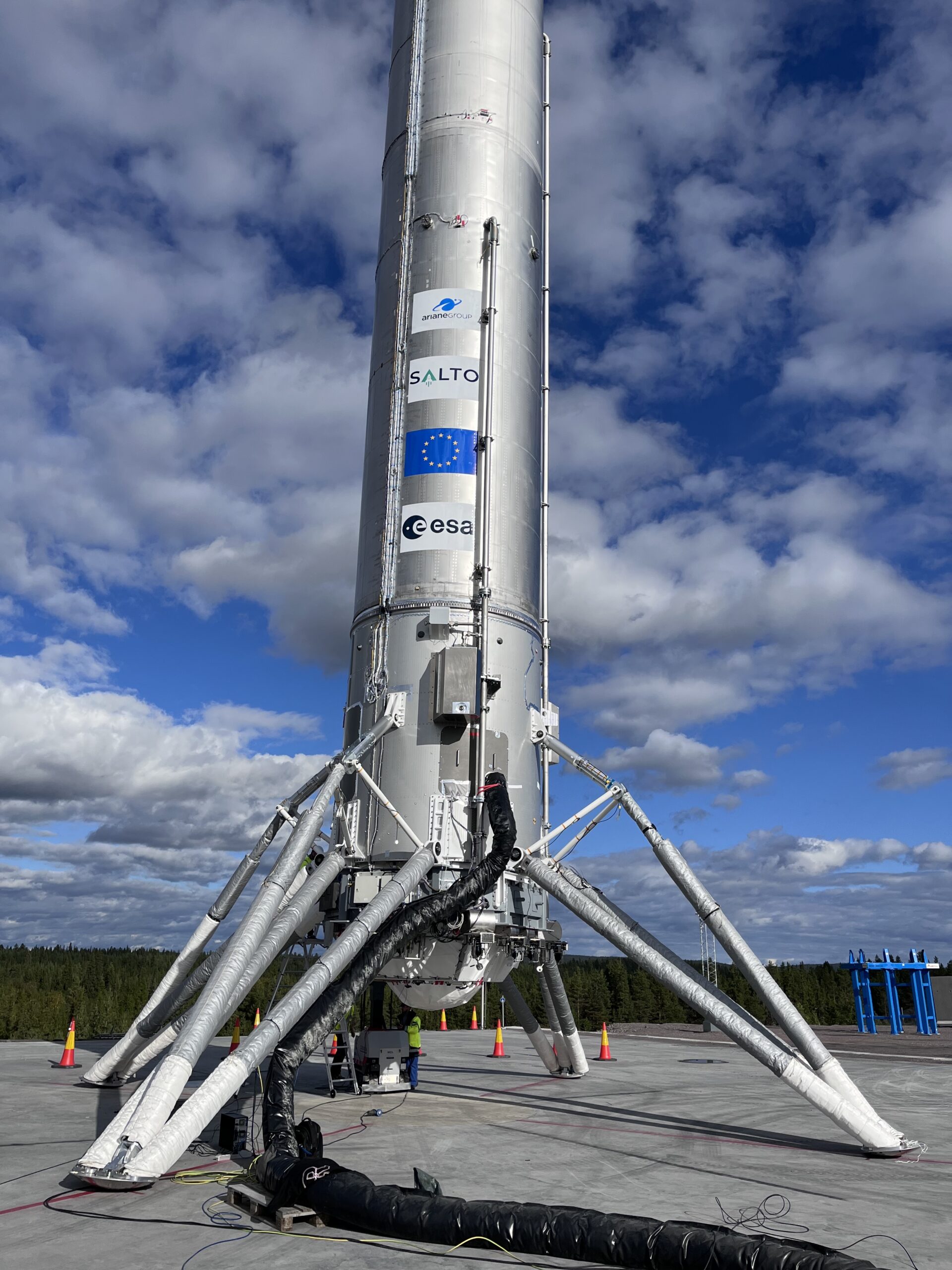
Landing on Four Legs
Near the end of the descent, landing legs deploy from the booster.
These legs absorb the forces generated during touchdown.
The landing burn slows the rocket dramatically until it gently settles onto a landing pad or specialized recovery platform.
The timing must be nearly perfect.
If the engines stop too early, the booster may crash.
If they continue firing for too long, the rocket could begin rising again.
Powerful computers calculate these timing adjustments many times every second.
Landing on Ocean Platforms
Not every mission allows the booster to return to its launch site.
Some rockets travel too far downrange.
In these cases, engineers use autonomous landing platforms positioned in the ocean.
These floating platforms maintain their location using powerful positioning systems and propulsion.
The rocket navigates toward the platform and lands vertically despite the movement of ocean waves.
This remarkable achievement combines aerospace engineering, marine engineering, robotics, and advanced navigation.
Flight Computers Make It Possible
Human pilots cannot manually control every aspect of a reusable rocket’s landing.
The calculations happen far too quickly.
Instead, sophisticated onboard computers monitor thousands of measurements every second.
They receive information from sensors measuring altitude, acceleration, engine performance, rotation, velocity, and position.
Using these data, the flight software continuously adjusts engine thrust and steering controls.
The rocket effectively flies itself during much of its return.
Sensors Guide the Rocket
Reusable rockets depend on numerous sensors.
Inertial measurement units detect changes in movement and orientation.
Global navigation systems help determine position.
Radar or laser-based systems measure altitude during landing.
Pressure sensors monitor engine performance.
Temperature sensors ensure critical components remain within safe operating limits.
Together, these instruments provide the information necessary for precise autonomous flight.
Rocket Engines Must Restart Reliably
Unlike many traditional rockets, reusable boosters require engines capable of restarting multiple times during a single mission.
These restarts occur after exposure to the harsh conditions of launch and spaceflight.
Engine designers therefore focus heavily on reliability.
The ignition systems, fuel delivery systems, and engine components must operate consistently under extreme temperatures and pressures.
Repeated successful restarts are essential for safe recovery.
Strong Yet Lightweight Materials
A reusable rocket experiences enormous stresses.
It must withstand launch vibrations, aerodynamic forces, rapid acceleration, engine heat, cryogenic fuel temperatures, and landing impacts.
To meet these demands, engineers use advanced aluminum alloys, stainless steel in some designs, titanium, carbon-fiber composites, and other high-performance materials.
Every kilogram saved increases efficiency, but reducing weight can never compromise safety.
Balancing strength and mass remains one of aerospace engineering’s greatest challenges.
Inspecting the Rocket After Landing
Landing safely does not mean the rocket is immediately ready for another mission.
Engineers carefully inspect every critical component.
They examine engines, fuel tanks, valves, pumps, electrical systems, structural elements, and guidance equipment.
Any damaged or worn parts are repaired or replaced.
The goal is to ensure the rocket performs as safely on its next flight as it did on its previous one.
Reducing inspection time while maintaining rigorous safety standards is an important part of making reusable launch systems more efficient.
Can a Rocket Fly Again?
Yes.
One of the defining features of reusable rockets is their ability to complete multiple missions.
Each successful reuse provides engineers with valuable information.
They learn how materials age, how engines perform over repeated flights, and which components require improvement.
This continuous learning process helps make future rockets safer, more reliable, and more economical.
Environmental Considerations
Reusable rockets may reduce the amount of hardware discarded after launches.
Building fewer new rocket stages can lower the demand for raw materials and manufacturing resources.
However, every rocket launch still consumes propellant and produces emissions. The overall environmental impact depends on many factors, including the type of fuel used, launch frequency, manufacturing processes, and recovery operations.
Researchers continue exploring cleaner propellants, more efficient engines, and sustainable manufacturing methods to reduce the environmental footprint of spaceflight.
How Reusable Rockets Are Changing Space Exploration
Lower launch costs have significant scientific benefits.
More satellites can be placed into orbit to improve communications, weather forecasting, navigation, and Earth observation.
Researchers gain more opportunities to conduct experiments in space.
Space agencies can pursue more ambitious exploration missions.
Private companies can develop new space technologies at a faster pace.
Reusability also supports long-term goals such as establishing lunar infrastructure and eventually sending humans to Mars by making frequent launches more practical.
Future Improvements
Engineers continue refining reusable rocket technology.
Future systems may require less maintenance between flights.
Engines may become even more efficient.
Landing precision may improve further through advances in artificial intelligence and navigation.
Some future rockets are being designed with the goal of making not only the first stage but also upper stages and even entire launch systems reusable.
If these ambitions are achieved, space transportation could become significantly more routine than it is today.
Conclusion
Reusable rockets represent one of the most important advances in modern spaceflight. By recovering and flying major parts of a rocket more than once, engineers are changing a system that for decades relied on vehicles designed for a single mission. This achievement is possible through a combination of powerful rocket engines, precise flight computers, advanced sensors, durable materials, and a deep understanding of the physics of motion, gravity, and aerodynamics.
Although building and operating reusable rockets remains an extraordinary engineering challenge, their success is already reshaping humanity’s relationship with space. As technology continues to improve, reusable launch systems are expected to make space exploration more frequent, more efficient, and more accessible. What was once considered impossible—a rocket launching into space, returning to Earth, and flying again—has become one of the defining achievements of twenty-first-century aerospace engineering, bringing us closer to a future where journeys beyond our planet are no longer rare events but a regular part of human progress.