Imagine a computer that does not rely on silicon chips, electronic circuits, or even electricity to perform calculations. Instead, imagine a computer built from the same molecules that carry the genetic instructions of every living organism on Earth. This may sound like science fiction, but it is a real and rapidly developing field of science known as DNA computing.
DNA computing is one of the most fascinating intersections of biology, chemistry, mathematics, and computer science. Rather than using electrons moving through tiny transistors like conventional computers, DNA computing performs calculations by manipulating strands of deoxyribonucleic acid (DNA)—the molecule that stores genetic information in living cells.
Although DNA computing is still largely confined to research laboratories, scientists believe it could one day transform medicine, artificial intelligence, biotechnology, cybersecurity, environmental monitoring, and scientific research. Its greatest promise lies not in replacing everyday laptops or smartphones, but in solving certain extremely complex problems that overwhelm even today’s most powerful supercomputers.
The idea that the molecules of life could also become powerful computing machines has opened an entirely new frontier in science.
Understanding DNA: Nature’s Information Storage System
To understand DNA computing, it is first necessary to understand what DNA is.
DNA, or deoxyribonucleic acid, is the molecule that carries the genetic instructions needed for the growth, development, functioning, and reproduction of almost every living organism. Every cell in your body contains DNA, except mature red blood cells.
DNA is often described as the blueprint of life because it stores the instructions that determine how cells build proteins, repair themselves, and perform countless biological functions.
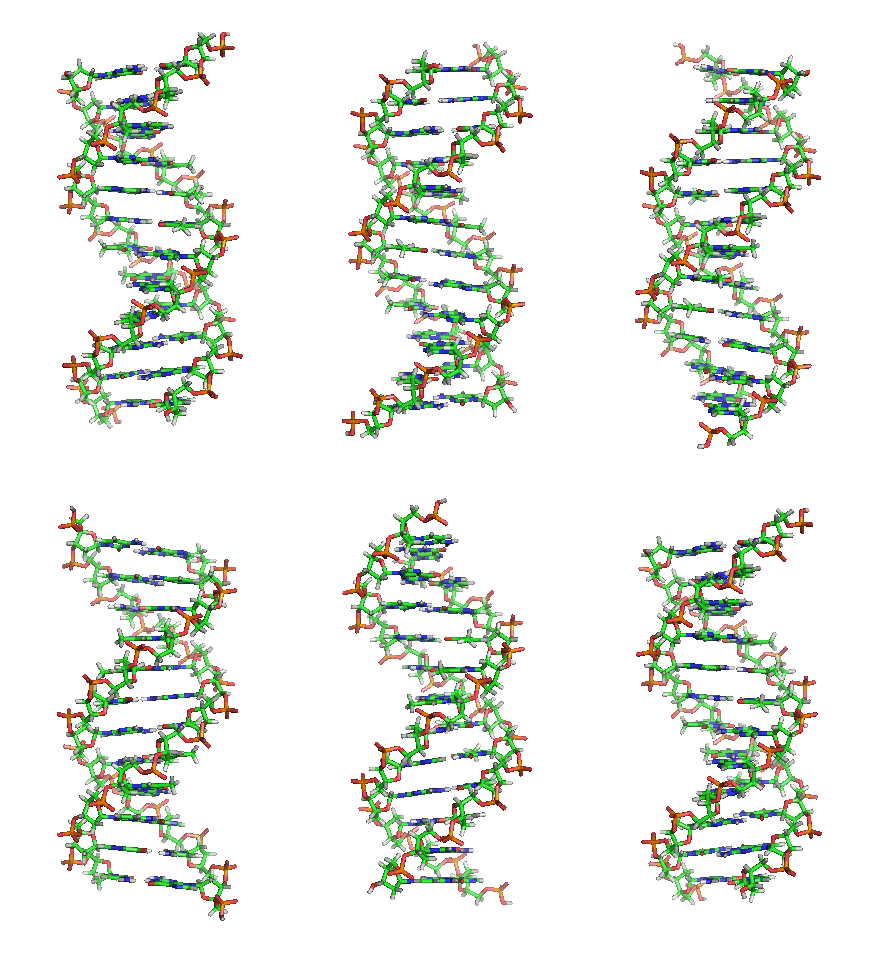
Its famous double-helix structure resembles a twisted ladder. The sides of the ladder are made of sugar and phosphate molecules, while the rungs consist of four chemical bases.
These four bases are:
Adenine (A)
Thymine (T)
Cytosine (C)
Guanine (G)
The bases pair in a highly predictable way. Adenine always pairs with thymine, while cytosine always pairs with guanine.
This simple pairing rule forms the foundation of DNA computing.
What Is DNA Computing?
DNA computing is a form of computation that uses DNA molecules to store information and perform calculations.
Instead of representing information using binary digits—zeros and ones—DNA computing represents information using combinations of the four DNA bases: A, T, C, and G.
Scientists design synthetic DNA molecules that represent data and mathematical problems. These DNA strands are then mixed together in carefully controlled laboratory conditions, where natural biochemical reactions process the information.
Rather than electronic circuits performing operations one after another, millions or even trillions of DNA molecules can react simultaneously.
This remarkable ability allows DNA computers to process enormous numbers of possible solutions at the same time.
In many cases, this is known as massive parallelism, one of DNA computing’s greatest strengths.
The History of DNA Computing
The idea of DNA computing first gained worldwide attention in 1994 when computer scientist Leonard Adleman demonstrated that DNA could solve a mathematical problem known as the Hamiltonian Path Problem.
The problem involves finding a path through several locations while visiting each location exactly once.
Although the problem sounds simple, it becomes extremely difficult as the number of locations increases.
Adleman represented each location with specially designed DNA molecules. When mixed together, the DNA strands naturally combined in ways that represented possible solutions.
Using laboratory techniques, he filtered out incorrect combinations until only the correct solution remained.
His experiment proved that DNA could perform computational tasks.
Although the calculation was relatively small, it marked the birth of DNA computing as a scientific field.
How Traditional Computers Work
Conventional computers process information using billions of tiny electronic switches called transistors.
Each transistor exists in one of two states.
These two states represent binary digits:
0
1
Every photo, video, document, game, website, and computer program eventually becomes an enormous collection of zeros and ones.
The computer’s processor performs calculations by rapidly switching billions of transistors on and off.
Modern processors can execute billions of operations every second.
This technology has driven computing for decades.
However, as engineers continue shrinking transistors, they are approaching physical limits imposed by quantum effects and heat generation.
Scientists are therefore exploring entirely new forms of computation—including DNA computing.
How DNA Computing Works
DNA computing replaces electronic circuits with carefully designed DNA molecules.
Scientists begin by encoding information into synthetic DNA strands.
Each DNA strand represents part of a computational problem.
The DNA molecules are then placed into a solution containing enzymes and other chemicals that allow biochemical reactions to occur.
As DNA strands naturally recognize and bind to complementary sequences, they perform operations similar to logical calculations.
After the reactions finish, laboratory methods identify which DNA molecules represent valid solutions.
These techniques may involve separating DNA by size, detecting fluorescent markers, or sequencing the resulting DNA.
Although the laboratory procedures can be complex, the underlying principle is elegant.
Nature’s own molecular interactions become the computing system.
DNA as a Data Storage Medium
DNA is not only useful for computing.
It is also one of the most efficient information storage systems ever discovered.
Every living organism stores astonishing amounts of genetic information inside microscopic cells.
Scientists have realized that synthetic DNA could also store digital information.
Text, photographs, music, videos, computer software, and scientific databases can all be converted into DNA sequences.
The information is encoded using combinations of A, T, C, and G.
Later, DNA sequencing machines can read the stored information and convert it back into digital form.
The storage capacity of DNA is extraordinary.
A tiny amount of DNA could theoretically store enormous quantities of digital data, making it one of the densest known data-storage media.
Because DNA can remain stable for thousands of years under suitable conditions, it may eventually become valuable for long-term archival storage.
Why DNA Computing Is So Powerful
The greatest strength of DNA computing lies in its ability to perform many calculations simultaneously.
A conventional computer typically processes calculations sequentially or with a limited number of processor cores working in parallel.
DNA, however, allows billions or even trillions of molecules to react at the same time.
Imagine trying to solve a giant maze.
A traditional computer might explore one path after another.
A DNA computer could explore an enormous number of paths simultaneously.
This massive parallelism gives DNA computing enormous potential for solving specific types of highly complex optimization problems.
DNA Computing and Parallel Processing
Parallel processing is one of the defining features of DNA computing.
Every DNA molecule can be viewed as an independent computational unit.
Instead of one processor solving one problem step by step, countless DNA molecules work together simultaneously.
This means certain calculations that would require enormous computational resources on conventional computers might become more manageable using DNA-based systems.
However, not every problem benefits equally from this approach.
DNA computing excels in specialized computational tasks rather than general-purpose computing.
The Role of Enzymes
DNA computing depends heavily on biological molecules known as enzymes.
Enzymes act as molecular tools.
Some enzymes cut DNA.
Others join DNA fragments together.
Some copy DNA sequences.
Others modify specific regions.
Scientists carefully select enzymes depending on the computational operation they want to perform.
Without enzymes, many DNA computing processes would not be possible.
Reading the Results
Once the biochemical reactions finish, scientists must determine the computational outcome.
Unlike electronic computers that instantly display results on a screen, DNA computing requires laboratory analysis.
Researchers may amplify DNA using the polymerase chain reaction (PCR), separate molecules using gel electrophoresis, or determine exact sequences through DNA sequencing.
The resulting DNA molecules reveal the solution produced during computation.
Although these laboratory methods have become much faster over the past few decades, they remain slower than reading results from conventional computers.
Advantages of DNA Computing
DNA computing offers several remarkable advantages.
One of the most important is its incredible information density.
DNA stores vast amounts of information within an extremely small volume.
Another advantage is energy efficiency.
Electronic computers consume electricity and generate heat.
DNA reactions require far less energy because they rely on natural chemical processes.
DNA computing also provides extraordinary parallel processing capabilities.
Millions or trillions of molecular reactions can occur simultaneously.
Furthermore, DNA is biodegradable and naturally occurring, making it environmentally attractive compared with some electronic components.
The Limitations of DNA Computing
Despite its promise, DNA computing also faces significant challenges.
Many DNA calculations require complex laboratory procedures.
Preparing DNA molecules takes time.
Reading results often requires advanced sequencing technologies.
Errors can occur during DNA synthesis, replication, or molecular reactions.
Contamination from unwanted DNA may also interfere with experiments.
Another challenge is speed.
Although DNA performs many reactions simultaneously, the overall laboratory workflow can still be slower than electronic computation for many everyday tasks.
For these reasons, DNA computing is unlikely to replace conventional personal computers.
Instead, it will probably complement existing technologies in specialized applications.
DNA Computing Versus Traditional Computing
Traditional computers excel at arithmetic, graphics, web browsing, gaming, and everyday software applications.
They provide instant responses and high reliability.
DNA computers operate very differently.
Rather than focusing on speed for individual calculations, they excel at exploring vast numbers of possible solutions simultaneously.
Electronic computers remain far better suited for general computing tasks.
DNA computing becomes attractive when solving certain highly complex optimization or combinatorial problems involving enormous numbers of possibilities.
The two technologies are therefore more complementary than competitive.
DNA Computing and Artificial Intelligence
Artificial intelligence requires enormous computational resources.
As AI systems continue growing in size and complexity, researchers are investigating alternative hardware technologies.
DNA computing may eventually contribute to future AI systems by performing specialized optimization tasks or handling certain forms of parallel computation.
Although practical DNA-based artificial intelligence remains an active area of research, scientists continue exploring how biological computing could support next-generation intelligent systems.
DNA Computing in Medicine
Medicine represents one of the most exciting applications of DNA computing.
Researchers are developing DNA-based molecular computers capable of operating inside living cells.
These molecular systems could someday detect disease markers and respond automatically.
For example, future DNA computers might recognize cancer-related molecules and trigger the release of medication only where it is needed.
Such targeted treatments could reduce side effects while improving effectiveness.
Scientists are also investigating DNA computing for disease diagnosis, personalized medicine, and smart drug delivery.
Although many of these technologies remain experimental, early research has produced encouraging results.
DNA Nanotechnology
DNA is not only an information molecule.
It is also an excellent building material.
Scientists have learned to fold DNA into remarkably complex microscopic shapes through a technique called DNA origami.
These structures may eventually become tiny machines capable of carrying medicines, sensing disease, or performing molecular-scale tasks inside the human body.
DNA computing and DNA nanotechnology often overlap because both rely on programmable DNA interactions.
Together they represent one of the fastest-growing areas of modern biotechnology.
DNA Computing and Cryptography
Protecting digital information is becoming increasingly important.
Researchers have explored whether DNA molecules could support new methods of encryption and secure communication.
Because DNA sequences can encode enormous amounts of information and generate vast numbers of combinations, they offer intriguing possibilities for future cryptographic systems.
Although practical DNA-based encryption remains largely experimental, it illustrates the growing range of applications being investigated.
Environmental Applications
DNA computing may also contribute to environmental science.
Scientists are exploring biological sensors capable of detecting pollutants, toxins, harmful bacteria, or viruses.
These systems could monitor water quality, food safety, and environmental health with remarkable sensitivity.
Some future DNA-based devices may operate without conventional electronics, making them useful in remote or resource-limited environments.
DNA Computing and Synthetic Biology
Synthetic biology aims to design and build new biological systems with predictable functions.
DNA computing fits naturally within this field.
Scientists can engineer genetic circuits that perform logical operations inside living cells.
These biological circuits behave similarly to electronic logic gates.
They respond to specific chemical signals and produce measurable biological outputs.
Such systems may eventually lead to programmable cells capable of sensing diseases, manufacturing medicines, or repairing damaged tissues.
Could DNA Replace Silicon?
One of the most common questions about DNA computing is whether it will replace today’s silicon-based computers.
The answer is probably no.
Silicon computers remain unmatched for everyday computing tasks.
They are fast, reliable, inexpensive, and capable of running billions of software applications.
DNA computing serves a very different purpose.
Rather than replacing laptops or smartphones, DNA computers will likely become specialized tools used alongside electronic computers.
Researchers envision hybrid systems where conventional computers handle most calculations while DNA-based systems solve highly specialized molecular problems.
Current Research
Today, scientists around the world continue improving DNA computing technologies.
Researchers are developing faster DNA synthesis methods, more accurate sequencing technologies, improved molecular programming techniques, and automated laboratory systems.
Advances in biotechnology are steadily reducing costs while increasing reliability.
At the same time, improvements in machine learning and robotics are helping automate many laboratory procedures involved in DNA computation.
Although commercial DNA computers are not yet available, progress continues at an impressive pace.
Challenges for the Future
Several scientific and engineering challenges must be overcome before DNA computing becomes widely practical.
Researchers need faster methods for writing and reading DNA.
Laboratory workflows must become more automated and less expensive.
Error rates need further reduction.
Scientists must also develop standardized programming methods that allow DNA computers to solve increasingly sophisticated problems.
Addressing these challenges will require collaboration among biologists, chemists, computer scientists, engineers, mathematicians, and physicists.
The Future of DNA Computing
The future of DNA computing is filled with exciting possibilities.
As DNA synthesis becomes cheaper and sequencing technologies continue improving, biological computation is expected to become increasingly practical.
Future DNA computers may assist in designing new medicines, optimizing transportation systems, analyzing massive scientific datasets, solving complex mathematical problems, monitoring environmental conditions, and supporting advanced medical diagnostics.
Researchers also envision tiny molecular computers operating inside living cells, continuously monitoring health and responding to disease long before symptoms appear.
Although many of these ideas remain under development, the pace of progress suggests that DNA computing will become an increasingly important part of future science and technology.
Why DNA Computing Matters
DNA computing represents a remarkable shift in how we think about computation. For more than half a century, computing has been dominated by electronic circuits built from silicon. DNA computing challenges that tradition by demonstrating that information processing is not limited to electronics. The same molecule that stores the genetic instructions for every known living organism can also be programmed to solve mathematical and computational problems.
This emerging technology combines the elegance of biology with the precision of computer science, opening possibilities that were once unimaginable. While DNA computers are unlikely to replace everyday electronic devices, they offer unique strengths that could revolutionize specialized fields such as medicine, biotechnology, data storage, and complex scientific research.
Ultimately, DNA computing reminds us that nature itself is an extraordinary information processor. By learning from the molecular systems that have evolved over billions of years, scientists are creating entirely new ways to compute, store information, and solve some of the most challenging problems facing humanity. As research continues, DNA computing may become one of the defining technologies of the twenty-first century, demonstrating that the future of computing can be built not only from silicon, but also from the very molecule that makes life possible.