Imagine standing in the dusty ruins of an ancient settlement near Baghdad, Iraq. Archaeologists carefully brush away layers of earth that have remained untouched for centuries. Among fragments of pottery, broken tools, and the remnants of long-forgotten lives, an unusual object emerges from the ground. At first glance, it appears ordinary—a simple clay jar. Yet hidden inside this humble vessel is a combination of materials that would eventually spark one of archaeology’s greatest mysteries.
Could people living nearly two thousand years ago have discovered electricity?
The question sounds like something from a science-fiction novel. After all, most of us associate electricity with modern civilization. We think of power plants, light bulbs, computers, and smartphones. We imagine scientists like Benjamin Franklin or Michael Faraday helping humanity unlock the secrets of electricity during the last few centuries.
Yet a curious artifact discovered in Iraq has led some researchers to wonder whether ancient people may have experimented with electrical principles long before modern science existed.
This object became known as the Baghdad Battery.
For decades, it has fascinated historians, archaeologists, engineers, and mystery enthusiasts. Some believe it may represent evidence of ancient electrical technology. Others argue that such claims go far beyond the available evidence. Between these opposing views lies a captivating story involving archaeology, science, speculation, and the enduring human desire to solve mysteries.
The Baghdad Battery remains one of the most debated artifacts ever discovered. It raises questions not only about ancient technology but also about how we interpret the past.
Was it really an ancient battery?
Or is it a misunderstood object whose true purpose has been lost to time?
The Discovery That Started the Mystery
The story begins in the 1930s.
Near Baghdad, archaeologists uncovered a collection of artifacts from an ancient site called Khujut Rabu. The excavation was part of ongoing efforts to understand the rich history of Mesopotamia, a region often called the cradle of civilization.
Among the discoveries was a small clay jar unlike anything archaeologists had expected.
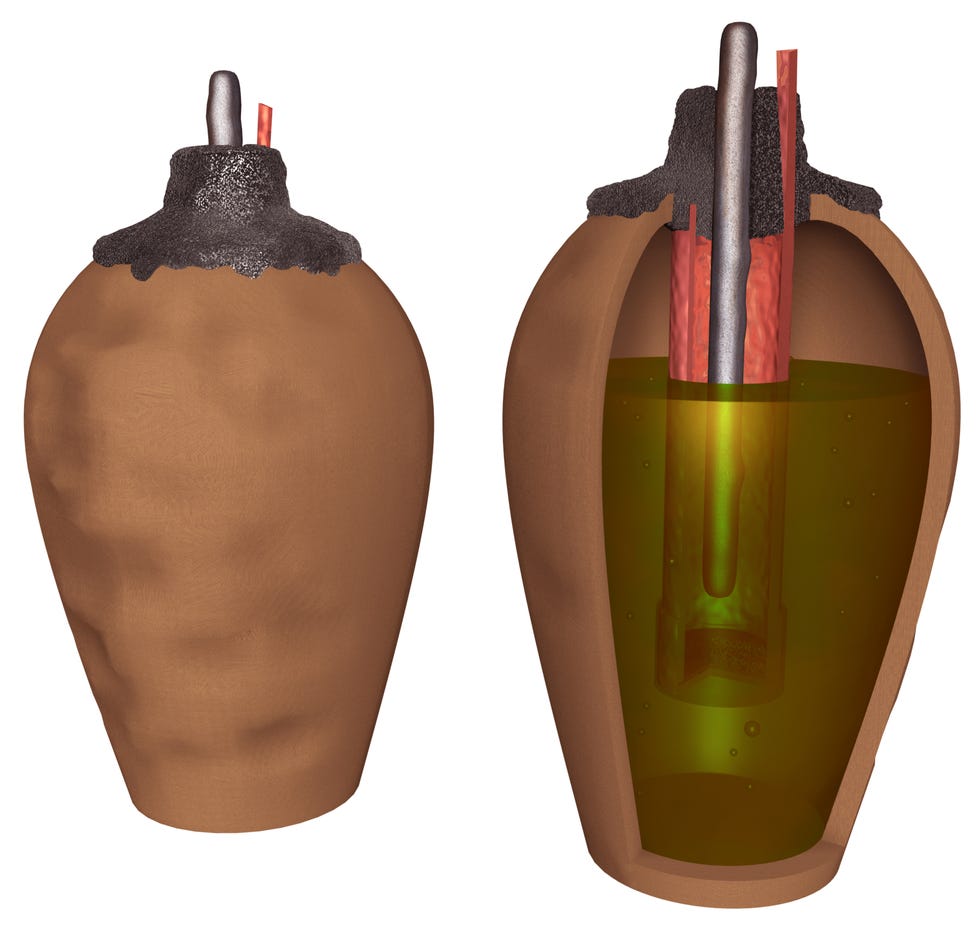
The jar measured roughly 13 centimeters in height. Inside it was a copper cylinder. Running through the center of that cylinder was an iron rod. The components were held together with a type of bitumen, a naturally occurring asphalt-like substance used by ancient peoples for sealing and waterproofing.
The artifact attracted attention because its construction seemed unusual.
The discovery was later examined by Wilhelm König, who served as director of the Iraq Museum in Baghdad.
König noticed something intriguing.
The arrangement of copper and iron resembled the basic structure of a galvanic cell, which is one of the simplest forms of battery.
His observation would ignite decades of debate.
Understanding How a Battery Works
To appreciate why the artifact generated so much excitement, it helps to understand the basic principles of a battery.
A battery produces electricity through a chemical reaction.
In a simple battery, two different metals are placed in a liquid capable of conducting electricity. This liquid is known as an electrolyte.
Because the metals have different chemical properties, electrons begin flowing from one metal to the other. This movement creates an electric current.
Modern batteries can be highly sophisticated, but the underlying principle is surprisingly simple.
A copper electrode and an iron electrode immersed in an acidic solution can generate a small voltage.
When researchers examined the Baghdad artifact, they realized it contained exactly these materials.
There was copper.
There was iron.
There was a container capable of holding liquid.
Suddenly an extraordinary possibility emerged.
What if ancient people had accidentally—or intentionally—created a primitive battery?
Why the Artifact Resembles a Battery
The structure of the Baghdad Battery appears surprisingly compatible with the requirements of a galvanic cell.
The clay jar could hold a liquid.
The copper cylinder could act as one electrode.
The iron rod could act as another.
If an acidic liquid such as vinegar, wine, or fruit juice were added, a chemical reaction could occur.
In theory, the device could generate electricity.
This possibility immediately captured public imagination.
The idea seemed almost unbelievable.
How could people living nearly two thousand years ago have created something resembling a battery?
Even more astonishing was the possibility that they might have used electricity for practical purposes.
The mystery quickly grew beyond archaeology and entered popular culture.
Dating the Artifact
One of the first challenges researchers faced involved determining the age of the artifact.
Most scholars believe the Baghdad Battery dates to the Parthian period, which lasted from approximately 247 BCE to 224 CE.
The Parthian Empire was a major power in the ancient Middle East. It controlled vast territories and played an important role in trade between East and West.
Some researchers have suggested the artifact might instead belong to the later Sasanian period, which followed the Parthians.
Unfortunately, precise dating remains difficult because the object was not recovered under ideal archaeological conditions by modern standards.
This uncertainty complicates efforts to understand its purpose.
Even if the artifact could generate electricity, we still need evidence showing that ancient people intended it to do so.
The First Battery Hypothesis
König proposed that the jar may have functioned as a battery.
His idea was revolutionary.
If correct, it would push the history of electrical experimentation back by nearly two thousand years.
The hypothesis attracted widespread attention because it challenged traditional assumptions about technological development.
Most histories of electricity focus on discoveries made during the seventeenth, eighteenth, and nineteenth centuries.
The Baghdad Battery suggested that people in antiquity may have stumbled upon electrical principles long before modern science emerged.
The possibility was exciting.
It hinted at lost knowledge, forgotten experiments, and technological achievements hidden beneath the sands of time.
Yet extraordinary claims require extraordinary evidence.
Many scholars remained skeptical.
Experimental Reconstructions
To test the battery theory, researchers began constructing replicas.
Using clay jars, copper cylinders, iron rods, and acidic liquids, they recreated the artifact as closely as possible.
The results were fascinating.
The replicas often generated small amounts of electricity.
Some experiments produced around one volt.
This voltage was modest but measurable.
The findings demonstrated something important.
The artifact could function as a battery.
The question, however, was not whether it could generate electricity.
The question was whether that was its intended purpose.
This distinction lies at the heart of the debate.
Many objects can perform functions never envisioned by their creators.
A stone can be used as a hammer even if it was originally intended as a decoration.
Similarly, the Baghdad artifact might generate electricity without having been designed as a battery.
Could Ancient People Have Used Electricity?
If the artifact truly functioned as a battery, what might it have been used for?
This question has inspired numerous theories.
One possibility involves electroplating.
Electroplating uses electricity to deposit a thin layer of metal onto another object.
For example, a silver object can be coated with gold.
Some researchers have suggested that ancient craftsmen may have used electricity to create decorative metal finishes.
This idea gained popularity because several ancient artifacts display remarkably fine metallic coatings.
Could ancient artisans have employed primitive batteries to achieve these effects?
The theory is intriguing but controversial.
No direct evidence links the Baghdad Battery to electroplating.
Furthermore, many metal coatings can be produced using purely chemical methods that require no electricity.
As a result, the electroplating hypothesis remains speculative.
The Electroplating Debate
Supporters of the battery theory often point to the possibility of ancient electroplating as evidence of advanced technological knowledge.
The idea is appealing.
Imagine skilled craftsmen quietly experimenting with electricity centuries before the scientific revolution.
However, archaeologists face a significant problem.
No electroplating workshop has been discovered alongside the artifact.
No wiring has been found.
No electrical tools have been identified.
No ancient texts describe electrical plating techniques.
Without supporting evidence, the theory remains difficult to prove.
Many experts argue that if electricity had been widely used for metalworking, more archaeological traces should exist.
The absence of such evidence raises important questions.
Medical Uses and Ancient Healing
Another theory suggests the artifact may have been used for medical purposes.
Ancient cultures practiced many forms of healing that seem unusual today.
Some researchers have speculated that small electrical currents may have been applied to patients.
This idea is not entirely impossible.
Even in later periods, people observed that electric fish could produce shocks. These shocks were occasionally used to treat pain and other conditions.
Could ancient physicians have discovered that mild electrical stimulation produced certain effects?
Perhaps.
But once again, direct evidence is lacking.
No ancient medical texts mention devices resembling the Baghdad Battery.
No records describe electrical treatments.
The theory remains an interesting possibility rather than a demonstrated fact.
Religious and Ritual Explanations
Some scholars have proposed religious explanations.
Ancient temples often used dramatic effects to inspire awe.
A mild electrical shock could potentially appear mysterious or supernatural.
Imagine a worshipper touching a sacred object and experiencing a strange sensation.
Such an event might reinforce beliefs about divine power.
This theory has obvious appeal because religion played a central role in many ancient societies.
Yet evidence remains sparse.
No archaeological context clearly connects the artifact to temples or ritual practices.
As with many Baghdad Battery theories, the idea is intriguing but difficult to verify.
The Skeptics Speak
While the battery hypothesis receives significant attention, many archaeologists remain unconvinced.
Their objections are serious and deserve consideration.
The first issue involves context.
Artifacts cannot be understood in isolation.
Archaeologists rely heavily on surrounding evidence to determine an object’s purpose.
Unfortunately, the Baghdad Battery lacks a clear context that supports electrical use.
No wires were found.
No connected devices were discovered.
No electrical infrastructure exists.
Without these supporting elements, the battery interpretation becomes less certain.
Skeptics argue that it is dangerous to project modern concepts onto ancient objects.
Just because something resembles a battery does not necessarily mean it was used as one.
Alternative Explanations
Several alternative interpretations have been proposed.
Some researchers believe the jar may have been used for storing scrolls.
The copper cylinder could have protected delicate documents from moisture and damage.
Others suggest the artifact functioned as a container for sacred objects or ritual materials.
Still others view it as a storage vessel with a purpose unrelated to electricity.
These explanations may seem less exciting than ancient batteries, but they align more closely with known ancient practices.
The challenge is that none of these alternatives can be proven definitively either.
The artifact remains ambiguous.
Its true purpose continues to elude certainty.
Why Ancient Technology Fascinates Us
Part of the Baghdad Battery’s popularity comes from a broader fascination with ancient technology.
People love stories suggesting that ancient civilizations possessed unexpected knowledge.
Such stories challenge assumptions about progress and innovation.
The Baghdad Battery appears to offer a glimpse into a forgotten chapter of technological history.
It encourages us to ask whether ancient societies were more sophisticated than we realize.
In many ways, this curiosity is justified.
Ancient civilizations achieved extraordinary feats.
They built massive monuments, developed complex mathematics, created advanced irrigation systems, and conducted impressive astronomical observations.
The ancient world was far more technologically capable than many people imagine.
Yet recognizing ancient ingenuity does not require accepting every extraordinary claim.
Careful evidence remains essential.
The Loss of Archaeological Evidence
One factor complicating the Baghdad Battery mystery is the tragic loss of archaeological materials over time.
Wars, looting, environmental damage, and political instability have affected many ancient sites in Iraq.
Artifacts have been destroyed or displaced.
Records have been lost.
Historical context has sometimes disappeared forever.
These losses make it harder to reconstruct the original purpose of objects like the Baghdad Battery.
Every missing piece of evidence leaves room for uncertainty.
In archaeology, context is often as valuable as the artifact itself.
Without complete context, mysteries become more difficult to solve.
Electricity Before Modern Science
The Baghdad Battery raises a fascinating question.
Could people discover practical electrical effects without understanding electricity scientifically?
The answer is yes.
History contains many examples of phenomena being used long before their underlying principles were understood.
People employed magnets for centuries before learning about magnetic fields.
They used fermentation long before understanding microorganisms.
They practiced metallurgy before developing modern chemistry.
It is entirely possible that ancient individuals observed electrical effects accidentally.
Whether they transformed those observations into useful technology is another matter.
The Baghdad Battery sits precisely at this crossroads of possibility and uncertainty.
What Modern Experiments Reveal
Modern reconstructions have continued for decades.
Researchers repeatedly demonstrate that replicas can generate small amounts of electricity.
Some experiments even connect multiple cells together to increase voltage.
These demonstrations show that the design is capable of producing current.
Yet they also highlight limitations.
The amount of electricity generated is relatively small.
Maintaining consistent operation would require suitable electrolytes and regular maintenance.
Most importantly, there is still no direct evidence that ancient people used the device in this manner.
The experiments prove capability.
They do not prove intention.
This distinction remains crucial.
The Media and the Mystery
The Baghdad Battery became especially popular through documentaries, books, magazines, and television programs.
Stories about ancient batteries naturally attract attention.
They combine archaeology, science, mystery, and the possibility of hidden knowledge.
However, media presentations sometimes oversimplify the debate.
Claims are occasionally presented as established facts when they remain speculative.
This can create misunderstandings.
In reality, the artifact exists within a spectrum of possibilities.
Its interpretation remains contested.
Serious scholars continue evaluating evidence rather than declaring the mystery solved.
The Importance of Scientific Skepticism
The Baghdad Battery offers an important lesson about scientific thinking.
Curiosity is essential.
Imagination is valuable.
But evidence matters.
A good hypothesis must be tested.
Alternative explanations must be considered.
Extraordinary ideas should be examined carefully rather than accepted automatically.
The battery theory deserves attention because it is plausible enough to investigate.
At the same time, skepticism prevents conclusions from outrunning evidence.
The best science balances open-mindedness with critical evaluation.
The Baghdad Battery provides a perfect example of this process in action.
What the Artifact Tells Us About Human Creativity
Regardless of its true purpose, the artifact reveals something remarkable about ancient craftsmanship.
The creators combined multiple materials in a sophisticated manner.
They worked with copper, iron, clay, and bitumen.
They understood how to manufacture durable objects.
They solved practical engineering challenges.
Whether their goal involved storage, ritual, preservation, or electricity, the artifact reflects ingenuity.
Ancient people were not primitive thinkers waiting for modern civilization to arrive.
They were skilled observers, experimenters, and innovators.
The Baghdad Battery reminds us that human creativity has deep roots stretching back thousands of years.
Could the Mystery Ever Be Solved?
Will we ever know the true purpose of the Baghdad Battery?
Perhaps.
Future discoveries may provide new clues.
Additional artifacts might emerge from archaeological excavations.
Ancient texts could reveal forgotten practices.
Scientific analysis may uncover evidence invisible to earlier researchers.
Yet it is also possible that the mystery will remain unresolved.
History does not always provide complete answers.
Sometimes the evidence simply does not survive.
Archaeologists must learn to work with uncertainty.
The Baghdad Battery may ultimately remain one of those rare puzzles that resist definitive explanation.
The Legacy of the Baghdad Battery
Today, the Baghdad Battery occupies a unique place in archaeological history.
It is neither fully understood nor entirely mysterious.
It exists in a fascinating middle ground where evidence and speculation meet.
To believers, it hints at forgotten technological achievements.
To skeptics, it serves as a cautionary tale about interpreting ancient artifacts through modern assumptions.
To historians, it represents a challenging puzzle.
To the public, it remains an irresistible mystery.
Few artifacts have inspired such enduring debate from such humble beginnings.
A simple clay jar discovered in Iraq continues to provoke questions about knowledge, innovation, and the limits of our understanding.
Conclusion
The Baghdad Battery is one of archaeology’s most captivating enigmas. Discovered near Baghdad and consisting of a clay jar, a copper cylinder, and an iron rod, it resembles a simple galvanic cell capable of generating electricity when combined with an acidic liquid. Experimental reconstructions have shown that such a device can indeed produce a small electrical current.
Yet the central mystery remains unsolved.
The fact that the artifact can function as a battery does not necessarily mean it was designed to do so. Archaeologists have found no clear evidence of ancient electrical technology, no associated tools, and no written records describing such use. Alternative explanations involving storage, ritual practices, or other purposes remain entirely possible.
What makes the Baghdad Battery so fascinating is not merely the question of electricity. It is the broader challenge of understanding the past. The artifact reminds us that ancient civilizations were complex, inventive, and often surprising. It also reminds us that history is filled with uncertainties.
Whether the Baghdad Battery was an ancient power source, a ritual object, a storage container, or something else entirely, it continues to capture imaginations around the world. More than eighty years after its discovery, the mystery endures.
And perhaps that is part of its power.
The Baghdad Battery invites us to look at the past with curiosity, humility, and wonder—recognizing that even the smallest object can raise questions large enough to challenge everything we think we know about human history.