In 1901, sponge divers searching the seafloor near the small Greek island of Antikythera stumbled upon the remains of an ancient shipwreck. At first, the discovery seemed like many other archaeological finds beneath the Mediterranean Sea. The wreck contained beautiful bronze statues, marble sculptures, pottery, jewelry, coins, and other valuable artifacts that had rested underwater for nearly two thousand years.
But hidden among these treasures was an object unlike anything anyone had ever seen.
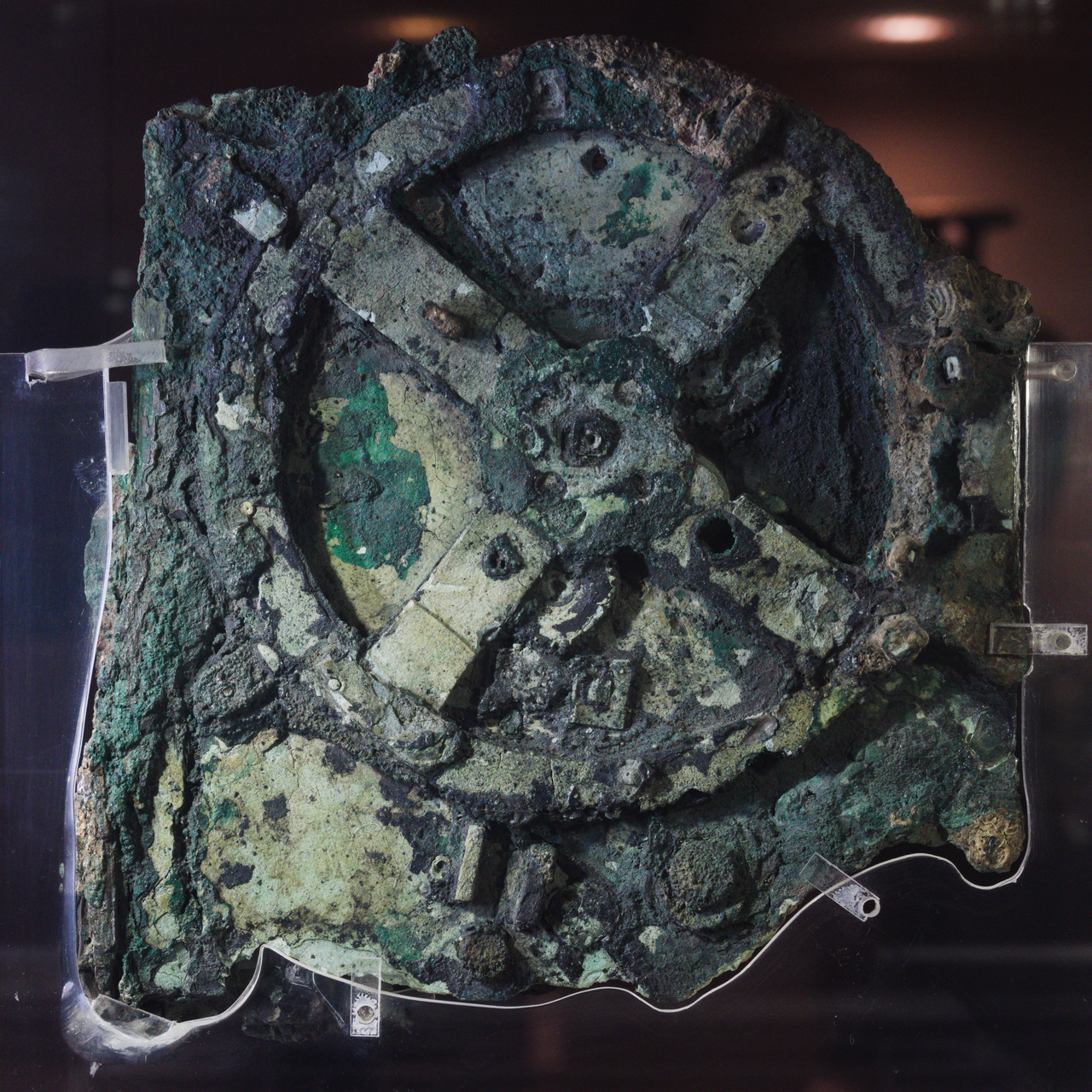
It looked like nothing more than a lump of green, heavily corroded bronze covered with rock-like deposits. For months, it attracted little attention. Then, as the object slowly dried, it cracked open.
Inside were tiny bronze gears.
Archaeologists and historians were stunned.
No one expected to find such a sophisticated mechanical device in an ancient Greek shipwreck dating to around the first century BCE. The intricate system of interlocking gears looked more like something from a medieval clock than an artifact built over 2,000 years ago.
As scientists began studying the mysterious object, they realized it was even more extraordinary than they had imagined.
The device could predict the movements of the Sun and Moon. It tracked the phases of the Moon, forecast eclipses, followed ancient calendars, and may even have displayed the positions of the known planets. It achieved all of this through an astonishing arrangement of precision-cut bronze gears, making it one of the most advanced scientific instruments of the ancient world.
Today, the artifact is known as the Antikythera Mechanism.
Often called the world’s first analog computer, it has transformed our understanding of ancient Greek science, engineering, astronomy, and mathematics. Before its discovery, historians believed technology of this complexity appeared more than a thousand years later.
Instead, the Antikythera Mechanism revealed that ancient engineers possessed levels of mechanical skill that had long been forgotten.
Yet despite decades of research, the device continues to raise fascinating questions.
Who designed it?
Who built it?
How was it used?
Why was such remarkable technology lost for centuries?
These mysteries continue to inspire scientists, historians, engineers, and curious minds around the world.
What Is the Antikythera Mechanism?
The Antikythera Mechanism is an ancient Greek mechanical device built from bronze gears enclosed within a wooden case.
Although only fragments survive today, researchers have reconstructed much of its original design.
The mechanism functioned by turning a hand-operated crank.
As the gears rotated, pointers moved across engraved scales, displaying astronomical information.
Rather than being a simple calendar, the device performed complex calculations involving celestial cycles.
It tracked time, predicted eclipses, followed lunar cycles, and modeled astronomical movements with remarkable precision.
Its sophisticated engineering has led many historians to describe it as the earliest known analog computer.
Unlike modern digital computers that process information using binary numbers, an analog computer models real-world systems through continuous mechanical movement.
The Antikythera Mechanism achieved this using carefully designed gears.
The Discovery of the Shipwreck
The story begins in the spring of 1900.
A group of sponge divers from the Greek island of Symi sought shelter from a storm near Antikythera.
While diving, one of the men descended nearly 50 meters beneath the surface.
Instead of finding sponges, he discovered something astonishing.
Scattered across the seafloor lay statues, pottery, glassware, coins, furniture, and countless other ancient objects.
The Greek government organized an archaeological recovery operation.
Divers worked under extremely dangerous conditions using early diving equipment.
Several suffered serious injuries, and one diver died during the expedition.
Despite these risks, they recovered hundreds of priceless artifacts.
Among them was the strange corroded object that would later become world famous.
A Forgotten Treasure
Initially, the mechanism attracted little attention.
Its appearance hardly suggested an advanced scientific instrument.
Years passed before scholars noticed tiny gear teeth embedded within the bronze fragments.
The discovery changed everything.
Ancient civilizations certainly possessed gears.
Simple gear systems had appeared in water-lifting devices and other machines.
However, nothing approaching the complexity of the Antikythera Mechanism had ever been found.
It represented technology centuries ahead of what historians believed existed during the ancient world.
Dating the Mechanism
Researchers estimate the mechanism was built between approximately 150 BCE and 100 BCE.
The ship carrying it likely sank around 70 to 60 BCE.
Several forms of evidence support these dates.
Coins recovered from the shipwreck provide chronological clues.
The style of inscriptions matches other Greek writing from the period.
Astronomical calculations encoded within the mechanism also fit this timeframe.
Although the exact construction date remains uncertain, scholars generally agree it originated during the Hellenistic period, when Greek science flourished.
The World That Created It
The Antikythera Mechanism emerged during an extraordinary era of intellectual achievement.
Following the conquests of Alexander the Great, Greek knowledge spread across the eastern Mediterranean.
Cities such as Alexandria became centers of learning.
Mathematicians, astronomers, engineers, philosophers, and physicians exchanged ideas.
This period produced remarkable scientific advances.
Geometry, astronomy, mechanics, medicine, and mathematics all developed rapidly.
The mechanism reflects this environment of innovation.
It demonstrates that Greek engineers combined theoretical knowledge with practical craftsmanship at an astonishing level.
What Was It Used For?
The Antikythera Mechanism was not a navigation device.
Nor was it a clock.
Instead, it served primarily as an astronomical calculator.
By rotating a handle, users could determine the positions of celestial bodies for specific dates.
The device displayed the annual movement of the Sun.
It showed the changing phases of the Moon.
It predicted solar and lunar eclipses.
It followed important astronomical cycles.
It may also have displayed the positions of the five planets visible to the naked eye—Mercury, Venus, Mars, Jupiter, and Saturn.
The mechanism essentially transformed complicated astronomical mathematics into mechanical motion.
The Amazing Gear System
One of the most astonishing features is its gear train.
Researchers have identified more than thirty surviving bronze gears, although the complete mechanism probably contained around thirty-seven or more.
Each gear possessed carefully cut triangular teeth.
Different gear sizes produced different rotational speeds.
By combining multiple gears, engineers recreated complex astronomical cycles.
Some gears rotated rapidly.
Others moved very slowly.
Together, they modeled celestial motions over many years.
This level of precision required exceptional engineering skill.
Understanding Analog Computing
Modern computers perform billions of calculations electronically.
The Antikythera Mechanism achieved calculations mechanically.
When one gear turned, it caused connected gears to rotate at carefully controlled rates.
These movements represented mathematical relationships.
Instead of displaying numbers on a screen, the mechanism displayed astronomical positions using rotating pointers.
Every gear ratio encoded mathematical knowledge.
The machine itself became a physical representation of astronomical calculations.
This is why historians often describe it as the world’s earliest known analog computer.
Predicting Eclipses
One of the mechanism’s greatest achievements involved eclipse prediction.
Ancient astronomers recognized that eclipses followed repeating cycles.
One particularly important cycle is the Saros cycle, lasting approximately eighteen years.
After one Saros cycle, similar eclipses tend to occur again.
The Antikythera Mechanism included a dial representing this cycle.
Users could determine when future eclipses were likely.
The device even indicated whether an eclipse would be solar or lunar.
Although it could not predict visibility for every location on Earth, its accuracy was extraordinary for its time.
Following the Moon
The Moon does not move across the sky at a perfectly constant speed.
Its orbit is slightly irregular.
Remarkably, the Antikythera Mechanism accounted for this complexity.
Researchers discovered evidence of a sophisticated gear arrangement producing variable lunar motion.
This feature astonished modern engineers.
The designers did not merely imitate simple circular motion.
They incorporated advanced astronomical understanding into mechanical form.
Few ancient devices demonstrate such mathematical sophistication.
Tracking the Calendar
The mechanism also functioned as a calendar.
Ancient Greece used several calendar systems.
The device incorporated the Egyptian solar calendar consisting of 365 days.
It also tracked the Metonic cycle, a nineteen-year period after which lunar phases repeat on nearly the same calendar dates.
This cycle helped coordinate lunar and solar calendars.
Such information proved useful for scheduling festivals, religious ceremonies, and agricultural activities.
The Olympic Games Dial
One fascinating discovery concerns a small dial connected with major Greek athletic festivals.
Among these was the Olympic Games.
The mechanism helped determine when important competitions would occur.
This feature reminds us that astronomy influenced everyday life.
Calendars governed religious festivals, political events, agriculture, and sporting competitions.
The mechanism connected scientific observation with practical human activities.
The Inscriptions
The Antikythera Mechanism contains thousands of Greek letters engraved onto its surfaces.
These inscriptions served as operating instructions and explanatory text.
Many are extremely small, requiring magnification to read.
Modern imaging techniques have revealed much of this writing.
The inscriptions describe astronomical cycles, calendar information, eclipse predictions, and operational guidance.
They effectively functioned as an instruction manual built directly into the device.
This remarkable documentation has greatly aided reconstruction efforts.
How Scientists Studied the Mechanism
The mechanism posed enormous challenges.
Removing corrosion risked destroying valuable information.
Instead, researchers developed increasingly sophisticated imaging methods.
Conventional photography revealed limited details.
Later, X-ray imaging transformed understanding.
Eventually, high-resolution X-ray computed tomography allowed scientists to examine hidden internal structures without dismantling the fragile fragments.
These scans revealed concealed gears, inscriptions, axles, and structural components previously invisible.
Modern technology unlocked secrets hidden inside the corroded bronze for nearly two millennia.
Reconstructing the Machine
No complete Antikythera Mechanism survives.
Only eighty-two fragments remain.
Researchers therefore reconstruct the original device using surviving pieces, inscriptions, gear ratios, and mathematical analysis.
Computer models simulate missing components.
Engineers build working replicas.
Each reconstruction improves understanding while remaining open to revision as new evidence emerges.
This process demonstrates how archaeology combines physical evidence with scientific reasoning.
Who Built It?
The identity of the mechanism’s creator remains uncertain.
Several possibilities have been proposed.
Some scholars associate the design with the intellectual tradition of Rhodes, an important center of astronomy and engineering.
Others suggest links with Alexandria.
Ancient mathematician Hipparchus, who worked on Rhodes, developed sophisticated astronomical theories matching some principles incorporated into the mechanism.
However, no evidence proves he designed it.
Another famous inventor, Archimedes, developed remarkable mechanical devices centuries earlier.
Although later ancient writers described astronomical machines built by Archimedes, the Antikythera Mechanism itself was constructed after his lifetime.
Whether it drew inspiration from his work remains unknown.
Ancient Greek Engineering
The mechanism forces historians to reconsider ancient engineering.
Before its discovery, scholars believed precision gear technology reached similar sophistication only during medieval Europe.
The Antikythera Mechanism proved otherwise.
Greek engineers mastered intricate gear design far earlier than expected.
Its construction required accurate measurement.
Bronze teeth had to mesh smoothly.
Axles required careful alignment.
The wooden housing protected delicate moving parts.
The entire machine reflected remarkable craftsmanship.
Why Was It So Advanced?
One obvious question arises.
If ancient Greeks could build such machines, why have so few survived?
Several factors explain this mystery.
Bronze was extremely valuable.
Old machines were often melted down and recycled.
Wooden cases decayed over time.
Wars destroyed libraries and workshops.
Knowledge sometimes disappeared when skilled craftsmen died or political systems collapsed.
The Antikythera Mechanism survived only because it sank beneath the sea, where oxygen-poor conditions slowed destruction.
Its preservation represents extraordinary luck.
Did Ancient People Have Other Machines Like It?
Most historians believe the Antikythera Mechanism was not unique.
It was probably one example of a broader tradition of scientific instrument making.
Ancient authors described mechanical planetariums and astronomical devices.
Unfortunately, these machines no longer exist.
The Antikythera Mechanism therefore offers a rare glimpse into technological achievements otherwise lost to history.
Its existence strongly suggests that additional sophisticated instruments once circulated among educated elites.
What the Mechanism Does Not Reveal
Because the mechanism appears so advanced, sensational claims often surround it.
Some suggest it proves ancient civilizations possessed lost super-technologies.
Others argue extraterrestrials must have helped construct it.
These ideas lack credible evidence.
Every feature of the mechanism fits within known Greek mathematics, astronomy, metallurgy, and engineering.
It is astonishing precisely because it demonstrates human ingenuity—not supernatural intervention.
The device expands appreciation for ancient science without requiring extraordinary explanations.
The Legacy of Greek Science
The mechanism reflects centuries of accumulated knowledge.
Greek philosophers studied geometry.
Astronomers measured celestial movements.
Mathematicians developed sophisticated calculations.
Engineers transformed abstract ideas into practical machines.
The Antikythera Mechanism united these achievements.
It represents one of humanity’s earliest successful attempts to model the universe mechanically.
Its creators believed nature followed understandable patterns.
Their machine embodied that belief.
Modern Scientific Importance
Today the Antikythera Mechanism continues inspiring researchers.
Mechanical engineers admire its precision.
Astronomers appreciate its sophisticated modeling.
Historians study its cultural context.
Computer scientists compare analog and digital computation.
Museums display replicas demonstrating its operation.
Educational programs use it to illustrate the history of science.
Few archaeological discoveries connect so many academic disciplines.
Continuing Mysteries
Despite remarkable progress, important questions remain unanswered.
Exactly how many gears did the complete mechanism contain?
Did it display all five known planets?
Who commissioned it?
Who operated it?
How many similar devices once existed?
Where was it manufactured?
What workshop produced such extraordinary craftsmanship?
New imaging techniques continue providing clues, but some mysteries may never be fully resolved.
Why the Antikythera Mechanism Still Amazes Us
The Antikythera Mechanism captures human imagination because it challenges assumptions.
Many people imagine technological progress as a simple upward journey.
This device reminds us that history is more complicated.
Knowledge can flourish.
It can also disappear.
Entire traditions of craftsmanship may vanish.
Remarkable achievements may remain hidden for centuries before being rediscovered.
The mechanism connects us with brilliant minds who lived more than two thousand years ago.
They observed the heavens with extraordinary care.
They understood mathematical patterns.
They transformed those patterns into moving bronze gears capable of predicting celestial events.
Their achievement continues inspiring wonder today.
Conclusion
The Antikythera Mechanism stands as one of the most extraordinary discoveries in the history of archaeology and science. Hidden for nearly two thousand years beneath the Mediterranean Sea, this remarkable device revealed that ancient Greek engineers possessed levels of mechanical skill and astronomical knowledge far beyond what historians once believed possible. Through an intricate system of precisely crafted bronze gears, it modeled the movements of the Sun and Moon, predicted eclipses, tracked important calendar cycles, and may even have displayed the motions of the visible planets.
Although much about the mechanism remains mysterious—including its exact creator, its place of manufacture, and whether other similar devices once existed—modern research has transformed it from an unrecognizable lump of corroded bronze into one of humanity’s greatest technological achievements. Advanced imaging techniques, computer modeling, engineering analysis, and archaeological research continue uncovering new details, bringing us ever closer to understanding how this ancient masterpiece functioned.
Perhaps the greatest lesson of the Antikythera Mechanism is that human ingenuity has deep roots. More than two thousand years ago, skilled craftsmen combined mathematics, astronomy, engineering, and careful observation to create a machine unlike any other known from the ancient world. It reminds us that scientific curiosity is not a modern invention but a timeless part of human nature.
Even today, the Antikythera Mechanism continues to inspire engineers, scientists, historians, and curious minds around the globe. It stands as a powerful symbol of what people can achieve through observation, creativity, and determination. While some mysteries surrounding the device may never be completely solved, its true legacy is already clear: it forever changed our understanding of ancient civilization and proved that the pursuit of knowledge has always been one of humanity’s greatest strengths.