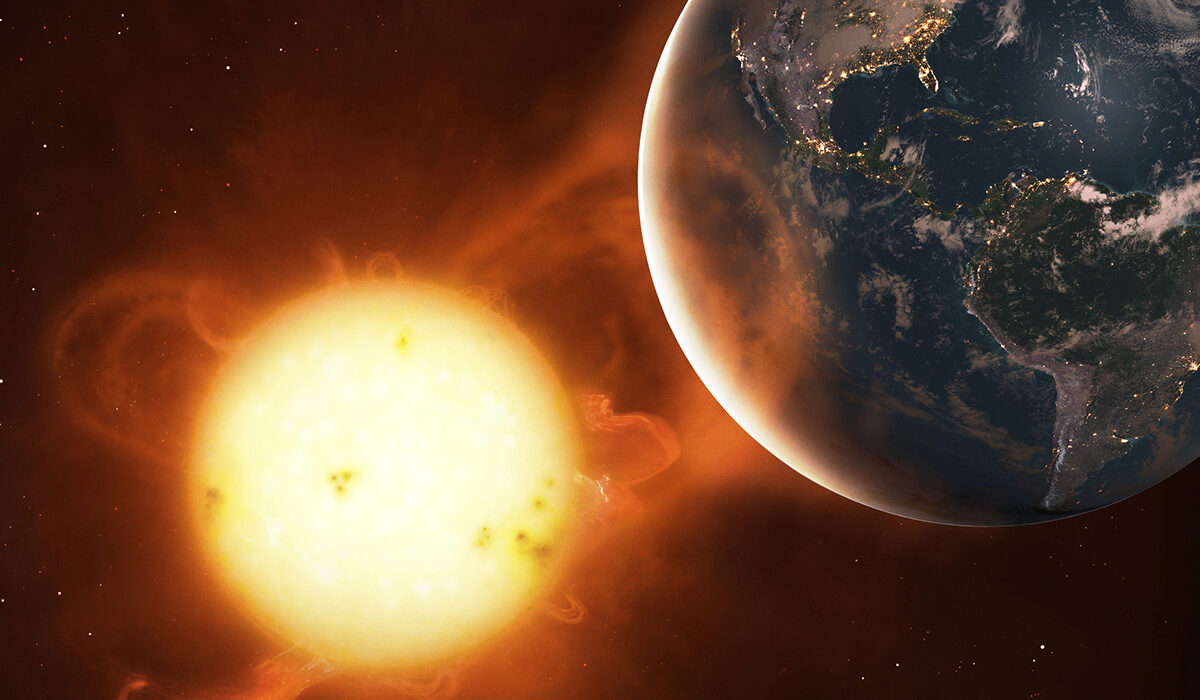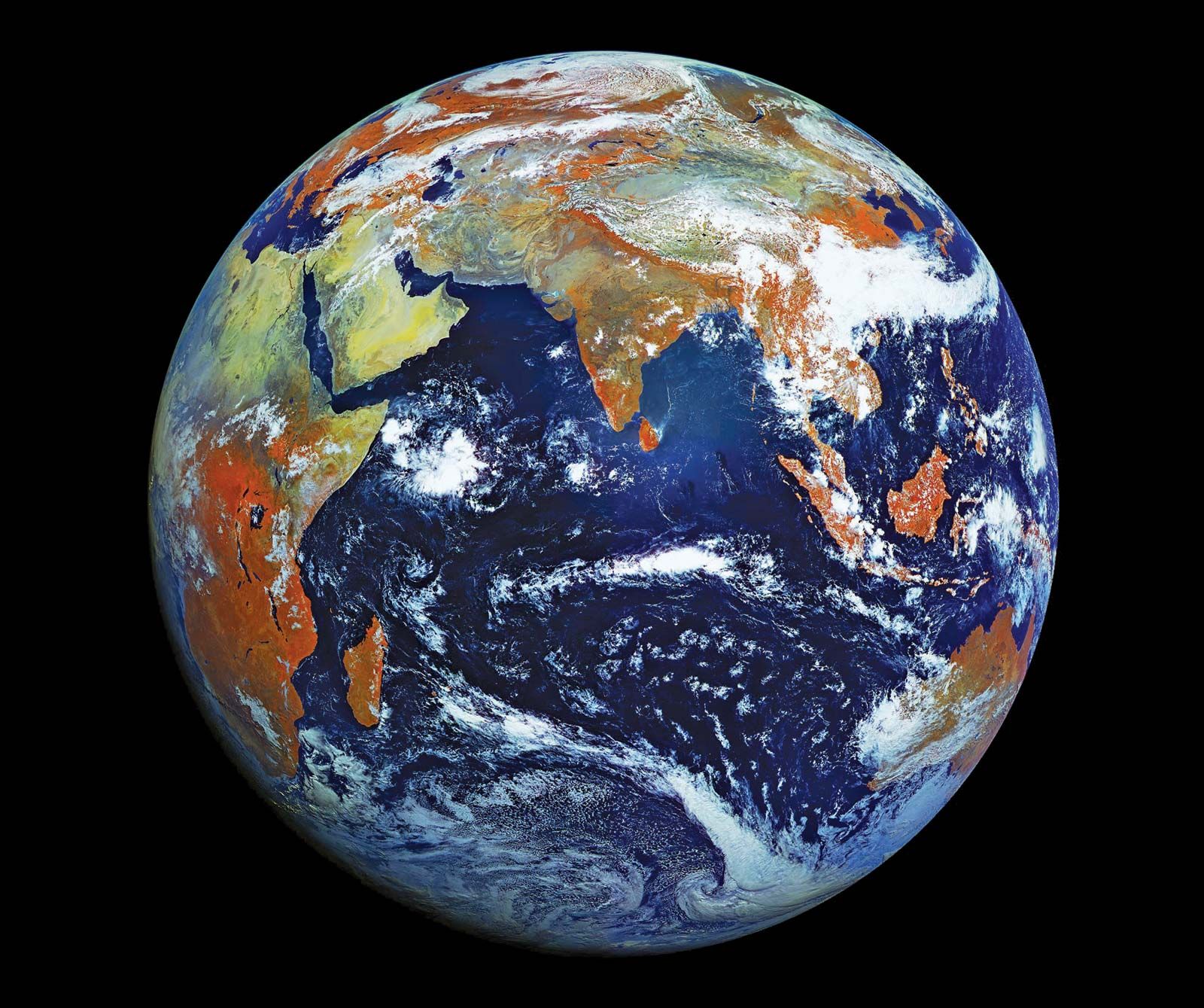
More than 4.5 billion years ago, there was no Earth. There were no oceans, no continents, no forests, no mountains, and certainly no life. The planet we call home did not appear overnight. Instead, it was built through an extraordinary sequence of cosmic events that began long before the Sun even existed.
Every rock beneath our feet, every drop of water in the oceans, and every atom in our bodies carries the history of this incredible journey. Earth’s story is one of fire, violence, collisions, and gradual transformation. It is a story written across billions of years, revealing how a lifeless ball of molten rock eventually became the only known world capable of supporting life.
Understanding how Earth formed not only explains our own origins but also helps scientists understand how planets throughout the universe are born.
Before Earth Existed
To understand Earth’s birth, we must begin even earlier—with the birth of the Solar System.
About 4.6 billion years ago, a giant cloud of gas and dust floated through a region of the Milky Way galaxy. This enormous cloud, called a molecular cloud, consisted mostly of hydrogen and helium, along with tiny amounts of heavier elements such as carbon, oxygen, silicon, iron, and magnesium.
These heavier elements had not always existed. They were forged inside earlier generations of stars through nuclear fusion and later scattered into space when those stars died, especially in powerful supernova explosions. In a very real sense, Earth was built from the recycled remains of ancient stars.
At some point, part of this enormous cloud began to collapse under its own gravity. Scientists think this collapse may have been triggered by the shock wave from a nearby supernova, although several processes could have contributed.
As the cloud shrank, gravity pulled more and more material toward its center.
The Birth of the Sun
As the collapsing cloud became denser, most of its material gathered at the center.
Pressure and temperature increased dramatically.
Eventually, temperatures reached about 15 million degrees Celsius (27 million degrees Fahrenheit) in the core.
At this point, hydrogen atoms began fusing into helium.
Nuclear fusion had started.
A new star—the Sun—was born.
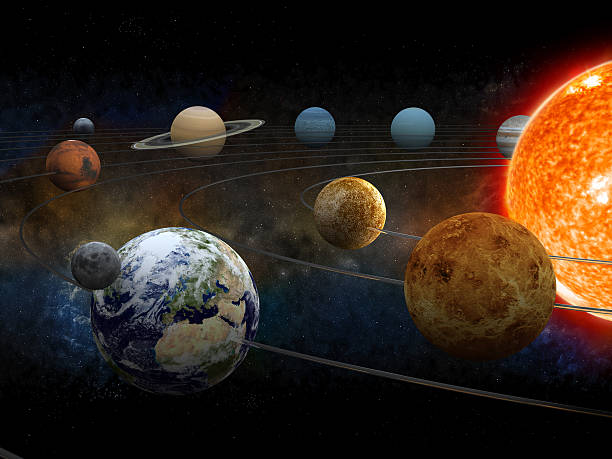
The newborn Sun contained more than 99.8 percent of all the mass in the Solar System. The tiny fraction that remained formed a rotating disk of gas, dust, and rocky material around the young star.
This spinning disk became the birthplace of all the planets.
A Cosmic Construction Site
The young Solar System was anything but peaceful.
Countless microscopic dust grains circled the Sun at enormous speeds.
As they collided, many stuck together because of electrostatic forces, forming slightly larger particles.
Over thousands and millions of years, these particles continued colliding and growing.
Pebbles became rocks.
Rocks became boulders.
Boulders became mountain-sized objects.
Gravity gradually became the dominant force, pulling more material together.
These growing bodies are known as planetesimals.
Some reached hundreds of kilometers across.
The Solar System had become a vast construction site where countless objects collided, merged, and sometimes shattered apart.
Building the Early Earth
One planetesimal gradually grew larger than many of its neighbors.
Its stronger gravity attracted more surrounding material.
Each collision added more mass.
Each impact released tremendous amounts of energy.
The growing Earth became increasingly hot.
Scientists estimate that Earth formed through this process over tens of millions of years, rather than appearing suddenly.
Every collision helped shape the young planet.
Some impacts were relatively gentle.
Others were unimaginably violent, releasing more energy than billions of modern nuclear weapons.
With every impact, Earth grew larger.
Why the Young Earth Was So Hot
Early Earth was nothing like today’s cool blue planet.
Instead, it was an extremely hot, partially or even completely molten world.
Several processes heated the young planet.
The first source was the enormous energy released by constant impacts from asteroids and planetesimals. Every collision converted kinetic energy into heat.
The second source came from gravity itself. As Earth grew larger, gravity compressed its interior, producing additional heat.
The third source was radioactive decay. Certain naturally occurring radioactive elements, including uranium, thorium, and potassium, released heat as they decayed.
Together, these energy sources turned much of early Earth into a global ocean of molten rock.
Earth’s Interior Begins to Separate
When Earth became molten, something remarkable happened.
The planet began sorting itself by density.
Heavy materials, especially iron and nickel, slowly sank toward the center.
Lighter rocks floated upward.
This process is known as planetary differentiation.
Over time, Earth’s interior developed distinct layers.
At the center formed the dense metallic core.
Surrounding it developed the rocky mantle.
Above the mantle formed the earliest crust.
This layered structure still exists today.
The iron-rich core later became responsible for generating Earth’s powerful magnetic field.
Without this protective magnetic shield, Earth’s atmosphere could have been gradually stripped away by charged particles flowing from the Sun.
The Giant Impact That Changed Everything
One of the most dramatic events in Earth’s history occurred about 4.5 billion years ago.
Scientists believe a Mars-sized protoplanet, commonly called Theia, collided with the young Earth.
This was not a simple crash.
It was one of the largest collisions known to have occurred in the Solar System.
The impact released unimaginable energy.
Much of both worlds melted or vaporized.
Huge amounts of rock were blasted into orbit around Earth.
Over time, this debris gradually came together through gravity.
Eventually, it formed our Moon.
This explanation, known as the Giant Impact Hypothesis, is supported by several lines of evidence. Rocks collected during the Apollo Moon missions have chemical compositions remarkably similar to Earth’s outer layers, suggesting that the Moon formed largely from material originating from Earth and the impacting body.
The collision also changed Earth’s rotation and likely contributed to the tilt of Earth’s axis, which is responsible for the changing seasons we experience today.
Earth Slowly Cools
After countless violent impacts, Earth gradually began cooling.
The surface no longer remained entirely molten.
Solid rocks formed.
The earliest crust developed.
However, this first crust was unstable.
Large impacts continued striking Earth during a period known as the Late Heavy Bombardment, although the exact intensity and timing of this episode remain areas of active research.
Many early rocks were repeatedly melted, recycled, and destroyed.
For this reason, very little of Earth’s original crust survives today.
The oldest known minerals on Earth are tiny zircon crystals found in Australia, dating back about 4.4 billion years.
These ancient crystals provide valuable clues about conditions on the young planet.
The Birth of the Atmosphere
Earth’s first atmosphere looked nothing like today’s.
The earliest atmosphere was probably dominated by hydrogen and helium, but the young planet’s gravity was not strong enough to retain much of these light gases while intense solar radiation and the young Sun’s solar wind also helped remove them.
A second atmosphere gradually developed.
Volcanoes released enormous quantities of gases trapped inside Earth.
These volcanic eruptions emitted water vapor, carbon dioxide, nitrogen, sulfur compounds, methane, and other gases.
Oxygen was almost entirely absent.
This volcanic atmosphere became the foundation of Earth’s modern atmosphere.
Where Did Earth’s Water Come From?
One of the greatest questions in planetary science concerns the origin of Earth’s water.
Scientists believe multiple sources likely contributed.
Large amounts of water vapor escaped from Earth’s interior through volcanic eruptions.
As Earth cooled, this vapor condensed into liquid water.
Rain may have fallen continuously for thousands or even millions of years.
Eventually, the first oceans formed.
In addition, some water was probably delivered by water-rich asteroids that struck the young Earth. Certain meteorites have chemical signatures similar to Earth’s water, supporting this idea.
Comets may also have contributed, although current evidence suggests they were probably not the dominant source.
Together, these processes filled Earth’s surface with vast oceans.
Continents Begin to Form
Earth’s earliest crust differed greatly from today’s continents.
Over hundreds of millions of years, the planet’s interior remained active.
Heat rising from the mantle caused parts of the crust to move.
This process eventually evolved into plate tectonics, the slow movement of large pieces of Earth’s outer shell.
As tectonic plates interacted, lighter continental crust gradually accumulated.
Mountains rose.
Volcanoes erupted.
Oceans opened and closed.
Continents repeatedly merged and separated over billions of years.
Earth’s surface became a constantly changing landscape.
The Importance of Plate Tectonics
Earth is unique among the rocky planets in having active plate tectonics.
This process continually reshapes the planet.
New crust forms at mid-ocean ridges.
Old crust sinks back into the mantle at subduction zones.
Plate tectonics plays a crucial role in regulating Earth’s climate over geological timescales by cycling carbon between the atmosphere, oceans, crust, and mantle.
It also builds mountain ranges, triggers earthquakes, fuels volcanic activity, and continually recycles Earth’s surface.
Without plate tectonics, Earth might have become a much less dynamic world.
Earth’s Magnetic Shield
Deep beneath Earth’s surface, the liquid outer core slowly circulates.
Because this molten iron is electrically conductive, its movement generates Earth’s magnetic field through a process called the geodynamo.
The magnetic field extends far into space, forming the magnetosphere.
This invisible shield deflects many charged particles arriving from the Sun.
Without it, Earth’s atmosphere would be much more vulnerable to erosion by the solar wind, as appears to have happened to much of Mars’ atmosphere.
The magnetic field has therefore played an important role in helping Earth remain habitable over billions of years.
A Planet Ready for Life
For hundreds of millions of years after its formation, Earth remained a hostile place.
Volcanoes erupted constantly.
Large asteroids frequently struck the surface.
The atmosphere lacked oxygen.
The oceans were unlike those we know today.
Yet conditions gradually stabilized.
Liquid water covered much of the planet.
The crust became more stable.
Chemical reactions occurred in the oceans and on mineral surfaces.
At some point, probably more than 3.5 billion years ago, life appeared.
Exactly how life began remains one of science’s greatest unsolved mysteries.
But Earth’s formation created the essential conditions that made biology possible.
How Scientists Know Earth’s History
No human witnessed Earth’s formation.
Instead, scientists have reconstructed its history using multiple independent lines of evidence.
Radiometric dating allows researchers to determine the ages of ancient rocks and meteorites by measuring the decay of radioactive isotopes.
Meteorites preserve material left over from the formation of the Solar System and provide clues about the environment in which Earth formed.
Seismic waves generated by earthquakes reveal the layered structure of Earth’s interior.
Computer simulations model how planets grow through collisions and gravitational interactions.
Observations of young stars surrounded by disks of gas and dust show that planet formation is still occurring elsewhere in our galaxy, providing a window into the processes that shaped our own Solar System billions of years ago.
Together, these methods create a remarkably consistent picture of Earth’s origin.
Could Earth Have Formed Differently?
Planet formation is influenced by countless factors.
If Earth had formed slightly closer to the Sun, temperatures might have been too high for stable liquid water.
If it had formed much farther away, water may have remained permanently frozen.
A significantly smaller Earth might not have retained a thick atmosphere.
A much larger Earth could have evolved in very different ways.
Even the giant impact that formed the Moon may have influenced Earth’s long-term evolution by affecting its rotation and stabilizing the tilt of its axis over long timescales.
Small differences during Earth’s formation could have produced a dramatically different world.
Earth Is Still Changing
Although Earth formed billions of years ago, its story is far from over.
The continents continue drifting a few centimeters each year.
Mountains slowly rise and erode.
Volcanoes build new land.
Earthquakes reshape the crust.
The magnetic field changes over time.
The atmosphere continues evolving.
Far in the future, the Sun itself will become brighter as it ages, eventually making Earth uninhabitable long before the Sun reaches the end of its life.
Planetary evolution never truly stops.
Conclusion
Earth’s formation was not a single event but a long and extraordinary journey that unfolded over millions of years. From a cloud of gas and dust left behind by ancient stars, gravity built the Sun and the planets. Countless collisions assembled the young Earth, intense heat melted its interior, heavy elements sank to form its core, and a giant impact created the Moon. As the planet cooled, oceans formed, continents emerged, the atmosphere evolved, and the conditions necessary for life gradually appeared.
Today, every mountain, every ocean, every living organism, and every human being exists because of this remarkable chain of events that began more than 4.5 billion years ago. The story of Earth’s formation reminds us that our planet is not separate from the universe—it is one of its most extraordinary creations, shaped by the same physical laws that govern stars, galaxies, and the cosmos itself.