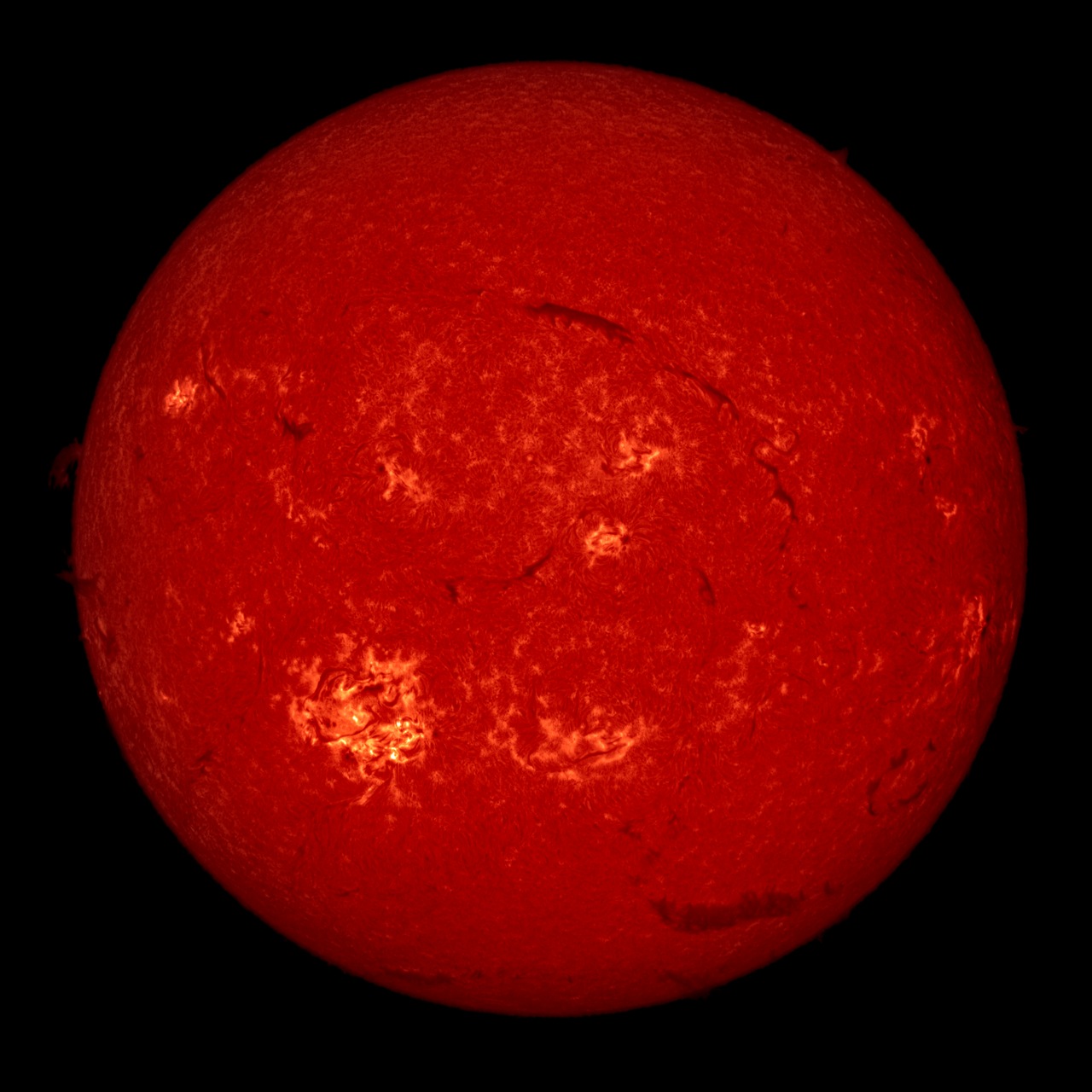
Every sunrise begins with a familiar sight—a brilliant golden disk climbing above the horizon. We call it the Sun, and for most of human history, it appeared to be a smooth, glowing sphere. But modern astronomy has revealed that the Sun is far more complex than it looks. It is made up of several distinct layers, each with its own unique properties and fascinating behavior.
One of the most remarkable of these layers is the chromosphere, a dynamic region where giant jets of hot gas erupt into space, powerful magnetic fields twist and snap, and energy surges upward toward the Sun’s outer atmosphere. Although it is only a thin layer compared to the Sun’s enormous size, the chromosphere plays a crucial role in shaping solar activity and influencing the environment throughout the Solar System.
Understanding the chromosphere helps scientists explain everything from spectacular solar eclipses to space weather that can affect satellites, communication systems, and even power grids on Earth.
Understanding the Chromosphere
The chromosphere is the second major layer of the Sun’s atmosphere, located directly above the photosphere, which is the visible surface of the Sun, and below the much hotter corona, the Sun’s outermost atmosphere.
Its name comes from the Greek words chroma (color) and sphaira (sphere), meaning “color sphere.” The chromosphere earned this name because it appears as a thin reddish-pink rim around the Sun during a total solar eclipse, when the Moon completely blocks the bright photosphere.
Normally, the intense brightness of the photosphere overwhelms the faint light from the chromosphere, making it invisible without specialized instruments or the rare conditions of a total solar eclipse.
Although it appears delicate, the chromosphere is an incredibly active region filled with constantly changing streams of hot plasma, magnetic fields, and energetic eruptions.
Where Is the Chromosphere Located?
The Sun is not a solid object like Earth. Instead, it is a giant sphere of extremely hot plasma composed mainly of hydrogen and helium.
The chromosphere sits immediately above the photosphere. Above the chromosphere lies the transition region, where temperatures rise dramatically, followed by the corona, which extends millions of kilometers into space.
Compared to the Sun’s diameter of about 1.39 million kilometers (864,000 miles), the chromosphere is relatively thin. It typically extends about 2,000 to 3,000 kilometers (1,200 to 1,900 miles) above the photosphere, although its exact thickness varies depending on solar activity and the specific wavelengths being observed.
Even though it represents only a tiny fraction of the Sun’s overall size, this layer plays an outsized role in transferring energy from the Sun’s surface into its outer atmosphere.
Why Does the Chromosphere Look Red?
One of the chromosphere’s most striking features is its beautiful crimson color.
This reddish appearance comes primarily from hydrogen atoms. Hydrogen is by far the most abundant element in the Sun, and under the extreme temperatures of the chromosphere, its electrons become excited. As these electrons return to lower energy levels, they emit light at specific wavelengths.
The strongest visible emission comes from the H-alpha spectral line, a deep red wavelength of light produced by hydrogen.
Because of this emission, the chromosphere glows with a distinctive reddish hue during total solar eclipses and in images captured using specialized solar telescopes equipped with H-alpha filters.
These filters allow astronomers to isolate the light from the chromosphere while blocking the overwhelming brightness of the photosphere.
The Temperature of the Chromosphere
One of the most surprising features of the chromosphere is how its temperature changes with altitude.
Near the bottom, just above the photosphere, temperatures are around 4,000 to 6,000 degrees Celsius (7,200 to 10,800 degrees Fahrenheit).
Instead of continuing to cool as one moves farther from the Sun’s energy-producing core, the chromosphere gradually becomes hotter with increasing height.
Near its upper boundary, temperatures can exceed 20,000 degrees Celsius (36,000 degrees Fahrenheit) before rising even more dramatically in the transition region and corona.
This unusual temperature increase has puzzled scientists for decades.
Researchers believe that magnetic waves, turbulence, and the release of magnetic energy all contribute to heating the chromosphere, although the exact balance of these processes remains an active area of research.
A Layer Filled With Constant Motion
The chromosphere is anything but calm.
Unlike the relatively smooth appearance of the photosphere, this layer is constantly changing.
Hot plasma rises.
Cooler material falls.
Magnetic fields twist into complex shapes.
Shock waves ripple through the atmosphere.
Jets of gas shoot upward before collapsing back toward the Sun.
These events occur on timescales ranging from seconds to minutes, making the chromosphere one of the most dynamic regions of the Sun.
High-resolution observations reveal that almost every part of the chromosphere is in motion.
Spicules: The Sun’s Tiny Plasma Jets
One of the chromosphere’s most fascinating features is the presence of spicules.
Spicules are narrow, finger-like jets of hot plasma that rapidly rise from the chromosphere into the Sun’s outer atmosphere.
Each spicule may extend several thousand kilometers above the Sun’s surface while remaining only a few hundred kilometers wide.
They form incredibly quickly, often lasting only a few minutes before disappearing.
At any given moment, millions of spicules are active across the Sun.
These tiny plasma fountains transport energy and material upward, and scientists believe they may help heat the corona and contribute to the flow of the solar wind.
Although individual spicules are relatively small, together they represent one of the most important forms of activity in the chromosphere.
Solar Flares Begin in Magnetic Regions
The chromosphere is closely linked to some of the Sun’s most powerful eruptions.
Solar flares occur when magnetic energy stored in the Sun’s atmosphere is suddenly released.
During these explosive events, enormous amounts of energy are emitted across the electromagnetic spectrum, including visible light, ultraviolet radiation, X-rays, and gamma rays.
The chromosphere responds dramatically to solar flares.
It brightens rapidly.
Plasma heats to extreme temperatures.
Powerful shock waves spread outward.
Material is accelerated into higher layers of the solar atmosphere.
These events can release as much energy as billions of nuclear bombs exploding simultaneously.
Although Earth is safely distant from the Sun, the radiation and charged particles associated with large solar eruptions can affect satellites, astronauts, radio communication, and navigation systems.
Prominences and Filaments
The chromosphere is also home to spectacular structures known as solar prominences.
Prominences are enormous loops or clouds of relatively cool plasma suspended high above the Sun’s surface by magnetic fields.
Some prominences remain stable for days or even weeks.
Others suddenly erupt into space.
When viewed against the darkness of space, they appear bright and glowing.
When seen against the Sun’s bright disk, the same structures appear dark and are called filaments because they absorb some of the light coming from below.
These remarkable formations demonstrate the incredible power of the Sun’s magnetic field.
Magnetic Fields Control the Chromosphere
The chromosphere cannot be understood without considering magnetism.
Unlike Earth’s magnetic field, which is relatively stable, the Sun’s magnetic field is constantly changing.
Hot plasma inside the Sun generates magnetic fields that emerge through the photosphere into the chromosphere.
These magnetic fields guide the movement of plasma, shape solar prominences, create spicules, and trigger solar flares.
In many ways, the chromosphere acts as a bridge where magnetic energy generated below begins interacting with the outer atmosphere.
Studying these magnetic interactions is one of the most important goals of modern solar physics.
The Chromosphere and Space Weather
Events occurring in the chromosphere can influence conditions throughout the Solar System.
Solar eruptions often originate in or pass through this layer before expanding into space.
These eruptions can produce space weather, a term describing changing conditions in the space environment caused by the Sun.
Strong space weather can interfere with radio communication, disrupt satellite electronics, increase radiation exposure for astronauts, and produce beautiful auroras near Earth’s polar regions.
Scientists continuously monitor the chromosphere because it often provides early signs of solar activity that may later affect Earth.
Understanding this layer improves our ability to predict solar storms and reduce their impacts on modern technology.
Observing the Chromosphere
Looking directly at the Sun without proper protection is extremely dangerous and can permanently damage eyesight.
Fortunately, astronomers have developed specialized instruments that safely reveal the chromosphere.
One of the most widely used techniques involves observing the Sun through H-alpha filters, which isolate the deep red light emitted by hydrogen.
These filters reveal a completely different Sun from the one visible to the naked eye.
Instead of a smooth bright disk, observers see swirling filaments, towering prominences, active regions, and countless spicules.
Space-based observatories have expanded our understanding even further.
Satellites equipped with ultraviolet and extreme ultraviolet instruments can study the chromosphere continuously without interference from Earth’s atmosphere.
These observations allow scientists to watch the chromosphere evolve in extraordinary detail.
The Chromosphere During a Total Solar Eclipse
For many people, the chromosphere becomes visible only during one of nature’s greatest spectacles—a total solar eclipse.
As the Moon completely covers the photosphere, the brilliant glare disappears.
For a brief moment, a thin red ring appears around the edge of the Sun.
This glowing rim is the chromosphere.
Observers may also see brilliant red prominences extending outward like giant flames.
Although totality may last only a few minutes, it offers one of the most beautiful views of the Sun available from Earth.
Before modern solar telescopes, total eclipses were among the few opportunities scientists had to study the chromosphere directly.
The Chromosphere and the Solar Cycle
The Sun follows an approximately 11-year solar cycle, during which its magnetic activity increases and decreases.
During periods of solar maximum, the chromosphere becomes especially active.
More sunspots appear on the photosphere.
More prominences rise into space.
Solar flares become more frequent.
Magnetic structures grow increasingly complex.
During solar minimum, the chromosphere becomes comparatively quiet, with fewer eruptions and less magnetic activity.
Monitoring changes in the chromosphere helps scientists track the progress of the solar cycle and better understand the Sun’s changing behavior.
Why Scientists Study the Chromosphere
The chromosphere holds important clues about several of solar physics’ greatest mysteries.
Scientists are working to understand how energy moves from the Sun’s interior into its atmosphere.
They want to know why the corona becomes so much hotter than the layers below.
They seek to explain how magnetic fields generate explosive solar eruptions.
Researchers are also improving models that predict space weather, helping protect satellites, communication networks, astronauts, and electrical infrastructure on Earth.
Every new observation of the chromosphere brings scientists closer to answering these questions.
The Chromosphere’s Place in the Sun
Although the chromosphere is only one layer of the Sun, it serves as a vital connection between the visible surface and the outer atmosphere.
Energy flowing upward from the photosphere passes through the chromosphere before reaching the corona.
Magnetic fields become increasingly complex in this region.
Hot plasma moves constantly, transporting both matter and energy.
Without the chromosphere, the Sun would behave very differently.
It is a crucial part of the chain of processes that powers solar activity throughout the Solar System.
A Thin Layer With an Enormous Influence
At first glance, the chromosphere may seem like a narrow band surrounding the Sun, visible only during rare eclipses. Yet beneath its delicate crimson glow lies one of the most energetic and dynamic environments in the Solar System. Here, magnetic fields reshape themselves, towering plasma jets rise and fall, solar flares release immense energy, and the foundations of space weather are formed.
Although scientists have learned a tremendous amount about this remarkable layer, many mysteries remain. How exactly is it heated? What role do its countless spicules play in warming the corona? How does magnetic energy build up and suddenly erupt?
As new telescopes, spacecraft, and computer models continue to improve, the chromosphere is revealing more of its secrets. Each discovery not only deepens our understanding of the Sun but also helps us better understand the powerful star that makes life on Earth possible.