Every morning, the Sun rises above the horizon, filling the world with light and warmth. It makes life on Earth possible, drives our weather, helps plants grow, and has inspired countless myths and scientific discoveries throughout human history. Yet despite seeing it almost every day, many people still wonder about a simple question: What is the Sun made of?
The answer is both surprisingly simple and incredibly fascinating.
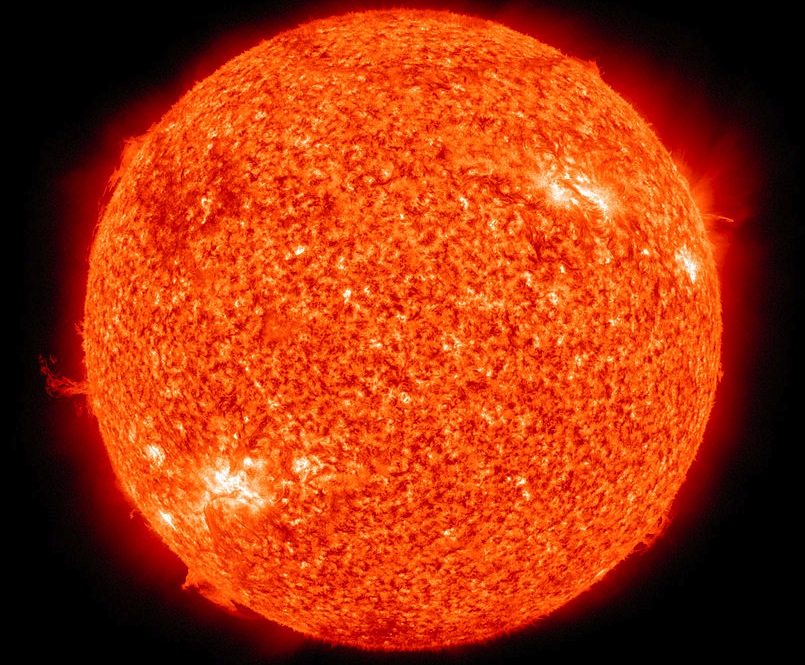
The Sun is not a giant ball of fire made from burning wood, coal, or gas like a campfire. Instead, it is an enormous sphere of extremely hot gas, or more accurately, plasma—a unique state of matter found throughout the universe. Deep inside the Sun, atomic nuclei are constantly fusing together, releasing an astonishing amount of energy that has been shining for billions of years.
Understanding what the Sun is made of helps us understand not only our own star but also the billions of other stars scattered across the universe.
The Sun Is Mostly Hydrogen
If you could somehow take the Sun apart and examine every atom inside it, you would discover that most of it is made of a single element: hydrogen.
Hydrogen is the lightest and most abundant element in the universe. It consists of just one proton and one electron, making it the simplest atom known.
By mass, about 73% of the Sun is hydrogen. By the number of atoms, hydrogen makes up an even larger share because hydrogen atoms are much lighter than other elements.
Hydrogen is the Sun’s primary fuel. Deep inside its core, hydrogen atoms collide under enormous pressure and temperatures of around 15 million degrees Celsius (27 million degrees Fahrenheit). These collisions allow hydrogen nuclei to fuse together, creating helium and releasing tremendous amounts of energy.
Without hydrogen, the Sun simply could not shine.
Helium Is the Second Main Ingredient
The second most abundant element in the Sun is helium.
Helium makes up about 25% of the Sun’s mass. It is produced continuously inside the Sun’s core through the process of nuclear fusion.
Every second, the Sun converts hundreds of millions of tons of hydrogen into helium. During this process, a small portion of mass is transformed into energy according to Einstein’s famous equation:
E = mc²
That energy eventually reaches Earth’s surface as sunlight and heat.
Interestingly, helium was first discovered in the Sun before scientists found it on Earth. During a solar eclipse in 1868, astronomers detected an unfamiliar spectral line in sunlight, revealing the existence of a previously unknown element. They named it helium after Helios, the Greek god of the Sun.
The Sun Contains Many Other Elements Too
Although hydrogen and helium dominate the Sun, they are not the only ingredients.
The remaining about 2% of the Sun consists of heavier elements that astronomers call metals, even though many of them are not metals in the everyday sense.
These include oxygen, carbon, neon, nitrogen, magnesium, silicon, sulfur, iron, and many others.
The amounts are small compared to hydrogen and helium, but these elements play important roles in how the Sun behaves. They affect the movement of energy, influence the Sun’s spectrum, and help scientists understand how stars evolve.
The iron found in your blood, the oxygen you breathe, the carbon in every living organism, and the calcium in your bones all originated in ancient stars that lived and died long before our Sun formed.
In that sense, the Sun carries the chemical history of the universe.
The Sun Is Not Solid
One common misconception is that the Sun has a solid surface like Earth.
It does not.
The Sun is made almost entirely of hot plasma, meaning there is no solid ground to stand on.
Plasma is often called the fourth state of matter, alongside solids, liquids, and gases.
When matter becomes extremely hot, electrons are stripped away from atoms, creating a mixture of free electrons and atomic nuclei. This electrically charged material behaves differently from ordinary gas and responds strongly to magnetic fields.
The Sun is essentially a gigantic glowing ball of plasma held together by its own gravity.
If a spacecraft could somehow survive the incredible heat, it would not land on a solid surface. Instead, it would sink deeper into increasingly hotter and denser layers of plasma.
What Is Plasma?
Plasma is the most common state of ordinary matter in the universe.
While it is relatively rare on Earth, it fills the stars, much of the space between galaxies, and many spectacular cosmic objects.
Lightning is plasma.
Neon signs contain plasma.
Auroras near Earth’s poles involve plasma particles from the Sun interacting with our atmosphere.
Inside the Sun, temperatures are so high that atoms cannot remain intact. Electrons separate from their nuclei, creating an energetic, electrically charged fluid.
This plasma constantly moves, flows, twists, and interacts with powerful magnetic fields, producing many of the Sun’s remarkable features.
Inside the Sun’s Core
The core is the Sun’s powerhouse.
This central region extends about one-quarter of the way from the Sun’s center to its surface.
Here, temperatures reach approximately 15 million degrees Celsius, while pressures are more than 250 billion times Earth’s atmospheric pressure.
These extraordinary conditions force hydrogen nuclei close enough together for nuclear fusion to occur.
Fusion combines hydrogen into helium while releasing enormous amounts of energy in the form of gamma rays and tiny particles called neutrinos.
Every second, the Sun converts roughly 600 million tons of hydrogen into helium.
Even after billions of years, the Sun still contains enough hydrogen to continue shining for about another five billion years.
The Layers of the Sun
Although the Sun appears as a simple glowing sphere, it actually has several distinct layers.
At its center lies the core, where nuclear fusion creates energy.
Surrounding the core is the radiative zone. Here, energy slowly moves outward as radiation. Surprisingly, a single photon may take thousands to hundreds of thousands of years—or even longer according to some models—to work its way through this dense region because it is constantly absorbed and re-emitted.
Above that is the convection zone. Hot plasma rises toward the surface while cooler plasma sinks back downward, much like boiling water in a pot.
The visible “surface” is called the photosphere. Although it looks solid, it is simply the layer where sunlight escapes into space. The photosphere has a temperature of about 5,500 degrees Celsius (9,900 degrees Fahrenheit).
Above the photosphere lie the chromosphere and the corona, the Sun’s outer atmosphere. Surprisingly, the corona is much hotter than the visible surface, reaching temperatures of over one million degrees Celsius. Scientists are still investigating exactly why this happens.
How Do Scientists Know What the Sun Is Made Of?
No one has ever brought back a sample from the Sun.
So how do scientists know its composition?
The answer lies in light.
Every chemical element absorbs and emits specific wavelengths of light, creating a unique pattern known as a spectral fingerprint.
When sunlight passes through scientific instruments called spectroscopes, it spreads into a rainbow crossed by dark lines.
Each line corresponds to a particular element.
By carefully studying these spectral lines, astronomers can determine which elements are present in the Sun and estimate their abundance with remarkable accuracy.
This technique, known as spectroscopy, has become one of the most powerful tools in astronomy.
It allows scientists to study not only our Sun but also stars located thousands or even billions of light-years away.
Why Doesn’t the Sun Burn Out?
Many people imagine the Sun is burning like a giant fire.
But ordinary fire requires oxygen and chemical reactions.
The Sun works in an entirely different way.
Its energy comes from nuclear fusion, not combustion.
Fusion is vastly more efficient than chemical burning.
A campfire might burn for a few hours.
A candle lasts for several hours.
The Sun has been shining continuously for about 4.6 billion years and still has enough hydrogen to continue producing energy for billions more.
This incredible longevity is possible because nuclear fusion releases millions of times more energy than ordinary chemical reactions.
The Sun Changes Over Time
Although the Sun seems constant, it is slowly changing.
Every second, it loses a tiny amount of mass as energy radiates into space.
It also releases streams of charged particles known as the solar wind, which spread throughout the solar system.
Meanwhile, the proportion of helium in the core steadily increases as hydrogen is consumed.
Over billions of years, these gradual changes will alter the Sun’s structure.
Eventually, after exhausting most of its core hydrogen, the Sun will expand into a red giant, growing large enough to engulf or scorch the inner planets.
Later, it will shed its outer layers, creating a beautiful planetary nebula, while its core becomes a white dwarf.
Even then, many of the elements forged inside the Sun will eventually become part of future generations of stars and planets.
The Sun and the Origins of the Solar System
The Sun formed about 4.6 billion years ago from a massive cloud of gas and dust.
Gravity pulled this cloud together, causing it to collapse.
As the cloud shrank, its center became hotter and denser.
Eventually, temperatures became high enough for hydrogen fusion to begin.
At that moment, a new star was born.
The leftover material surrounding the young Sun gradually formed the planets, moons, asteroids, and comets of our solar system.
In other words, the Earth and every other planet formed from the same giant cloud that created the Sun.
Although the Sun contains most of the solar system’s mass, the planets are made from the remaining material that did not become part of the star itself.
Why the Sun Matters to Life on Earth
Everything living on Earth depends on the Sun.
Plants use sunlight to produce food through photosynthesis.
Animals depend directly or indirectly on those plants.
The Sun powers weather systems, ocean currents, and the water cycle.
Its gravity keeps Earth in a stable orbit.
Without the Sun’s energy, our planet would become a frozen, lifeless world within a relatively short time.
The sunlight reaching your face today began as nuclear fusion in the Sun’s core. After an incredibly long journey through the Sun’s interior, it traveled across space for about eight minutes and twenty seconds before arriving at Earth.
Every sunrise is a reminder of the extraordinary processes happening inside our nearest star.
The Sun Is a Cosmic Laboratory
The Sun is much more than a bright object in the sky. It is a giant natural laboratory where the laws of physics operate on an immense scale. By studying its composition, scientists learn about nuclear fusion, plasma, gravity, magnetism, and the life cycles of stars throughout the universe.
Because the Sun is the closest star to Earth, it serves as a bridge between laboratory science and the wider cosmos. Every discovery about our Sun helps astronomers better understand distant stars, galaxies, and the history of the universe itself.
The Remarkable Ingredients of Our Star
At first glance, the Sun appears to be a simple glowing sphere, but its composition tells a far richer story. It is made primarily of hydrogen and helium, with small amounts of heavier elements inherited from even older stars. These ingredients are transformed by nuclear fusion, producing the light and heat that sustain life on Earth.
Every ray of sunshine carries energy created deep within the Sun’s core. Every sunrise reminds us that we live beside an extraordinary star whose simple ingredients have powered our world for billions of years. By understanding what the Sun is made of, we gain a deeper appreciation not only of our nearest star but also of the remarkable universe that gave rise to it.