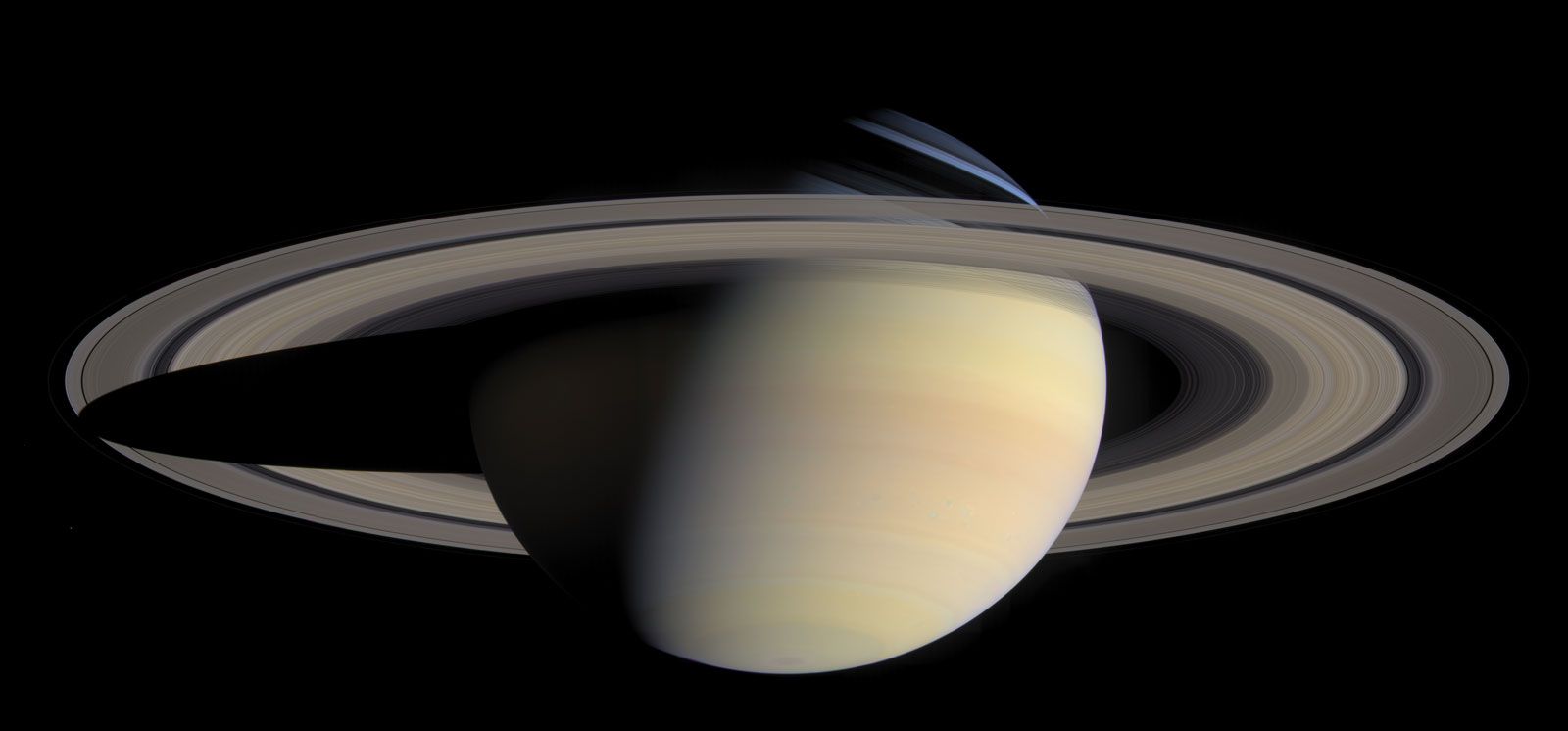
Have you ever looked at a picture of Saturn and wondered why it wears such magnificent rings while Earth does not? The sight is so breathtaking that it almost seems as though someone carefully placed a giant cosmic crown around the planet. Yet those rings are not decorations. They are real, dynamic, and constantly changing structures created by the laws of physics over millions—or even billions—of years.
Planetary rings are among the most beautiful features in our Solar System. They are made of countless tiny particles traveling together around a planet, each following the pull of gravity. From a distance, the particles blend into graceful, shining bands that appear solid. Up close, however, they resemble an enormous swarm of rocks, dust, and chunks of ice, all moving through space at tremendous speeds.
For centuries, these mysterious rings puzzled astronomers. Today, thanks to powerful telescopes and spacecraft, scientists have learned that planetary rings are not rare accidents. They are natural outcomes of gravity, collisions, and the complex evolution of planetary systems.
Understanding why some planets have rings reveals not only the history of our own Solar System but also the incredible processes that shape worlds throughout the universe.
What Are Planetary Rings?
Planetary rings are vast collections of countless small objects orbiting around a planet. Instead of being one solid circle, a ring is made of millions to trillions of individual particles.
These particles vary enormously in size. Some are as tiny as grains of dust, while others are as large as houses or even small mountains. Every particle follows its own orbit around the planet.
Although they move independently, together they create the appearance of broad, continuous rings that stretch tens or even hundreds of thousands of kilometers across space.
If you could somehow stand safely within Saturn’s rings, you would not see a solid sheet beneath your feet. Instead, you would find yourself surrounded by countless icy fragments spread over enormous distances. In many places, the particles are surprisingly far apart.
The rings only appear solid because there are so many particles reflecting sunlight.
Which Planets Have Rings?
All four giant planets in our Solar System have ring systems.
Saturn has by far the largest, brightest, and most spectacular rings. They are so wide that they could stretch nearly halfway from Earth to the Moon, yet in many places they are only about 10 to 100 meters thick.
Jupiter also has rings, but they are extremely faint and difficult to see because they contain much less material.
Uranus possesses narrow, dark rings discovered in 1977. They are much less reflective than Saturn’s icy rings.
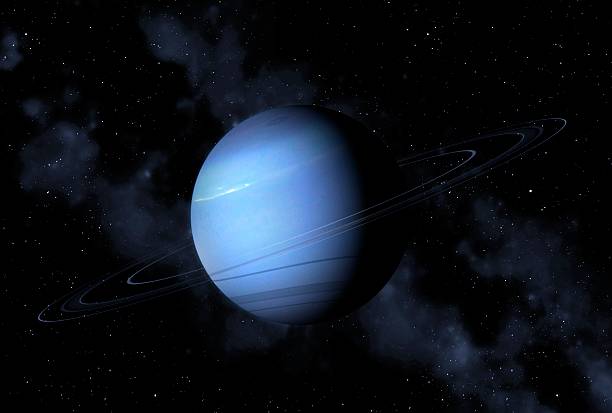
Neptune has several thin rings, some of which contain brighter regions known as ring arcs.
Although these four planets all have rings, each system is remarkably different in appearance, composition, and age.
Why Don’t All Planets Have Rings?
Earth, Venus, Mercury, and Mars do not have large, permanent ring systems.
The main reason is that these smaller rocky planets lack the conditions needed to maintain stable rings over long periods.
A ring can only survive if particles remain in orbit instead of falling onto the planet or escaping into space.
Around terrestrial planets, several factors make long-lasting rings less likely. Their weaker gravity makes it harder to retain large amounts of orbiting material. The gravitational influence of nearby moons, the Sun, and other planets can also gradually disturb ring particles.
Earth may actually have possessed temporary rings at various times in its history, perhaps after enormous asteroid impacts. However, such rings would probably have disappeared relatively quickly compared with the age of the Solar System.
Today, our planet has only one natural satellite—the Moon—and no permanent rings.
How Do Planetary Rings Form?
Scientists believe planetary rings can form in several different ways.
One possibility begins with a moon.
If a moon travels too close to its parent planet, the planet’s immense gravity can become stronger than the moon’s own gravity holding it together. Eventually, the moon may be pulled apart into countless pieces.
These fragments continue orbiting the planet instead of immediately falling onto it.
Over time, they spread out into a ring.
Another possibility involves collisions.
Early in the Solar System’s history, giant impacts between moons, asteroids, and comets were much more common than they are today.
A violent collision could shatter an object into billions of pieces. If enough of that debris remained in orbit, it could gradually evolve into a ring system.
Some rings also form from continuous sources of material.
Tiny meteoroids striking small moons can blast dust into space. That dust may become trapped in orbit, slowly replenishing faint rings.
This process helps maintain the delicate rings around Jupiter.
The Roche Limit: Where Moons Cannot Survive
One of the most important ideas in understanding planetary rings is the Roche limit.
The Roche limit is the minimum distance at which a large object held together mainly by its own gravity can orbit a planet without being torn apart by tidal forces.
Inside this region, the planet’s gravity pulls much more strongly on the near side of a moon than on its far side.
If the difference becomes too great, the moon can break apart.
The resulting debris remains trapped in orbit instead of coming back together to form another moon.
Many of Saturn’s rings lie inside its Roche limit, helping explain why they exist as countless separate particles instead of combining into one larger object.
Why Is Saturn’s Ring System So Spectacular?
Among all the planets, Saturn is unquestionably the king of rings.
Its ring system is enormous, bright, and incredibly complex.
The main reason is composition.
Saturn’s rings consist mostly of water ice.
Ice reflects sunlight very efficiently, making the rings shine brilliantly even from great distances.
Some particles are nearly pure ice, giving Saturn its dazzling appearance.
Another reason is quantity.
Saturn simply possesses far more ring material than any other planet in our Solar System.
Its rings contain countless particles organized into thousands of individual ringlets separated by narrow gaps.
Spacecraft observations have revealed waves, ripples, braided structures, and constantly changing patterns produced by gravity.
Rather than being quiet and motionless, Saturn’s rings are remarkably active.
What Are the Rings Made Of?
The composition of planetary rings depends on the planet.
Saturn’s rings contain mostly water ice mixed with smaller amounts of rocky material and dust.
Jupiter’s rings are dominated by tiny dust particles.
Uranus and Neptune have darker rings containing more radiation-darkened material and less reflective ice.
Scientists study the light reflected from ring particles to determine their composition.
Different materials absorb and reflect different wavelengths of light.
By analyzing this light, astronomers can estimate what the rings are made of without physically collecting samples.
Fortunately, spacecraft such as Cassini, which orbited Saturn for more than 13 years, provided detailed measurements that greatly expanded our understanding.
Why Are There Gaps Between the Rings?
One of Saturn’s most fascinating features is the presence of numerous gaps separating its rings.
These empty regions are not random.
Many are created by moons.
Small moons orbiting near the rings exert gravitational influences that repeatedly tug on nearby particles.
Over time, these tiny gravitational pulls remove particles from certain regions while concentrating them in others.
This process creates sharply defined gaps and narrow ring structures.
Some small moons actually orbit within the rings themselves.
These “shepherd moons” help maintain ring edges by gently guiding nearby particles through gravity.
Their influence keeps many rings surprisingly narrow and well organized.
Do Ring Particles Ever Collide?
Yes.
The countless particles within rings are constantly interacting.
Fortunately, most collisions occur at relatively low speeds because neighboring particles move along similar orbits.
Instead of violent crashes, many encounters resemble gentle bumps.
These repeated collisions gradually alter particle motions, redistribute material, and help maintain the flat shape of the rings.
Without these interactions, ring systems would gradually become thicker and more chaotic.
Gravity and collisions work together to create the graceful structures we observe.
Are Planetary Rings Permanent?
Although rings appear timeless, they are constantly evolving.
Individual particles collide, break apart, stick together, and slowly migrate through the ring system.
Some particles spiral inward toward the planet.
Others escape into space.
Scientists now believe that many ring systems may be temporary on astronomical timescales.
Recent research suggests Saturn’s rings may be surprisingly young compared with the planet itself, perhaps only a few hundred million years old, although some uncertainties remain.
Measurements also indicate that material from Saturn’s rings slowly falls into the planet in a process sometimes called “ring rain.”
This means the rings are gradually losing mass.
Unless new material is added, they may eventually disappear.
Could Earth Ever Have Rings?
It is an intriguing possibility.
Some scientists have proposed that Earth may briefly have possessed rings after enormous asteroid impacts.
One famous example involves the giant collision thought to have formed the Moon over 4 billion years ago.
Immediately after that impact, vast amounts of rocky debris orbited Earth.
Before eventually combining to form the Moon, some of this material may have resembled a temporary ring.
More recent studies have also suggested that major asteroid impacts might occasionally create short-lived rings lasting thousands or perhaps millions of years.
Compared with the age of Earth, however, these would be fleeting events.
Do Moons and Rings Influence Each Other?
Moons and rings share a fascinating relationship.
Some moons help create rings.
Others shape them.
Still others gradually remove material from them.
In some cases, moons act almost like cosmic sculptors, carving gaps and producing beautiful spiral waves through gravitational interactions.
At the same time, ring particles can slowly accumulate onto small moons.
Over immense periods, these interactions continuously reshape both the rings and the moons themselves.
Rather than existing independently, they evolve together.
Can Other Worlds Beyond Our Solar System Have Rings?
The answer is almost certainly yes.
Astronomers have discovered thousands of planets orbiting distant stars, known as exoplanets.
Although directly observing rings around these distant worlds is extremely difficult, several observations suggest that some exoplanets may possess enormous ring systems.
One famous candidate appears to have rings far larger than Saturn’s, possibly extending tens of millions of kilometers.
Future telescopes may reveal many more ringed planets throughout our galaxy.
If so, Saturn may not be unique after all—it may simply be the nearest spectacular example.
How Space Missions Changed Our Understanding
For centuries, astronomers could only admire planetary rings through telescopes.
Everything changed with the arrival of robotic spacecraft.
NASA’s Voyager missions flew past all four giant planets during the late twentieth century, revealing astonishing details invisible from Earth.
Later, the Cassini-Huygens mission transformed our knowledge of Saturn.
From 2004 to 2017, Cassini photographed the rings in extraordinary detail.
It observed tiny moons embedded within the rings, measured particle composition, discovered new ring structures, and monitored changes over time.
The mission showed that rings are living systems, constantly shaped by gravity, collisions, and the influence of nearby moons.
Its discoveries continue to inspire new research today.
Why Rings Are So Thin
One surprising fact about planetary rings is how incredibly thin they are.
Although Saturn’s rings extend over hundreds of thousands of kilometers, most of their thickness is measured in only tens of meters.
Compared with their enormous width, they are astonishingly flat.
This happens because particles repeatedly collide with one another.
These gentle collisions reduce vertical motion, causing particles to settle into nearly the same orbital plane around the planet.
Gravity and collisions together maintain this remarkably thin structure.
If you could somehow shrink Saturn’s rings to the size of a dinner plate, their thickness would be much less than a sheet of paper.
What Planetary Rings Teach Us About the Universe
Planetary rings are more than beautiful ornaments.
They are natural laboratories where scientists study gravity, orbital motion, collisions, and the evolution of planetary systems.
Many of the same physical processes operating in rings also helped shape the early Solar System.
Long ago, our planets formed within enormous disks of gas and dust surrounding the young Sun.
By studying today’s rings, scientists gain valuable clues about how planets, moons, and even entire solar systems came into existence.
In a sense, Saturn’s rings offer a glimpse into our own distant past.
A Cosmic Masterpiece Created by Gravity
Planetary rings remind us that the universe can create extraordinary beauty through simple natural laws. They are not carefully crafted circles placed around planets by chance. They are the result of gravity, motion, collisions, and time working together over millions and billions of years.
Some worlds possess the right conditions for rings to form and survive, while others do not. Each ring system tells a unique story of shattered moons, icy particles, gravitational forces, and the constant evolution of the Solar System.
Every time we look at Saturn through a telescope or admire photographs sent back by spacecraft, we are witnessing one of nature’s most elegant creations—a breathtaking display of physics written across the sky, reminding us that even in the vast emptiness of space, order and beauty can emerge from the invisible forces that govern the universe.