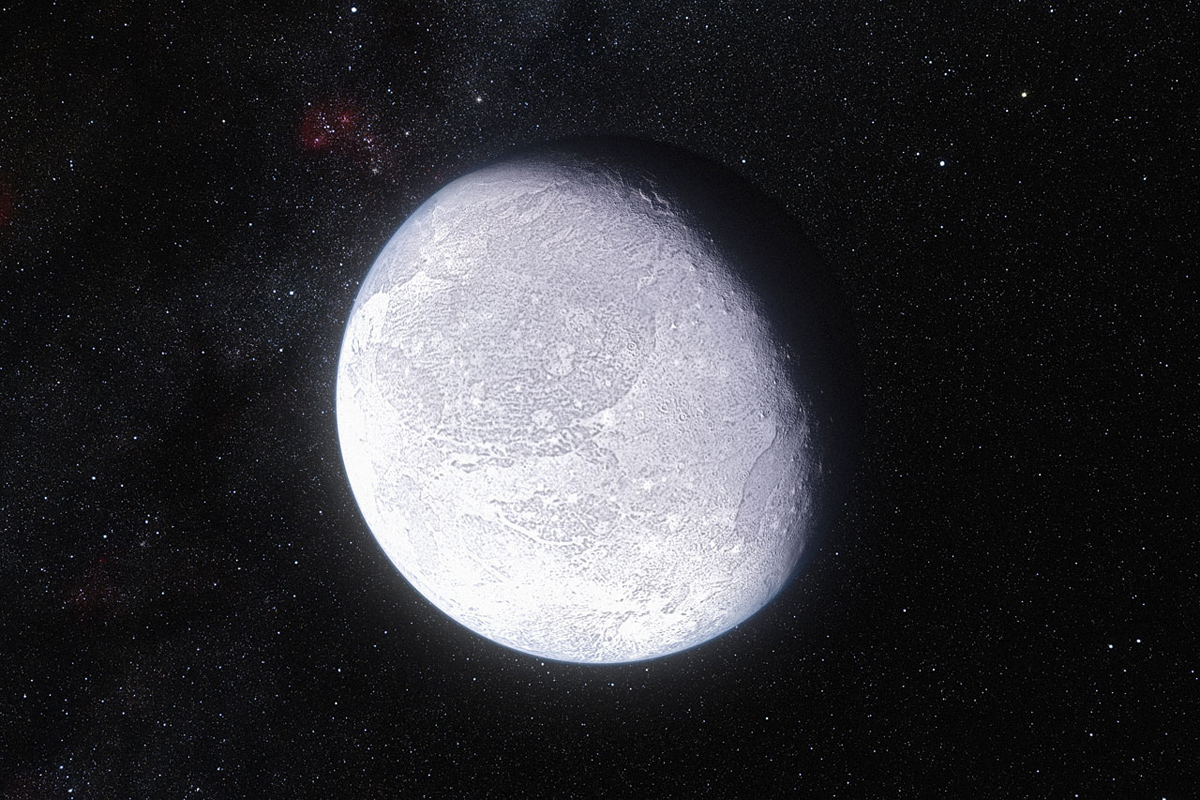
Far beyond the bright planets that most people recognize lies a distant world so cold and remote that sunlight is little more than a brilliant star in its sky. This icy object, named Eris, changed astronomy forever. It sparked one of the biggest debates in modern science and ultimately led to Pluto losing its status as the ninth planet. Although Eris remains hidden in the dark outer reaches of the Solar System, its discovery transformed the way scientists define what a planet truly is.
Eris is one of the largest known dwarf planets and one of the most massive objects beyond Neptune. It belongs to a vast population of icy worlds that orbit the Sun in the distant region known as the Kuiper Belt and the scattered disk. While Eris may seem like a frozen curiosity on the edge of our cosmic neighborhood, it has become one of the most important objects ever discovered in planetary science.
The Discovery That Changed Astronomy
Eris was discovered on January 5, 2005, by astronomers Mike Brown, Chad Trujillo, and David Rabinowitz using observations made at the Samuel Oschin Telescope at Palomar Observatory in California.
Although the official discovery came in 2005, the object had actually appeared in images taken in 2003. Because Eris moved so slowly across the sky due to its enormous distance from Earth, it took time for astronomers to recognize that they had found a new world.
At first, the discovery created tremendous excitement. Early measurements suggested Eris might even be slightly larger than Pluto. Newspapers around the world announced that the Solar System might finally have a “tenth planet.”
But instead of adding another planet to textbooks, Eris forced scientists to ask a much deeper question.
What exactly is a planet?
Why Is It Named Eris?
The dwarf planet is named after Eris, the ancient Greek goddess of discord and conflict.
The name turned out to be surprisingly appropriate.
The discovery of Eris triggered intense debate among astronomers over Pluto’s classification. That disagreement eventually led to one of the most controversial decisions in modern astronomy.
In many ways, Eris truly lived up to its mythological namesake by creating “discord” in the scientific community.
Where Is Eris?
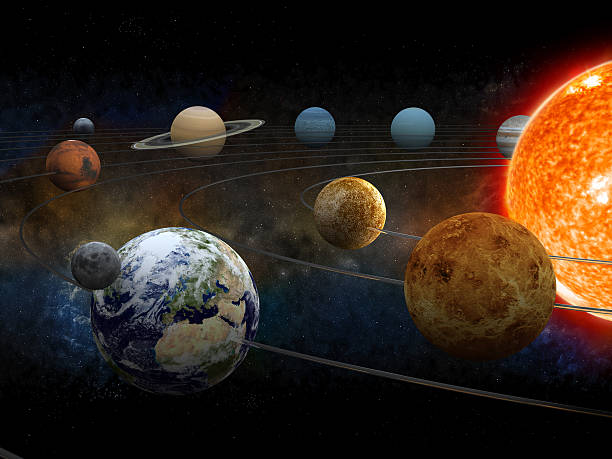
Eris orbits in one of the most distant regions of the Solar System.
Unlike the eight major planets, which travel in relatively circular orbits, Eris follows a highly elongated path around the Sun.
At its closest point, called perihelion, Eris comes to about 38 astronomical units (AU) from the Sun. One astronomical unit is the average distance between Earth and the Sun.
At its farthest point, known as aphelion, Eris travels nearly 98 AU away.
For comparison, Neptune orbits at an average distance of about 30 AU.
This means Eris spends most of its journey far beyond Neptune, where sunlight is extremely weak and temperatures are unimaginably low.
Because it is so distant, sunlight takes more than nine hours to reach Eris, compared with about eight minutes to reach Earth.
How Big Is Eris?
Eris has a diameter of approximately 2,326 kilometers (1,445 miles).
This makes it almost the same size as Pluto. While Pluto is slightly larger in diameter, Eris is actually more massive because it is denser.
Eris has about 27% more mass than Pluto, making it the most massive known dwarf planet in the Solar System.
Its strong gravity allows it to maintain a nearly spherical shape, one of the defining characteristics of dwarf planets.
What Is Eris Made Of?
Eris is primarily composed of rock and ice.
Scientists believe its interior contains a large rocky core surrounded by layers of frozen materials.
Its surface is covered with bright ices, including frozen methane. These methane ices reflect a remarkable amount of sunlight, making Eris one of the brightest large objects in the outer Solar System.
Unlike many darker icy bodies that have been weathered by billions of years of radiation, Eris remains unusually reflective.
One explanation is that when Eris approaches the Sun during its orbit, some frozen gases briefly evaporate into a thin atmosphere. As Eris moves farther away again, those gases freeze back onto the surface as fresh frost, creating a bright new coating.
An Extremely Cold World
Eris is among the coldest known worlds orbiting the Sun.
Surface temperatures typically range between about −231°C and −243°C (−384°F to −405°F).
At these temperatures, water ice becomes as hard as rock.
Nitrogen and methane, which are gases on Earth, exist as solid ice.
The Sun appears much smaller than it does from Earth, yet it would still shine brightly enough to cast faint shadows across Eris’ frozen landscape.
How Long Is a Year on Eris?
Because Eris is so far from the Sun, it takes an incredibly long time to complete one orbit.
A single year on Eris lasts about 557 Earth years.
That means Eris has completed only a tiny fraction of its current orbit since humans invented the telescope.
Its slow journey reminds us just how vast the Solar System truly is.
How Long Is a Day on Eris?
Although its year is extremely long, Eris rotates fairly quickly.
A day on Eris lasts approximately 25.9 Earth hours.
This is surprisingly similar to Earth’s 24-hour day.
As Eris rotates, its icy surface experiences long periods of sunlight and darkness depending on its seasons and location.
Does Eris Have a Moon?
Yes.
Eris has one known moon named Dysnomia.
Dysnomia was discovered later in 2005 using the Hubble Space Telescope.
The moon is named after the daughter of the Greek goddess Eris. In mythology, Dysnomia represents lawlessness, continuing the theme established by Eris’ name.
Dysnomia orbits Eris approximately every 16 days.
Its discovery proved extremely important because astronomers could use its orbit to calculate the mass of Eris with remarkable accuracy.
Without Dysnomia, determining Eris’ mass would have been much more difficult.
Why Isn’t Eris a Planet?
This question lies at the heart of one of astronomy’s greatest debates.
Before Eris was discovered, Pluto had been considered the ninth planet since 1930.
If Eris qualified as a planet, astronomers realized they might soon have to recognize many additional icy worlds as planets as improved telescopes discovered more distant objects.
To solve the problem, the International Astronomical Union (IAU) established an official definition of a planet in 2006.
According to this definition, a planet must satisfy three conditions.
It must orbit the Sun.
It must have enough gravity to become nearly round.
It must have “cleared the neighborhood” around its orbit, meaning it is gravitationally dominant and has removed or controlled most other objects nearby.
Eris satisfies the first two conditions.
However, like Pluto, it shares its orbital region with many other icy objects.
Because it has not cleared its neighborhood, Eris is classified as a dwarf planet rather than a full-sized planet.
This same decision also reclassified Pluto as a dwarf planet.
What Is a Dwarf Planet?
A dwarf planet is a celestial body that orbits the Sun, has enough gravity to become nearly spherical, but has not become the dominant object in its orbital region.
Currently, the International Astronomical Union officially recognizes five dwarf planets:
Ceres
Pluto
Haumea
Makemake
Eris
Scientists expect that many more dwarf planets remain to be officially recognized as discoveries continue.
Eris and the Scattered Disk
Eris belongs to a population of distant icy bodies known as the scattered disk.
The scattered disk overlaps with the Kuiper Belt but contains objects with much more elongated and tilted orbits.
Astronomers believe many scattered disk objects were gravitationally disturbed by Neptune billions of years ago during the early evolution of the Solar System.
These ancient worlds preserve valuable clues about how the planets formed more than 4.5 billion years ago.
What Does Eris Look Like?
No spacecraft has ever visited Eris.
Even the largest telescopes see it only as a tiny point of light.
However, by combining observations from Earth-based telescopes, the Hubble Space Telescope, and other instruments, scientists have learned a surprising amount about its surface.
Researchers believe Eris is covered with bright methane ice mixed with frozen nitrogen and possibly other volatile compounds.
Its high reflectivity, known as albedo, suggests that fresh frost regularly coats the surface.
If a spacecraft ever flew past Eris, it would likely reveal a brilliant white world stretching across an icy landscape under a dark, nearly star-filled sky.
Could Humans Visit Eris?
In theory, yes.
In practice, such a mission would be extraordinarily difficult.
Even NASA’s New Horizons spacecraft, which flew past Pluto in 2015 after traveling for more than nine years, would require several decades—or even longer depending on mission design—to reach Eris.
Its immense distance makes communication slow, spacecraft operations challenging, and missions expensive.
For now, Eris remains one of the most remote worlds studied only through powerful telescopes.
Why Is Eris Important?
Eris is important not simply because it is another icy world.
Its discovery reshaped planetary science.
Before Eris, many people assumed the Solar System contained nine planets.
After Eris, astronomers recognized that the outer Solar System is populated by numerous large icy bodies that blur the distinction between planets and smaller objects.
The discovery forced scientists to create a clearer definition of what a planet actually is.
That debate improved our understanding of the Solar System and highlighted how science changes as new evidence emerges.
Rather than weakening science, the reclassification of Pluto demonstrated one of science’s greatest strengths: it adapts when discoveries reveal a better understanding of nature.
What Scientists Still Hope to Learn
Although astronomers know much more about Eris today than they did at its discovery, many mysteries remain.
Scientists want to determine the exact composition of its surface, understand whether its thin atmosphere appears and disappears during different parts of its orbit, and learn more about its internal structure.
Future telescopes, including next-generation ground-based observatories and advanced space telescopes, will continue studying Eris in greater detail.
One day, a dedicated spacecraft mission could reveal its mountains, craters, icy plains, and geological history up close.
Eris Reminds Us How Much We Have Yet to Discover
Eris is a frozen world orbiting at the edge of the Solar System, but its impact reaches far beyond its distant location. It challenged long-held ideas, reshaped the definition of a planet, and opened a new chapter in our exploration of the Solar System. Today, Eris stands as one of the most fascinating dwarf planets known to science—a bright, icy relic from the Solar System’s earliest days.
As astronomers continue exploring the farthest reaches beyond Neptune, Eris reminds us that even in our own cosmic neighborhood, there are still remarkable worlds waiting to be understood.