Far beyond the warmth of the Sun, in the icy reaches of our Solar System, travels a giant world unlike any other. It spins on its side, glows with a beautiful blue-green color, possesses a surprisingly complex system of rings, and is surrounded by dozens of moons. This remarkable planet is Uranus, one of the most mysterious worlds ever discovered.
Although Uranus is one of the eight major planets in our Solar System, it remains one of the least explored. Only a single spacecraft has ever visited it, leaving scientists with countless unanswered questions. Yet every new observation from powerful telescopes continues to reveal that Uranus is far more fascinating than anyone once imagined.
Understanding Uranus helps scientists learn not only about our own Solar System but also about the thousands of similar planets that have been discovered orbiting distant stars across the Milky Way.
Introducing Uranus
Uranus is the seventh planet from the Sun, located between Saturn and Neptune. It is classified as an ice giant, a type of planet different from the larger gas giants Jupiter and Saturn.
The planet orbits the Sun at an average distance of about 2.9 billion kilometers (1.8 billion miles), making it nearly twenty times farther from the Sun than Earth.
Because sunlight takes much longer to reach Uranus, the planet receives only about one four-hundredth of the sunlight that Earth enjoys. As a result, Uranus is an incredibly cold and dim world.
Despite its enormous distance, Uranus is still visible from Earth without a telescope under very dark skies. However, because it appears only as a faint point of light, it was mistaken for a star until the eighteenth century.
The Discovery of Uranus
For thousands of years, people believed the Solar System ended with Saturn. No one realized another planet lay farther away.
That changed on March 13, 1781, when British astronomer William Herschel noticed an unusual object while observing the night sky through his telescope.
At first, Herschel thought he had discovered a comet. However, careful observations revealed something astonishing—the object was actually an entirely new planet.
This was the first planet ever discovered using a telescope, expanding the known boundaries of the Solar System.
The discovery transformed astronomy. It showed that the Solar System was much larger than previously imagined and inspired astronomers to search even farther into space, eventually leading to the discovery of Neptune and many smaller worlds.
Why Is Uranus Blue?
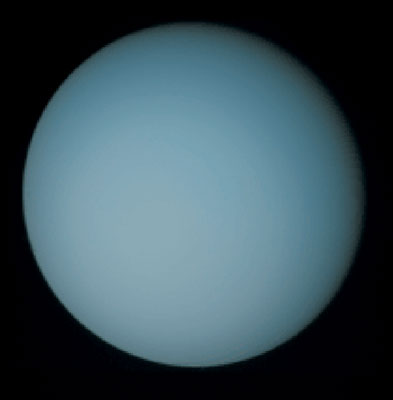
One of Uranus’s most striking features is its beautiful blue-green appearance.
This color comes from methane gas in the planet’s atmosphere.
Sunlight contains many different colors. When sunlight reaches Uranus, methane absorbs much of the red light while allowing blue and green wavelengths to scatter back into space.
This selective absorption gives Uranus its calm turquoise appearance.
Although Neptune is also blue because of methane, Neptune appears deeper and richer in color due to additional atmospheric processes that scientists are still studying.
How Big Is Uranus?
Uranus is enormous.
Its diameter measures about 50,700 kilometers (31,500 miles), making it roughly four times wider than Earth.
If Earth were the size of a grape, Uranus would be about the size of a basketball.
The planet’s volume is so immense that more than 60 Earths could fit inside it.
Even though Uranus is much larger than Earth, it is less dense than our planet because it consists mostly of lighter materials rather than solid rock and metal.
An Ice Giant, Not a Gas Giant
People often group Uranus together with Jupiter and Saturn as giant planets, but scientists place Uranus and Neptune into their own category called ice giants.
The name can be misleading because Uranus is not made of solid ice.
Instead, much of its interior contains hot, dense fluids rich in water, ammonia, and methane under enormous pressure. These substances behave very differently from ordinary ice on Earth.
Above this deep interior lies a thick atmosphere made primarily of hydrogen and helium, with smaller amounts of methane.
The exact structure of Uranus remains uncertain because scientists have never been able to look beneath its cloud tops directly.
The Strange Planet That Rolls Around the Sun
Perhaps the most famous fact about Uranus is that it rotates on its side.
Most planets spin like upright tops, with their poles pointing roughly upward and downward relative to their orbit around the Sun.
Uranus is dramatically different.
Its rotational axis is tilted by about 98 degrees, meaning the planet essentially rolls around the Sun like a giant ball.
Scientists believe this unusual tilt was probably caused billions of years ago by one or more enormous collisions with large planetary bodies during the early history of the Solar System.
This extraordinary orientation creates seasons unlike anywhere else.
Seasons That Last More Than Twenty Years
Because Uranus is tipped over so dramatically, its seasons are extreme.
One pole can face the Sun continuously for about 42 Earth years, experiencing decades of uninterrupted daylight.
Meanwhile, the opposite pole remains in complete darkness for the same amount of time.
Afterward, the situation slowly reverses as Uranus continues its long journey around the Sun.
A full orbit takes approximately 84 Earth years, meaning each season lasts around 21 Earth years.
Imagine living somewhere where summer lasted more than two decades before winter finally arrived.
A Day on Uranus
Although its year is incredibly long, Uranus spins fairly quickly.
One complete rotation takes about 17 hours.
This means the planet experiences relatively short days despite taking 84 Earth years to complete one orbit around the Sun.
The Atmosphere of Uranus
The atmosphere of Uranus is cold, deep, and constantly changing.
It consists mostly of hydrogen and helium, along with methane and trace amounts of other gases.
The upper atmosphere contains layers of clouds that are difficult to observe because they are much fainter than the dramatic cloud systems seen on Jupiter.
However, modern telescopes have revealed enormous storms, bright cloud features, and powerful winds.
Some winds race through the atmosphere at speeds exceeding 900 kilometers per hour (560 miles per hour).
Although Uranus often appears calm from a distance, its atmosphere can be surprisingly active.
One of the Coldest Places in the Solar System
Uranus holds an unexpected record.
Its upper atmosphere reaches temperatures as low as about 49 kelvins (−224°C or −371°F), making it the coldest planetary atmosphere in the Solar System.
This is surprising because Neptune is farther from the Sun.
Scientists think Uranus emits very little internal heat compared with the other giant planets, though the exact reason remains uncertain.
Understanding why Uranus is so cold is one of astronomy’s biggest mysteries.
What Lies Inside Uranus?
No spacecraft has ever drilled into Uranus, so scientists must estimate its internal structure using computer models, gravity measurements, and observations.
Researchers believe Uranus probably has a relatively small rocky core surrounded by an enormous layer of hot water-rich, ammonia-rich, and methane-rich fluids.
These materials exist under crushing pressures and extreme temperatures.
Above this interior lies the thick atmosphere visible from space.
Conditions become increasingly intense with depth, making Uranus one of the most extreme environments in the Solar System.
Does Uranus Have Rings?
Many people know Saturn for its spectacular rings, but Uranus has rings too.
Astronomers discovered Uranus’s ring system in 1977.
Today, scientists have identified 13 known rings surrounding the planet.
Unlike Saturn’s bright icy rings, Uranus’s rings are narrow, dark, and difficult to see.
They contain particles ranging from tiny dust grains to larger rocky fragments.
Exactly how these rings formed remains uncertain.
They may be the remains of shattered moons or debris left over from the formation of the planet.
The Moons of Uranus
Uranus has 28 known moons.
Many are named after characters from the works of William Shakespeare and Alexander Pope, making Uranus unique among the planets.
Its five largest moons are Miranda, Ariel, Umbriel, Titania, and Oberon.
Each possesses its own fascinating landscape.
Miranda is especially remarkable.
Its surface appears patched together with enormous cliffs, deep valleys, and strange geological formations, suggesting a violent history.
Titania is the largest moon of Uranus and may contain a hidden subsurface ocean beneath its icy crust.
Scientists suspect that several Uranian moons could still hold liquid water deep below their frozen surfaces, although this has not yet been confirmed.
The Magnetic Field of Uranus
Most planetary magnetic fields are roughly aligned with the planet’s rotation.
Uranus breaks this rule.
Its magnetic field is tilted by nearly 59 degrees relative to its rotation axis and is also significantly offset from the planet’s center.
As Uranus rotates, its magnetic field swings around in an unusual way, creating one of the strangest magnetospheres in the Solar System.
Scientists are still trying to understand how this unusual magnetic field is generated inside the planet.
How Far Away Is Uranus?
The enormous distance between Earth and Uranus means communication with spacecraft takes a long time.
Depending on the planets’ positions in their orbits, radio signals can require between about 2.5 and 3 hours to travel one way between Earth and Uranus at the speed of light.
Sunlight itself takes roughly 2 hours and 40 minutes to reach Uranus.
Standing there, if it were possible, the Sun would appear much smaller and far dimmer than it does from Earth.
Visiting Uranus
Only one spacecraft has ever explored Uranus up close.
NASA’s Voyager 2 flew past the planet in January 1986.
During its brief visit, Voyager 2 photographed the planet, studied its atmosphere, measured its magnetic field, examined several moons, and discovered additional rings.
The flyby transformed scientists’ understanding of Uranus, but it lasted only a few hours.
Since then, no spacecraft has returned.
Because of this, Uranus remains one of the least explored major planets.
Many planetary scientists consider a future dedicated mission to Uranus one of the highest priorities for exploring the outer Solar System.
Weather on Uranus
For many years, Uranus was thought to be a quiet world with little atmospheric activity.
More recent observations have changed that view.
Powerful telescopes have detected bright storms, enormous cloud systems, seasonal changes, and fast-moving winds.
As Uranus approaches different seasons during its long orbit, its atmosphere appears to become more active.
Scientists continue monitoring these changes to understand how sunlight influences weather on such a distant planet.
Could Humans Live on Uranus?
Humans could not live on Uranus.
The planet has no solid surface where people could stand.
Its atmosphere becomes increasingly dense and hot with depth, eventually reaching pressures capable of crushing any known spacecraft.
Temperatures in the upper atmosphere are unimaginably cold, while deeper regions become extremely hot under immense pressure.
In addition, Uranus lies so far from the Sun that sunlight is very weak.
Any future exploration would likely involve robotic spacecraft rather than human missions.
Why Scientists Study Uranus
Uranus is more than just another distant planet.
Many planets discovered around other stars are similar in size to Uranus and Neptune.
By understanding Uranus, scientists gain valuable clues about a common class of planets throughout our galaxy.
Studying Uranus also helps researchers understand how giant planets form, how atmospheres evolve, how magnetic fields develop, and how planetary systems change over billions of years.
Because so little has been explored, Uranus represents one of the greatest opportunities for future planetary science.
Fascinating Mysteries That Remain
Despite centuries of observation, Uranus still keeps many secrets.
Scientists are trying to determine why its internal heat is unusually weak, what lies deep beneath its clouds, how its magnetic field forms, whether some of its moons hide underground oceans, and exactly how its unusual tilt developed.
Future spacecraft equipped with modern instruments could answer many of these questions.
Each mystery makes Uranus even more exciting to study.
Uranus in the Story of the Solar System
Every planet tells a different chapter in the story of our Solar System.
Mercury reveals the effects of intense solar heat.
Venus teaches us about runaway greenhouse warming.
Earth is the only known world with life.
Mars preserves clues to an ancient watery past.
Jupiter dominates with its immense gravity.
Saturn dazzles with magnificent rings.
Neptune showcases powerful winds.
Uranus stands apart as the tilted ice giant—a world of extreme seasons, hidden mysteries, icy depths, and elegant blue beauty.
Though distant and often overlooked, Uranus reminds us that the Solar System is far more diverse and extraordinary than early astronomers ever imagined. Every future mission to this fascinating planet promises discoveries that could reshape our understanding not only of Uranus itself but also of countless similar worlds scattered throughout the universe.