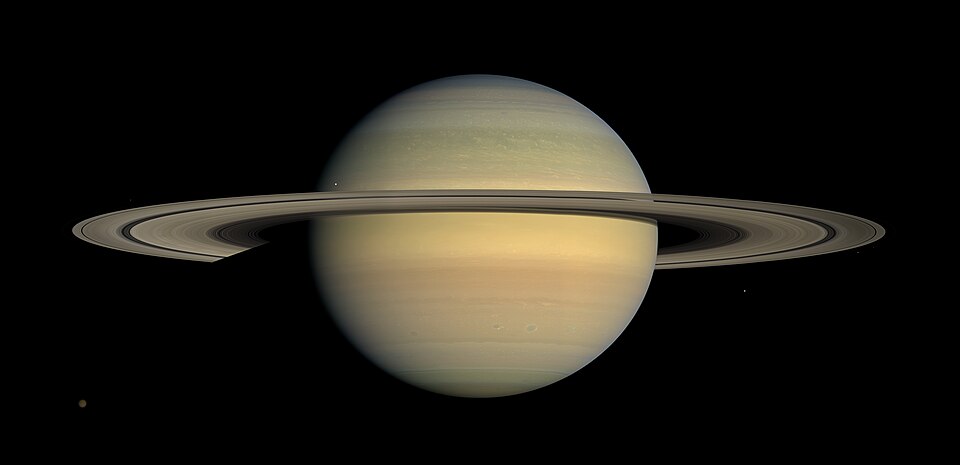
Few sights in the Solar System are as breathtaking as Saturn floating in space with its magnificent rings stretching hundreds of thousands of kilometers around the planet. Through even a small telescope, Saturn instantly stands out from every other world. Its glowing rings make it look almost unreal, like a giant jewel suspended in the darkness of space.
For centuries, these rings have fascinated astronomers and inspired countless questions. Why does Saturn have rings while most planets do not? Where did these rings come from? Have they always been there? Were they created when Saturn formed, or did something dramatic happen later?
Today, thanks to decades of spacecraft exploration and advanced scientific research, astronomers have developed several compelling ideas about how Saturn’s rings formed. While some mysteries remain, we now understand far more about their origin than ever before. The story of Saturn’s rings is one of destruction, gravity, and cosmic recycling—a story that continues to unfold.
The Beauty of Saturn’s Rings
At first glance, Saturn’s rings appear to be solid, flat discs circling the planet. In reality, they are nothing like a solid surface.
Instead, the rings are made of countless individual pieces of ice mixed with small amounts of rock and dust. These particles range enormously in size. Some are as tiny as grains of sand, while others are as large as houses, buses, or even mountains several kilometers across.
Each piece follows its own orbit around Saturn, held in place by the planet’s immense gravity. Together, billions upon billions of these icy fragments create the bright rings we see from Earth.
Although the rings stretch about 280,000 kilometers (174,000 miles) across, they are astonishingly thin. In many places, they are only about 10 to 100 meters (33 to 330 feet) thick, though the thickness varies throughout the ring system. If Saturn’s rings were scaled to the size of a sheet of paper, they would still be wider than an entire football field.
Galileo’s First Confusing View
The mystery of Saturn’s rings began in 1610 when the Italian astronomer Galileo Galilei turned one of the first telescopes toward the planet.
His telescope was not powerful enough to reveal the rings clearly. Instead, he saw what looked like two mysterious objects attached to Saturn’s sides. He could not explain what he was seeing.
A few years later, the strange objects seemed to disappear. Galileo was puzzled because he did not realize that Earth had reached an angle where the extremely thin rings appeared almost edge-on, making them nearly invisible.
In 1655, Dutch astronomer Christiaan Huygens solved the mystery. Using a better telescope, he correctly concluded that Saturn was surrounded by a thin, flat ring that did not touch the planet.
Since then, every improvement in telescope technology has revealed more detail, eventually showing that Saturn actually possesses thousands of separate ringlets rather than a single continuous ring.
What Are Saturn’s Rings Made Of?
The rings are composed mostly of water ice.
Measurements made by spacecraft show that between about 90% and 95% of the ring material is water ice. The remaining material consists of rocky particles and dark compounds that slightly reduce the rings’ brightness.
The high percentage of clean ice explains why Saturn’s rings reflect so much sunlight. They are the brightest planetary rings in the Solar System.
When sunlight strikes the icy particles, the rings shine brilliantly, making Saturn visible even through relatively small telescopes.
Scientists believe that if the rings contained much more dust, they would appear significantly darker.
A Planet with Many Rings
Saturn does not have just one ring.
Instead, it possesses an intricate system divided into several major rings named alphabetically according to their discovery rather than their distance from the planet.
The main rings are known as the D, C, B, A, F, G, and E rings.
The B Ring is the brightest and most massive part of the system.
Between the A and B rings lies the famous Cassini Division, a broad gap first observed in 1675 by Italian astronomer Giovanni Domenico Cassini. Despite its appearance, the Cassini Division is not completely empty. It contains much less material than the neighboring rings but still includes many orbiting particles.
Each ring contains thousands of narrower ringlets, waves, gaps, and complex structures shaped by Saturn’s moons and gravitational interactions.
The Leading Idea: A Destroyed Moon
Today, one of the strongest scientific explanations is that Saturn’s rings formed when one or more icy moons ventured too close to the planet and were torn apart by gravity.
Saturn’s gravitational pull becomes enormously stronger closer to the planet. If a moon crosses a critical distance called the Roche limit, tidal forces can exceed the moon’s own gravity.
Instead of remaining intact, the moon begins to break apart.
Over time, the fragments spread into countless icy pieces that continue orbiting Saturn rather than falling directly onto the planet.
These fragments gradually collide with one another, becoming flatter and more evenly distributed until they form a broad ring system.
Computer simulations show that this process can naturally produce rings very similar to those observed today.
Understanding the Roche Limit
The Roche limit is one of the most important concepts in explaining Saturn’s rings.
Named after the French astronomer Édouard Roche, it represents the minimum distance at which a celestial body held together mainly by its own gravity can safely orbit a larger planet.
Outside this limit, gravity is strong enough to keep the moon together.
Inside the limit, Saturn’s gravity pulls more strongly on the moon’s near side than on its far side. These tidal forces stretch the moon until it can no longer hold itself together.
Once the object begins breaking apart, the debris spreads into orbit instead of immediately reassembling.
This makes the Roche limit an ideal location for long-lasting rings.
Could a Giant Comet Have Created the Rings?
Another possibility is that Saturn’s rings formed after a large comet or icy object passed too close to the planet.
If such an object entered within the Roche limit, Saturn’s gravity could have shattered it into countless pieces.
Those fragments would continue orbiting Saturn, eventually forming rings.
This idea is scientifically possible, especially because the outer Solar System contains many icy objects.
However, many scientists believe the destroyed moon scenario is somewhat more likely because it better explains the large amount of material currently found in Saturn’s rings.
It is also possible that both processes occurred at different times in Saturn’s history.
Were the Rings Born with Saturn?
For many years, astronomers wondered whether Saturn’s rings formed at the same time as the planet itself about 4.5 billion years ago.
If that were true, the rings would be among the oldest structures in the Solar System.
However, evidence gathered during recent decades suggests that the visible rings may actually be much younger.
Measurements by NASA’s Cassini spacecraft indicate that the rings contain surprisingly little dark dust.
If they had been exposed to billions of years of impacts from tiny meteoroids, they would likely appear much darker than they do today.
This suggests that the rings may have formed only a few hundred million years ago, although their exact age remains uncertain.
Some researchers continue to investigate whether certain parts of the ring system could be older than others.
Cassini Changed Everything
One of humanity’s greatest explorations of Saturn began in 2004 when NASA’s Cassini spacecraft entered orbit around the giant planet.
For more than 13 years, Cassini studied Saturn, its moons, magnetic field, atmosphere, and rings in extraordinary detail.
The spacecraft photographed intricate ring structures never seen before.
It observed waves moving through the rings, tiny moonlets embedded within them, and gravitational interactions that constantly reshape the ring system.
Near the end of its mission, Cassini repeatedly flew between Saturn and its innermost rings, making measurements impossible from Earth.
These close observations provided the most accurate estimates yet of the rings’ total mass, composition, and structure.
Cassini’s discoveries greatly improved scientists’ understanding of how the rings formed and how they continue to evolve.
Tiny Moons Shape the Rings
Although Saturn’s gravity dominates the ring system, many of its moons also play crucial roles.
Small moons orbit near or even within the rings.
Their gravity creates gaps, waves, ripples, and narrow ringlets.
Some moons, called shepherd moons, help keep certain rings sharply defined.
As they orbit, their gravity gently guides nearby particles, preventing the rings from spreading too quickly.
Without these moons, many ring features would gradually become blurred over time.
The interaction between moons and rings is one of the most beautiful examples of gravity shaping the Solar System.
Why Don’t the Ring Particles Crash Together Constantly?
The rings may appear crowded, but each particle follows a carefully balanced orbit around Saturn.
Nearby particles travel at similar speeds, reducing the likelihood of violent collisions.
When collisions do occur, they are usually gentle because the relative speeds are low.
These repeated small collisions actually help keep the rings thin and flat.
Instead of forming a chaotic cloud, the particles gradually settle into an organized disk.
Gravity and collisions work together to maintain the ring system over long periods.
Are Saturn’s Rings Permanent?
Although Saturn’s rings seem timeless, they are actually changing.
Small particles are constantly being pulled toward Saturn by the planet’s magnetic field and gravity.
This process is sometimes called ring rain because charged water particles gradually fall into Saturn’s upper atmosphere.
At the same time, tiny meteoroids continuously strike the rings, breaking particles apart and adding dust.
These slow processes mean the rings are gradually losing material.
Scientists estimate that, unless new material is added, Saturn’s bright rings may eventually disappear over tens to hundreds of millions of years.
Compared with the age of the Solar System, this is relatively short.
We may be living during a special period when Saturn’s rings are especially bright and prominent.
Could New Rings Form Again?
Nature often recycles material.
If another icy moon or large comet were to wander inside Saturn’s Roche limit in the distant future, it could potentially be torn apart.
The resulting debris might form an entirely new ring system.
This means Saturn’s rings may not represent a single event but part of an ongoing cycle of destruction and renewal spanning billions of years.
Planets and their moons continue evolving long after they first form.
Do Other Planets Have Rings?
Saturn’s rings are the largest and brightest, but it is not the only planet with rings.
Jupiter, Uranus, and Neptune also possess ring systems.
However, their rings are much darker, thinner, and more difficult to observe.
Saturn’s rings stand out because they contain enormous amounts of highly reflective water ice.
The other giant planets likely experienced different formation histories, resulting in much less spectacular ring systems.
Studying these differences helps astronomers understand how planets and moons evolve throughout the Solar System.
What Saturn’s Rings Teach Us
Saturn’s rings are more than a beautiful decoration.
They serve as a natural laboratory for studying gravity, orbital motion, collisions, and the processes that shape planetary systems.
Many of the same physical principles operating within Saturn’s rings also influence the formation of planets around young stars and the evolution of galaxies on much larger scales.
By understanding the rings, scientists gain insights into how disks of material behave throughout the universe.
The rings remind us that even seemingly stable objects are constantly changing under the influence of gravity and time.
The Mystery Continues
Despite centuries of observation and years of close exploration by spacecraft, Saturn’s rings continue to surprise scientists.
Researchers are still investigating their precise age, the exact event that created them, and how rapidly they are disappearing. New computer models, telescope observations, and future missions may eventually answer these questions.
What is already clear is that Saturn’s rings are not permanent ornaments but dynamic structures shaped by powerful natural forces. Whether they were born from the destruction of an ancient moon, the breakup of a giant comet, or a combination of multiple events, they represent one of the most spectacular examples of gravity at work.
Every icy particle circling Saturn tells part of a story that began long ago—a story of cosmic collisions, delicate balance, and continuous change. As we gaze at Saturn through telescopes or admire images returned by spacecraft, we are witnessing not just one of the Solar System’s greatest wonders, but an evolving masterpiece created by the laws of physics themselves.