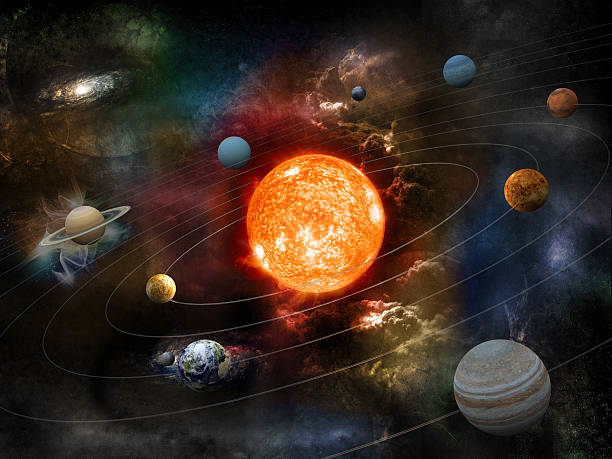
For more than 75 years, Pluto held a special place in our imagination. Children learned that it was the ninth planet in our Solar System, books proudly listed it alongside Mercury through Neptune, and generations grew up thinking of Pluto as the smallest and most distant planet orbiting the Sun.
Then, in 2006, everything changed.
Scientists announced that Pluto was no longer classified as a planet. Around the world, people reacted with surprise, disappointment, and even anger. Many wondered, “Did Pluto shrink?” “Was there a mistake?” “How can a planet suddenly stop being a planet?”
The truth is far more interesting than many people realize.
Pluto did not change. It did not disappear. It did not lose its orbit or become less fascinating. Instead, our understanding of the Solar System became much deeper. As astronomers discovered many new worlds beyond Neptune, they realized that the old definition of a planet no longer made scientific sense.
The story of Pluto is not about taking something away. It is about science growing through new discoveries.
The Discovery of Pluto
The story begins in the early twentieth century.
Astronomers believed another large object might exist beyond Neptune because they thought the orbits of Uranus and Neptune showed unexplained irregularities. They called this hypothetical world “Planet X.”
An American astronomer named Clyde Tombaugh spent months carefully comparing photographs of the night sky. On February 18, 1930, he found a tiny object that moved against the background stars.
That object was Pluto.
The discovery was celebrated around the world. Pluto quickly became known as the ninth planet, extending the boundaries of the Solar System farther than ever before.
Although astronomers soon realized Pluto was much smaller than originally expected, it remained classified as a planet because no better system of classification existed.
Pluto Is Much Smaller Than Most People Imagine
When Pluto was first discovered, scientists could not accurately measure its size.
Many assumed it was at least as large as Earth.
As telescopes improved, astronomers gradually discovered that Pluto is surprisingly small.
Its diameter is only about 2,377 kilometers (1,477 miles), making it smaller than Earth’s Moon.
If Earth were the size of a basketball, Pluto would be about the size of a golf ball.
Its mass is only about 0.2% that of Earth.
Despite its small size, Pluto remains a complex world with mountains, glaciers, valleys, plains, and a thin atmosphere that changes as it moves around the Sun.
Pluto Lives in a Crowded Neighborhood
For decades, Pluto seemed unique because astronomers had not discovered many other objects beyond Neptune.
That changed dramatically during the 1990s.
Powerful telescopes began revealing countless icy bodies in a region known as the Kuiper Belt.
The Kuiper Belt is a vast ring of frozen objects that stretches beyond Neptune’s orbit. It contains millions of icy bodies left over from the formation of the Solar System about 4.6 billion years ago.
Scientists realized Pluto was not alone.
Instead, it appeared to be one of many similar icy worlds.
This raised an important question.
If Pluto is a planet, should every large object in the Kuiper Belt also become a planet?
The Discovery That Changed Everything
The biggest turning point came in 2005.
Astronomers discovered a distant object named Eris.
At first, Eris appeared to be slightly larger than Pluto, although later measurements showed the two are very similar in size, with Eris being slightly more massive.
The discovery created a scientific dilemma.
If Pluto was considered a planet, then Eris should probably become one too.
But astronomers suspected many more Pluto-sized objects were waiting to be discovered.
If every one of them became a planet, textbooks might eventually contain dozens—or even hundreds—of planets.
Scientists realized they needed a clear and consistent definition of what actually makes something a planet.
Why Defining a Planet Was So Difficult
Most people assume a planet is simply a large object that orbits the Sun.
However, this description creates problems.
Many moons are larger than some planets.
For example, Jupiter’s moon Ganymede and Saturn’s moon Titan are both larger than Mercury.
Yet they are not planets because they orbit planets rather than the Sun.
Similarly, many objects beyond Neptune orbit the Sun but differ greatly in size and behavior.
Astronomers needed a definition that reflected how planets form and interact with their surroundings.
The International Astronomical Union Steps In
In August 2006, astronomers from around the world gathered in Prague for a meeting of the International Astronomical Union (IAU), the organization responsible for standardizing astronomical terminology.
After extensive discussion and debate, the IAU adopted an official definition of a planet.
According to this definition, a planet must satisfy three conditions.
It must orbit the Sun.
It must have enough mass for its own gravity to pull it into a nearly round shape.
It must have “cleared the neighborhood” around its orbit.
Pluto easily satisfies the first two conditions.
It orbits the Sun.
Its gravity has shaped it into a nearly spherical world.
The problem lies with the third condition.
What Does “Clearing the Neighborhood” Mean?
This phrase often causes confusion.
It does not mean a planet has literally removed every object from its orbit.
Even Earth shares space with asteroids, dust, and small near-Earth objects.
Instead, clearing the neighborhood means that a planet has become overwhelmingly dominant in its orbital region through gravity.
Over billions of years, major planets either absorb nearby objects, eject them from the region, or trap them as moons.
As a result, they become by far the largest gravitational influence in their orbital paths.
Earth dominates its orbit.
Jupiter dominates its orbit.
Neptune dominates its orbit.
Pluto does not.
Why Pluto Failed the Third Requirement
Pluto travels through the Kuiper Belt, where countless icy objects share similar orbits.
Rather than dominating this region, Pluto is simply one member of a much larger population.
Its gravity is far too weak to control the entire neighborhood.
Although Pluto is one of the larger Kuiper Belt objects, it has not cleared nearby bodies over the history of the Solar System.
Because it does not satisfy the third criterion, it does not meet the IAU’s definition of a planet.
This is the primary scientific reason behind Pluto’s reclassification.
Pluto Became a Dwarf Planet
Rather than being removed entirely from astronomical classification, Pluto received a new category.
It became a dwarf planet.
A dwarf planet orbits the Sun and has enough gravity to become nearly round, but it has not cleared its orbital neighborhood.
Pluto is therefore both a dwarf planet and one of the largest known members of the Kuiper Belt.
This new category also includes several other fascinating worlds, such as Eris, Haumea, Makemake, and Ceres.
Being called a dwarf planet does not mean Pluto is unimportant.
It simply reflects its place within the broader structure of the Solar System.
Pluto Is Still an Amazing World
The change in classification did nothing to reduce Pluto’s scientific importance.
In fact, scientists became even more interested in studying it.
On July 14, 2015, NASA’s New Horizons spacecraft flew past Pluto after traveling for nearly nine and a half years through space.
The mission transformed our understanding of this distant world.
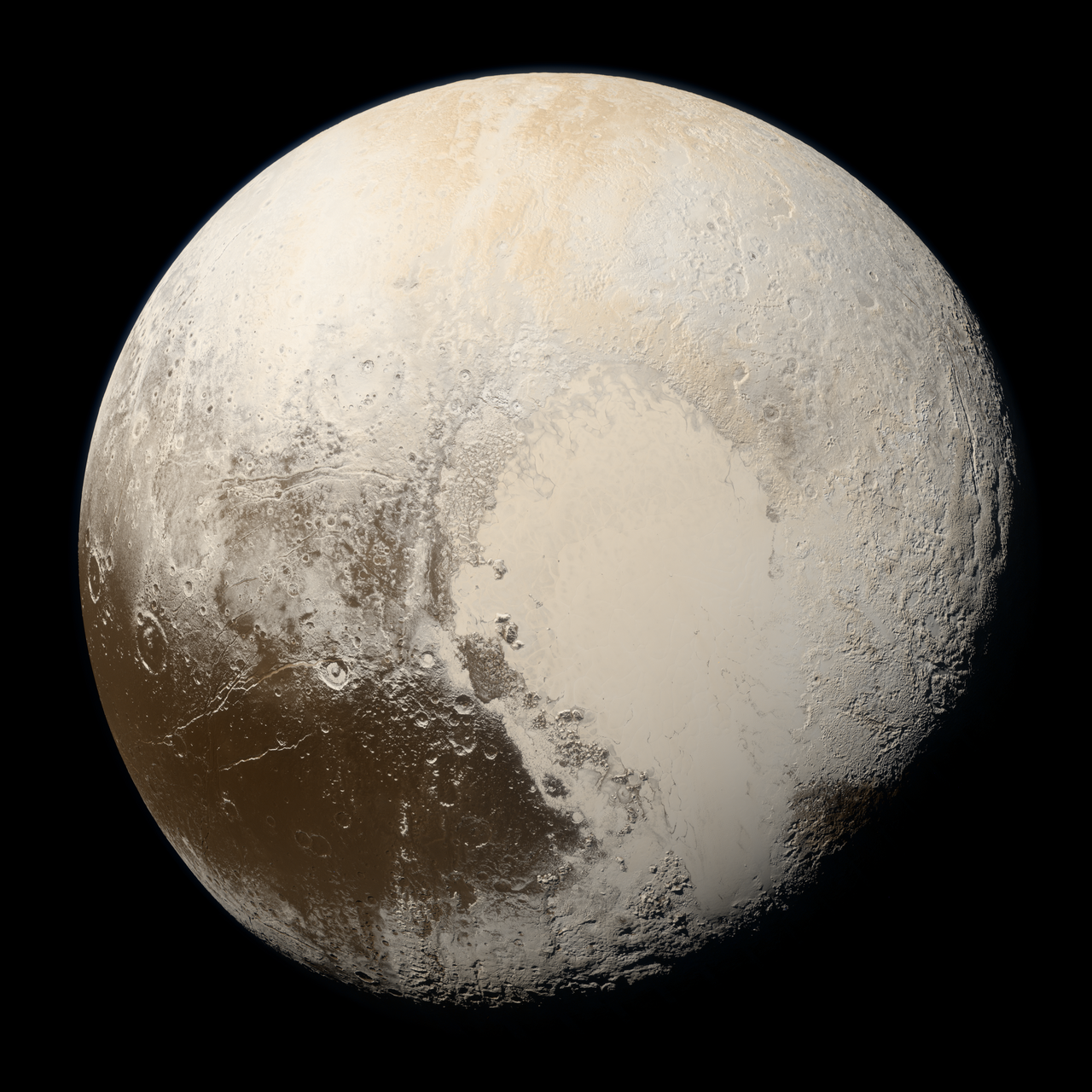
Instead of finding a frozen, inactive ball of ice, New Horizons revealed an incredibly complex landscape.
Towering mountains made of water ice rise several kilometers above the surface.
Huge glaciers of frozen nitrogen slowly flow across plains.
Dark regions contrast with bright icy deposits.
Evidence suggests that Pluto may even contain a liquid ocean beneath its icy crust.
Its famous heart-shaped region, officially called Sputnik Planitia, became one of the most recognizable landscapes in planetary science.
Far from being a dull frozen rock, Pluto turned out to be one of the most geologically interesting objects in the Solar System.
Pluto Has Moons Too
Many people are surprised to learn that Pluto has its own family of moons.
The largest is Charon, which is unusually massive compared with Pluto.
Charon is about half Pluto’s diameter, making the pair more like a double-world system than a typical planet and moon.
Pluto also has four smaller moons: Styx, Nix, Kerberos, and Hydra.
Together, they create a surprisingly dynamic system despite being billions of kilometers from the Sun.
Why Some Scientists Still Debate Pluto’s Status
Although the IAU definition is widely used, not every astronomer agrees with it.
Some scientists argue that a planet should be defined mainly by its own physical characteristics rather than by its orbital environment.
According to this view, Pluto’s spherical shape and geological complexity could qualify it as a planet.
Others believe the current definition works well because it distinguishes the dominant worlds from the many smaller bodies in regions like the Kuiper Belt.
This scientific debate continues, showing that science is always open to discussion and refinement when supported by evidence.
Did Pluto Actually Change?
One of the biggest misconceptions is that Pluto somehow changed in 2006.
It did not.
Pluto remains exactly the same object it has always been.
Its size stayed the same.
Its orbit stayed the same.
Its mountains, glaciers, moons, and icy plains stayed the same.
Only our classification changed.
This is similar to discovering that a whale is not a fish but a mammal. The whale itself did not change—our understanding improved.
Why Science Sometimes Changes
Some people see changes in scientific classifications as signs that science is unreliable.
The opposite is true.
Science changes because it follows evidence.
As new discoveries are made, scientists refine ideas to better reflect reality.
When Pluto was discovered in 1930, astronomers knew of very few distant icy worlds.
Today, they know of thousands of objects beyond Neptune.
The definition of a planet evolved because our knowledge of the Solar System expanded dramatically.
Changing classifications in light of new evidence is one of the greatest strengths of science.
Pluto’s Place in the Solar System Today
Today, Pluto is recognized as one of the largest and most important dwarf planets in our Solar System.
It serves as a gateway to understanding the Kuiper Belt, the formation of planets, and the icy worlds that populate the outer reaches of our cosmic neighborhood.
Rather than being the “former ninth planet,” many scientists now see Pluto as the first well-studied member of an entirely new class of distant worlds.
Its exploration has helped reshape planetary science and inspired new missions to investigate the mysterious frontier beyond Neptune.
The True Story Behind Pluto’s Reclassification
Pluto’s journey from planet to dwarf planet is not a story of loss but of discovery. As astronomers uncovered a vast population of icy worlds beyond Neptune, they realized that the Solar System was far richer and more complex than anyone had imagined. To describe this growing family of objects accurately, they needed a clearer definition of what a planet is.
Pluto did not become less interesting because of its new classification. If anything, it became even more remarkable. It is a frozen world with towering mountains, flowing glaciers, a surprisingly active surface, multiple moons, and perhaps even a hidden ocean beneath its ice.
The debate over Pluto also reminds us of something deeply important about science: knowledge is never frozen. As we explore farther into space and uncover new evidence, our understanding evolves. Pluto’s story is a perfect example of science doing exactly what it is meant to do—following the evidence wherever it leads while revealing an ever more fascinating universe.