Light is so familiar that we rarely stop to think about how extraordinary it really is. Every morning, sunlight brightens the sky. At night, we see the Moon because it reflects sunlight toward Earth. We use light to read books, take photographs, browse the internet through fiber-optic cables, and explore the distant universe with powerful telescopes. Yet behind this everyday experience lies one of the most astonishing facts in science: light travels faster than anything else known in the universe.
Its speed is so immense that it can circle Earth more than seven times in just one second. At the same time, even this incredible speed has limits. Because light does not travel instantaneously, looking into the night sky is actually like looking back in time. The stars, galaxies, and nebulae we observe today appear as they were years, centuries, or even billions of years ago.
Understanding how fast light travels opens the door to some of the most fascinating ideas in physics, astronomy, and cosmology. It reveals how we measure the universe, how modern technology works, and why space and time are more deeply connected than they seem.
What Is Light?
Light is a form of electromagnetic radiation. It carries energy through space as electromagnetic waves and also behaves as tiny particles called photons. This dual nature, known as wave-particle duality, is one of the fundamental discoveries of quantum physics.
The light visible to human eyes represents only a small portion of the electromagnetic spectrum. Radio waves, microwaves, infrared radiation, ultraviolet light, X-rays, and gamma rays are all forms of electromagnetic radiation that travel according to the same physical principles.
Unlike sound, which requires air, water, or another material to move, light can travel through the vacuum of space. This ability allows sunlight to reach Earth despite the nearly empty space between our planet and the Sun.
The Speed of Light
In a vacuum, light travels at exactly 299,792,458 meters per second.
This value is commonly rounded to 300 million meters per second, or about 186,282 miles per second.
Scientists use the symbol c to represent the speed of light in a vacuum. The value of c is one of the most important constants in all of physics.
To appreciate how fast this is, imagine light traveling around Earth’s equator. At its maximum speed, light could circle the planet about 7.5 times in just one second.
Nothing with mass has ever been observed traveling faster than light in a vacuum. According to our current understanding of physics, the speed of light represents the ultimate speed limit of the universe.
How Long Does Light Take to Reach Earth from the Sun?
Although light moves incredibly fast, space is unimaginably vast.
The average distance between Earth and the Sun is approximately 149.6 million kilometers (93 million miles). Even at nearly 300 million meters per second, sunlight takes about 8 minutes and 20 seconds to reach Earth.
This means every sunrise shows us the Sun as it was more than eight minutes ago.
If the Sun were somehow to disappear—a purely hypothetical scenario—we would continue seeing it in the sky for about eight minutes because the last photons already traveling toward Earth would still need time to arrive.
The same delay applies to the Sun’s gravitational influence according to Einstein’s theory of general relativity.
Light from the Moon
The Moon is much closer to Earth than the Sun.
On average, the Moon lies about 384,400 kilometers away.
Light reflected from the Moon reaches Earth in roughly 1.3 seconds.
Whenever we look at the Moon, we are seeing it as it appeared just over one second earlier.
Although this delay is tiny compared with astronomical distances, it reminds us that light always requires time to travel.
Looking at the Stars Means Looking into the Past
One of the most amazing consequences of light’s finite speed is that astronomy allows us to look backward in time.
When we observe a nearby star located ten light-years away, we see it exactly as it was ten years ago.
If that star changed yesterday, we would not know for another ten years.
Some stars visible without telescopes are hundreds or even thousands of light-years away.
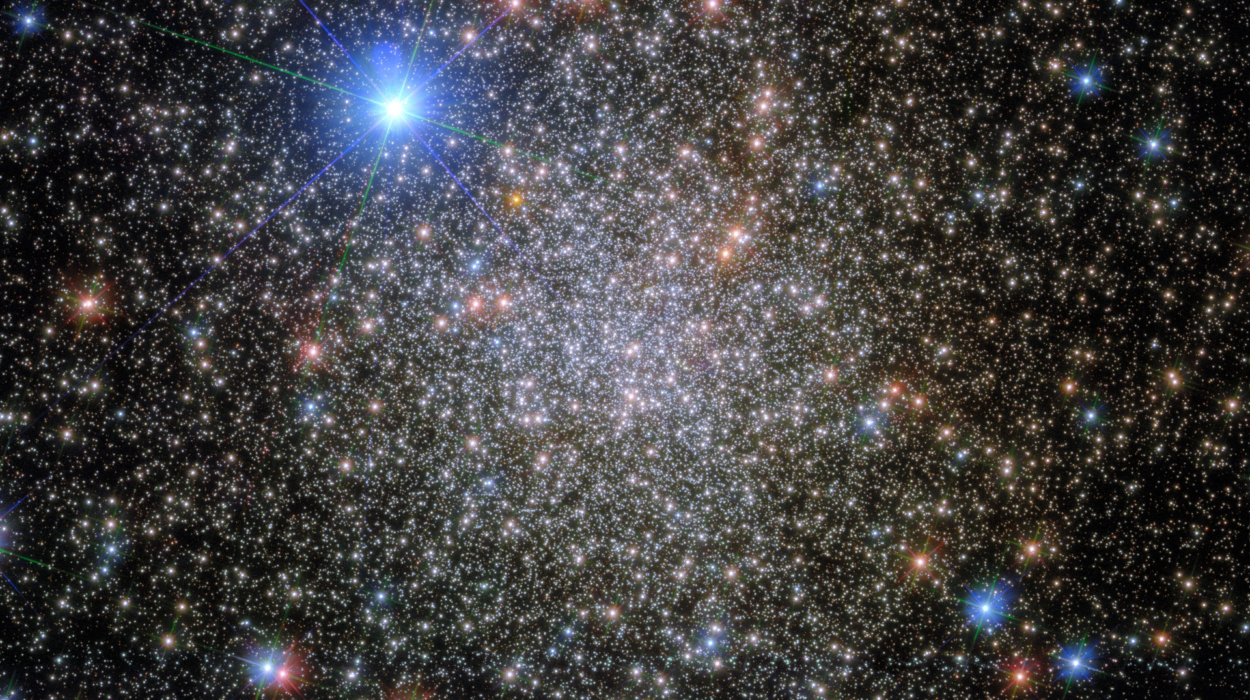
The most distant galaxies observed by powerful space telescopes are so far away that their light began its journey more than 13 billion years ago, not long after the universe itself formed.
Astronomers are therefore historians of the cosmos. Every telescope is effectively a time machine that reveals earlier stages of cosmic history.
What Is a Light-Year?
Because distances in space are enormous, astronomers often use the light-year as a unit of distance rather than kilometers or miles.
A light-year is the distance light travels in one year.
Since light moves at nearly 300 million meters every second, one light-year equals approximately 9.46 trillion kilometers, or about 5.88 trillion miles.
Despite its name, a light-year measures distance, not time.
For example, the nearest star beyond our Sun, Proxima Centauri, is about 4.24 light-years away. This means its light requires more than four years to reach Earth.
Does Light Always Travel at the Same Speed?
The speed of light depends on the medium through which it travels.
In a vacuum, light always moves at its maximum speed.
When light passes through materials such as air, water, glass, or diamond, it slows down because it interacts with atoms inside the material.
Even though the photons themselves continue moving between atoms at the fundamental speed of light, repeated interactions cause the overall travel time through the material to increase.
This slowing explains why a straw appears bent when placed in a glass of water and why lenses can focus light into sharp images.
Different materials slow light by different amounts, producing fascinating optical effects used in cameras, microscopes, telescopes, and eyeglasses.
How Scientists Measured the Speed of Light
For much of human history, people believed light traveled instantaneously.
The first convincing evidence that light has a measurable speed came in 1676 when Danish astronomer Ole Rømer studied Jupiter’s moon Io.
He noticed that the moon’s eclipses appeared slightly early or late depending on Earth’s position in its orbit around the Sun.
Rømer correctly concluded that these timing differences occurred because light required additional time to travel across the greater distance when Earth was farther from Jupiter.
His observations provided the first successful estimate of the speed of light.
During the nineteenth century, scientists developed increasingly precise laboratory experiments using rotating mirrors and other sophisticated equipment.
Today, advanced lasers, atomic clocks, and highly accurate electronic instruments have allowed scientists to determine the speed of light with extraordinary precision.
In fact, the speed of light is now defined exactly, making it one of the fundamental constants upon which the International System of Units (SI) is based.
Why Is the Speed of Light So Important?
The speed of light is much more than just another number.
It lies at the heart of modern physics.
Albert Einstein’s theory of special relativity showed that the speed of light remains the same for every observer in a vacuum, regardless of how they are moving.
This surprising discovery transformed our understanding of space and time.
Instead of being separate, space and time form a unified structure called spacetime.
As objects move faster, time passes more slowly relative to stationary observers. Distances also appear shorter along the direction of motion.
These effects become noticeable only at speeds approaching that of light, but they have been confirmed repeatedly through experiments.
Without accounting for relativity, technologies such as GPS would gradually accumulate navigation errors.
Can Anything Travel Faster Than Light?
According to current scientific evidence, no object with mass can be accelerated to the speed of light, let alone exceed it.
As an object’s speed increases, its energy requirements grow dramatically.
Approaching the speed of light would require increasingly enormous amounts of energy.
Reaching exactly the speed of light would require an infinite amount of energy, making it impossible for matter according to our current understanding of physics.
Photons, however, naturally travel at the speed of light because they have no rest mass.
Although some theoretical ideas in physics discuss concepts such as wormholes or hypothetical particles called tachyons, none have been experimentally confirmed as ways to send matter or information faster than light.
As far as modern science knows, the speed of light remains the ultimate cosmic speed limit.
Light and Einstein’s Famous Equation
One of the best-known equations in science is:
E = mc²
In this equation, c represents the speed of light.
Because the speed of light is such an enormous number, even a tiny amount of mass corresponds to an immense amount of energy.
This relationship explains how the Sun generates energy through nuclear fusion.
Inside the Sun’s core, small amounts of mass are converted into tremendous amounts of energy, producing the sunlight that eventually reaches Earth.
The same principle underlies nuclear power and many processes studied in particle physics.
Why Doesn’t Light Need Air?
Unlike sound waves, light does not require a material medium.
Sound travels by vibrating particles in air, water, or solids.
In space, where almost no particles exist, sound cannot travel.
Light is different because it consists of self-propagating electric and magnetic fields.
These fields sustain one another as they move through empty space.
That is why sunlight crosses nearly 150 million kilometers of space before illuminating Earth.
Without this remarkable property, life on our planet would not exist.
How Light Powers Modern Technology
The speed and properties of light make many modern technologies possible.
Fiber-optic communication sends pulses of light through extremely thin strands of glass, allowing enormous amounts of information to travel across continents and oceans.
Lasers are used in medicine, manufacturing, scientific research, and telecommunications.
Digital cameras detect incoming photons to create images.
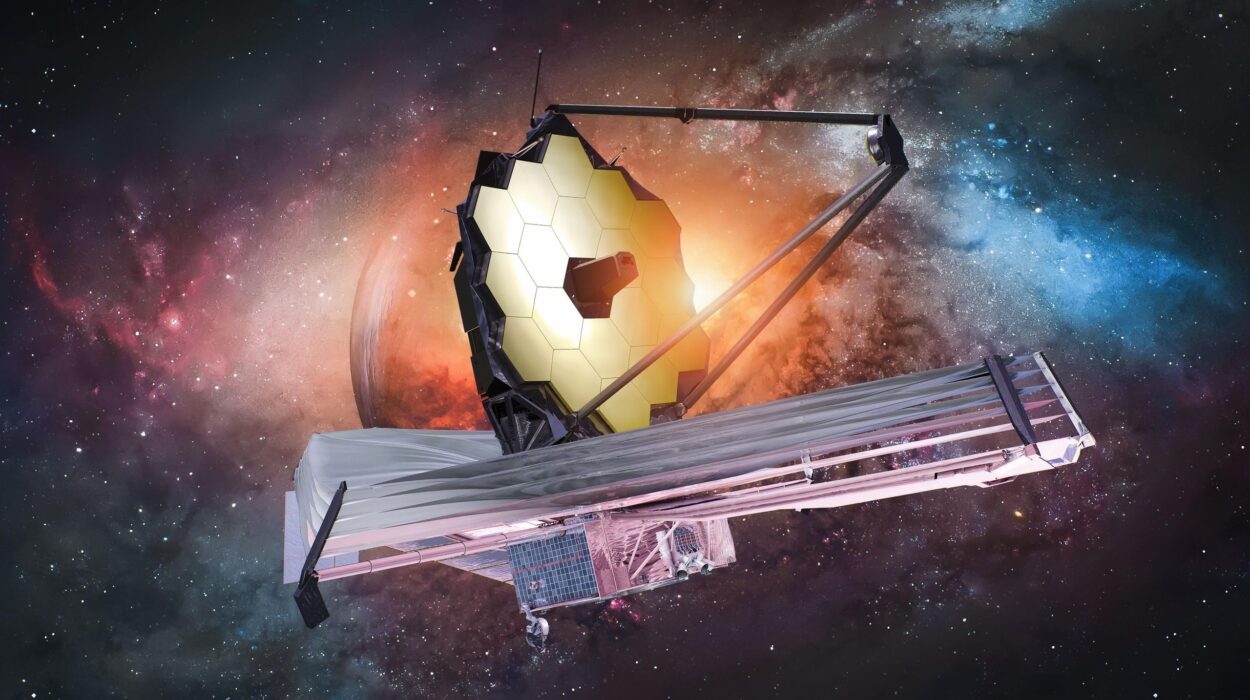
Astronomical telescopes collect faint light that has traveled across billions of years.
Barcode scanners, optical sensors, remote controls, and many medical instruments also depend upon the behavior of light.
Although light cannot exceed its universal speed limit, engineers have learned to harness its remarkable properties in countless practical ways.
Measuring the Universe with Light
Nearly everything astronomers know about the universe comes from light.
Different wavelengths reveal different aspects of celestial objects.
Visible light shows stars and galaxies.
Infrared light can penetrate cosmic dust clouds.
Radio waves reveal cold hydrogen gas.
X-rays expose extremely hot environments near black holes and exploding stars.
Gamma rays reveal some of the universe’s most energetic events.
Because every type of electromagnetic radiation travels at the speed of light in a vacuum, astronomers can use these signals to measure distances, determine chemical compositions, calculate temperatures, and study cosmic evolution.
Without light, our understanding of the universe would be almost nonexistent.
Why the Speed of Light Feels Instantaneous
In everyday life, light appears to travel instantly because the distances around us are relatively small.
If you switch on a lamp across the room, the light reaches your eyes in only a few billionths of a second.
Even light traveling from one side of a large city to another requires only a tiny fraction of a second.
Only when dealing with astronomical distances does the travel time become noticeable.
This difference between human-scale distances and cosmic distances explains why the universe can seem both immediate and unimaginably vast.
The Speed of Light and the Future of Exploration
As humanity dreams of traveling to distant stars, the speed of light presents one of our greatest challenges.
Even spacecraft traveling much faster than today’s rockets would need years or decades to reach the nearest star systems.
Communicating with future interstellar spacecraft would also involve significant delays because radio signals themselves travel at the speed of light.
Understanding this limitation helps scientists develop realistic plans for future exploration while inspiring new ideas in physics and engineering.
Although the speed of light sets a boundary, it also serves as a guide, defining the structure of the universe itself.
Conclusion
Light travels through the vacuum of space at exactly 299,792,458 meters per second, making it the fastest known phenomenon in the universe. This extraordinary speed allows sunlight to reach Earth in about eight minutes, moonlight in just over one second, and the light from distant galaxies after journeys lasting billions of years. Because light requires time to travel, every observation of the cosmos is also a glimpse into the past.
More than a physical constant, the speed of light is a cornerstone of modern science. It shapes our understanding of space, time, energy, and the universe itself. From Einstein’s theory of relativity to GPS navigation, fiber-optic communication, and the exploration of distant galaxies, the remarkable speed of light connects the smallest particles to the largest structures in the cosmos. It reminds us that while the universe is vast beyond imagination, every beam of light carries a story across space and time, waiting to be discovered.