The internet has become as essential to modern life as electricity and clean water. It connects families across continents, powers businesses, enables online education, streams entertainment, supports remote work, and even allows doctors to provide healthcare from thousands of miles away. Yet not all internet connections are created equal. Two of the most important technologies that bring the internet into homes and businesses are fiber internet and satellite internet.
At first glance, both seem to accomplish the same goal—getting you online. You can browse websites, watch videos, play games, attend video meetings, and download files with either connection. However, the way these technologies deliver internet service is completely different, and those differences have a major impact on speed, reliability, latency, availability, and overall user experience.
Understanding how fiber and satellite internet work can help you choose the right connection for your needs. Whether you live in a busy city or a remote countryside, the science behind these technologies explains why one may perform differently from the other.
Understanding Internet Connections
Before comparing fiber and satellite internet, it helps to understand what an internet connection actually does.
When you open a website, send an email, stream a movie, or join a video call, your device exchanges information with computers called servers. This information travels as tiny packets of digital data across networks spanning cities, countries, and oceans.
The speed and reliability of this journey depend largely on the technology carrying those data packets.
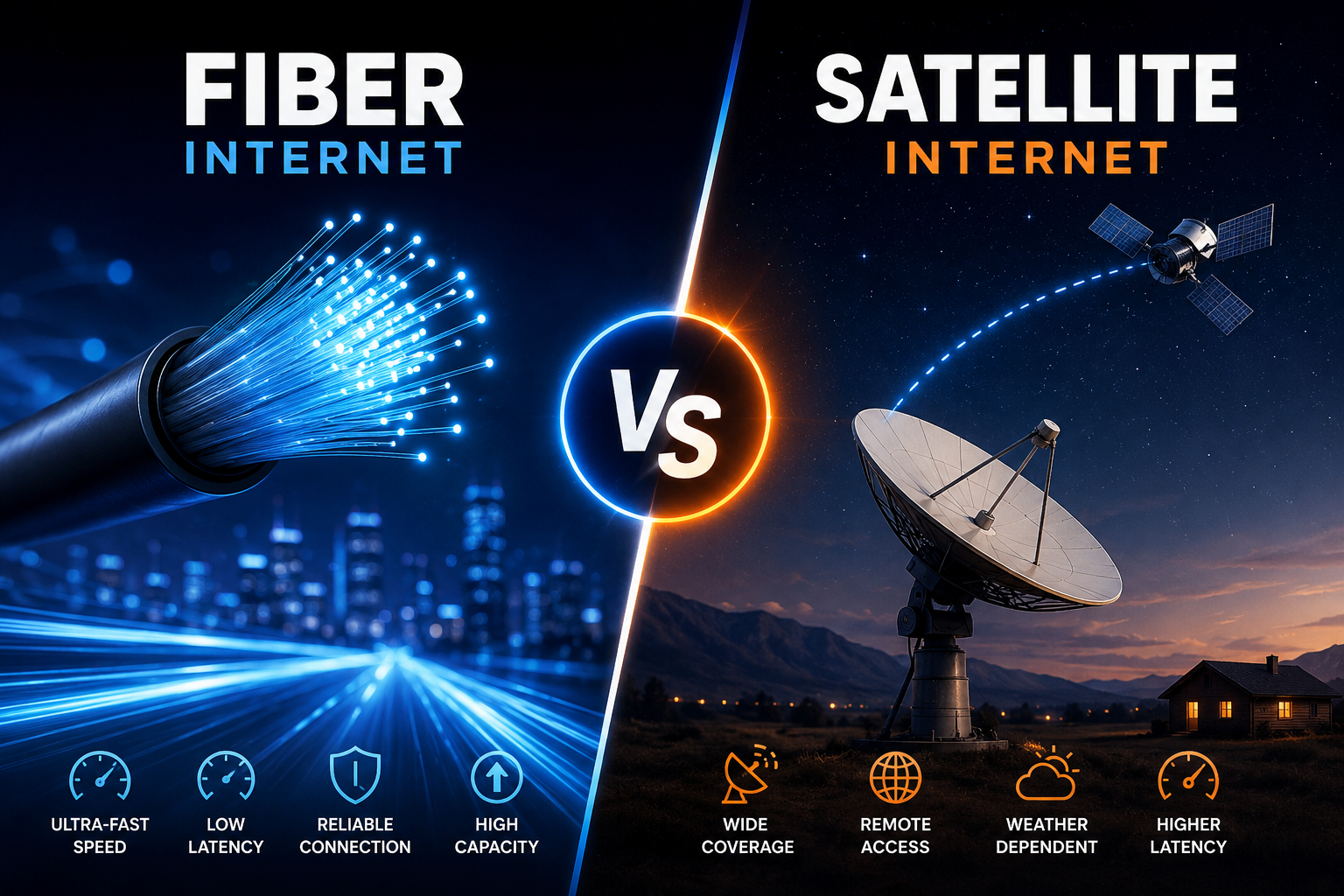
Fiber internet carries information through extremely thin strands of glass using pulses of light.
Satellite internet sends information as radio waves between your home, satellites orbiting Earth, and ground stations connected to the internet.
Although both methods achieve the same objective, they use entirely different physical principles.
What Is Fiber Internet?
Fiber internet, often called fiber-optic internet, uses fiber-optic cables made from incredibly pure glass or specialized plastic.
These cables are much thinner than a human hair but can transmit enormous amounts of information.
Instead of using electricity like traditional copper cables, fiber-optic cables carry data using pulses of laser or LED light.
Inside each fiber, light repeatedly reflects off the inner walls through a phenomenon called total internal reflection. This allows the light to travel long distances with remarkably little signal loss.
Because light moves extremely fast and experiences very little interference inside the fiber, this technology can deliver exceptionally high internet speeds.
Today, fiber networks commonly offer speeds ranging from hundreds of megabits per second to multiple gigabits per second for residential customers.
How Fiber Internet Works
The journey begins at your internet service provider’s network.
Digital information is converted into pulses of light by optical transmitters.
These light signals travel through underground or overhead fiber-optic cables.
At your home, an optical network terminal converts the incoming light signals back into electrical signals that your router and devices can understand.
Since the information remains as light for most of its journey, the connection experiences very little delay and almost no electrical interference.
This efficient transmission is one of the main reasons fiber internet is considered the fastest widely available broadband technology.
What Is Satellite Internet?
Satellite internet takes a completely different approach.
Instead of relying on physical cables connecting your home to the provider, it communicates through satellites orbiting Earth.
A satellite internet system usually consists of three main parts.
The first is a satellite dish installed at your home.
The second is one or more communication satellites in space.
The third is a ground station connected to the global internet.
When you request a webpage, your satellite dish sends radio signals upward toward the satellite.
The satellite relays those signals to a ground station.
The response then travels back through the satellite and finally reaches your home.
Although this process happens incredibly quickly, the vast distances involved significantly affect performance.
How Satellite Internet Works
Satellite internet uses microwave radio frequencies rather than visible light.
The dish installed outside your home continuously communicates with a satellite moving in orbit above Earth.
Modern satellite systems use sophisticated antennas, powerful transmitters, advanced signal processing, and error-correction technologies to maintain stable communication even across thousands of kilometers.
The exact performance depends greatly on the type of satellite being used.
Traditional satellite internet relied mainly on geostationary satellites orbiting approximately 35,786 kilometers (22,236 miles) above Earth.
Newer services increasingly use low Earth orbit satellites positioned only a few hundred to about 2,000 kilometers above Earth’s surface.
These lower orbits dramatically reduce communication delays.
The Biggest Difference: How Data Travels
The most fundamental difference between fiber and satellite internet lies in the path your information takes.
With fiber, your data travels almost entirely through glass cables.
With satellite internet, the data must travel from Earth into space and back again.
Even though radio waves move at the speed of light in a vacuum, the enormous distance to space introduces unavoidable delays.
For traditional geostationary satellite systems, a single request may travel roughly 72,000 kilometers or more during a round trip between your home and the satellite.
Fiber connections typically involve much shorter travel distances.
This simple difference explains why fiber usually provides lower latency than satellite internet.
Internet Speed
Speed is often the first factor people consider.
Fiber internet is widely recognized as the fastest consumer internet technology available today.
Many providers offer download and upload speeds of 1 gigabit per second or even higher.
Some regions now provide residential services reaching 2, 5, or even 10 gigabits per second.
Because fiber uses light traveling through high-capacity cables, enormous amounts of data can be transmitted simultaneously.
Satellite internet has improved dramatically in recent years.
Modern satellite systems can provide speeds fast enough for streaming high-definition video, online learning, video conferencing, and everyday browsing.
However, speeds often vary depending on network congestion, weather conditions, satellite capacity, and local demand.
Fiber generally offers more consistent high-speed performance.
Upload Speeds
Many online activities require sending information as well as receiving it.
Uploading videos, backing up files to cloud storage, joining video conferences, or live streaming all depend on upload speed.
Fiber internet often provides symmetrical connections, meaning upload and download speeds are nearly identical.
For example, a fiber connection might offer 1 Gbps download and 1 Gbps upload.
Satellite internet usually provides much slower upload speeds than download speeds.
Although sufficient for everyday communication, heavy content creators may notice the difference.
Latency: Why It Matters
Latency measures how long data takes to travel between your device and its destination.
It is measured in milliseconds.
Lower latency means faster responses.
Latency becomes especially important during online gaming, video conferencing, remote desktop access, financial trading, and other real-time applications.
Fiber internet usually has extremely low latency because light travels directly through cables over relatively short distances.
Satellite internet naturally experiences higher latency because signals must travel into space before reaching the internet.
Traditional geostationary satellite systems often have latency measured in hundreds of milliseconds.
Modern low Earth orbit satellite networks have greatly reduced latency, making video calls and interactive applications much smoother than older satellite systems.
Nevertheless, fiber generally maintains the lowest latency available to residential users.
Reliability
A reliable internet connection remains stable throughout the day.
Fiber internet performs exceptionally well because the cables are protected from most forms of electrical interference.
Glass fibers are immune to electromagnetic interference, unlike traditional copper cables.
Weather usually has little effect on underground fiber infrastructure.
Satellite internet depends on uninterrupted communication between your dish and the satellite.
Heavy rain, snow, dense clouds, or severe storms can weaken radio signals, a phenomenon known as rain fade.
Trees, buildings, mountains, or other obstacles blocking the dish’s view of the sky may also reduce performance.
While modern satellite systems are far more reliable than earlier generations, fiber generally offers greater consistency.
Coverage and Availability
Here satellite internet has a major advantage.
Installing fiber-optic cables requires extensive construction.
Companies must dig trenches, install poles, lay cables, and maintain physical infrastructure.
This process is expensive and often focuses first on cities and densely populated communities.
Many rural and remote areas still lack fiber access.
Satellite internet, on the other hand, requires no cable connection to your home.
As long as your location has a clear view of the sky and falls within the provider’s coverage area, satellite service may be available.
This makes satellite internet especially valuable for farms, islands, mountain communities, deserts, forests, research stations, and other hard-to-reach locations.
For millions of people worldwide, satellite internet provides broadband access where no wired alternative exists.
Installation
Fiber installation usually involves bringing an optical cable directly into your home.
Technicians connect the cable to specialized equipment and verify the optical signal.
Once installed, little maintenance is typically required.
Satellite internet requires mounting a dish in a location with an unobstructed view of the appropriate section of the sky.
The dish must be carefully aligned to communicate with satellites.
Any major obstruction can reduce signal quality.
Both installations are generally performed by trained technicians, although some modern satellite systems simplify setup.
Weather Effects
Fiber internet is relatively resistant to weather.
Storms may occasionally damage utility poles or underground infrastructure during extreme events, but normal rain, snow, heat, and wind rarely affect the optical signals themselves.
Satellite internet is more vulnerable to atmospheric conditions.
Heavy rainfall, thick snow, hail, and severe storms can temporarily weaken radio signals between the dish and the satellite.
Engineers design modern systems to minimize these interruptions, but weather remains a more significant factor for satellite than for fiber.
Capacity and Network Congestion
Fiber-optic cables have enormous data-carrying capacity.
A single optical fiber can carry many separate streams of information simultaneously using different wavelengths of light.
This technology allows providers to expand capacity efficiently as demand grows.
Satellite systems share bandwidth among many users communicating with the same satellites.
During busy periods, performance may vary depending on network load.
New satellite constellations continue increasing capacity, but fiber still offers greater long-term scalability for densely populated areas.
Gaming Performance
Online gaming requires rapid communication between players and game servers.
Even small delays can affect competitive gameplay.
Because fiber offers extremely low latency and stable connections, it is generally the preferred choice for gaming.
Satellite internet can support many games, particularly modern low Earth orbit systems.
However, traditional high-latency satellite services may introduce noticeable delays during fast-paced multiplayer games.
Streaming Movies and Television
Both fiber and modern satellite internet can support streaming services.
Fiber easily handles multiple simultaneous 4K video streams without difficulty.
Satellite internet also supports high-definition and even 4K streaming under suitable conditions.
However, households with many users streaming simultaneously may experience more consistent performance with fiber due to its higher capacity.
Video Calls and Remote Work
Remote work depends heavily on stable internet.
Video meetings require steady upload and download speeds with minimal delay.
Fiber internet excels in this area because of its low latency and symmetrical speeds.
Modern satellite internet has significantly improved video conferencing performance, especially with low Earth orbit satellites.
For most professional users, fiber still provides the smoother overall experience.
Security
Both fiber and satellite providers use encryption and modern network security technologies.
Fiber has a slight physical security advantage because intercepting optical signals requires specialized access to the cables.
Satellite communications also employ sophisticated encryption to protect user data.
In practice, cybersecurity depends more on secure passwords, software updates, and safe browsing habits than on whether your connection uses fiber or satellite.
Environmental Considerations
Building fiber networks requires manufacturing cables, digging trenches, installing equipment, and maintaining extensive infrastructure.
Once installed, fiber networks are highly energy-efficient and can operate for decades.
Satellite internet requires launching satellites into space, operating ground stations, and periodically replacing aging spacecraft.
Both technologies have environmental impacts, though they differ substantially in nature.
Scientists and engineers continue developing more sustainable methods for both approaches.
The Future of Fiber Internet
Fiber technology continues advancing rapidly.
Researchers are developing faster optical transmission techniques capable of carrying astonishing amounts of information through existing fibers.
Future networks may support dramatically higher speeds without requiring entirely new infrastructure.
As demand for cloud computing, artificial intelligence, virtual reality, and ultra-high-definition media grows, fiber is expected to remain the backbone of global internet infrastructure.
The Future of Satellite Internet
Satellite internet is also evolving quickly.
Large constellations of low Earth orbit satellites are reducing latency while increasing coverage and capacity.
Advances in satellite manufacturing, reusable rockets, phased-array antennas, and laser communication links between satellites promise even better performance.
These innovations are making broadband internet available to communities that previously had little or no reliable connectivity.
Rather than replacing fiber, satellite technology is expanding internet access to places where laying cables would be impractical or prohibitively expensive.
Which Internet Connection Is Better?
The answer depends largely on where you live and how you use the internet.
If fiber internet is available, it generally offers the best overall performance. Its exceptional speed, extremely low latency, high reliability, and consistent upload capabilities make it ideal for streaming, gaming, remote work, online learning, cloud computing, and households with many connected devices.
Satellite internet becomes the better choice when fiber or other wired broadband options are unavailable. It provides high-speed connectivity across remote regions, bringing education, healthcare, business opportunities, and communication to locations once considered beyond the reach of modern internet infrastructure.
Final Thoughts
Fiber and satellite internet represent two remarkable achievements of modern engineering, each solving the challenge of global connectivity in a different way. Fiber uses beams of light traveling through strands of glass to deliver extraordinary speed and reliability, while satellite internet sends radio signals through space to reach places where cables cannot.
As technology continues to advance, both systems are becoming faster, more capable, and more accessible. Fiber will likely remain the gold standard for speed and performance wherever physical infrastructure can be built, while satellite internet will continue closing the digital divide by connecting remote communities across the globe.
Together, these technologies demonstrate humanity’s remarkable ability to overcome distance, geography, and engineering challenges, ensuring that more people than ever can participate in our increasingly connected digital world.