The internet has become one of the most important inventions in human history. It connects billions of people, powers global businesses, supports scientific research, enables online education, and allows everything from smartphones and laptops to smart refrigerators and self-driving cars to communicate. Yet behind this vast digital world lies an invisible system that makes every online connection possible: the Internet Protocol, or IP.
Every device connected to the internet needs a unique address, much like every home has its own postal address. Without these addresses, data would have no idea where to go. For decades, the internet has relied on a system called IPv4 to assign these addresses. It served the world remarkably well and helped build the modern internet.
But the internet has grown far beyond what its creators imagined. Today, billions of devices compete for a limited supply of IPv4 addresses. To solve this growing problem, the internet is gradually adopting a newer system known as IPv6.
The transition to IPv6 is not simply a technical upgrade. It is one of the most significant changes in the history of the internet, ensuring that the online world can continue growing for decades to come.
What Is an IP Address?
Every time you visit a website, send an email, stream a movie, or chat with friends online, your device exchanges information with other computers across the internet.
To deliver this information correctly, every connected device needs a unique identifier known as an Internet Protocol (IP) address.
Think of an IP address as the digital equivalent of a mailing address.
When someone sends you a letter, the postal service uses your address to deliver it to the correct house. Similarly, when information travels across the internet, routers and network equipment use IP addresses to send data to the correct device.
Without IP addresses, the internet simply could not function.
What Is IPv4?
IPv4 stands for Internet Protocol version 4.
Developed during the late 1970s and standardized in the early 1980s, IPv4 became the foundation of the modern internet.
An IPv4 address usually looks something like this:
192.168.1.25
It consists of four numbers separated by periods.
Each number ranges from 0 to 255.
Although this system was revolutionary at the time, it has one major limitation.
IPv4 uses 32-bit addresses.
That means it can create approximately 4.3 billion unique addresses.
During the early days of the internet, this number seemed unimaginably large.
Few people imagined a future where nearly every person would own multiple internet-connected devices.
The Internet Grew Beyond Expectations
When IPv4 was designed, the internet was a small research network connecting universities and government organizations.
Personal computers were rare.
Smartphones did not exist.
Cloud computing was decades away.
There were no smart TVs, wearable fitness trackers, voice assistants, connected vehicles, or Internet of Things (IoT) devices.
Today, the situation is dramatically different.
Billions of smartphones connect to the internet every day.
Homes contain dozens of connected devices.
Factories rely on internet-connected sensors.
Hospitals use networked medical equipment.
Cities deploy smart traffic systems.
Modern cars communicate through online services.
Even household appliances can connect to Wi-Fi.
The explosive growth of connected devices has dramatically increased demand for IP addresses.
Running Out of IPv4 Addresses
The world’s supply of IPv4 addresses has effectively been exhausted.
Regional Internet Registries, the organizations responsible for distributing IP addresses, have largely allocated all available IPv4 address blocks.
This does not mean the internet stopped working.
Instead, engineers developed temporary solutions to stretch the limited address space.
The most important of these solutions is Network Address Translation, commonly known as NAT.
How NAT Delayed the Problem
Network Address Translation allows multiple devices to share a single public IPv4 address.
For example, your home Wi-Fi network may connect several smartphones, laptops, tablets, smart speakers, gaming consoles, and televisions.
Although each device has its own private address inside your home, your internet service provider may assign only one public IPv4 address to your router.
The router keeps track of which device requested which data and directs incoming information to the correct destination.
NAT has allowed billions of devices to access the internet without requiring unique public IPv4 addresses.
Without NAT, the internet would likely have run out of addresses years earlier.
Why NAT Is Only a Temporary Solution
Although NAT is extremely useful, it was never intended as a permanent solution.
Sharing addresses introduces additional complexity into network communication.
Some applications require direct connections between devices.
Online gaming, video conferencing, peer-to-peer communication, remote access, and certain business applications can become more complicated when NAT is involved.
Engineers have developed techniques to overcome these challenges, but they add complexity and sometimes reduce efficiency.
The long-term solution is not sharing addresses more efficiently.
The long-term solution is creating vastly more addresses.
What Is IPv6?
IPv6 stands for Internet Protocol version 6.
It was developed by the Internet Engineering Task Force (IETF) specifically to replace IPv4.
Instead of using 32-bit addresses, IPv6 uses 128-bit addresses.
This difference is enormous.
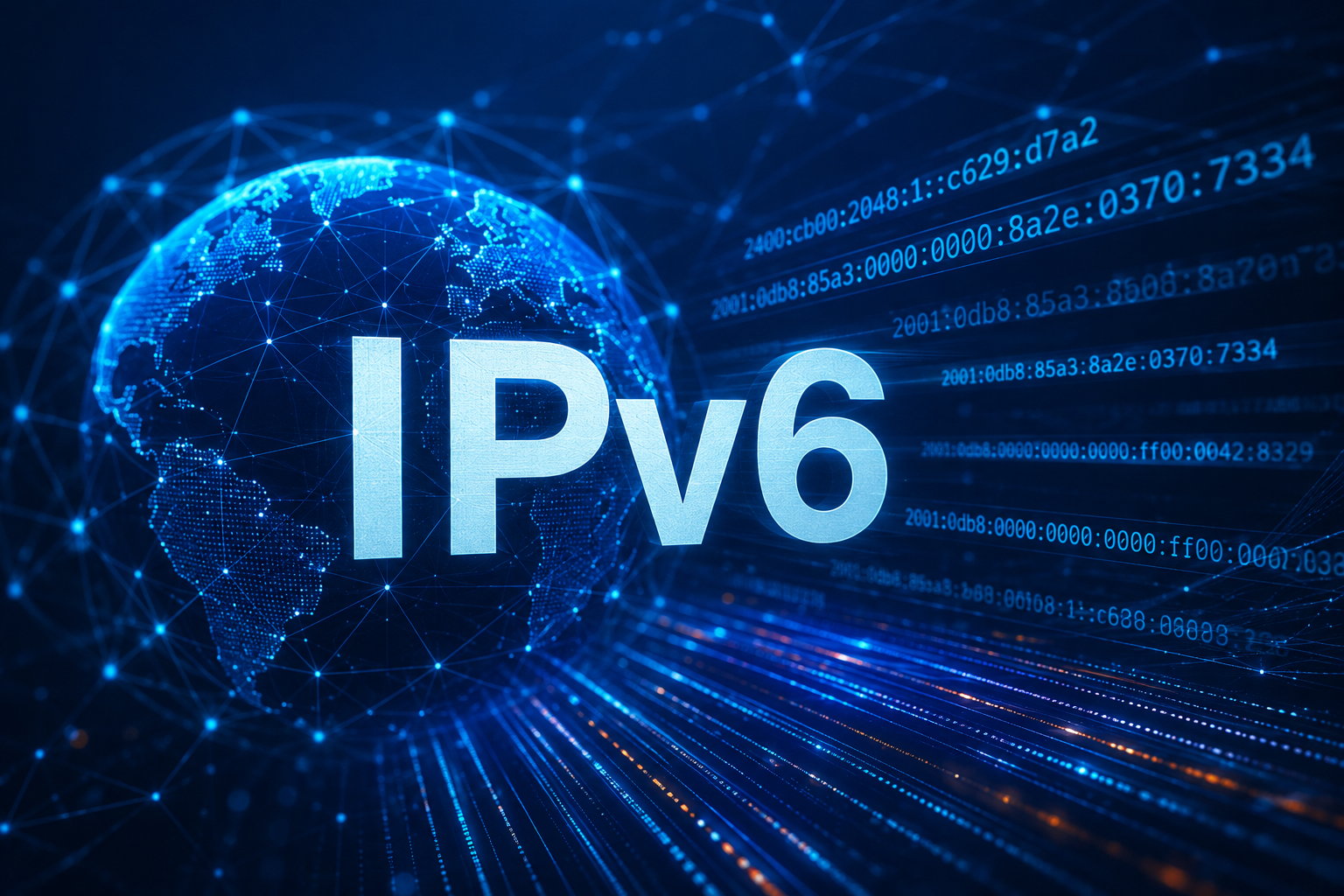
An IPv6 address looks something like this:
2001:0db8:85a3:0000:0000:8a2e:0370:7334
Unlike IPv4, IPv6 uses hexadecimal numbers separated by colons.
At first glance, these addresses appear much longer and more complex.
However, computers handle them automatically, and users rarely need to type them.
An Almost Unlimited Number of Addresses
One of IPv6’s greatest strengths is its enormous address space.
IPv6 can generate approximately 340 undecillion unique addresses.
This number is so incredibly large that it is difficult to comprehend.
It is enough to assign an unimaginably large number of addresses to every person on Earth.
Scientists often explain that IPv6 provides enough addresses for future generations of technology far beyond today’s internet.
Rather than conserving addresses, IPv6 allows devices to have their own globally unique identities.
Every Device Can Have Its Own Address
Under IPv6, devices no longer need to share public addresses in the same way they often do with IPv4.
A smartphone, laptop, smartwatch, smart thermostat, security camera, and even individual sensors can each receive unique global addresses.
This simplifies many aspects of networking.
Applications that rely on direct communication between devices can often operate more naturally.
The original vision of the internet—a network where devices communicate directly—is easier to achieve with IPv6.
Better Support for the Internet of Things
The Internet of Things, or IoT, refers to everyday objects connected to the internet.
These include smart lights, environmental sensors, agricultural monitoring equipment, industrial robots, medical devices, traffic systems, and countless other technologies.
As billions of additional devices join the internet, IPv4’s limited address space becomes increasingly restrictive.
IPv6 was designed with this future in mind.
Its massive address capacity ensures that future generations of connected devices can continue expanding without exhausting available addresses.
Improved Network Efficiency
IPv6 simplifies several aspects of network design.
Its packet headers are more streamlined than those used by IPv4, allowing routers to process traffic more efficiently in many situations.
IPv6 also eliminates some of the complexity introduced by decades of IPv4 workarounds.
Although real-world performance depends on many factors—including hardware, software, internet service providers, and network configuration—IPv6 provides a cleaner foundation for modern internet communication.
Built-In Support for Automatic Configuration
One particularly useful feature of IPv6 is Stateless Address Autoconfiguration, often abbreviated as SLAAC.
When a compatible device joins an IPv6 network, it can often generate its own address automatically.
This reduces administrative work for network managers and simplifies deployment in many environments.
Large organizations managing thousands of devices particularly benefit from this automation.
Stronger Support for Modern Networking
IPv6 includes features designed for today’s internet rather than the internet of the 1980s.
It provides improved handling of multicast communication, where one transmission reaches multiple devices efficiently.
It supports modern routing techniques that improve scalability across enormous networks.
Its design makes future expansion easier as internet technologies continue evolving.
Is IPv6 More Secure?
Many people assume IPv6 is automatically more secure than IPv4.
The reality is more nuanced.
IPv6 was designed with support for IPsec, a suite of protocols that can encrypt and authenticate internet communications.
However, using IPsec is optional rather than mandatory in most real-world deployments.
Security depends primarily on proper network configuration, software updates, firewalls, authentication, and good cybersecurity practices—not simply on whether IPv4 or IPv6 is used.
Nevertheless, IPv6 supports modern security architectures effectively and integrates well with today’s networking technologies.
Why the Transition Is Taking So Long
Despite its advantages, the entire internet cannot switch overnight.
The global internet consists of countless interconnected networks operated by internet service providers, businesses, governments, universities, cloud providers, and individuals.
Many older devices were designed only for IPv4.
Replacing or upgrading this infrastructure requires significant time and investment.
As a result, IPv4 and IPv6 currently operate together.
This approach is known as dual-stack networking.
Many websites, internet service providers, operating systems, and devices support both protocols simultaneously.
Your computer may automatically choose IPv6 whenever available while falling back to IPv4 when necessary.
Most People Do Not Notice the Change
One interesting aspect of IPv6 adoption is that most users never realize it is happening.
Modern operating systems—including Windows, macOS, Linux, Android, and iOS—support IPv6 by default.
Many websites are accessible using both IPv4 and IPv6.
Your web browser automatically selects the appropriate protocol without requiring any action from you.
For most people, the internet simply continues working normally.
Behind the scenes, however, more and more traffic is flowing across IPv6 every year.
Internet Service Providers Are Expanding IPv6
Around the world, internet service providers are steadily deploying IPv6 across their networks.
Mobile networks have become particularly important drivers of IPv6 adoption because smartphones represent such a large share of internet traffic.
Many cloud computing platforms, content delivery networks, streaming services, and major websites now fully support IPv6.
As new infrastructure is built, IPv6 increasingly becomes part of the standard design.
Major Technology Companies Support IPv6
Many of the world’s largest internet companies have embraced IPv6.
Search engines, social media platforms, streaming services, cloud providers, and content delivery networks commonly operate over both IPv4 and IPv6.
This widespread industry support helps accelerate global adoption.
As more services become IPv6-ready, internet users benefit from smoother connectivity and improved long-term scalability.
Challenges That Still Remain
Although IPv6 solves the address shortage, deployment still presents challenges.
Older networking equipment may require upgrades.
Network administrators need training to manage IPv6 effectively.
Some legacy software must be updated.
Organizations often need to redesign parts of their networks during migration.
These challenges explain why IPv6 adoption has been gradual rather than immediate.
However, the long-term benefits make the transition worthwhile.
The Future of the Internet Depends on IPv6
Emerging technologies will place even greater demands on internet infrastructure.
Artificial intelligence systems exchange enormous amounts of data.
Autonomous vehicles require reliable communication.
Smart cities depend on millions of connected sensors.
Advanced manufacturing relies on networked robotics.
Telemedicine continues expanding.
Virtual and augmented reality applications require increasingly sophisticated networking.
Supporting these innovations requires an internet capable of connecting far more devices than IPv4 was ever designed to handle.
IPv6 provides the addressing foundation necessary for this future.
Why IPv6 Matters to Everyone
Even if you never see an IPv6 address, the transition affects everyone who uses the internet.
It allows the internet to continue growing without running out of addresses.
It simplifies network architecture.
It supports billions of new connected devices.
It provides a scalable foundation for future technologies.
Most importantly, IPv6 ensures that the internet remains capable of supporting innovation for generations to come.
The internet has transformed the way humanity communicates, learns, works, and explores the world. As billions of new devices join the global network, the limitations of IPv4 have become impossible to ignore. IPv6 is not simply a replacement for an older protocol—it is the next chapter in the internet’s evolution. By providing an almost limitless supply of addresses and a more modern networking framework, IPv6 is helping build an internet that is ready for the challenges and opportunities of the future.