The internet feels almost magical. You type a web address into your browser, press Enter, and within seconds, a website appears on your screen. Whether you’re reading the latest news, shopping online, streaming videos, or checking your bank account, a complex system works quietly behind the scenes to deliver information safely and efficiently.
One of the most important parts of this system is the communication protocol that connects your browser to a website. You may have noticed that some web addresses begin with http://, while others begin with https://. At first glance, the difference is just a single letter—an “S.” Yet that single letter represents one of the most significant improvements in internet security.
Understanding the difference between HTTP and HTTPS is essential for anyone who uses the internet. Whether you own a website, run an online business, or simply browse the web every day, knowing how these two protocols work can help you better understand online privacy, security, and trust.
What Is HTTP?
HTTP stands for Hypertext Transfer Protocol.
It is the foundation of communication on the World Wide Web. HTTP defines how a web browser requests information from a web server and how the server responds by sending webpages, images, videos, and other files back to the browser.
Imagine visiting a website. When you type a URL into your browser, your browser sends an HTTP request to the website’s server. The server receives the request, processes it, and returns the requested webpage.
This request-and-response process happens in fractions of a second, making the internet feel almost instantaneous.
HTTP was introduced in the early days of the web, when the internet was much smaller and security threats were relatively limited. At that time, its primary goal was simply to allow computers to exchange web pages efficiently.
How HTTP Works
HTTP follows a client-server model.
Your web browser acts as the client.
The website’s computer acts as the server.
When you visit a webpage, the browser sends a request asking for specific information. The server processes that request and sends the requested content back to your browser.
This exchange may happen dozens or even hundreds of times while loading a single webpage. Every image, font, stylesheet, and script often requires its own request.
HTTP itself is considered a stateless protocol. This means each request is treated independently. The server does not automatically remember previous requests from the same browser. Technologies such as cookies and sessions help websites maintain login information and user preferences despite HTTP’s stateless design.
The Biggest Problem with HTTP
Although HTTP successfully allows communication between browsers and servers, it has one major weakness.
Everything sent using standard HTTP travels in plain text.
This means that anyone capable of intercepting the network traffic may be able to read the information being transmitted.
Imagine sending a postcard through the mail. Anyone handling the postcard could read the message because nothing is hidden.
HTTP works in a similar way.
If sensitive information such as usernames, passwords, payment details, or personal messages travels through an unsecured HTTP connection, it could potentially be viewed or modified by attackers if the network is compromised.
This weakness became increasingly serious as online banking, shopping, healthcare, cloud computing, and social media became part of everyday life.
What Is HTTPS?
HTTPS stands for Hypertext Transfer Protocol Secure.
It is the secure version of HTTP.
HTTPS performs the same basic job as HTTP—it allows browsers and web servers to communicate—but it adds an essential layer of security through encryption.
When you visit an HTTPS website, the information exchanged between your browser and the server is encrypted before it travels across the internet.
Encryption transforms readable information into coded data that cannot be understood without the proper cryptographic keys.
Even if someone intercepts the communication, they would see encrypted data instead of readable information.
This simple improvement dramatically increases online security.
What Does the “S” Mean?
The extra “S” in HTTPS stands for Secure.
That security comes from cryptographic protocols known as Transport Layer Security (TLS), which replaced the older Secure Sockets Layer (SSL) technology.
Although many people still say “SSL certificate,” modern secure websites almost always use TLS.
TLS protects the connection between your browser and the website, ensuring that data remains private while traveling across the internet.
How HTTPS Works
When you visit an HTTPS website, your browser and the web server perform a process called the TLS handshake.
During this handshake, several important things happen.
The browser verifies the website’s digital certificate.
The browser confirms the website’s identity.
Both sides agree on encryption methods.
They securely create temporary encryption keys for that browsing session.
Only after this secure connection is established does the browser begin exchanging information with the website.
The entire process usually takes only milliseconds and is invisible to users.
Understanding Encryption
Encryption is one of the most important technologies in modern cybersecurity.
Think of it as placing your message inside a locked safe before sending it across the internet.
Only someone with the correct key can unlock the safe and read the message.
Modern HTTPS uses sophisticated mathematical algorithms that would take an impractically long time to break using current computing technology, provided they are implemented correctly and current standards are followed.
This makes encrypted communication highly resistant to unauthorized access.
Why HTTPS Is More Secure
HTTPS protects internet users in several important ways.
First, it provides confidentiality.
Only your browser and the website can read the information being exchanged.
Second, it provides integrity.
Attackers cannot easily alter information while it is traveling between your browser and the server without the tampering being detected.
Third, it provides authentication.
Digital certificates help confirm that you are actually connected to the intended website rather than an impersonator.
Together, these protections make HTTPS vastly safer than standard HTTP.
Digital Certificates Explained
A secure website uses a digital certificate issued by a trusted Certificate Authority (CA).
This certificate proves the website’s identity.
When your browser connects to the website, it checks whether the certificate is valid.
If everything matches correctly, the browser establishes a secure encrypted connection.
If something appears suspicious—such as an expired certificate or a mismatch between the certificate and the website address—the browser may display a security warning.
These warnings help protect users from fraudulent websites.
What Happens Without HTTPS?
Without HTTPS, internet traffic becomes much easier to intercept under certain circumstances.
Someone using an insecure public Wi-Fi network, for example, may face greater risks if websites do not use encryption.
Attackers may attempt to monitor network traffic or modify unencrypted data if they gain access to the communication path.
This could expose sensitive information such as login credentials or personal data.
HTTPS significantly reduces these risks by encrypting communications and helping verify website authenticity.
Public Wi-Fi and Online Safety
Public Wi-Fi networks in airports, hotels, cafés, and shopping malls are convenient but may not always be secure.
If a website still relies on HTTP instead of HTTPS, information sent over such networks could be more vulnerable to interception by malicious actors with network access.
HTTPS helps protect users even when using shared or public internet connections because the transmitted information remains encrypted.
While HTTPS greatly improves security, users should still practice good cybersecurity habits, such as avoiding suspicious websites and keeping devices updated.
Browser Warnings for HTTP Websites
Modern web browsers actively encourage secure browsing.
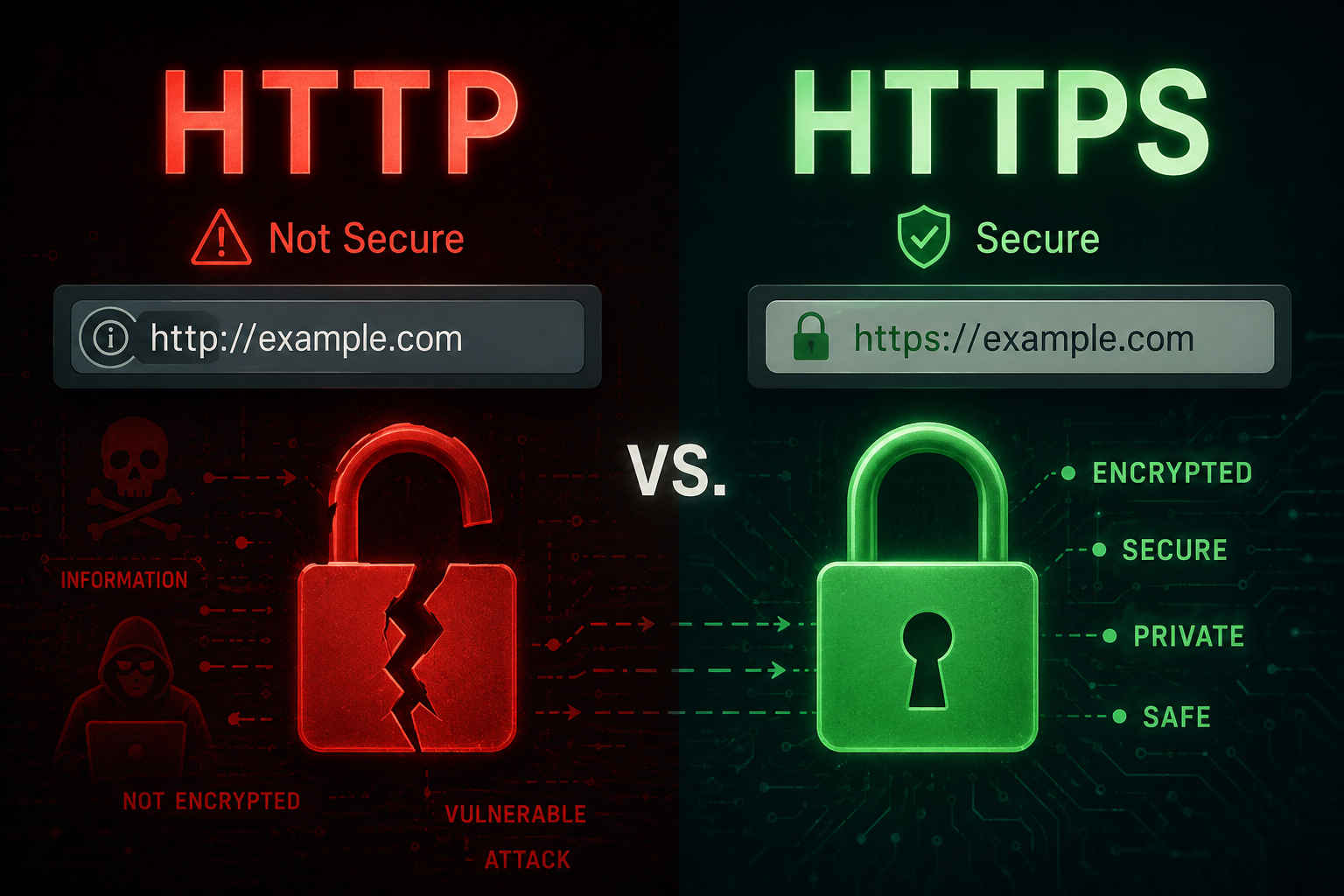
When visiting websites that still use HTTP, browsers may display messages such as “Not Secure.”
These warnings remind users that information entered on the page may not be protected during transmission.
The warning becomes especially important if the webpage asks for passwords, payment information, or personal details.
Browsers increasingly treat HTTPS as the standard rather than an optional feature.
The Padlock Icon
Most browsers display a padlock icon beside the website address when the connection uses HTTPS successfully.
The padlock indicates that the connection between your browser and the website is encrypted.
However, the padlock does not guarantee that the website itself is trustworthy, honest, or free from scams.
A fraudulent website can also obtain a valid HTTPS certificate.
HTTPS confirms that your connection is secure, not that the website’s content or business practices are legitimate.
Users should still evaluate websites carefully before sharing sensitive information.
HTTP vs HTTPS: Speed Differences
Many people assume HTTPS must be slower because it performs encryption.
Years ago, this was sometimes true.
Modern computers, servers, and browsers, however, handle encryption extremely efficiently.
In many situations, HTTPS websites perform just as fast as HTTP websites.
Modern web technologies such as HTTP/2 and HTTP/3, which are commonly used over secure connections, can even improve overall website performance by optimizing how data is transferred.
As a result, the performance difference between HTTP and HTTPS is usually negligible for users.
Why Search Engines Prefer HTTPS
Search engines want users to have safe browsing experiences.
Because of this, HTTPS has become an important ranking signal.
While high-quality content remains the most important factor in search visibility, secure websites may receive a modest ranking advantage over equivalent HTTP websites.
Using HTTPS also increases user confidence, which can improve engagement and reduce visitors leaving due to browser security warnings.
HTTPS Protects Online Shopping
Imagine purchasing a laptop from an online store.
During checkout, you enter your name, shipping address, payment information, and other personal details.
Without HTTPS, transmitting this information securely would be much more difficult.
HTTPS encrypts these sensitive details while they travel between your browser and the retailer’s server.
This protection has become essential for e-commerce.
Today, reputable online stores almost always use HTTPS across their entire websites.
Online Banking Depends on HTTPS
Banks handle extremely sensitive financial information.
Customers regularly check balances, transfer money, pay bills, and manage investments online.
HTTPS provides the encrypted communication needed to protect these activities from unauthorized interception during transmission.
Combined with additional security measures such as multi-factor authentication and fraud monitoring, HTTPS plays a critical role in secure online banking.
HTTPS and Login Security
Every time you log into an email account, streaming service, social media platform, or workplace portal, your credentials travel between your browser and the website.
HTTPS encrypts these login requests, helping protect usernames and passwords while they are transmitted.
This reduces the risk of credentials being exposed through network interception.
However, HTTPS cannot protect against every threat. Weak passwords, phishing attacks, or malware on a device can still compromise accounts, making good security practices equally important.
Why Website Owners Should Use HTTPS
For website owners, HTTPS has become a necessity rather than a luxury.
Visitors expect secure browsing.
Browsers expect secure browsing.
Search engines encourage secure browsing.
Many modern browser features and web technologies also require HTTPS before they can function fully.
Migrating from HTTP to HTTPS improves user trust while helping meet current web security standards.
Common Misunderstandings About HTTPS
Some people believe HTTPS makes a website completely immune to hacking.
This is not true.
HTTPS protects the communication between users and servers.
It does not automatically protect against software vulnerabilities, insecure passwords, phishing, malicious code, or compromised servers.
A website can still suffer from security problems even if it uses HTTPS correctly.
Good cybersecurity requires multiple layers of protection.
HTTPS is one important layer—not the only one.
The Evolution of Web Security
The internet has changed dramatically since HTTP first appeared.
Early websites mostly displayed simple text.
Today’s websites support online education, banking, healthcare, cloud computing, video conferencing, artificial intelligence, and countless other services involving sensitive information.
As the internet evolved, stronger security became essential.
HTTPS emerged as the global standard because it addresses the growing need for privacy and data protection.
Today, the overwhelming majority of popular websites use HTTPS by default.
Can HTTP Still Be Used?
Technically, HTTP still exists and continues to function.
Some local development environments, internal testing systems, and certain non-sensitive applications may still use HTTP.
However, for websites accessible on the public internet, especially those collecting user information, HTTPS is strongly recommended and has become the accepted standard.
Most modern websites no longer have practical reasons to remain on HTTP.
The Future of Secure Browsing
Internet security continues to evolve.
Researchers are developing stronger encryption methods, improving certificate management, and preparing cryptographic systems for future technologies such as quantum computing.
New web protocols also continue improving both speed and security.
Although technologies will change over time, the fundamental principle behind HTTPS will remain the same: protecting communication between users and websites through authenticated, encrypted connections.
Conclusion
At first glance, HTTP and HTTPS differ by only a single letter. In reality, that single letter represents a major advancement in the security of the modern internet.
HTTP provides the basic framework for communication between web browsers and servers, making it possible to access websites around the world. HTTPS builds upon that foundation by adding encryption, authentication, and data integrity, helping protect sensitive information as it travels across the internet.
For everyday users, HTTPS means greater privacy, safer online shopping, more secure banking, and better protection when logging into websites. For businesses and website owners, it builds trust, supports modern web technologies, and aligns with today’s security expectations.
As more of our personal, professional, and financial lives move online, secure communication has become essential rather than optional. The widespread adoption of HTTPS reflects one of the internet’s most important achievements: creating a web where information can move quickly while remaining far better protected from interception and tampering.