Every time you take a photo with your smartphone, save a document on your laptop, download an app, or plug in a USB flash drive, you are relying on one of the most important inventions of the digital age: flash memory.
Although most people never see it, flash memory quietly powers countless devices that have become part of everyday life. It stores family photographs, important work files, favorite songs, operating systems, games, videos, and even the software that allows electronic devices to function in the first place.
Unlike older storage technologies that depended on moving mechanical parts, flash memory stores information electronically, making it remarkably fast, durable, compact, and energy-efficient. These advantages have transformed the way people use technology, replacing bulky hard drives in many devices and enabling the creation of thinner, lighter, and more powerful electronics.
Understanding flash memory not only helps explain how modern devices work but also reveals how advances in semiconductor technology have reshaped computing over the past several decades.
What Is Flash Memory?
Flash memory is a type of non-volatile semiconductor memory that stores digital information even when electrical power is turned off.
The term non-volatile means the stored data remains intact without a continuous supply of electricity. This distinguishes flash memory from volatile memory such as RAM, which loses its contents as soon as power is removed.
Flash memory stores information as tiny electrical charges trapped inside microscopic structures built into silicon chips. These charges represent the binary values—zeros and ones—that computers use to store every type of digital information.
Whether the stored data is a photograph, an e-book, a movie, or a computer program, it ultimately exists as billions of binary digits recorded inside flash memory cells.
Why Is It Called “Flash” Memory?
The name “flash” comes from the way the memory is erased.
Earlier electrically erasable memory technologies removed stored information slowly, often one memory location at a time.
Flash memory introduced a much faster method by erasing large groups of memory cells simultaneously, almost like the flash of a camera. This dramatic improvement inspired the name, even though modern flash memory has continued to evolve far beyond its original design.
How Flash Memory Stores Data
At the heart of flash memory are billions of microscopic electronic components called memory cells.
Each memory cell contains a specialized transistor known as a floating-gate transistor or, in many newer designs, a charge-trap transistor.
These transistors can trap tiny numbers of electrons inside an electrically insulated layer.
When electrons are trapped, the transistor behaves differently than when no electrons are present. Electronics inside the memory chip detect these differences and interpret them as digital information.
A stored electrical charge may represent one binary value, while the absence of charge represents another.
Modern flash memory often stores more than one bit in each memory cell by measuring several different charge levels instead of only two states.
Because the insulating layer prevents the electrons from escaping easily, the stored information can remain intact for many years even when the device is completely powered off.
Understanding Bits and Bytes
Computers communicate entirely through binary numbers.
Every piece of digital information is built from two symbols: 0 and 1.
Each binary digit is called a bit.
Eight bits form one byte.
A single photograph may contain millions of bytes.
A high-definition movie contains billions of bytes.
Modern flash memory chips contain billions or even trillions of memory cells capable of storing enormous amounts of binary information in an incredibly small physical space.
How Data Is Written to Flash Memory
Writing information into flash memory involves carefully placing electrical charges into selected memory cells.
Special electronic circuits apply controlled voltages that force electrons through extremely thin insulating layers using quantum mechanical effects.
These trapped electrons remain inside the memory cell after the writing process finishes.
The pattern of charged and uncharged cells forms the digital information being stored.
Although this process is highly sophisticated, it happens so quickly that users rarely notice it while saving files or installing applications.
How Data Is Read
Reading stored information is much simpler than writing it.
The memory controller applies a small voltage to each memory cell and measures how the transistor responds.
The presence or absence of trapped electrons changes the transistor’s electrical characteristics.
The controller converts these measurements back into binary data, allowing computers to reconstruct photographs, videos, applications, documents, and every other type of stored file.
This reading process is extremely fast and consumes relatively little power.
How Data Is Erased
Unlike writing and reading individual memory cells, erasing flash memory happens in larger groups called blocks.
Before new information can be written into previously used cells, the entire block containing those cells must first be erased.
During erasure, electrical voltages remove the trapped electrons from every memory cell within the selected block.
Once erased, those cells become ready to receive new information.
This block-based design influences how flash memory performs and explains why specialized software inside storage devices carefully manages writing operations.
Why Flash Memory Keeps Data Without Power
One of flash memory’s greatest strengths is its ability to preserve information without electricity.
The trapped electrons remain isolated inside insulating materials that prevent them from escaping under normal conditions.
As a result, the stored data often remains readable for years.
Manufacturers typically design flash memory to retain information for long periods, although exact retention depends on factors such as temperature, usage history, manufacturing quality, and memory type.
Types of Flash Memory
Flash memory is produced in two primary architectural forms: NOR flash and NAND flash.
Although both rely on similar semiconductor principles, they are designed for different purposes.
NOR flash allows direct access to individual memory locations. Because of this capability, it is commonly used for storing firmware, BIOS software, embedded operating systems, and other code that devices need immediately after powering on.
NAND flash is optimized for storing large amounts of data efficiently. It offers much higher storage density, faster writing speeds, and lower manufacturing costs than NOR flash. For this reason, NAND flash dominates consumer storage products such as SSDs, USB drives, smartphones, memory cards, and tablets.
Today, NAND flash is by far the most widely used type of flash memory worldwide.
Different NAND Technologies
As flash memory technology advanced, manufacturers found ways to store more information inside each memory cell.
Originally, one memory cell stored only a single bit.
This design became known as Single-Level Cell (SLC) memory.
SLC provides exceptional speed, durability, and reliability but is relatively expensive because each cell stores only one bit.
To reduce costs and increase storage capacity, engineers developed Multi-Level Cell (MLC) technology, which stores two bits per memory cell.
Further improvements produced Triple-Level Cell (TLC) memory, storing three bits per cell, and Quad-Level Cell (QLC) memory, storing four bits per cell.
Each increase in storage density lowers manufacturing cost while generally reducing write endurance and sometimes affecting performance.
Manufacturers choose different technologies depending on whether the priority is speed, reliability, capacity, or affordability.
What Is 3D NAND?
For many years, engineers increased storage capacity by shrinking memory cells.
Eventually, the cells became so small that further shrinking became increasingly difficult.
The solution was to build upward rather than only outward.
This innovation created 3D NAND.
Instead of placing memory cells on a single flat layer, manufacturers stack dozens or even hundreds of layers vertically.
Modern chips may contain more than two hundred layers of memory cells.
This three-dimensional architecture dramatically increases storage capacity while improving efficiency, reducing cost per gigabyte, and enhancing reliability.
Nearly all modern SSDs and many other flash storage devices now use 3D NAND technology.
Flash Memory Versus RAM
Flash memory and RAM both store digital information, but they serve different purposes.
RAM temporarily stores data that the processor actively uses while a computer or smartphone is running.
When power is removed, RAM immediately loses all stored information.
Flash memory, however, permanently stores files, applications, operating systems, and user data.
A smartphone, for example, uses RAM to keep currently running apps available for quick access, while flash memory stores the apps themselves, along with photos, videos, and documents.
Together, these two memory technologies enable modern computing.
Flash Memory Versus Hard Disk Drives
Traditional hard disk drives store data magnetically on spinning metal platters.
A mechanical arm moves across the platters to read and write information.
Flash memory operates completely differently.
It contains no moving parts.
Instead, electronic circuits access stored data directly.
Because there are no spinning disks or mechanical components, flash memory offers several important advantages.
It accesses data much faster.
It consumes less electricity.
It produces almost no noise.
It generates less heat.
It resists physical shocks much better.
These benefits explain why solid-state drives have largely replaced hard drives in many laptops and premium desktop computers.
However, traditional hard drives often remain more economical for storing extremely large amounts of data.
Solid-State Drives and Flash Memory
A Solid-State Drive (SSD) is one of the most common applications of flash memory.
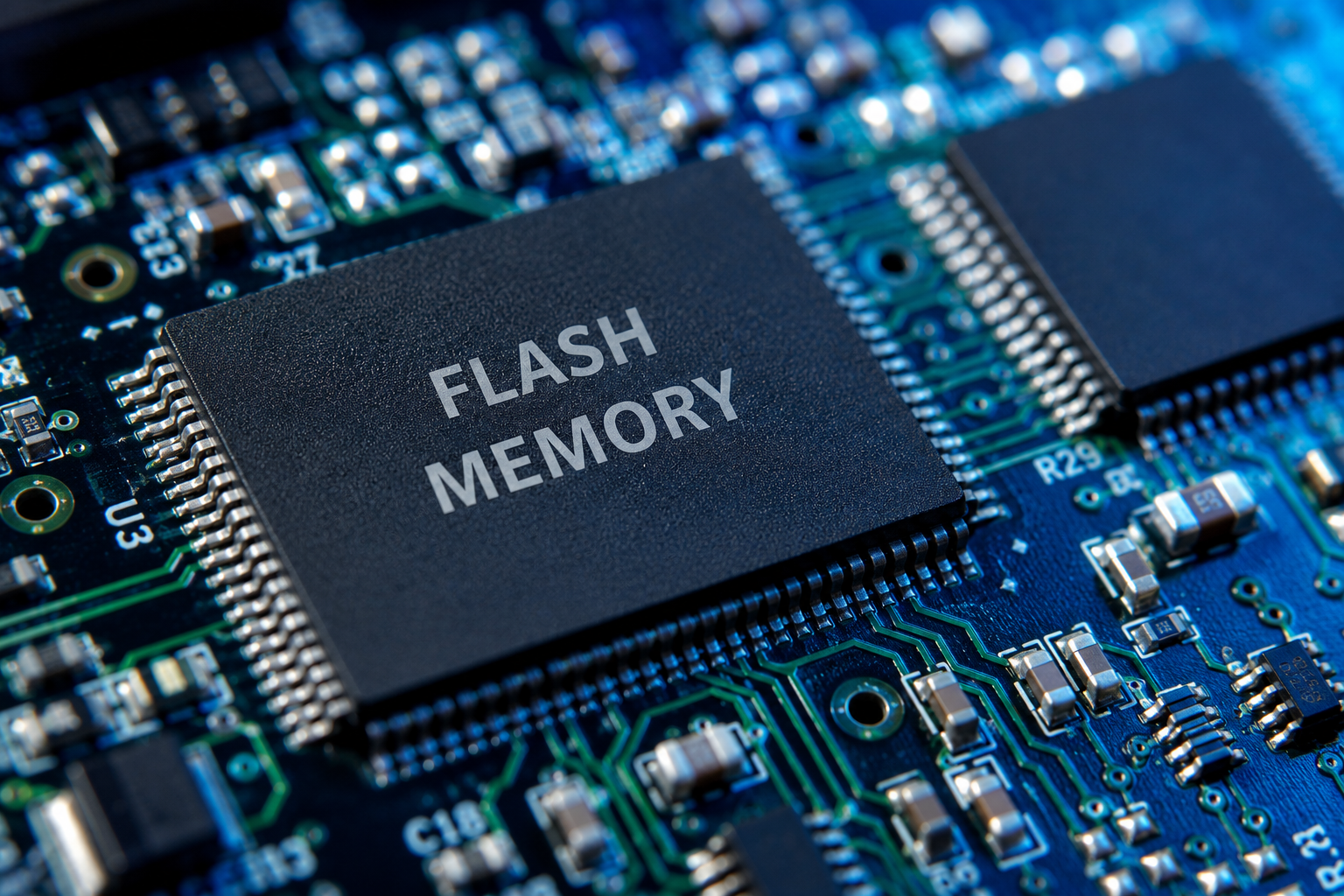
Inside an SSD are multiple NAND flash memory chips controlled by an advanced processor called the flash controller.
The controller performs many important tasks.
It distributes writing operations evenly across memory cells.
It corrects data errors.
It manages erased blocks.
It optimizes performance.
It communicates with the computer through high-speed interfaces such as SATA or PCI Express.
The result is storage that can load operating systems, launch applications, and transfer files dramatically faster than traditional hard drives.
USB Flash Drives
USB flash drives are perhaps the most recognizable examples of flash memory.
These small portable devices combine NAND flash chips with a USB controller inside a compact housing.
When plugged into a computer, they appear as removable storage devices.
Because they contain no moving parts, they are lightweight, portable, and relatively durable.
Millions of people use USB flash drives every day to carry documents, presentations, software installers, photographs, and backups.
Memory Cards
Digital cameras, drones, smartphones, action cameras, and gaming devices frequently rely on flash memory cards.
Formats such as SD cards and microSD cards contain NAND flash chips packaged into extremely compact designs.
Despite their tiny size, modern memory cards can store hundreds of gigabytes or even several terabytes of information.
Advances in flash technology continue increasing their speed, making it possible to record high-resolution photographs and 8K video.
Flash Memory Inside Smartphones
Every smartphone depends heavily on flash memory.
The operating system, installed applications, photographs, downloaded videos, text messages, contacts, and user settings all reside within internal flash storage.
Modern smartphones typically use advanced storage standards such as Universal Flash Storage (UFS), which deliver much higher performance than earlier mobile storage technologies.
Fast flash storage significantly improves app loading times, camera performance, and overall responsiveness.
Flash Memory in Everyday Electronics
Many devices contain flash memory even when users never notice it.
Smart televisions use flash memory to store their operating systems.
Cars contain numerous electronic control units with embedded flash memory.
Medical equipment stores firmware and patient data.
Industrial robots rely on flash memory for control software.
Smart home devices, wireless routers, printers, wearable fitness trackers, gaming consoles, digital cameras, and Internet of Things devices all depend on flash memory.
Its widespread use makes it one of the most important semiconductor technologies ever developed.
Why Flash Memory Wears Out
Although flash memory is remarkably reliable, it has one important limitation.
Every time information is erased and rewritten, the insulating layers inside memory cells experience tiny amounts of physical wear.
Eventually, repeated writing causes the cells to become less reliable.
Manufacturers therefore specify a limited number of program-erase cycles for flash memory.
Fortunately, modern storage devices include sophisticated techniques that spread writing operations evenly across all memory cells.
This process, known as wear leveling, prevents individual cells from wearing out prematurely.
As a result, modern SSDs often last for many years under normal consumer use.
Error Correction and Reliability
Tiny electrical disturbances can occasionally affect stored information.
To maintain reliability, flash memory controllers use powerful error correction codes (ECC).
These mathematical techniques detect and often automatically correct small data errors before users ever notice them.
Advanced controllers also monitor the health of memory cells, replace failing areas with spare capacity, and continually optimize storage performance.
These technologies have made modern flash storage remarkably dependable despite its microscopic scale.
Advantages of Flash Memory
Flash memory revolutionized computing because it combines several valuable characteristics.
It provides rapid access to stored information.
It retains data without power.
Its compact size allows manufacturers to build smaller devices.
Its lack of moving parts improves durability and reduces mechanical failures.
It consumes relatively little electricity, extending battery life in portable electronics.
Its silent operation and low heat generation make it ideal for modern computing systems.
These strengths explain why flash memory has become the preferred storage technology for countless consumer and industrial applications.
Limitations of Flash Memory
Despite its many advantages, flash memory is not perfect.
Its memory cells eventually wear out after many write-and-erase cycles.
Very high-capacity flash storage often costs more than traditional hard drives.
Long-term archival storage may require careful environmental conditions to maximize data retention.
Performance can also vary depending on memory technology, controller design, workload, and available free space.
Nevertheless, continual improvements in semiconductor engineering have steadily reduced these limitations.
The Future of Flash Memory
Flash memory continues to evolve at an impressive pace.
Researchers are developing higher-density memory cells, more efficient controllers, faster interfaces, and increasingly sophisticated manufacturing techniques.
Future generations are expected to provide even greater storage capacities while improving performance, reducing power consumption, and lowering manufacturing costs.
At the same time, scientists are exploring entirely new forms of non-volatile memory, including MRAM, ReRAM, and phase-change memory. While these technologies show promise, flash memory remains the dominant storage technology for consumer electronics due to its maturity, affordability, and proven reliability.
Flash Memory and the Digital Age
Modern society generates an extraordinary amount of digital information every second. Photos capture life’s moments, videos preserve memories, cloud services synchronize files across continents, and artificial intelligence systems process enormous datasets. Behind much of this digital activity lies flash memory, quietly storing and retrieving information with remarkable speed and reliability.
From the smallest smartwatch to powerful enterprise data centers, flash memory has become one of the foundational technologies of the information age. Its ability to combine high speed, compact size, low power consumption, and persistent data storage has transformed personal computing, mobile devices, communication, scientific research, healthcare, transportation, and countless other fields.
As digital technology continues advancing, flash memory will remain an essential part of the world’s electronic infrastructure. Though invisible to most users, it is one of the semiconductor innovations that has fundamentally changed how humanity creates, stores, and shares information.