Look around you for a moment. A smartphone that fits in your pocket is more powerful than the room-sized computers that helped send astronauts to the Moon. Tiny smartwatches can monitor your heart, laptops can edit 8K videos, artificial intelligence can generate realistic images in seconds, and data centers perform trillions of calculations every moment.
This extraordinary transformation did not happen by chance. Behind decades of rapid technological progress lies one of the most influential ideas in the history of computing: Moore’s Law.
Despite its name, Moore’s Law is not a scientific law like gravity or thermodynamics. Instead, it is a remarkably accurate observation about how computer chips have improved over time. For more than half a century, it served as a roadmap for the semiconductor industry, guiding innovation and inspiring engineers to continually make computers faster, smaller, cheaper, and more powerful.
Understanding Moore’s Law means understanding why technology has advanced at an astonishing pace and why the future of computing is now entering a fascinating new chapter.
What Is Moore’s Law?
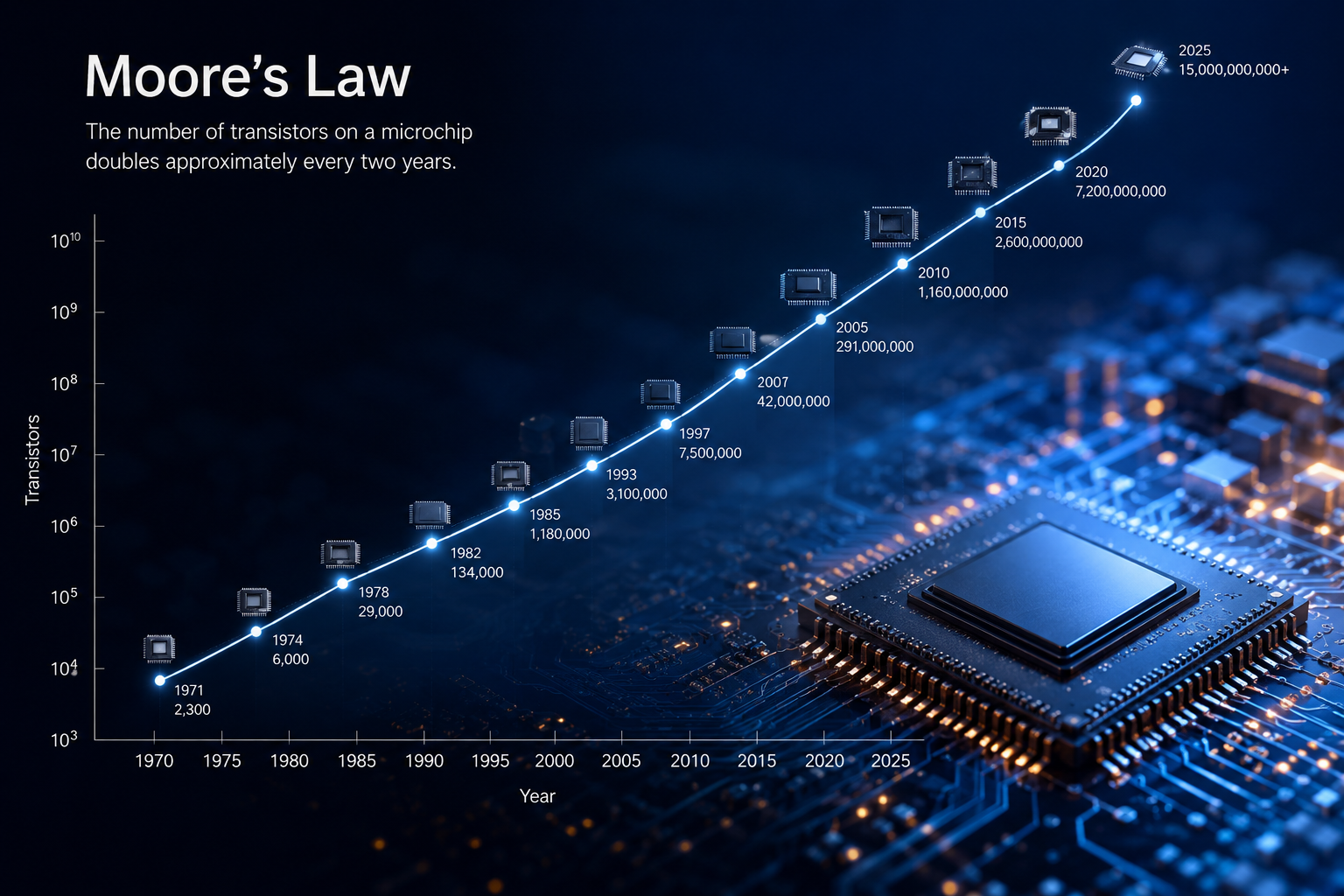
Moore’s Law is the observation that the number of transistors that can be placed on an integrated circuit tends to double approximately every two years while the cost per transistor decreases.
As more transistors fit onto a chip, computers become more powerful without necessarily becoming larger. In many cases, devices also become more energy-efficient and less expensive to manufacture per unit of computing power.
The idea was first proposed by Gordon Moore in 1965, long before personal computers, smartphones, cloud computing, or artificial intelligence existed. Yet his prediction accurately anticipated decades of technological progress.
Moore’s Law became one of the most successful forecasts in the history of technology.
Who Was Gordon Moore?
Gordon Moore was an American chemist and engineer who helped transform the semiconductor industry.
He co-founded Intel Corporation in 1968 along with Robert Noyce, another pioneer of integrated circuits. Intel would later become one of the world’s leading manufacturers of microprocessors.
In April 1965, while writing an article for Electronics magazine, Moore studied the rapid progress of integrated circuits and noticed a clear pattern. Engineers were consistently finding ways to place more electronic components onto semiconductor chips.
He predicted that this trend would continue for at least another decade.
Few people realized at the time that this simple observation would influence the direction of the global technology industry for generations.
The Original Prediction
Moore’s original article stated that the number of components on integrated circuits would double approximately every year.
Ten years later, in 1975, after observing how manufacturing technology had evolved, Moore revised his prediction.
He suggested that transistor counts would double approximately every two years.
This updated version became widely known as Moore’s Law and remained surprisingly accurate for decades.
Although the exact timing has varied depending on technological advances, the overall trend held remarkably well from the 1970s through much of the early twenty-first century.
What Is a Transistor?
To understand Moore’s Law, it helps to understand the transistor.
A transistor is a tiny electronic switch made from semiconductor materials, most commonly silicon. It can turn electrical current on or off or control the flow of electricity.
Modern computer chips contain billions of these microscopic switches.
Every calculation performed by a computer—from opening an app to running artificial intelligence models—depends on transistors switching on and off at extraordinary speeds.
Although a single transistor performs a very simple function, billions working together create incredibly powerful computers.
The more transistors engineers can place onto a chip, the more calculations that chip can perform.
Why More Transistors Matter
Adding more transistors does far more than simply increase numbers.
More transistors allow processors to perform additional calculations simultaneously, store more information close to the processor, improve graphics performance, accelerate artificial intelligence tasks, and execute increasingly sophisticated software.
As transistor density increases, engineers can design more complex processor architectures.
This enables faster applications, smoother gaming, improved scientific simulations, more realistic computer graphics, and advanced machine learning systems.
In many cases, greater transistor density also improves energy efficiency because newer transistors often require less electrical power than older designs.
How Moore’s Law Changed Computing
The influence of Moore’s Law extends into nearly every aspect of modern life.
In the early days of computing, computers filled entire rooms, consumed enormous amounts of electricity, and were available only to governments, universities, and large corporations.
As semiconductor technology improved, computers became dramatically smaller while becoming exponentially more powerful.
Personal computers entered homes.
Laptops became practical.
Smartphones placed supercomputer-like capabilities into people’s pockets.
Today, wearable devices, smart appliances, autonomous vehicles, and artificial intelligence systems all rely on integrated circuits that evolved through decades of progress predicted by Moore’s Law.
Without this steady increase in computing power, many modern technologies would simply not exist.
The Relationship Between Moore’s Law and Integrated Circuits
An integrated circuit, often called a chip or microchip, is a small piece of semiconductor material containing interconnected electronic components.
Rather than building electronic systems from thousands of separate parts, engineers combine millions or billions of transistors onto a single chip.
This approach makes electronic devices smaller, faster, more reliable, and less expensive.
As manufacturing techniques improved, engineers repeatedly reduced transistor sizes.
Smaller transistors meant more could fit within the same physical area.
This continual miniaturization became the engine driving Moore’s Law.
Shrinking the Size of Transistors
One of the greatest engineering achievements behind Moore’s Law has been transistor miniaturization.
During the early decades of semiconductor manufacturing, transistor dimensions were measured in micrometers.
Today, leading semiconductor manufacturers produce chips using fabrication processes measured in just a few nanometers.
A nanometer is one-billionth of a meter.
For comparison, a human hair is approximately 80,000 to 100,000 nanometers wide.
Modern transistors are therefore astonishingly small.
Creating structures this tiny requires some of the most advanced manufacturing equipment ever built.
The Manufacturing Revolution
Building modern computer chips is among the most complex manufacturing processes in human history.
Chip fabrication occurs inside highly controlled cleanrooms where even microscopic dust particles can damage delicate circuits.
Engineers use advanced techniques such as photolithography to transfer intricate circuit patterns onto silicon wafers.
Today’s most advanced chips are manufactured using extreme ultraviolet (EUV) lithography, which uses extremely short wavelengths of light to create incredibly small transistor features.
This technology enables billions of transistors to fit onto chips no larger than a postage stamp.
Moore’s Law and Computer Performance
For many years, increasing transistor counts led directly to faster processors.
Higher clock speeds allowed computers to perform more calculations every second.
However, this trend eventually encountered physical limits.
As processors became faster, they generated more heat and consumed more electricity.
Instead of relying solely on higher clock frequencies, engineers began designing processors with multiple cores.
A multicore processor contains several independent processing units on a single chip, allowing multiple tasks to run simultaneously.
This shift enabled continued performance improvements even as clock speeds stabilized.
Moore’s Law and Falling Costs
An important aspect of Moore’s Law is economics.
As manufacturing techniques improved, the cost of producing each transistor steadily declined.
This meant manufacturers could build increasingly powerful computers without making them prohibitively expensive.
The result was an extraordinary reduction in the cost of computing.
Tasks that once required million-dollar supercomputers can now be performed on affordable consumer devices.
The dramatic decline in computing costs has transformed education, healthcare, business, communication, entertainment, and scientific research.
Moore’s Law Enabled the Smartphone Era
Modern smartphones represent one of the greatest demonstrations of Moore’s Law.
Inside a single smartphone chip are billions of transistors handling photography, graphics, wireless communication, artificial intelligence, encryption, navigation, and multimedia processing simultaneously.
A smartphone today contains vastly greater computing power than the computers used during NASA’s Apollo Moon missions.
This remarkable achievement became possible because semiconductor engineers continuously improved transistor density over many decades.
Artificial Intelligence and Moore’s Law
Artificial intelligence depends heavily on computing power.
Training advanced AI models requires enormous numbers of mathematical calculations.
The continual improvement predicted by Moore’s Law provided increasingly capable processors, graphics processing units (GPUs), and specialized AI accelerators.
Without decades of exponential improvements in semiconductor technology, modern AI systems would be impractical.
Although software algorithms also advanced dramatically, their success relied upon hardware becoming steadily faster and more efficient.
Moore’s Law in Everyday Life
Even people who have never heard of Moore’s Law benefit from it every day.
Streaming high-definition videos.
Making video calls across continents.
Using navigation apps.
Playing realistic video games.
Editing digital photographs.
Shopping online.
Managing finances.
Receiving medical diagnoses through advanced imaging systems.
Operating satellites.
Forecasting weather.
All of these activities depend upon semiconductor technology that improved according to the long-term trend described by Moore’s Law.
Is Moore’s Law a Scientific Law?
Despite its name, Moore’s Law is not a law of nature.
Unlike Newton’s laws of motion or the laws of thermodynamics, Moore’s Law does not describe a fundamental property of the universe.
Instead, it describes a historical trend in technological progress.
Its continued accuracy depended not on nature itself but on the creativity, investment, engineering, and innovation of the global semiconductor industry.
Companies around the world worked tirelessly to keep advancing chip technology, often treating Moore’s Law as both a prediction and an engineering challenge.
The Physical Limits of Miniaturization
Nothing can shrink forever.
As transistors approach atomic dimensions, engineers encounter increasingly difficult physical challenges.
Quantum mechanical effects become significant.
Electrical leakage increases.
Heat becomes harder to manage.
Manufacturing grows dramatically more expensive.
Materials behave differently at extremely small scales.
Eventually, transistors cannot simply continue shrinking indefinitely.
These realities have slowed the pace at which Moore’s Law continues.
Has Moore’s Law Ended?
Many experts believe that the traditional form of Moore’s Law has slowed considerably.
Transistor counts continue to increase, but often not at the rapid pace observed during previous decades.
Modern chip development also requires enormous investments.
Building a state-of-the-art semiconductor fabrication facility now costs tens of billions of dollars.
The complexity of designing advanced processors has increased dramatically as well.
Although Moore’s Law is no longer progressing exactly as it once did, semiconductor innovation certainly has not stopped.
Instead, engineers are finding new ways to improve computing performance.
New Directions Beyond Moore’s Law
Rather than relying solely on shrinking transistors, modern chip designers pursue multiple strategies simultaneously.
Processor architectures have become more sophisticated.
Multicore designs allow parallel processing.
Specialized hardware accelerates artificial intelligence, graphics rendering, encryption, and scientific computing.
Three-dimensional chip stacking places multiple layers of circuitry on top of one another.
Advanced packaging technologies improve communication between different chip components.
New semiconductor materials continue to be investigated alongside traditional silicon.
These innovations represent the next era of computing beyond the classic interpretation of Moore’s Law.
Moore’s Law and Quantum Computing
Quantum computing represents an entirely different approach to computation.
Instead of using classical transistors that store binary values of zero or one, quantum computers use quantum bits, or qubits, which exploit quantum mechanical principles.
Although quantum computers remain in early stages of development, they could eventually solve certain specialized problems far more efficiently than conventional computers.
Rather than replacing Moore’s Law directly, quantum computing may complement traditional semiconductor technology.
Why Moore’s Law Matters Today
Even as its original pace slows, Moore’s Law remains one of the most influential concepts in the history of engineering.
It demonstrated that sustained technological progress is possible through continuous innovation.
For decades, it motivated companies to invest in research, improve manufacturing, and push the limits of science and engineering.
Many of today’s greatest technological achievements—from cloud computing and artificial intelligence to smartphones and modern medicine—stand upon the foundation created by generations of semiconductor advances.
The Lasting Legacy of Moore’s Law
Few ideas have influenced the modern world as profoundly as Moore’s Law. What began as a careful observation by Gordon Moore became the guiding principle for an entire industry, driving decades of extraordinary innovation.
Although the rapid pace of transistor miniaturization is no longer as predictable as it once was, the spirit behind Moore’s Law remains alive. Engineers continue to develop new architectures, advanced manufacturing techniques, specialized processors, and entirely new computing paradigms to meet the world’s growing demand for performance.
Moore’s Law reminds us that progress often comes through countless small improvements accumulated over many years. Each generation of computer chips built upon the achievements of the last, transforming room-sized machines into powerful devices that fit in our hands. As computing enters new frontiers—including artificial intelligence, quantum technologies, and advanced semiconductor designs—the legacy of Moore’s Law continues to shape the future of the digital age.