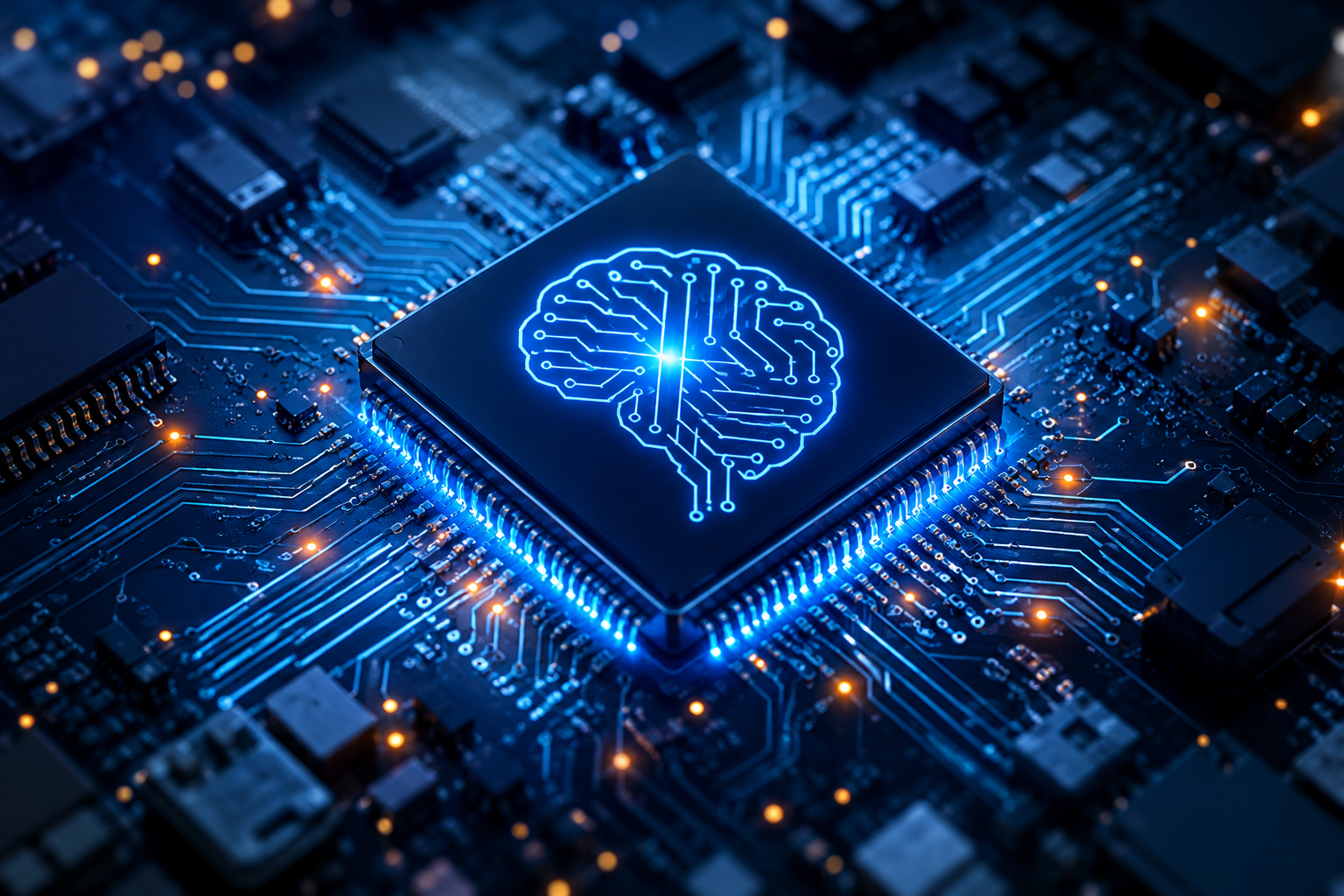
Artificial intelligence has become part of everyday life. It helps unlock smartphones with a glance, translates languages in seconds, recommends movies, writes text, recognizes speech, powers self-driving cars, and even assists doctors in detecting diseases. Behind these remarkable abilities lies a special type of computer hardware that most people never see: the AI chip.
An AI chip is one of the most important technologies of the modern digital era. While software gives artificial intelligence its instructions, AI chips provide the computing power needed to carry them out quickly and efficiently. Without them, many of today’s AI applications would be far too slow, too expensive, or too energy-hungry to be practical.
As artificial intelligence becomes more advanced, AI chips are transforming industries, scientific research, and consumer technology. They are becoming as essential to the AI revolution as engines were to the Industrial Revolution.
What Is an AI Chip?
An AI chip is a specialized computer processor designed to perform the complex mathematical calculations required by artificial intelligence and machine learning much faster and more efficiently than traditional processors.
Every AI system works by processing enormous amounts of data. Whether an AI is recognizing faces, understanding spoken words, generating images, or predicting weather patterns, it must perform billions—or even trillions—of calculations every second.
Traditional computer processors can perform these calculations, but they were originally designed for general-purpose computing. AI chips are built specifically to handle the kinds of operations that artificial intelligence performs most often, allowing them to complete AI tasks much more quickly while using less energy.
In simple terms, if artificial intelligence is the brain of a smart machine, the AI chip is the powerful engine that allows that brain to think.
Why Do AI Systems Need Special Chips?
Artificial intelligence works very differently from traditional computer programs.
A standard computer program follows a clear sequence of instructions. For example, a calculator simply performs arithmetic according to fixed rules.
Artificial intelligence, however, learns patterns from data. A language model analyzes relationships between words. An image-recognition system compares millions of tiny details in photographs. A recommendation engine searches through enormous datasets to predict what someone might enjoy watching or buying.
These tasks involve huge numbers of mathematical operations happening simultaneously.
General-purpose processors can perform them, but not as efficiently.
AI chips are designed to process many calculations in parallel, allowing them to analyze massive amounts of information far more quickly than conventional processors.
How Does an AI Chip Work?
At the heart of artificial intelligence are mathematical operations involving large arrays of numbers called matrices and tensors.
Whenever an AI model recognizes a cat in a photo, predicts tomorrow’s weather, or answers a question, it performs countless matrix calculations.
AI chips include specialized circuits optimized for these operations.
Instead of processing one calculation after another like many traditional processors, AI chips can perform thousands or even millions of similar calculations simultaneously.
This parallel processing dramatically increases speed while reducing energy consumption.
The result is faster AI responses, lower operating costs, and the ability to run much larger and more capable AI models.
AI Chips Learn During Training
Artificial intelligence systems are not born intelligent.
Before they can recognize speech or answer questions, they must first be trained.
Training involves feeding enormous datasets into an AI model so it can gradually adjust billions of internal parameters. This process requires extraordinary computational power.
Modern AI training can take days, weeks, or even months, depending on the size of the model.
AI chips accelerate this learning process by performing vast numbers of mathematical calculations simultaneously.
Without specialized hardware, training today’s largest AI systems would be far slower and significantly more expensive.
AI Chips Also Make AI Fast After Training
Once an AI model has been trained, it begins performing real-world tasks. This stage is called inference.
Whenever you ask a chatbot a question, unlock your phone with facial recognition, or use voice assistants, AI chips perform inference.
Inference usually requires less computing power than training, but it must happen extremely quickly.
People expect nearly instant responses.
Specialized AI chips help deliver those responses within fractions of a second.
The Difference Between AI Chips and Traditional Computer Chips
A traditional computer processor, known as a CPU, is designed to perform many different kinds of computing tasks.
It handles operating systems, web browsing, spreadsheets, word processing, and countless everyday applications.
An AI chip focuses specifically on accelerating artificial intelligence workloads.
Instead of trying to do everything equally well, it specializes in the kinds of calculations that machine learning requires.
This specialization allows AI chips to deliver far higher performance for AI tasks while often consuming less electricity.
Rather than replacing traditional processors, AI chips usually work alongside them.
GPUs and the Rise of Artificial Intelligence
Many of today’s AI breakthroughs became possible because of graphics processing units, or GPUs.
GPUs were originally created to render video games and computer graphics.
Unlike CPUs, GPUs contain thousands of smaller processing cores capable of performing many calculations simultaneously.
Researchers realized that this architecture was also ideal for training neural networks.
As deep learning expanded during the 2010s, GPUs became the primary hardware used for developing modern artificial intelligence.
Today, they remain among the most widely used AI accelerators.
TPUs: Chips Built Specifically for AI
As artificial intelligence continued to grow, engineers began designing processors dedicated entirely to machine learning.
These specialized processors are often called Tensor Processing Units, or TPUs, along with other AI-specific accelerator architectures developed by different companies.
Rather than supporting every type of computation, these chips focus on the mathematical operations used by neural networks.
Because of this specialization, they can deliver exceptional speed and efficiency for AI workloads.
Many cloud-based AI services rely on these dedicated accelerators.
NPUs Bring AI to Personal Devices
Artificial intelligence is increasingly running directly on smartphones, laptops, tablets, and wearable devices.
Many modern devices now include Neural Processing Units, commonly called NPUs.
An NPU is an AI accelerator integrated into consumer electronics.
It enables features such as real-time language translation, photo enhancement, background blur during video calls, voice recognition, handwriting analysis, and on-device generative AI.
Because these calculations happen locally, devices can often respond more quickly while reducing the need to send personal information to remote servers.
AI Chips Inside Smartphones
Modern smartphones contain several different processors working together.
The CPU handles general computing.
The GPU processes graphics.
The NPU performs artificial intelligence tasks.
When your phone automatically improves a photograph, removes background noise during a call, predicts the next word you will type, or recognizes your face for secure authentication, the AI chip is often doing much of the work.
These capabilities have become increasingly important as smartphones incorporate more intelligent features.
AI Chips in Data Centers
Some of the world’s largest AI models operate inside enormous data centers containing thousands of AI chips working together.
These facilities train advanced language models, analyze scientific data, process internet searches, recommend online content, and support cloud-based AI services.
Individual AI chips work together through high-speed communication networks, allowing massive computing tasks to be distributed across thousands of processors.
This collective computing power enables AI systems with hundreds of billions of parameters.
AI Chips in Self-Driving Cars
Autonomous vehicles rely heavily on artificial intelligence.
Their cameras, radar systems, ultrasonic sensors, and lidar continuously collect information about the surrounding environment.
The vehicle must rapidly identify pedestrians, traffic signs, bicycles, road markings, and other vehicles while planning safe driving decisions.
AI chips process this sensor data in real time.
Because safety depends on immediate responses, these chips must deliver extremely fast performance with exceptional reliability.
AI Chips in Healthcare
Medicine is becoming increasingly dependent on artificial intelligence.
AI systems help analyze medical images, identify possible signs of disease, assist in drug discovery, monitor patients, and support clinical decision-making.
AI chips enable these systems to process large amounts of medical data efficiently.
Researchers are also using AI hardware to accelerate studies in genomics, protein structure prediction, and personalized medicine.
While AI supports healthcare professionals, medical decisions still require expert clinical judgment and appropriate oversight.
AI Chips in Scientific Research
Scientific discovery often depends on enormous computational workloads.
Astronomers analyze images from powerful telescopes.
Climate scientists simulate Earth’s atmosphere.
Physicists study particle collisions.
Biologists examine DNA sequences.
Chemists model molecular interactions.
AI chips help researchers analyze these vast datasets much more quickly than would otherwise be possible, allowing new discoveries to emerge faster.
AI Chips and Robotics
Modern robots increasingly rely on artificial intelligence.
Industrial robots inspect products on factory assembly lines.
Warehouse robots organize inventory.
Agricultural robots identify crops and weeds.
Household robots navigate around furniture.
All of these systems depend on AI chips to process information from cameras and sensors while making rapid decisions about movement and actions.
AI Chips and Energy Efficiency
Performance is only one part of the story.
Energy efficiency has become equally important.
Training large AI models requires enormous amounts of electricity.
Running AI applications across billions of devices also consumes significant energy.
Modern AI chips are carefully designed to perform more calculations using less power.
Improving efficiency reduces operating costs while helping decrease the environmental impact associated with large-scale computing.
Energy-efficient hardware has become one of the most important goals in AI chip design.
Designing an AI Chip Is Extremely Complex
Creating an AI chip is among the most challenging engineering tasks in the world.
Engineers must design billions of microscopic transistors that operate reliably while generating as little heat as possible.
These transistors are fabricated using advanced semiconductor manufacturing technologies measured in nanometers.
The manufacturing process requires extraordinary precision, clean-room environments, and highly sophisticated equipment capable of producing features only a few dozen atoms wide.
Only a small number of companies possess the technological expertise required to manufacture the most advanced AI chips.
The Growing Importance of AI Chips
Artificial intelligence is expanding rapidly into nearly every industry.
Businesses use AI to improve productivity.
Scientists use it to analyze research.
Hospitals use it to support diagnosis.
Schools use it for personalized learning.
Manufacturers use it to automate production.
As AI applications become larger and more sophisticated, demand for faster and more efficient AI chips continues to rise.
Many experts now view AI chips as strategic technologies that will shape economic growth, scientific progress, and technological leadership for decades to come.
Challenges Facing AI Chips
Despite their remarkable capabilities, AI chips also face important challenges.
As AI models grow larger, they require increasing amounts of memory, computing power, and electricity.
Producing advanced semiconductors is technically demanding and depends on highly specialized manufacturing facilities.
Researchers are also working to improve chip reliability, reduce heat generation, increase energy efficiency, and make AI hardware more affordable.
Balancing performance, cost, and sustainability remains one of the industry’s greatest engineering challenges.
The Future of AI Chips
The next generation of AI chips is expected to become even faster, smaller, and more energy efficient.
Researchers are exploring new semiconductor materials, advanced packaging techniques, three-dimensional chip designs, optical computing, and neuromorphic chips inspired by the structure of the human brain.
Quantum computing may eventually complement certain AI workloads, although it is still an emerging technology with significant scientific and engineering challenges.
Future AI hardware will likely allow increasingly powerful artificial intelligence to run directly on personal devices, reducing dependence on cloud computing while improving privacy and responsiveness.
Why AI Chips Matter More Than Ever
Artificial intelligence has become one of the defining technologies of the twenty-first century, but software alone cannot make AI possible. Every intelligent application depends on hardware capable of performing extraordinary amounts of computation quickly, accurately, and efficiently.
AI chips provide that foundation. They transform mathematical models into practical tools that can recognize speech, understand language, generate images, drive vehicles, assist scientists, and help solve complex real-world problems.
As artificial intelligence continues to evolve, AI chips will remain at the heart of that progress. Though they are tiny pieces of silicon hidden inside computers, smartphones, and data centers, their impact reaches far beyond their physical size. They are powering a new era of discovery, innovation, and intelligent technology—one calculation at a time.