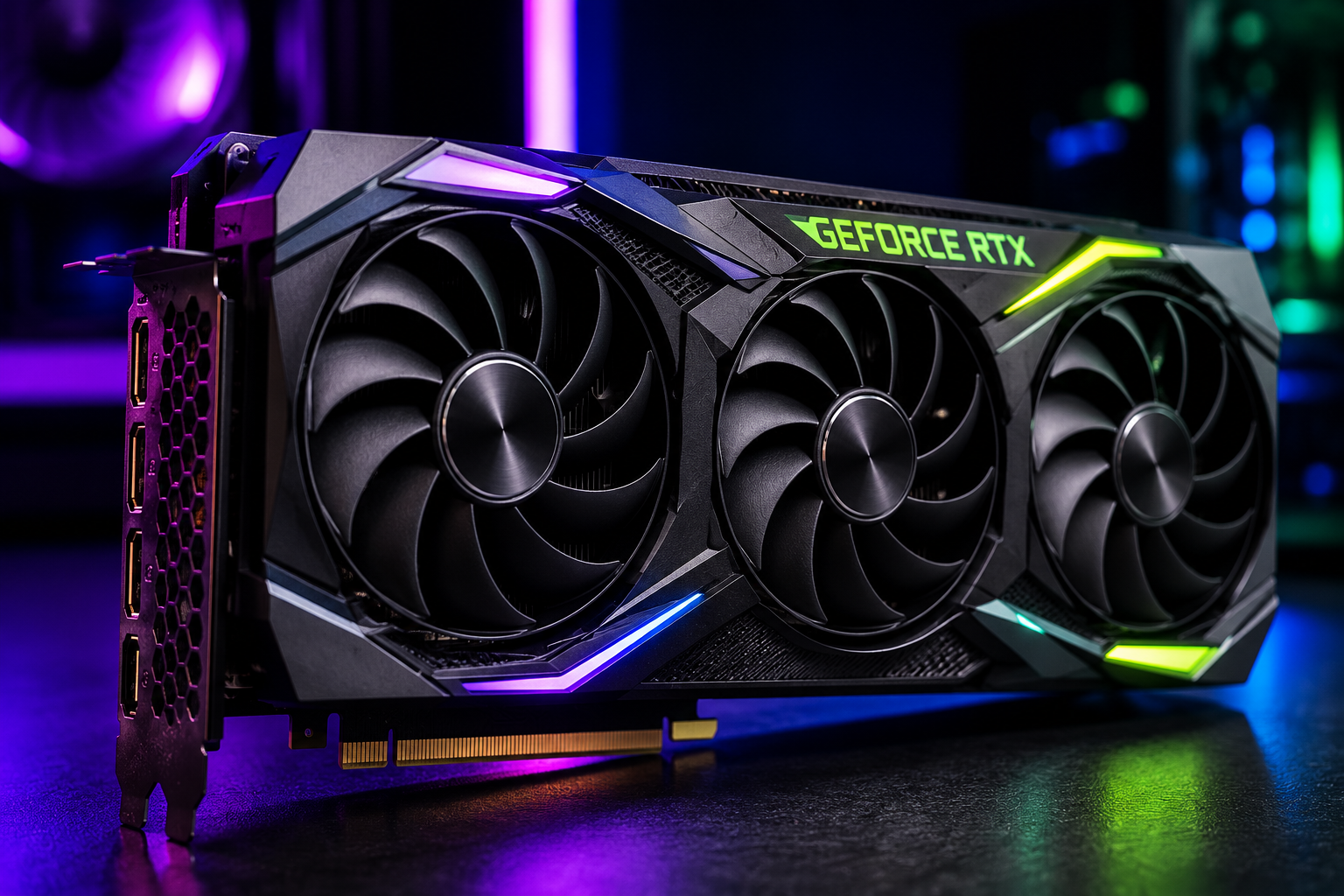
There was a time when a computer’s central processing unit (CPU) handled nearly every task. Whether you were typing a document, browsing the web, or playing a simple game, the CPU was the unquestioned heart of computing. But as technology advanced and our digital lives became more demanding, a new kind of processor stepped into the spotlight—the Graphics Processing Unit, better known as the GPU.
Today, GPUs do far more than create beautiful graphics in video games. They power artificial intelligence, accelerate scientific research, help doctors analyze medical images, train self-driving cars, edit movies, mine enormous datasets, simulate climate change, and even help astronomers study distant galaxies. In many of the world’s fastest supercomputers, GPUs perform the majority of the computational work.
Modern computing simply would not look the same without them. From the smartphone in your pocket to the most powerful AI systems in the world, GPUs have become one of the defining technologies of the 21st century.
What Is a GPU?
A Graphics Processing Unit (GPU) is a specialized processor designed to perform many calculations simultaneously. Unlike a CPU, which focuses on executing a small number of complex tasks as quickly as possible, a GPU is built to handle thousands of simpler operations at the same time.
The first GPUs were created to speed up the rendering of computer graphics. Every image displayed on a screen consists of millions of pixels, and generating those pixels requires an enormous number of mathematical calculations. As video games and computer graphics became more realistic, graphics processing demanded far more computing power than CPUs alone could provide.
Engineers solved this challenge by designing processors optimized for highly parallel workloads. That design eventually proved useful for many other fields beyond graphics.
The Difference Between a CPU and a GPU
Although both CPUs and GPUs are processors, they are designed for different purposes.
A CPU is often called the “brain” of a computer because it manages operating systems, runs software, executes instructions, and coordinates all hardware components. It excels at tasks that require fast decision-making, complex logic, and sequential processing.
A GPU, on the other hand, is designed for parallel computing. Instead of solving one problem after another, it solves thousands of similar problems simultaneously.
Imagine a library with ten thousand books.
A CPU is like a single expert librarian who carefully organizes each book one by one.
A GPU is like thousands of assistants, each organizing books at the same time.
Neither approach is universally better. They simply excel at different kinds of work. Modern computers rely on both processors working together.
Why Parallel Processing Matters
Many computational problems involve repeating the same calculation millions or even billions of times.
Rendering a 3D scene requires calculating the color, lighting, texture, and position of millions of pixels.
Training an artificial intelligence model requires performing vast numbers of mathematical operations on enormous datasets.
Weather forecasting simulates atmospheric conditions across millions of locations.
Molecular simulations calculate interactions among huge numbers of atoms.
These problems are ideal for parallel processing because many calculations can occur independently.
GPUs are specifically designed for this kind of workload, allowing them to complete these tasks dramatically faster than CPUs alone.
How GPUs Work
Inside a GPU are thousands of smaller processing units known as cores. These cores work together to perform large numbers of calculations simultaneously.
Instead of focusing on maximizing the speed of a single calculation, GPU architecture emphasizes maximizing overall throughput—the total amount of work completed over time.
Modern GPUs also include specialized hardware for certain tasks. For example, many AI-focused GPUs contain tensor cores that accelerate matrix operations commonly used in machine learning. Some GPUs also include dedicated hardware for ray tracing, enabling more realistic lighting and reflections in computer graphics.
This specialized architecture makes GPUs exceptionally efficient for many modern computing tasks.
The Evolution of GPUs
Early graphics accelerators appeared in the 1980s and 1990s, primarily to improve video game performance.
Initially, these processors performed fixed graphical operations. Developers had limited control over how they worked.
Everything changed when programmable shaders were introduced. Instead of performing only predefined graphics functions, GPUs became programmable processors capable of handling increasingly complex calculations.
Researchers soon realized that GPUs could solve many scientific and engineering problems far faster than traditional CPUs.
This idea gave rise to General-Purpose Computing on Graphics Processing Units (GPGPU), where GPUs are used for applications far beyond graphics rendering.
Today, GPU computing drives breakthroughs across nearly every scientific and technological field.
GPUs and Artificial Intelligence
Artificial intelligence has become one of the biggest reasons GPUs are essential.
Modern AI systems rely heavily on deep learning, which involves training neural networks using enormous amounts of data.
Training these models requires trillions of mathematical operations, particularly matrix multiplications. GPUs excel at these operations because they can perform many calculations simultaneously.
Without GPUs, training today’s large language models, image-generation systems, speech recognition software, and recommendation algorithms would take vastly longer and consume significantly more computing resources.
Even after training is complete, GPUs continue accelerating AI inference, allowing models to respond quickly when users ask questions, generate images, or analyze information.
Gaming: Where GPUs First Became Famous
Video games remain one of the most visible applications of GPUs.
Modern games feature incredibly realistic environments, detailed characters, dynamic lighting, shadows, reflections, and complex physics simulations.
Every frame displayed on a monitor requires millions or even billions of calculations.
A GPU renders these scenes many times every second, creating smooth animation and immersive gameplay.
Technologies such as ray tracing simulate the physical behavior of light, producing reflections, shadows, and global illumination that closely resemble the real world.
Upscaling technologies powered by AI can also generate higher-resolution images while reducing computational demands, helping games run more efficiently.
Video Editing and Digital Content Creation
Professional creators rely heavily on GPUs.
Editing high-resolution video requires processing enormous amounts of visual data.
Color grading, visual effects, animation, 3D rendering, motion graphics, and special effects all involve computationally intensive workloads that GPUs accelerate dramatically.
Without GPU acceleration, rendering complex visual projects could take many times longer.
Photographers also benefit from GPUs when processing large image collections, applying AI-powered editing tools, or removing noise from photographs.
Scientific Research
Some of humanity’s greatest scientific discoveries now depend on GPU computing.
Astronomers use GPUs to process data from massive telescopes.
Physicists simulate particle collisions and astrophysical phenomena.
Climate scientists build sophisticated models that predict future climate patterns.
Chemists study molecular interactions.
Biologists analyze genomic data.
Researchers developing new medicines simulate protein folding and molecular behavior using GPU-accelerated computing.
Many of these calculations would be impractical or prohibitively slow without GPUs.
Medical Applications
Healthcare has increasingly embraced GPU technology.
Medical imaging systems generate detailed scans that require substantial computational processing.
GPUs help reconstruct images from CT scanners, MRI machines, and other diagnostic equipment.
Artificial intelligence powered by GPUs assists physicians by identifying patterns in medical images that may indicate diseases such as cancer, helping prioritize cases for expert review.
Medical researchers also use GPU computing to analyze genetic information, simulate biological systems, and accelerate drug discovery.
Supercomputers
Many of the world’s fastest supercomputers rely extensively on GPUs.
Rather than using only traditional CPUs, modern supercomputers combine CPUs with thousands of GPUs working together.
This hybrid architecture enables extraordinary performance for scientific simulations, engineering calculations, weather prediction, nuclear research, astrophysics, and AI development.
By combining the strengths of CPUs and GPUs, these systems achieve computational capabilities that were unimaginable only a few decades ago.
GPUs and Cryptocurrency
GPUs became widely known outside gaming during the rise of cryptocurrency mining.
Certain cryptocurrencies originally relied on algorithms that GPUs could execute efficiently.
Miners used large collections of graphics cards to perform the necessary calculations for validating blockchain transactions.
Although many major cryptocurrencies have since changed their validation methods or rely on specialized hardware, this period demonstrated the immense computational power of GPUs.
Everyday Devices Use GPUs Too
GPUs are no longer limited to desktop computers.
Smartphones contain graphics processors that render user interfaces, play videos, display games, and accelerate AI features such as photo enhancement and voice recognition.
Tablets, laptops, gaming consoles, smart TVs, virtual reality headsets, and even many automobiles now include GPUs.
Modern vehicles use GPU-powered systems to process camera feeds, assist with navigation, and support advanced driver-assistance technologies.
GPUs in Cloud Computing
Not everyone owns a powerful graphics card.
Cloud computing allows businesses and researchers to access GPU resources remotely through data centers.
Cloud GPUs make advanced computing available to startups, universities, researchers, and developers without requiring expensive local hardware.
This accessibility has significantly accelerated innovation in artificial intelligence, engineering, biotechnology, and digital media.
Energy Efficiency
One reason GPUs are so valuable is their efficiency for suitable workloads.
Although high-performance GPUs can consume considerable electrical power, they often complete parallel tasks much faster than CPUs. As a result, the total energy required to solve a problem can be lower because the work finishes sooner.
Improving performance per watt has become a major focus of GPU design, especially for large data centers and supercomputers where energy costs are substantial.
Challenges of GPU Computing
Despite their remarkable capabilities, GPUs are not ideal for every task.
Many everyday computing operations still depend primarily on CPUs because they involve complex decision-making, branching logic, or sequential processing.
Programming GPUs can also be more challenging than programming CPUs. Developers often need specialized programming frameworks and must redesign algorithms to take advantage of parallel execution.
In addition, high-end GPUs can be expensive and may require advanced cooling systems and substantial electrical power.
These limitations mean GPUs complement CPUs rather than replace them.
The Future of GPUs
The importance of GPUs continues to grow.
Artificial intelligence is expanding rapidly, demanding ever-greater computational power.
Scientists are building increasingly detailed simulations of Earth’s climate, the human brain, galaxies, and biological systems.
Virtual reality, augmented reality, digital twins, robotics, autonomous vehicles, and advanced robotics all require powerful graphics and AI processing.
Future GPUs will likely become even more specialized, integrating dedicated hardware for AI, scientific computing, and real-time simulation while improving energy efficiency.
Researchers are also exploring new computing architectures that combine GPUs with other specialized processors to tackle increasingly complex problems.
Why GPUs Have Become Indispensable
GPUs have evolved from specialized graphics hardware into one of the most important technologies in modern computing. Their ability to perform thousands of calculations simultaneously has transformed industries ranging from entertainment and medicine to scientific research and artificial intelligence.
Rather than replacing CPUs, GPUs work alongside them, each contributing its unique strengths. CPUs provide flexible control and execute diverse software, while GPUs deliver extraordinary parallel computing power for data-intensive tasks.
As the world generates more data, develops more advanced AI systems, and tackles increasingly complex scientific challenges, the role of GPUs will only become more significant. They are no longer simply components that make games look better—they are engines of discovery, innovation, and technological progress, helping humanity solve problems that once seemed beyond the reach of computation.