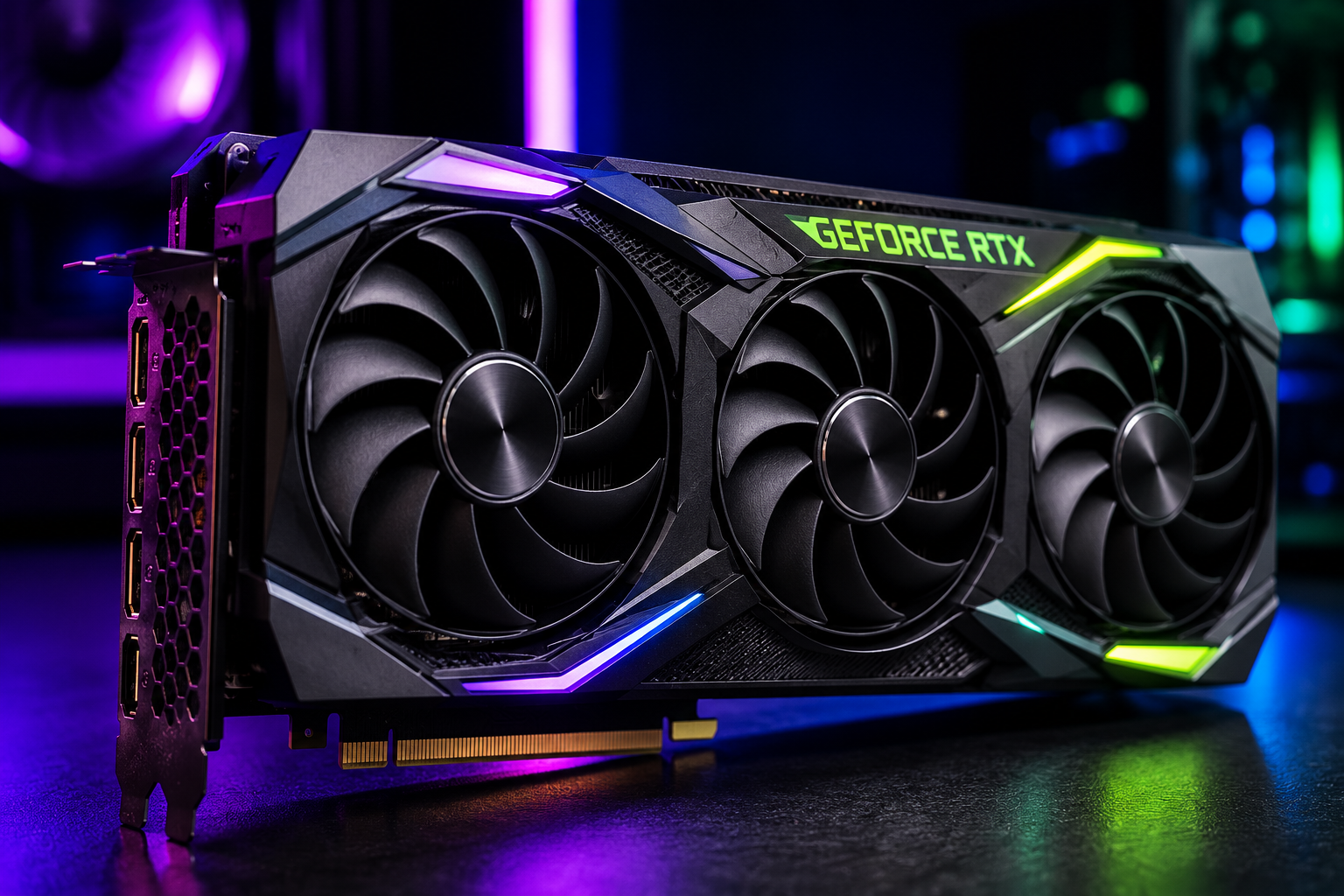
Modern scientific discoveries are happening faster than ever before. Astronomers are capturing breathtaking images of distant galaxies, biologists are decoding DNA at incredible speeds, climate scientists are modeling Earth’s future, and artificial intelligence is helping researchers solve problems that once seemed impossible. Behind many of these breakthroughs is a remarkable piece of technology that most people associate with gaming: the Graphics Processing Unit, or GPU.
Originally designed to render realistic graphics in video games, GPUs have evolved into some of the world’s most powerful scientific computing tools. Today, they are accelerating research in medicine, physics, chemistry, astronomy, engineering, and countless other fields. They enable scientists to analyze enormous datasets, perform billions of calculations simultaneously, and solve complex problems in hours instead of weeks or even months.
The story of the GPU is a powerful reminder that technology often finds uses far beyond its original purpose. What began as a way to create smoother graphics has become one of the driving forces behind modern science.
What Is a GPU?
A Graphics Processing Unit (GPU) is a specialized processor designed to perform many calculations at the same time. Unlike a traditional Central Processing Unit (CPU), which is optimized to execute a smaller number of complex tasks very quickly, a GPU contains thousands of smaller processing cores that can work simultaneously.
This architecture makes GPUs exceptionally good at handling workloads where the same type of calculation must be repeated over and over on large amounts of data.
When playing a video game, for example, millions of pixels must be processed every second to create realistic images. Instead of calculating each pixel one at a time, a GPU processes many pixels simultaneously. Scientists realized that many research problems involve similar patterns of repeated calculations, making GPUs ideal for scientific computing.
Today, GPUs are no longer limited to graphics. They have become powerful general-purpose computing devices capable of solving some of the world’s most demanding scientific challenges.
Why Scientific Research Requires So Much Computing Power
Scientific research often involves calculations on an enormous scale.
A climate model may need to simulate decades of atmospheric interactions involving billions of data points. A particle physics experiment can generate petabytes of data that must be analyzed to identify rare events. A medical imaging study may process millions of high-resolution images. An artificial intelligence model may require trillions of mathematical operations during training.
These tasks demand extraordinary computational resources.
Using only traditional CPUs, many of these calculations would take far longer to complete. Researchers might wait weeks or months for results, slowing scientific progress.
GPUs dramatically reduce this waiting time by performing many calculations simultaneously. Instead of solving one calculation after another, they solve thousands at once, allowing researchers to explore ideas much more quickly.
Parallel Computing: The Secret Behind GPU Performance
The true strength of a GPU lies in parallel computing.
Imagine trying to count every tree in a large forest. One person could count each tree individually, but the process would take a long time. Now imagine sending thousands of people into different parts of the forest, each counting trees at the same time. The work finishes much faster.
A GPU works in a similar way.
Instead of relying on a few powerful cores like a CPU, a GPU uses thousands of smaller cores that work together. Each core performs part of the overall calculation, dramatically increasing the total speed for suitable tasks.
Not every scientific problem can be divided this way, but many of the most important ones can. Whenever large datasets can be processed independently or repeated mathematical operations are required, GPUs provide enormous performance advantages.
From Gaming Technology to Scientific Revolution
The transformation of GPUs into scientific tools began in the early 2000s.
Researchers recognized that graphics hardware could perform mathematical operations useful for scientific simulations. This realization led to the development of General-Purpose GPU Computing (GPGPU), allowing programmers to use graphics processors for much more than rendering images.
Software platforms such as CUDA and OpenCL made it easier for scientists to write programs that harness GPU hardware for research applications.
Since then, GPU technology has advanced rapidly. Modern scientific GPUs contain thousands of processing cores, high-speed memory, and specialized hardware designed for artificial intelligence and numerical computation.
Today, nearly every major supercomputer in the world relies on GPUs for a significant portion of its computational power.
Accelerating Artificial Intelligence Research
Artificial intelligence is one of the biggest reasons GPUs have become essential in modern science.
Training deep learning models requires processing enormous amounts of data while performing billions or even trillions of mathematical calculations.
Neural networks repeatedly adjust millions or billions of parameters during training. GPUs excel at these repetitive matrix and vector calculations, allowing AI systems to learn much more efficiently.
Without GPUs, many of today’s advanced AI models would take impractically long to train.
Researchers use GPU-powered AI to identify diseases from medical images, predict protein structures, analyze satellite imagery, discover new materials, study ecosystems, and assist scientific discovery across many disciplines.
Transforming Medical Research
Medicine has become increasingly dependent on powerful computing.
Modern hospitals generate vast amounts of imaging data through MRI scanners, CT scanners, X-rays, ultrasound systems, and other diagnostic technologies.
GPUs accelerate the reconstruction and analysis of these images, allowing doctors to view high-quality scans more quickly.
In medical research, GPUs help scientists analyze genetic information, identify disease patterns, model the spread of infectious diseases, and simulate biological processes.
Drug discovery has also benefited enormously.
Researchers can use GPUs to simulate how potential drug molecules interact with proteins inside the human body. These simulations allow scientists to evaluate promising compounds before moving into laboratory testing, helping to guide and accelerate the drug development process.
While laboratory experiments remain essential, GPU-powered simulations reduce the number of possibilities researchers need to investigate experimentally.
Unlocking the Secrets of DNA
The human genome contains more than three billion DNA base pairs.
Modern sequencing technologies generate enormous amounts of genetic data that must be analyzed rapidly and accurately.
GPUs help researchers compare DNA sequences, identify genetic mutations, assemble genomes, and study evolutionary relationships.
These capabilities have contributed to advances in personalized medicine, cancer research, rare disease diagnosis, and our understanding of human evolution.
As sequencing technologies continue improving, GPU computing is becoming even more important for managing the growing flood of biological data.
Exploring the Universe
Astronomy has entered an era of massive datasets.
Modern telescopes observe billions of stars and galaxies while generating enormous quantities of information every night.
Radio telescopes, space telescopes, and large optical observatories require advanced computing to process their observations.
GPUs allow astronomers to analyze these data much faster.
Researchers use them to search for exoplanets, identify distant galaxies, detect gravitational lensing, simulate galaxy formation, and study the evolution of the universe.
They also help process signals from radio telescopes searching for fast radio bursts and other rare cosmic events that might otherwise remain hidden within massive datasets.
Simulating the Birth and Death of Stars
Stars evolve over millions or billions of years, making direct observation of their complete life cycles impossible.
Instead, astrophysicists build computer simulations that model nuclear fusion, gravity, magnetic fields, gas dynamics, and radiation.
These simulations involve solving millions of mathematical equations simultaneously.
GPUs allow scientists to perform these calculations much faster, enabling more detailed models of star formation, supernova explosions, neutron stars, and black holes.
The improved computational speed allows researchers to test different scenarios and compare their predictions with astronomical observations.
Understanding Earth’s Climate
Climate science depends heavily on computer simulations.
Researchers divide Earth’s atmosphere, oceans, ice sheets, and land surfaces into millions of small regions.
Each region interacts continuously with neighboring regions through processes such as heat transfer, air circulation, ocean currents, cloud formation, and precipitation.
Calculating these interactions requires extraordinary computing power.
GPUs accelerate climate models, allowing scientists to perform higher-resolution simulations that capture more details of Earth’s complex systems.
These improved models help researchers better understand long-term climate trends, extreme weather events, sea-level rise, and the effects of changing greenhouse gas concentrations.
Predicting Natural Disasters
Scientists use GPU-powered simulations to better understand earthquakes, volcanic eruptions, hurricanes, floods, wildfires, and tsunamis.
These models combine enormous datasets with sophisticated physical equations.
By performing many calculations simultaneously, GPUs help researchers explore different scenarios more quickly and improve forecasting methods.
Although no model can predict every event with complete certainty, faster simulations contribute to better preparedness and risk assessment.
Discovering New Materials
Materials science seeks to create substances with new and useful properties.
Researchers investigate materials for stronger buildings, lighter aircraft, faster electronics, better batteries, cleaner energy technologies, and improved medical devices.
Instead of testing every possibility experimentally, scientists often begin with computer simulations.
GPUs allow researchers to model the behavior of atoms and molecules under different conditions, helping identify promising materials before laboratory experiments begin.
This approach saves both time and resources while expanding the range of materials scientists can investigate.
Advancing Physics Research
Many areas of physics involve mathematical calculations too large for ordinary computers.
Particle physicists analyze collisions produced by powerful accelerators, searching for evidence of new particles and previously unknown physical phenomena.
Plasma physicists model fusion reactions in the pursuit of clean energy.
Condensed matter physicists investigate the behavior of electrons inside advanced materials.
Theoretical physicists simulate quantum systems that would otherwise be impossible to study directly.
GPUs provide the computational speed needed to perform these demanding calculations efficiently.
Helping Chemists Understand Molecules
Chemistry depends on understanding how atoms interact.
Many chemical reactions involve the movement of electrons, changes in molecular structure, and energy transfer between particles.
Quantum chemistry simulations describe these interactions using the principles of quantum mechanics.
Such calculations are computationally intensive because they involve solving complex mathematical equations for many interacting particles.
GPUs enable chemists to simulate larger molecules with greater accuracy, supporting research in catalysis, renewable energy, pharmaceuticals, and industrial chemistry.
Engineering Better Technologies
Engineers use computer simulations before constructing real-world products.
Aircraft designers model airflow around wings.
Automobile manufacturers test crash performance.
Civil engineers analyze bridges under heavy loads.
Electronics engineers study heat flow inside computer chips.
GPUs accelerate these engineering simulations, allowing designers to evaluate many different possibilities while reducing development costs and improving safety.
Virtual testing often identifies problems before expensive prototypes are built.
Powering the World’s Fastest Supercomputers
Many of the world’s fastest supercomputers combine CPUs with powerful GPUs.
Rather than replacing CPUs, GPUs work alongside them.
The CPU manages overall program execution while the GPU handles computationally intensive tasks that benefit from parallel processing.
This partnership creates systems capable of performing quadrillions of calculations every second.
Such supercomputers support research in weather forecasting, national security, astrophysics, biology, artificial intelligence, materials science, and many other fields.
The Role of GPUs in Space Exploration
Space missions produce vast quantities of scientific data.
Satellites continuously observe Earth’s atmosphere, oceans, forests, glaciers, and weather systems.
Planetary missions capture high-resolution images and analyze rocks, soils, and atmospheres on distant worlds.
Researchers use GPUs to process these observations, reconstruct images, analyze terrain, and interpret scientific measurements.
Future missions involving autonomous spacecraft and robotic explorers may increasingly rely on advanced computing systems inspired by GPU technologies.
Energy Efficiency Matters
Scientific computing is not only about speed but also about efficiency.
For many parallel workloads, GPUs can perform more calculations per unit of electrical energy than CPUs alone.
Improved energy efficiency is especially important for large research centers operating thousands of computers around the clock.
Reducing energy consumption lowers operating costs while helping decrease the environmental impact of scientific computing.
As computational demands continue growing, energy-efficient hardware has become an increasingly important area of research.
Challenges of GPU Computing
Although GPUs are extremely powerful, they are not the ideal solution for every problem.
Some calculations must be performed in a strict sequence and cannot easily be divided among thousands of processing cores. In these cases, CPUs may remain more effective.
Programming GPUs also requires specialized software and expertise. Researchers often need to redesign algorithms to fully benefit from parallel processing.
In addition, scientific simulations require careful validation. Faster calculations do not automatically guarantee correct results. Scientists must ensure that GPU-accelerated software produces accurate and reproducible outcomes consistent with established physical principles and experimental evidence.
The Future of GPU-Powered Science
GPU technology continues to evolve rapidly.
New generations provide greater computational performance, larger memory capacity, and specialized hardware for artificial intelligence and scientific computing.
Researchers are combining GPUs with advances in machine learning, cloud computing, high-speed networking, and eventually quantum computing to tackle problems that were once considered beyond reach.
Future scientific discoveries may include more accurate climate predictions, faster drug development, improved renewable energy technologies, deeper understanding of the human brain, better models of the early universe, and new insights into the fundamental laws of nature.
As scientific datasets continue growing, the importance of GPU computing will only increase.
A Technology That Changed the Pace of Discovery
The Graphics Processing Unit has become one of the most transformative technologies in modern scientific research. What began as hardware designed to create realistic computer graphics has evolved into a cornerstone of high-performance computing, enabling scientists to process vast amounts of data and perform complex simulations at remarkable speed.
Across medicine, astronomy, biology, chemistry, engineering, climate science, physics, and artificial intelligence, GPUs are helping researchers answer questions that once seemed impossible to investigate. By dramatically reducing the time needed for computation, they allow scientists to spend less time waiting for results and more time exploring ideas, testing hypotheses, and making discoveries.
As research grows increasingly data-intensive, GPUs will continue to play a central role in expanding human knowledge. They are not merely making computers faster—they are helping humanity understand the universe, improve lives, and push the boundaries of science further than ever before.