The internet has become the invisible backbone of modern life. We stream movies in 4K, join video meetings, play competitive online games, connect dozens of smart home devices, and transfer massive files in seconds. Behind nearly all of these activities is a technology most of us rarely think about until it slows down—Wi-Fi.
Over the past few years, Wi-Fi 6 has become the standard in many homes, offices, laptops, and smartphones. But a new generation has arrived. Wi-Fi 7 promises dramatically faster speeds, lower latency, improved efficiency, and the ability to handle an even greater number of connected devices.
The big question is simple: Is Wi-Fi 7 really that much better than Wi-Fi 6, or is Wi-Fi 6 still good enough?
The answer depends on how you use your network, the devices you own, and whether you need the latest wireless technology. While Wi-Fi 7 is unquestionably more advanced, Wi-Fi 6 remains an excellent choice for millions of people.
Let’s explore exactly how these two wireless standards compare and what the differences mean in everyday life.
What Is Wi-Fi?
Wi-Fi is a wireless networking technology that allows devices to connect to the internet or communicate with one another without physical cables.
Instead of using wires, Wi-Fi transmits data using radio waves. A wireless router sends and receives these radio signals, allowing smartphones, laptops, tablets, gaming consoles, smart TVs, security cameras, and countless other devices to communicate.
The technology behind Wi-Fi continues to evolve. Each new generation improves speed, efficiency, reliability, security, and performance in crowded environments.
The names “Wi-Fi 6” and “Wi-Fi 7” are consumer-friendly versions of the official IEEE wireless networking standards.
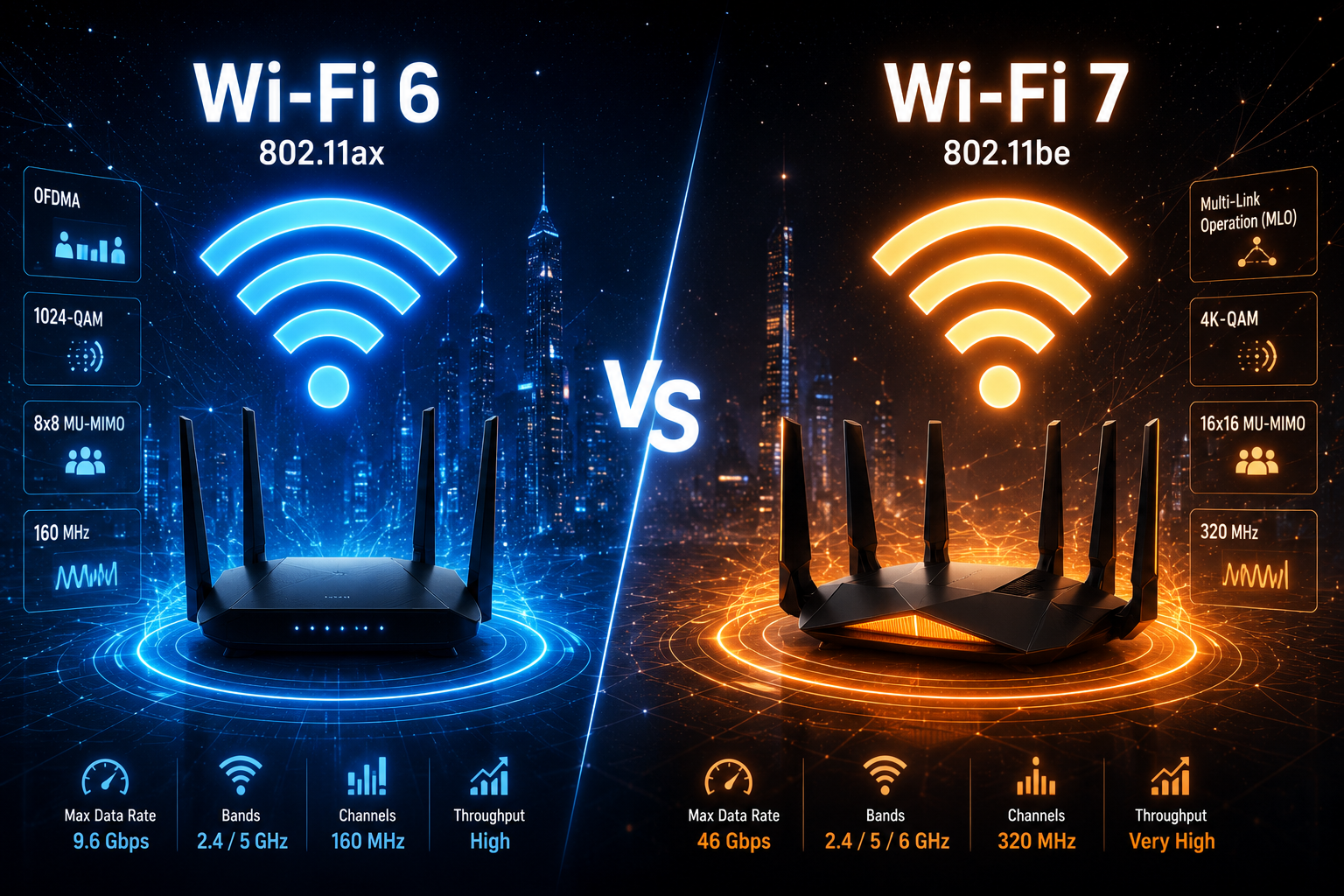
Wi-Fi 6 is based on IEEE 802.11ax.
Wi-Fi 7 is based on IEEE 802.11be and is often described as Extremely High Throughput (EHT) because of its significant performance improvements.
What Is Wi-Fi 6?
Wi-Fi 6 was introduced to improve wireless networking in an era when homes and offices suddenly became filled with connected devices.
Previous Wi-Fi generations mainly focused on increasing maximum speed. Wi-Fi 6 took a different approach by improving overall network efficiency.
Instead of simply making one device faster, Wi-Fi 6 was designed to help many devices share the wireless network more effectively.
Whether multiple people are streaming movies, attending video calls, gaming online, or using smart home devices simultaneously, Wi-Fi 6 helps reduce congestion and maintain stable performance.
Today, Wi-Fi 6 has become the standard wireless technology found in many routers, smartphones, laptops, tablets, and gaming systems.
What Is Wi-Fi 7?
Wi-Fi 7 represents the next major leap in wireless networking.
Rather than making small improvements, Wi-Fi 7 introduces several entirely new technologies that dramatically increase speed, reduce latency, and improve reliability.
The goal is to make wireless connections perform much more like wired Ethernet connections.
Wi-Fi 7 is designed for future applications that demand enormous bandwidth and extremely responsive connections, including cloud gaming, virtual reality, augmented reality, 8K video streaming, artificial intelligence workloads, ultra-high-resolution video conferencing, and professional content creation.
Although internet speeds provided by your service plan still limit how fast you can access online content, Wi-Fi 7 can greatly improve communication between devices on your local network and make better use of very fast broadband connections.
Wi-Fi 6 vs Wi-Fi 7 at a Glance
Both technologies support the 2.4 GHz, 5 GHz, and 6 GHz frequency bands (the 6 GHz band requires Wi-Fi 6E or Wi-Fi 7-compatible hardware and regulatory approval in each country).
Wi-Fi 7 builds upon everything Wi-Fi 6 introduced but significantly expands its capabilities.
It supports wider wireless channels, more simultaneous data streams, higher-order modulation, Multi-Link Operation (MLO), and several scheduling enhancements that together increase throughput and reduce latency under suitable conditions.
These improvements make Wi-Fi 7 much more capable than Wi-Fi 6, especially in demanding environments.
Speed Comparison
Speed is the difference most people notice first.
Wi-Fi 6 already delivers impressive performance, with a theoretical maximum data rate of about 9.6 Gbps under ideal laboratory conditions.
Wi-Fi 7 raises that theoretical limit to approximately 46 Gbps.
That is nearly five times faster than Wi-Fi 6.
In real-world homes, however, actual speeds are usually much lower because performance depends on your internet plan, router quality, device capabilities, distance from the router, interference from walls and neighboring networks, and network congestion.
Even so, Wi-Fi 7 generally offers substantially higher real-world throughput when both the router and client device support its features.
Channel Width
One of the biggest reasons Wi-Fi 7 can achieve higher speeds is its support for wider wireless channels.
Wi-Fi 6 supports channel widths up to 160 MHz.
Wi-Fi 7 doubles this to 320 MHz on the 6 GHz band where available.
A wider channel is similar to adding more lanes to a highway.
When there is more room for data to travel, larger amounts of information can move simultaneously, increasing overall speed and reducing congestion.
This wider channel is especially useful for transferring large files, editing videos over a network, and supporting future high-bandwidth applications.
Multi-Link Operation
One of Wi-Fi 7’s most important innovations is Multi-Link Operation, commonly called MLO.
Traditional Wi-Fi devices communicate over one wireless band at a time.
With Multi-Link Operation, compatible devices can use multiple frequency bands simultaneously or switch seamlessly between them, depending on implementation and network conditions.
This allows data to take the fastest or least congested path, improving speed, lowering latency, and increasing connection reliability.
Imagine driving on several highways at once instead of being limited to one road. Traffic flows much more efficiently.
This feature is one of the most significant technological advances introduced by Wi-Fi 7.
Lower Latency
Latency measures how long it takes data to travel from one device to another.
Lower latency means faster responses.
While downloading a movie mainly depends on bandwidth, activities like online gaming, cloud gaming, video conferencing, and virtual reality depend heavily on low latency.
Wi-Fi 7 introduces mechanisms that reduce delays and improve responsiveness.
For gamers, this can mean smoother gameplay.
For video calls, conversations feel more natural.
For augmented reality and virtual reality, lower latency helps reduce lag and improves the overall experience.
Better Performance in Busy Homes
Modern households often have dozens of connected devices.
Smartphones, laptops, tablets, smart TVs, security cameras, speakers, gaming consoles, smart thermostats, lights, appliances, and even refrigerators may all share the same Wi-Fi network.
Wi-Fi 6 was specifically designed to improve performance in these crowded environments through technologies such as OFDMA and enhanced MU-MIMO.
Wi-Fi 7 builds on these capabilities, making it even more efficient at managing heavy traffic and reducing interference among devices.
As homes continue adding more connected technology, this improved efficiency becomes increasingly valuable.
Higher Modulation
Wi-Fi 7 introduces 4096-QAM (Quadrature Amplitude Modulation), while Wi-Fi 6 supports 1024-QAM.
Without diving into complex mathematics, higher-order modulation allows more data to be encoded into each wireless signal under good signal conditions.
This increases throughput without requiring additional spectrum.
The improvement is most noticeable when devices are close to the router and signal quality is excellent.
Reliability
Wireless networks constantly deal with interference from neighboring Wi-Fi networks, household electronics, walls, and other obstacles.
Wi-Fi 7 includes several enhancements that improve reliability under changing conditions.
Features such as Multi-Link Operation help maintain stable connections by allowing traffic to use multiple links more intelligently.
This reduces interruptions and improves consistency during demanding tasks.
Security
Security remains a top priority for both wireless standards.
Most modern Wi-Fi 6 and Wi-Fi 7 routers support WPA3, the latest widely adopted Wi-Fi security protocol.
WPA3 provides stronger encryption and improved protection against password-guessing attacks compared with the older WPA2 standard.
The Wi-Fi generation itself does not determine security; proper router configuration, strong passwords, regular firmware updates, and the use of WPA3 are equally important.
Power Efficiency
Battery-powered devices benefit from efficient wireless communication.
Wi-Fi 6 introduced Target Wake Time (TWT), which allows compatible devices to schedule when they communicate with the router instead of remaining constantly active.
This helps reduce battery consumption in smartphones, tablets, laptops, and Internet of Things (IoT) devices.
Wi-Fi 7 continues to support these efficiency improvements while adding features that optimize communication under heavier workloads.
Battery life still depends on many factors, but efficient wireless communication can contribute to longer operating times.
Streaming Performance
Streaming services continue increasing video quality.
High Dynamic Range (HDR), 4K Ultra HD, and even 8K content require substantial bandwidth.
Wi-Fi 6 already handles multiple 4K streams comfortably in most homes.
Wi-Fi 7 provides even more capacity for simultaneous high-resolution streaming.
Families with multiple televisions, gaming consoles, tablets, and smart devices operating at the same time may notice smoother performance and fewer buffering issues, particularly when transferring data within the home network or using very fast internet service.
Gaming Experience
Online gaming demands both speed and consistency.
A fast connection means little if latency suddenly spikes during a competitive match.
Wi-Fi 7’s lower latency, Multi-Link Operation, and increased bandwidth create a more responsive gaming experience when supported by both the router and gaming device.
Cloud gaming services, which stream games over the internet instead of running them locally, also benefit from these improvements because they rely heavily on low latency and stable connections.
Virtual Reality and Augmented Reality
Virtual reality and augmented reality place enormous demands on wireless networks.
These technologies require high bandwidth and extremely low latency to deliver smooth, immersive experiences.
Wi-Fi 7 was designed with these future applications in mind.
As VR headsets become more powerful and increasingly rely on wireless connections, Wi-Fi 7 provides the performance needed to support high-resolution graphics with minimal delay.
Smart Homes
The modern smart home may include dozens or even hundreds of connected devices.
Security cameras, smart locks, thermostats, voice assistants, sensors, lights, and appliances all compete for wireless resources.
Wi-Fi 6 already performs well in these environments.
Wi-Fi 7 improves coordination among devices, helping networks remain responsive even as the number of connected products continues to grow.
Business Applications
Businesses often operate networks supporting hundreds of users simultaneously.
Video conferencing, cloud computing, large file transfers, remote collaboration, and wireless workstations all require dependable connectivity.
Wi-Fi 7’s increased capacity and lower latency make it well suited for offices, schools, hospitals, airports, factories, and other environments with demanding wireless requirements.
Do You Need a New Router?
To enjoy Wi-Fi 7’s full capabilities, you need a Wi-Fi 7-compatible router.
However, that’s only part of the equation.
Your smartphone, laptop, tablet, or other device must also support Wi-Fi 7.
If either the router or the connected device only supports Wi-Fi 6, the connection will operate using Wi-Fi 6 features.
Fortunately, Wi-Fi standards are backward compatible.
A Wi-Fi 7 router can still connect with older Wi-Fi devices, although those devices will use the features of their own Wi-Fi generation.
Is Wi-Fi 7 Worth Upgrading?
The answer depends on your needs.
If your current Wi-Fi 6 network is stable, your internet speed is moderate, and you mainly browse the web, stream videos, and work from home, upgrading may provide only modest day-to-day benefits.
On the other hand, Wi-Fi 7 can be a worthwhile investment if you have multi-gigabit internet service, frequently transfer large files across your local network, play competitive online games, use cloud gaming, edit high-resolution media, or own many next-generation wireless devices.
For people buying a new premium router today, choosing Wi-Fi 7 may also provide better long-term value as more compatible devices enter the market.
The Future of Wireless Networking
The demand for wireless data continues to grow every year.
Artificial intelligence, cloud computing, remote work, immersive entertainment, autonomous systems, and billions of Internet of Things devices will require faster, smarter, and more reliable networks.
Wi-Fi 7 is designed with these future demands in mind.
Its improvements are not simply about higher numbers on a specification sheet—they create a wireless network that is more efficient, more responsive, and better prepared for the technologies of tomorrow.
Final Thoughts
Wi-Fi 6 and Wi-Fi 7 are both outstanding wireless technologies, but they are designed for different stages of our increasingly connected world.
Wi-Fi 6 transformed wireless networking by making connections more efficient, especially in homes and workplaces filled with multiple devices. For most households today, it still provides excellent speed, strong reliability, and enough performance for streaming, gaming, video calls, and everyday internet use.
Wi-Fi 7 takes wireless networking to the next level. With dramatically higher theoretical speeds, support for wider 320 MHz channels, Multi-Link Operation, lower latency, and improved efficiency, it is built for the future of high-performance networking. As more Wi-Fi 7 devices become available and internet speeds continue to increase, its advantages will become more noticeable.
If you’re satisfied with your current Wi-Fi 6 setup, there’s no urgent need to upgrade. But if you’re purchasing new networking equipment, planning for the future, or need the highest possible wireless performance, Wi-Fi 7 offers meaningful technological improvements that make it the most advanced Wi-Fi standard available today.