The internet has become an essential part of modern life. We shop online, send emails, stream movies, manage businesses, attend virtual classes, and even control smart devices through connected networks. But as our dependence on digital technology grows, so does the number of cyber threats targeting computers and networks. Every day, hackers attempt to exploit security weaknesses to steal data, install malware, disrupt services, or gain unauthorized access to valuable systems.
Traditional security tools like firewalls provide an important first line of defense, but they cannot stop every attack. Many cyber threats are designed to bypass firewalls by exploiting vulnerabilities within legitimate network traffic. Organizations need a security solution that can recognize suspicious behavior and stop attacks before they cause damage.
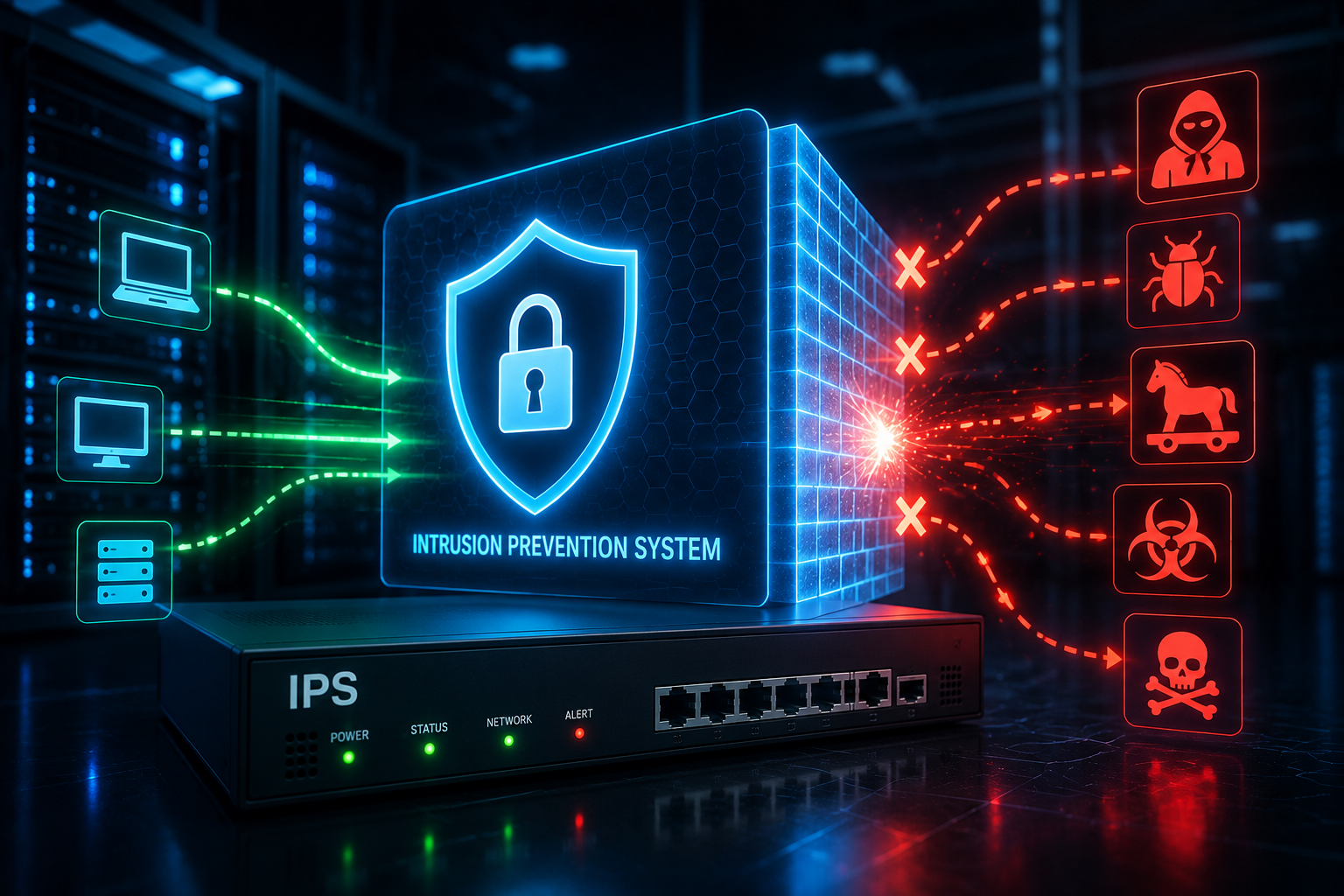
This is where an Intrusion Prevention System, commonly known as an IPS, plays a critical role. An IPS actively monitors network traffic, detects malicious activity, and immediately blocks attacks in real time. Unlike security tools that simply report suspicious events, an IPS takes action automatically, making it one of the most important technologies in modern cybersecurity.
Understanding an Intrusion Prevention System
An Intrusion Prevention System (IPS) is a network security technology that continuously monitors incoming and outgoing network traffic to detect cyber threats and automatically prevent them from reaching their targets.
Think of an IPS as a highly trained security guard standing at the entrance to a building. Instead of simply watching people enter and reporting suspicious individuals, the guard immediately stops anyone attempting to break in or cause harm.
An IPS performs a similar function for computer networks. It examines every packet of data traveling through the network, looking for signs of malicious activity. If it detects an attack, it can instantly block the traffic, terminate the connection, quarantine suspicious data, or alert security administrators.
The primary goal of an IPS is simple: stop attacks before they succeed.
Why an IPS Is Important
Cyberattacks have become faster, more sophisticated, and more automated than ever before. Malware can spread across networks within seconds, while attackers constantly search for vulnerabilities in software and connected devices.
Even a single successful intrusion can lead to serious consequences, including stolen customer information, financial losses, business downtime, damaged reputation, and legal penalties.
An IPS provides an extra layer of protection by identifying and stopping attacks in real time. This proactive approach reduces the chance that attackers can exploit weaknesses before organizations have an opportunity to respond.
For businesses, government agencies, hospitals, schools, and financial institutions, this protection is often essential.
How an IPS Works
An Intrusion Prevention System is typically placed directly within the path of network traffic. This position allows it to inspect every packet before the data reaches its destination.
As information flows through the network, the IPS carefully analyzes it using multiple detection techniques. It compares traffic against known attack signatures, examines network behavior for unusual activity, and looks for suspicious patterns that could indicate an ongoing attack.
If the traffic appears legitimate, the IPS allows it to continue normally.
If malicious activity is detected, the IPS immediately takes action.
Depending on its configuration, the system may block the malicious packets, terminate the connection, prevent further communication from the attacker, update firewall rules, or notify security teams about the incident.
This entire process usually happens within milliseconds, allowing attacks to be stopped before users even notice.
The Difference Between IPS and IDS
Many people confuse an Intrusion Prevention System with an Intrusion Detection System (IDS), but they serve different purposes.
An Intrusion Detection System monitors network traffic and alerts administrators when suspicious activity is detected. However, it generally does not stop the attack automatically.
An Intrusion Prevention System goes one step further.
Instead of only identifying threats, an IPS actively blocks them in real time.
Imagine a smoke detector inside a home.
A smoke detector warns you when there is a fire, but it does not extinguish the flames.
Now imagine an automatic fire sprinkler system.
It not only detects the fire but also immediately releases water to stop it.
An IDS functions like the smoke detector.
An IPS functions like the sprinkler system.
Many organizations deploy both technologies together for maximum protection.
Where an IPS Is Installed
Most network-based IPS solutions are installed behind the firewall and in front of critical internal systems.
This location allows the IPS to inspect traffic that has already passed basic firewall filtering while still preventing threats from reaching servers, databases, employee computers, or cloud resources.
Some IPS technologies are also installed directly on individual computers or servers, where they monitor local activity and protect specific devices from attacks.
Cloud environments increasingly use virtual IPS solutions designed specifically for modern cloud infrastructure.
Types of Intrusion Prevention Systems
There are several kinds of IPS technologies, each designed to protect different parts of an organization’s digital environment.
A Network-based IPS monitors traffic flowing across an entire network. It protects multiple devices simultaneously and is commonly deployed in corporate networks and data centers.
A Host-based IPS runs directly on an individual computer or server. It monitors operating system activity, system calls, applications, and file changes to detect attacks targeting that specific device.
A Wireless IPS focuses on Wi-Fi networks. It detects unauthorized wireless devices, rogue access points, and attacks targeting wireless communications.
A Network Behavior Analysis IPS specializes in identifying unusual traffic patterns that may indicate attacks such as distributed denial-of-service (DDoS) attacks, worm infections, or compromised devices.
Each type provides protection against different categories of cyber threats.
Detection Methods Used by an IPS
Modern IPS solutions rely on several detection techniques to recognize malicious activity.
Signature-based detection compares network traffic against a database of known attack patterns. This method is highly effective against previously identified malware, viruses, exploits, and hacking techniques.
Anomaly-based detection establishes a baseline of normal network behavior. When unusual traffic patterns appear, the IPS recognizes the deviation and investigates whether it represents an attack.
Behavior-based detection focuses on how users, applications, and devices normally behave. If software suddenly begins performing unexpected actions, the IPS may identify it as malicious.
Policy-based detection checks whether network activity violates predefined security rules established by administrators.
Most enterprise IPS platforms combine several detection methods to improve accuracy and reduce the likelihood of missed attacks.
What Threats Can an IPS Stop?
An Intrusion Prevention System protects against a wide variety of cyber threats.
It can detect malware attempting to enter a network through malicious downloads or infected files.
It can stop attackers exploiting software vulnerabilities before patches are installed.
It helps block ransomware before encryption begins.
It detects attempts to gain unauthorized access to systems.
An IPS can identify suspicious scanning activity, where attackers search for vulnerable devices connected to the network.
It helps defend against certain denial-of-service attacks by recognizing abnormal traffic patterns.
Many IPS solutions also detect command-and-control communications used by infected devices to communicate with cybercriminals.
By stopping these attacks early, organizations can significantly reduce the impact of security incidents.
Deep Packet Inspection
One of the most powerful capabilities of an IPS is Deep Packet Inspection, often abbreviated as DPI.
Rather than examining only the basic information attached to each network packet, DPI analyzes the actual contents of the data being transmitted.
This allows the IPS to identify hidden malware, suspicious commands, exploit code, and malicious payloads concealed within otherwise normal-looking traffic.
Deep Packet Inspection provides much greater visibility than simple packet filtering, making it an essential feature of modern intrusion prevention systems.
The Role of Artificial Intelligence in Modern IPS
Cyber threats evolve constantly.
New attack techniques appear every day, making it impossible for security teams to manually identify every threat.
Modern IPS platforms increasingly use artificial intelligence and machine learning to improve detection.
These technologies analyze enormous amounts of network traffic, identify subtle behavioral changes, recognize previously unseen attack patterns, and reduce false alarms.
AI-powered IPS solutions become more effective over time as they learn from new threats and adapt to changing network environments.
While human security experts remain essential, artificial intelligence significantly enhances the speed and accuracy of threat detection.
IPS and Zero-Day Attacks
One of the greatest cybersecurity challenges involves zero-day vulnerabilities.
A zero-day vulnerability is a software flaw that becomes known before developers have released a security patch.
Attackers often exploit these weaknesses quickly because organizations have little time to defend themselves.
Traditional signature-based detection may not recognize completely new attacks.
However, advanced IPS solutions using behavioral analysis, anomaly detection, heuristic techniques, and threat intelligence can sometimes identify suspicious activity associated with zero-day attacks even when no specific signature exists.
Although no security technology guarantees complete protection, an IPS greatly improves an organization’s ability to defend against emerging threats.
IPS and Encrypted Traffic
Today, much of the internet uses encrypted connections through protocols such as HTTPS.
Encryption protects user privacy by preventing unauthorized parties from reading transmitted data.
However, cybercriminals also take advantage of encryption to hide malware and malicious communications.
Modern IPS solutions often include encrypted traffic inspection capabilities.
With appropriate security policies and legal considerations, they can temporarily decrypt traffic, inspect it for threats, and then re-encrypt it before forwarding it to its destination.
This allows organizations to maintain visibility while preserving secure communications.
Benefits of Using an IPS
An Intrusion Prevention System offers numerous advantages for organizations of all sizes.
It provides real-time protection against cyberattacks.
It reduces the workload for security teams by automatically blocking many threats before manual intervention becomes necessary.
An IPS helps minimize financial losses associated with data breaches.
It improves compliance with cybersecurity regulations and industry standards.
It strengthens overall network resilience by adding an additional layer of defense beyond traditional firewalls.
Perhaps most importantly, it helps organizations detect attacks much earlier than they otherwise might.
Limitations of an IPS
Although an IPS is an extremely valuable security technology, it is not perfect.
Improper configuration can cause legitimate traffic to be blocked accidentally, disrupting normal business operations.
Signature databases require regular updates to recognize newly discovered threats.
Sophisticated attackers may develop techniques specifically designed to evade detection.
Encrypted traffic inspection may require additional computing resources and careful privacy management.
An IPS should therefore be viewed as one component of a comprehensive cybersecurity strategy rather than a complete solution by itself.
IPS and Firewalls
Firewalls and Intrusion Prevention Systems often work together, but they serve different purposes.
A firewall primarily controls which network connections are allowed or denied based on predefined rules involving IP addresses, ports, protocols, and applications.
An IPS examines the actual content of allowed traffic to determine whether it contains malicious activity.
For example, a firewall may permit web traffic because it uses the standard HTTPS protocol.
The IPS then inspects that web traffic to determine whether it contains malware or an exploit attempting to compromise a web server.
Together, these technologies create stronger protection than either could provide alone.
IPS in Cloud Computing
As businesses increasingly move their infrastructure to the cloud, intrusion prevention has evolved alongside them.
Cloud-native IPS solutions monitor virtual machines, containers, cloud applications, and hybrid environments.
They integrate with cloud security platforms to provide continuous monitoring across geographically distributed systems.
This flexibility allows organizations to maintain strong security even as their infrastructure changes.
IPS in Home Networks
Although IPS technologies are commonly associated with large organizations, they are becoming more accessible for home users.
Some advanced home routers include built-in intrusion prevention features.
These systems monitor household internet traffic and block known malicious websites, malware downloads, suspicious network scans, and attacks targeting smart home devices.
As homes become filled with internet-connected devices, IPS technology is becoming increasingly valuable outside traditional business environments.
IPS and Cybersecurity Frameworks
Modern cybersecurity follows the principle of layered defense, often called “defense in depth.”
Rather than relying on a single security tool, organizations combine multiple technologies.
An IPS works alongside firewalls, antivirus software, endpoint detection and response systems, multi-factor authentication, security information and event management platforms, vulnerability scanners, encryption, backup systems, and employee security awareness training.
Each layer addresses different types of threats, making it much more difficult for attackers to succeed.
Choosing an IPS
Selecting an Intrusion Prevention System requires careful consideration of an organization’s needs.
Factors such as network size, internet speed, cloud usage, remote workers, regulatory requirements, and available security personnel all influence the best choice.
Performance is especially important.
An IPS must inspect enormous volumes of traffic without creating noticeable delays.
Organizations also look for accurate detection, frequent security updates, manageable administration, scalability, and integration with existing security tools.
The Future of Intrusion Prevention Systems
Cybersecurity continues to evolve rapidly, and IPS technology is evolving with it.
Future systems are expected to rely even more heavily on artificial intelligence, automated threat hunting, cloud-native architecture, and real-time global threat intelligence.
Machine learning models will become better at recognizing previously unseen attacks, while automation will reduce the time between detection and response.
As organizations adopt technologies such as the Internet of Things (IoT), 5G networks, edge computing, and quantum-resistant security, intrusion prevention systems will continue adapting to protect increasingly complex digital environments.
Why an IPS Is Essential for Modern Cybersecurity
Every internet-connected device faces potential cyber threats. Attackers continuously search for vulnerabilities, develop new malware, and create increasingly sophisticated methods for bypassing traditional defenses. In this constantly changing landscape, reacting after an attack is no longer enough.
An Intrusion Prevention System represents a proactive approach to cybersecurity. Instead of waiting for damage to occur, it continuously analyzes network activity, identifies suspicious behavior, and automatically blocks attacks before they can compromise systems.
While no single security solution can eliminate every cyber risk, an IPS provides one of the most effective layers of protection available today. Combined with strong security practices, regular software updates, user awareness, and other defensive technologies, it helps create a safer digital environment where individuals and organizations can use technology with greater confidence.