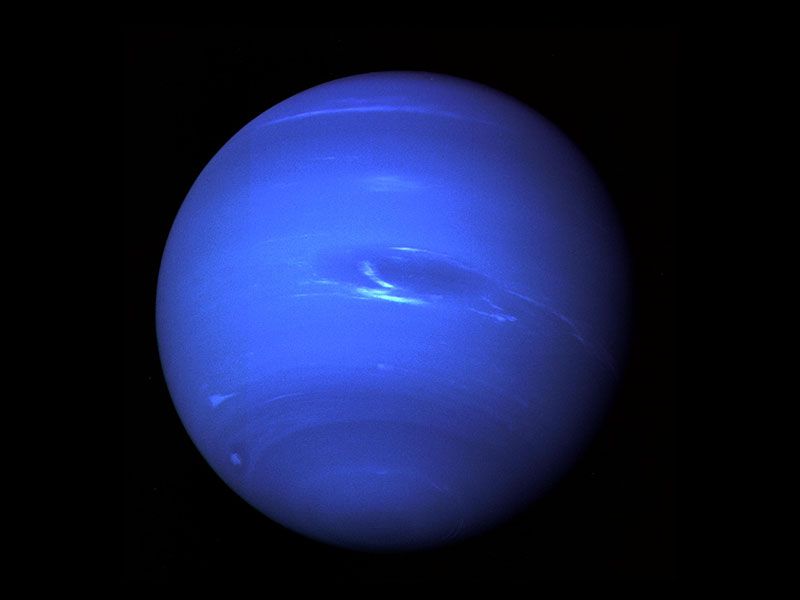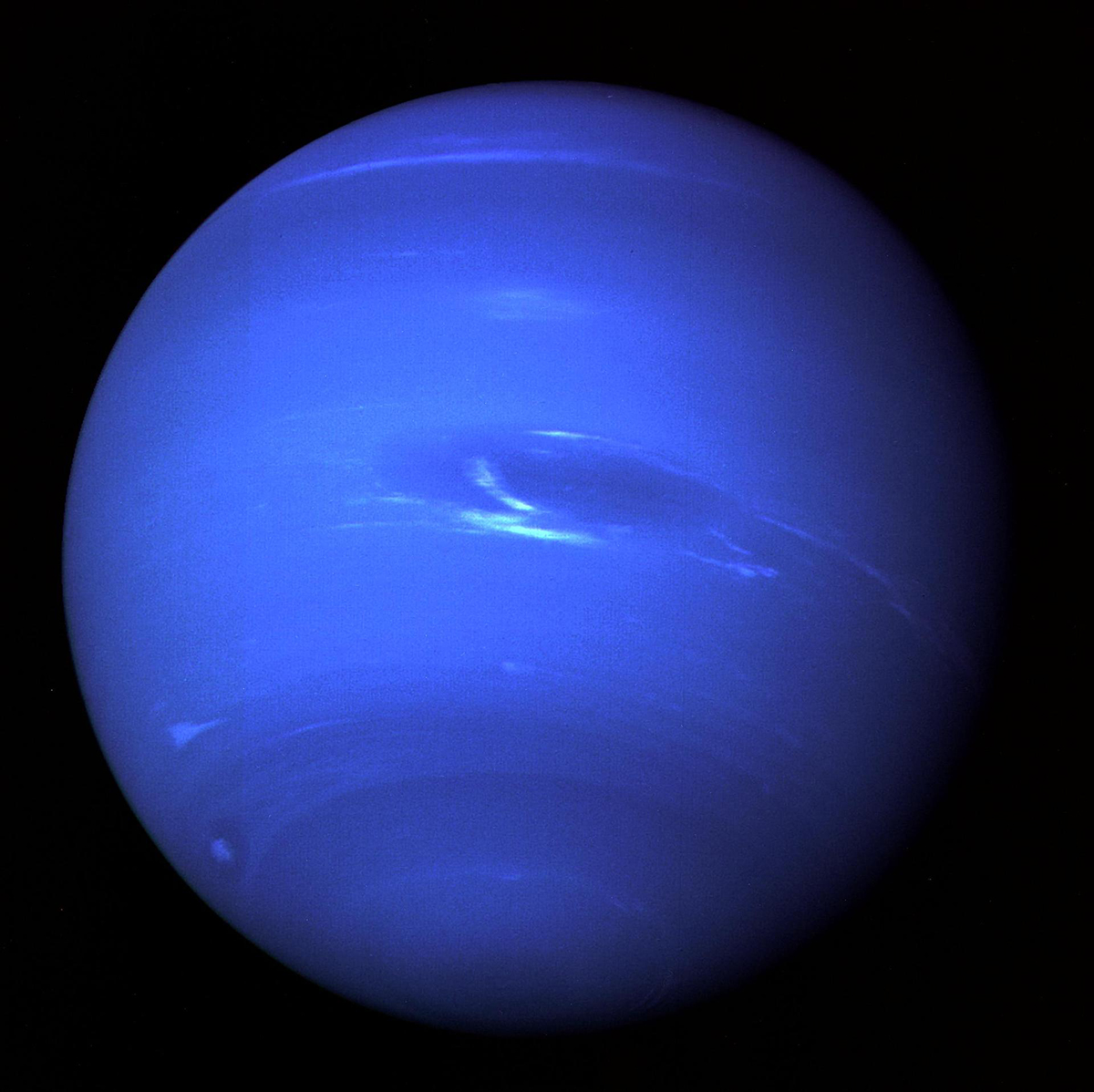
Have you ever looked at a picture of Neptune and wondered why it glows with such a deep, brilliant blue? Among all the planets in our Solar System, Neptune stands out like a dazzling sapphire suspended in the darkness of space. Its rich blue color is so striking that it has fascinated astronomers and space enthusiasts for decades.
At first glance, it might seem that Neptune simply reflects the blue light of the Sun, much like Earth’s oceans appear blue. But the truth is far more interesting. Neptune’s beautiful color is created by a complex combination of atmospheric chemistry, the way sunlight interacts with gases and tiny particles, and physical processes that scientists are still working to understand.
The story of Neptune’s blue sky is not just about color. It is also a story about light, molecules, clouds, weather, and one of the most mysterious worlds in our Solar System.
Neptune: The Blue Giant at the Edge of the Solar System
Neptune is the eighth and farthest major planet from the Sun. It orbits at an average distance of about 4.5 billion kilometers (2.8 billion miles), making it nearly 30 times farther from the Sun than Earth.
Although Neptune is often called an “ice giant,” it is not covered in ice like Earth’s polar regions. Instead, the term refers to its interior composition, which contains large amounts of water, ammonia, and methane mixed under enormous pressures.
The planet itself has no solid surface. Instead, it is surrounded by a thick atmosphere that gradually becomes denser with depth. This atmosphere is where Neptune’s remarkable blue color is born.
What Is Neptune’s Atmosphere Made Of?
Neptune’s atmosphere consists mainly of hydrogen and helium, the two lightest and most abundant elements in the universe.
Hydrogen makes up roughly 80 percent of the atmosphere.
Helium accounts for nearly 19 percent.
The remaining small fraction includes methane and trace amounts of other gases.
Although methane represents only a tiny percentage of Neptune’s atmosphere, it plays an enormous role in determining the planet’s appearance.
Sometimes, a small ingredient can have a huge effect.
Sunlight Contains Every Color
To understand Neptune’s color, it helps to understand sunlight itself.
Sunlight may look white to our eyes, but it actually contains every color of the visible spectrum.
When white light passes through a prism, it separates into the familiar rainbow of red, orange, yellow, green, blue, indigo, and violet.
Each color has a different wavelength.
Red light has one of the longest wavelengths.
Blue light has much shorter wavelengths.
When sunlight reaches Neptune, these different colors begin interacting with the planet’s atmosphere in different ways.
Methane Absorbs Red Light
The most important reason Neptune appears blue is methane.
Methane molecules are especially good at absorbing red wavelengths of sunlight.
As sunlight enters Neptune’s atmosphere, much of the red light is absorbed before it can escape back into space.
Blue wavelengths, however, are absorbed much less efficiently.
Because more blue light remains available to be reflected and scattered, Neptune appears predominantly blue to distant observers.
Imagine shining a flashlight through colored glass that blocks red light but lets blue light pass. The light emerging from the other side would appear much bluer.
A similar process happens naturally in Neptune’s atmosphere.
Reflection and Scattering Work Together
Methane absorption alone does not completely explain Neptune’s appearance.
The atmosphere also reflects and scatters sunlight.
When sunlight encounters gas molecules and tiny atmospheric particles, it changes direction. Some of that scattered light eventually travels back into space.
Since much of the red light has already been removed by methane, the reflected light contains proportionally more blue wavelengths.
This combination of selective absorption and atmospheric scattering gives Neptune its vivid color.
Why Isn’t Neptune the Same Color as Uranus?
At first glance, Neptune and Uranus look very similar.
Both are ice giants.
Both contain methane.
Both appear blue.
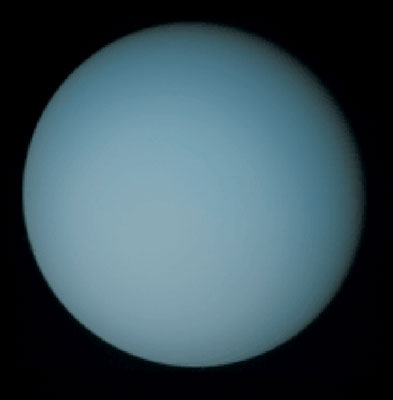
Yet careful observations reveal that Neptune has a noticeably deeper and richer blue than Uranus.
For many years, this puzzled scientists.
Since both planets contain methane, why don’t they look exactly alike?
Recent research suggests that the answer involves more than methane alone.
Scientists now believe differences in atmospheric haze play an important role.
The Role of Atmospheric Haze
Both Neptune and Uranus contain layers of tiny particles known as atmospheric haze.
These microscopic particles float high above the cloud tops.
However, the haze layers are not identical.
Observations suggest that Uranus possesses a thicker haze than Neptune.
This thicker haze scatters light differently, giving Uranus a paler, greener-blue appearance.
Neptune appears darker because its haze layer is thinner or behaves differently, allowing its deeper blue color to become more visible.
Although researchers continue studying these differences, atmospheric haze is now considered one of the major reasons the two planets have distinct colors.
Neptune’s Dynamic Weather
Neptune is anything but calm.
Despite receiving only about one nine-hundredth of the sunlight Earth receives, it has one of the most active atmospheres in the Solar System.
Powerful storms constantly form and disappear.
Bright white clouds drift across the planet.
Dark storm systems sometimes grow to enormous sizes before fading away.
These changing weather patterns can slightly alter the appearance of different regions of Neptune.
Clouds composed of methane ice often stand out against the deep blue background, creating spectacular contrasts visible in spacecraft images and telescope observations.
The Fastest Winds in the Solar System
Neptune is famous for its incredible winds.
Some winds exceed speeds of 2,000 kilometers per hour (about 1,200 miles per hour), making them the fastest measured planetary winds in our Solar System.
These violent winds transport clouds, reshape storms, and constantly mix gases throughout the atmosphere.
This atmospheric activity helps distribute methane and haze, influencing how sunlight interacts with different layers of the atmosphere.
Does Neptune Have a Blue Sky Like Earth?
The answer depends on where you are.
From far away in space, Neptune appears as a brilliant blue globe.
But standing within Neptune’s atmosphere would be a completely different experience.
Unlike Earth, Neptune has no solid surface where someone could safely stand.
As you descended through its atmosphere, the surrounding light would change depending on altitude, cloud layers, haze, and atmospheric density.
Scientists use computer models to estimate what the sky might look like.
Near the upper atmosphere, the sky would likely appear various shades of blue.
Deeper down, increasing pressure, thicker clouds, and changing lighting conditions could produce entirely different colors and levels of brightness.
Since no spacecraft has directly photographed Neptune’s sky from within its atmosphere, these remain scientific predictions rather than direct observations.
Neptune Is Much Darker Than Earth
Although Neptune looks bright in telescope images, it actually receives very little sunlight.
The Sun appears much smaller from Neptune than it does from Earth.
Sunlight there is roughly 900 times weaker than the sunlight reaching our planet.
Even at midday on Neptune, the lighting would resemble a deeply overcast day on Earth.
Yet despite the reduced sunlight, enough blue light is reflected to make the planet’s color unmistakable when viewed from space.
Voyager 2 Revealed Neptune’s Beauty
Before 1989, astronomers could only observe Neptune through telescopes.
Everything changed when NASA’s Voyager 2 spacecraft became the first—and so far only—spacecraft to fly past Neptune.
The images it returned amazed the world.
They revealed an intensely blue planet covered with bright white clouds, giant storms, and a massive dark atmospheric feature known as the Great Dark Spot.
Voyager 2 transformed Neptune from a distant point of light into a dynamic and fascinating world.
Its observations continue to guide scientific research decades later.
Modern Images Show Neptune’s True Color
For many years, some published images made Neptune appear even bluer than it truly is.
This happened because image processing techniques often enhanced certain colors to reveal atmospheric details.
In recent years, scientists carefully reprocessed spacecraft data and compared it with observations from modern telescopes.
These updated analyses produced more accurate representations of Neptune’s natural appearance.
The planet remains unmistakably blue, but its true color is slightly less saturated than some older images suggested.
Even so, Neptune is still the deepest blue planet in our Solar System.
Why Earth’s Sky Is Blue for a Different Reason
It is easy to assume that Neptune’s sky is blue for the same reason Earth’s sky is blue.
In reality, the two worlds achieve their blue appearances through different physical processes.
On Earth, tiny molecules in the atmosphere scatter short-wavelength blue sunlight much more efficiently than red light. This phenomenon is known as Rayleigh scattering.
On Neptune, methane absorption removes much of the red light before it can escape into space. Atmospheric scattering and haze then enhance the remaining blue light.
Both planets appear blue, but the physics behind their colors is not identical.
Could Neptune’s Color Change?
Planetary atmospheres are not static.
Clouds evolve.
Storms grow and disappear.
Haze layers shift.
Chemical reactions continue over time.
These processes can cause subtle changes in Neptune’s appearance.
Seasonal changes also occur, although each season lasts more than 40 Earth years because Neptune takes about 165 Earth years to complete one orbit around the Sun.
Scientists continue monitoring the planet to understand how its atmosphere changes over decades.
Why Studying Neptune’s Color Matters
Understanding Neptune’s blue color is about much more than appreciating a beautiful planet.
Its atmosphere serves as a natural laboratory where scientists study chemistry, cloud formation, atmospheric circulation, and the interaction between light and gases.
These studies improve our understanding of giant planets throughout the universe.
Thousands of exoplanets discovered around distant stars are similar in size to Neptune.
By learning how Neptune’s atmosphere behaves, astronomers gain valuable clues about the appearance and composition of these distant worlds.
A Sapphire World Waiting to Be Explored
Neptune remains one of the least explored planets in our Solar System. Only a single spacecraft has visited it, leaving countless mysteries still unanswered. Scientists continue to investigate why its atmosphere behaves so differently from Uranus, how its powerful storms form, and exactly how haze, methane, and sunlight combine to produce its extraordinary color.
Every new telescope observation and every improved computer model brings us closer to understanding this distant world. Future space missions may one day dive deeper into Neptune’s atmosphere, providing direct measurements that answer questions today’s scientists can only explore through remote observations.
Neptune’s magnificent blue sky is more than a beautiful feature. It is a visible reminder that even across billions of kilometers of empty space, the laws of physics, chemistry, and light work together to create worlds of astonishing beauty. From the selective absorption of red light by methane to the scattering of sunlight by gases and haze, Neptune’s color tells a story written in the language of science—a story that continues to inspire curiosity about the farthest reaches of our cosmic neighborhood.