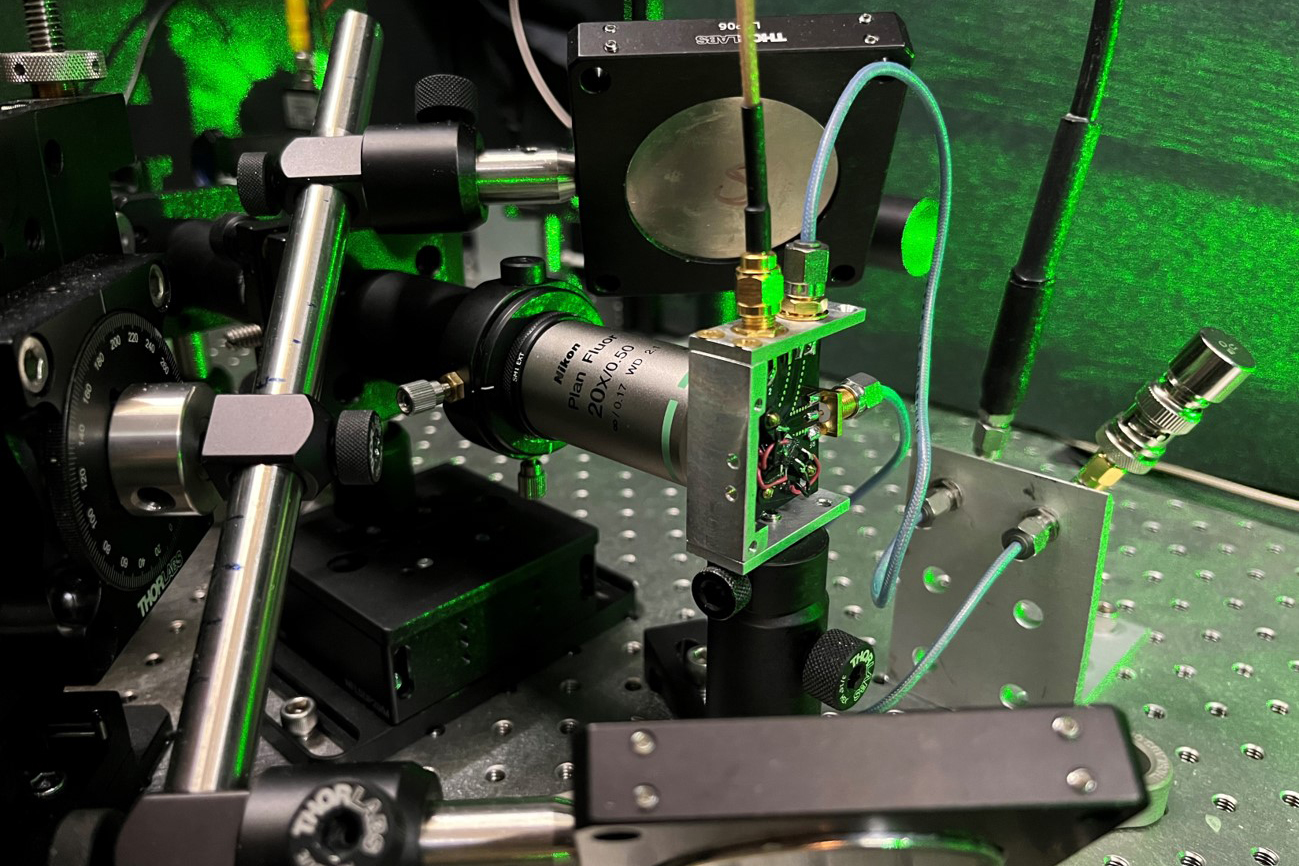
Every moment of our lives is shaped by things we cannot directly see. Invisible magnetic fields surround us. Tiny changes in gravity reveal hidden structures beneath Earth’s surface. Atoms and particles constantly interact in ways beyond human senses. For centuries, scientists have searched for better ways to detect and measure these hidden signals.
Quantum sensors represent one of the most remarkable advances in this search. They use the strange but powerful principles of quantum mechanics—the science that describes nature at the smallest scales—to measure physical changes with extraordinary precision.
Unlike ordinary sensors that rely on classical properties of materials, quantum sensors take advantage of the behavior of individual atoms, electrons, photons, and other quantum systems. By carefully controlling these tiny systems, scientists can detect extremely small changes in time, motion, temperature, magnetic fields, gravity, and many other physical quantities.
Quantum sensors are not simply improved versions of existing devices. They represent a completely new approach to measurement, allowing humanity to explore the universe with a level of sensitivity that was once impossible.
What Is a Quantum Sensor?
A quantum sensor is a device that uses quantum phenomena to measure physical properties.
Traditional sensors usually work by detecting changes in macroscopic materials. For example, a thermometer measures temperature by observing how a material expands or changes electrical properties. A camera detects light by measuring the response of electronic components. A compass measures magnetic fields using magnetic materials.
Quantum sensors operate differently. They use carefully prepared quantum states as the measuring system itself.
The basic idea is simple but profound: quantum systems are extremely sensitive to their surroundings. Even a tiny environmental change can alter the behavior of an atom, electron, or photon. Scientists use these changes as signals to measure the world with remarkable accuracy.
A quantum sensor does not need to “see” an object directly. Instead, it can detect the subtle effects that objects produce in their environment.
Understanding the Quantum World
To understand how quantum sensors work, it is important to understand a few basic ideas from quantum physics.
The world of everyday objects follows the rules of classical physics. A ball has a specific location. A car has a measurable speed. A table remains in one place.
At the atomic scale, however, nature behaves differently.
Quantum particles can exist in combinations of possible states called superposition. They can also become connected through a phenomenon called quantum entanglement, where the properties of particles become linked in ways that classical physics cannot explain.
Quantum systems are also highly sensitive to disturbances from their surroundings. This sensitivity, which can make quantum technologies challenging to build, becomes a powerful advantage in sensing.
A quantum sensor uses this sensitivity as a tool.
The Role of Quantum States
The heart of every quantum sensor is a controlled quantum state.
Atoms, electrons, and photons possess properties that can be used for measurement. These properties include energy levels, spin, polarization, and quantum phase.
Scientists prepare a quantum system in a known state. Then they expose it to the environment they want to measure.
If the environment changes, the quantum state changes.
By carefully measuring this change, scientists can determine information about the surrounding world.
For example, an atom placed near a magnetic field may experience a change in its energy levels. By measuring that change, researchers can determine the strength of the magnetic field.
The quantum system becomes a highly sensitive measuring instrument.
Quantum Superposition and Measurement
One of the most important principles behind quantum sensors is superposition.
A quantum particle can exist in a combination of different possible states before measurement. This allows scientists to compare multiple possibilities simultaneously.
A useful way to imagine this is to think about a tiny quantum system acting like a delicate instrument with many possible responses. When the environment affects it, the relationship between those possibilities changes.
This change can reveal extremely small physical effects.
In many quantum sensors, scientists measure a property called quantum phase. The phase describes the relationship between quantum waves. Small environmental changes can shift this phase, creating a measurable signal.
Because quantum phases can be extremely sensitive, even tiny disturbances can become detectable.
Quantum Interference: Detecting Tiny Changes
Quantum interference is another key principle used in quantum sensing.
When quantum waves combine, they can strengthen or cancel each other depending on their relationship. This creates patterns called interference.
If an external influence changes the quantum system, it alters the interference pattern.
Scientists can analyze these changes to determine what happened.
For example, in an atomic interferometer, atoms are placed into different quantum states and then recombined. The resulting interference pattern reveals information about forces acting on the atoms, including gravity and acceleration.
This allows extremely precise measurements that are impossible with many traditional technologies.
Atomic Clocks: The Most Famous Quantum Sensors
One of the most successful examples of quantum sensing is the atomic clock.
Timekeeping may seem simple, but measuring time with extreme accuracy requires understanding the behavior of atoms.
Atomic clocks use the predictable transitions of atoms between energy levels. When atoms absorb or release energy, they produce electromagnetic signals at extremely precise frequencies.
Scientists use these frequencies as natural time references.
Modern atomic clocks are so accurate that they can measure incredibly tiny differences in time. They form the foundation of global navigation systems, telecommunications networks, and scientific experiments.
The accuracy of atomic clocks also allows researchers to test fundamental theories of physics, including Einstein’s theories of relativity.
Quantum Sensors and Magnetic Fields
Magnetic fields are everywhere.
Earth itself produces a magnetic field. Electrical devices generate magnetic fields. The human brain and heart create extremely weak magnetic signals.
Quantum sensors can detect these fields with exceptional sensitivity.
Some quantum magnetic sensors use atoms or defects in crystals to measure magnetic changes.
One example involves tiny imperfections in diamond crystals known as nitrogen-vacancy centers. These defects have quantum properties that respond to magnetic fields. By observing changes in their quantum states, scientists can measure extremely weak magnetic signals.
These sensors have potential applications in medicine, materials science, and fundamental physics research.
How Diamond Quantum Sensors Work
Diamonds are not only valuable gemstones; they can also serve as advanced quantum devices.
A perfect diamond consists of carbon atoms arranged in a crystal structure. However, some diamonds contain tiny defects where a carbon atom is replaced by another type of atom, such as nitrogen.
Near this defect, the crystal structure creates a special quantum system.
The electrons associated with this defect have quantum properties that can interact with magnetic fields, temperature changes, and other environmental conditions.
Scientists can use lasers to control and read the quantum state of these electrons.
When the surrounding environment changes, the quantum state changes as well. By measuring this response, researchers can determine information about the environment.
Because these sensors can operate at room temperature and in small devices, they are among the most promising quantum sensing technologies.
Quantum Gravity Sensors
Gravity may seem like a constant force, but tiny variations in gravity exist everywhere.
Differences in underground structures, water movement, geological formations, and changes in Earth’s mass distribution can slightly alter local gravitational fields.
Quantum gravity sensors use atoms that behave like extremely sensitive test particles.
In atomic interferometers, clouds of ultracold atoms are released and manipulated using lasers. Because gravity affects the motion of these atoms, scientists can measure changes in their trajectories.
These measurements can reveal subtle gravitational differences.
Future quantum gravity sensors could improve underground mapping, monitor environmental changes, and help scientists study Earth’s structure with greater detail.
Quantum Sensors and Navigation
Modern navigation systems rely heavily on signals from satellites.
However, satellite-based navigation has limitations. Signals can be blocked, disrupted, or unavailable in certain environments such as underwater locations, underground areas, or military situations.
Quantum sensors may provide a new approach.
Quantum accelerometers and gyroscopes can measure motion and rotation with extreme precision without relying on external signals.
These devices could enable advanced navigation systems for ships, aircraft, spacecraft, and autonomous vehicles.
Instead of depending entirely on satellites, future systems may use quantum measurements to calculate movement directly.
Quantum Sensors in Medicine
One of the most exciting possibilities of quantum sensing is its impact on healthcare.
The human body produces extremely small electrical and magnetic signals. The activity of the brain and heart creates measurable fields, but they are incredibly weak.
Highly sensitive quantum sensors may allow scientists and doctors to detect these signals more accurately.
For example, quantum magnetometers could improve brain imaging by detecting tiny magnetic fields produced by neurons.
Such technologies may provide new ways to study brain function, diagnose diseases, and understand complex biological processes.
Although many medical applications are still under development, quantum sensing offers a promising path toward more precise and non-invasive measurement techniques.
Quantum Sensors in Environmental Science
Understanding Earth’s changing environment requires accurate measurements.
Quantum sensors could help monitor climate-related changes by detecting extremely small variations in physical systems.
Sensitive gravity measurements may reveal changes in underground water supplies. Magnetic sensors may help study geological processes. Precision measurements may improve monitoring of oceans, ice sheets, and natural resources.
Because quantum sensors can detect subtle changes, they may provide scientists with new tools for studying environmental systems.
Quantum Sensors and Space Exploration
Space is a challenging environment where precise measurements are essential.
Spacecraft must navigate accurately across enormous distances. Scientists need sensitive instruments to study planets, stars, gravitational fields, and cosmic phenomena.
Quantum sensors could improve spacecraft navigation and scientific observations.
Quantum accelerometers may help spacecraft determine their movement without relying completely on Earth-based communication.
Quantum clocks may improve timing systems for deep-space missions.
Gravity sensors may allow researchers to study planets and moons in greater detail.
As humanity explores farther into space, quantum sensing technologies may become increasingly important.
The Challenge of Building Quantum Sensors
Although quantum sensors are powerful, creating practical devices is not easy.
Quantum states are extremely delicate.
Interactions with the environment can destroy quantum information, a process known as decoherence.
Scientists must carefully isolate quantum systems while still allowing them to interact with the physical property being measured.
Temperature control, noise reduction, and precise engineering are often required.
Some quantum sensors need extremely cold conditions, while others require advanced laser systems or specialized materials.
Researchers around the world are working to make quantum sensors smaller, more stable, and easier to use.
Quantum Sensors Compared with Traditional Sensors
Traditional sensors remain extremely useful and will continue to play an important role in technology.
However, quantum sensors offer advantages in situations where extreme sensitivity and precision are required.
A conventional sensor may measure a physical change by detecting a large-scale effect. A quantum sensor can detect changes at the level of individual atoms or particles.
This difference allows quantum sensors to explore phenomena that were previously hidden from observation.
They do not replace all existing sensors, but they open entirely new possibilities.
The Future of Quantum Sensing
Quantum sensing is still developing, but its potential is enormous.
Future quantum sensors may become smaller, cheaper, and more widely available.
They could transform navigation, healthcare, environmental monitoring, communication, and scientific research.
Scientists are exploring new quantum materials, improved control methods, and innovative designs that could bring quantum sensing from specialized laboratories into everyday technology.
Just as electronics transformed society by controlling electrons, quantum technologies may transform the future by controlling the deeper rules of nature itself.
Why Quantum Sensors Matter
Quantum sensors represent a powerful example of how curiosity about the smallest parts of nature can lead to revolutionary technology.
For centuries, humans have built tools to extend our senses. Telescopes allowed us to see distant galaxies. Microscopes revealed invisible worlds of cells and microorganisms. Quantum sensors now allow us to detect subtle changes at the deepest levels of reality.
They reveal hidden information about forces, fields, time, and matter.
The universe is filled with signals that were once beyond human ability to measure. Quantum sensors are changing that by turning the strange behavior of quantum particles into practical tools for discovery.
As scientists continue unlocking the possibilities of quantum technology, these sensors may help answer some of the greatest questions in science and create technologies that reshape the future.
Quantum sensors are not just instruments of measurement. They are windows into the hidden workings of nature, allowing humanity to observe the universe with a level of precision that brings us closer than ever to understanding the invisible world around us.