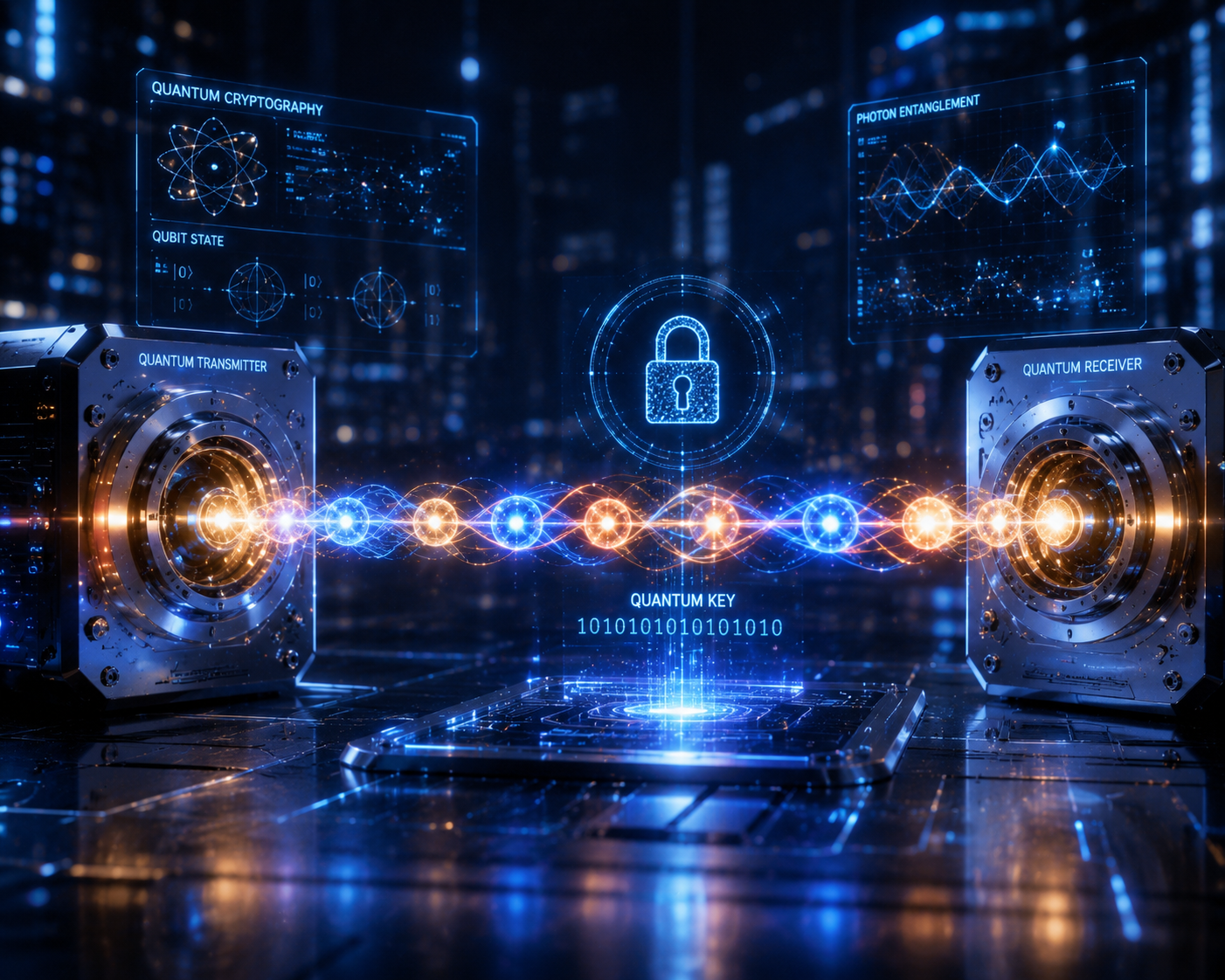
Every day, billions of pieces of private information travel across the internet. When you send a text message, shop online, transfer money, log in to your email, or use a mobile banking app, your personal data moves through networks connecting computers all over the world. Most of the time, this information remains safe because it is protected by cryptography, the science of securing information through mathematical techniques.
For decades, modern cryptography has done an extraordinary job of protecting digital communication. Yet as technology advances, especially with the development of powerful quantum computers, scientists have begun exploring new ways to keep information secure. One of the most exciting results of this effort is quantum cryptography, a technology that uses the laws of quantum physics rather than relying only on complex mathematical problems.
Quantum cryptography is unlike anything that came before it. Instead of assuming that an attacker lacks enough computing power to break an encryption system, it takes advantage of the fundamental behavior of nature itself. In the quantum world, simply trying to observe certain kinds of information changes that information. This remarkable property makes it possible to detect attempts to intercept secret communication.
Although quantum cryptography is still an emerging technology, researchers believe it could become an essential part of the future of secure communication. Governments, scientific institutions, financial organizations, and technology companies around the world are investing heavily in its development.
To understand why quantum cryptography is so revolutionary, we first need to understand what cryptography is and why it matters.
What Is Cryptography?
Cryptography is the science of protecting information so that only authorized people can read it.
Imagine writing a secret letter. Instead of sending the message in ordinary language, you transform it into a coded form that appears meaningless to anyone else. Only someone with the correct key can convert the message back into its original form.
This basic idea has existed for thousands of years. Ancient civilizations used secret codes to protect military plans and confidential information. Today, cryptography has become far more sophisticated.
Modern cryptography protects almost every aspect of digital life. It secures online banking, internet shopping, cloud storage, video calls, digital signatures, wireless communication, and countless other technologies.
Without cryptography, the modern internet would not function safely.
How Traditional Cryptography Works
Most encryption systems used today rely on mathematics.
The security of many widely used cryptographic methods depends on mathematical problems that are extremely difficult for classical computers to solve efficiently. For example, some public-key encryption systems rely on the difficulty of factoring very large integers or solving related mathematical problems.
Breaking these encryption systems by simply guessing the correct key would take an impractically long time using today’s classical computers.
For this reason, traditional encryption has remained highly effective for many years.
However, its security depends on assumptions about computational difficulty rather than the laws of physics.
If future algorithms or more powerful computers can solve those mathematical problems much faster, some existing encryption methods could become vulnerable.
This possibility has motivated scientists to explore entirely different approaches to secure communication.
The Birth of Quantum Cryptography
Quantum cryptography combines two fascinating fields.
The first is cryptography, which protects information.
The second is quantum mechanics, the branch of physics that describes how atoms, photons, electrons, and other tiny particles behave.
Quantum mechanics often seems strange because particles at very small scales behave differently from objects in everyday life.
One of its most remarkable features is that measuring certain quantum systems inevitably affects their state.
Scientists realized that this unusual property could become a powerful security tool.
Instead of depending solely on mathematical complexity, secure communication could rely on the fundamental laws of nature.
This insight gave birth to quantum cryptography.
What Is Quantum Cryptography?
Quantum cryptography is a method of securing communication by using principles of quantum mechanics.
Its best-known application is Quantum Key Distribution (QKD), a technique that allows two parties to generate and share a secret cryptographic key while detecting attempts at eavesdropping.
It is important to understand that QKD does not replace the encryption algorithms used to protect messages. Instead, it provides a secure way to distribute the secret keys that those algorithms require.
If an unauthorized person tries to intercept the quantum signals during key distribution, the disturbance introduced by measurement can reveal the intrusion.
This capability makes quantum cryptography fundamentally different from conventional key exchange methods.
Why Quantum Physics Makes a Difference
The extraordinary strength of quantum cryptography comes from the laws of quantum mechanics.
In the everyday world, someone can often copy information without leaving any trace.
For example, a digital file can be duplicated perfectly countless times.
Quantum information behaves differently.
According to quantum mechanics, certain quantum states cannot be measured or copied arbitrarily without affecting them. This means an eavesdropper cannot generally observe the transmitted quantum information without introducing detectable changes under the assumptions of the protocol.
This natural property provides the foundation for quantum cryptographic security.
The Role of Photons
Many quantum cryptography systems use tiny particles of light called photons.
Photons are ideal for transmitting quantum information because they travel rapidly through optical fibers and open space.
Researchers can prepare photons in carefully chosen quantum states that encode information.
These quantum states carry the information needed to establish a shared secret key.
Because photons obey quantum mechanics, they provide a practical way to implement quantum cryptographic protocols.
Quantum Key Distribution
The most mature application of quantum cryptography is Quantum Key Distribution.
Imagine that two people want to exchange secret messages.
Before they can encrypt those messages, they need to share a secret key.
Traditionally, exchanging this key securely can be challenging.
Quantum Key Distribution solves this problem by transmitting quantum states between the two parties.
If the transmission proceeds without significant disturbance, they can use additional classical communication and processing steps to establish a shared secret key.
If the observed disturbance exceeds expected levels, they can conclude that the communication channel may have been compromised or affected by excessive noise, and they can discard the key.
In this way, QKD provides a mechanism for detecting potential eavesdropping during key establishment.
The BB84 Protocol
One of the first and most influential quantum cryptographic protocols is known as BB84.
Proposed in 1984 by physicists Charles Bennett and Gilles Brassard, BB84 demonstrated that quantum mechanics could be used to distribute cryptographic keys securely.
In this protocol, information is encoded into quantum states of photons.
After transmission, the communicating parties compare selected information over a public classical channel to estimate whether an eavesdropper may have interfered.
If the measured error rate remains sufficiently low, they can proceed with error correction and privacy amplification to produce a shared secret key.
BB84 remains one of the foundational protocols in quantum cryptography research.
The No-Cloning Theorem
One of the most important principles supporting quantum cryptography is the No-Cloning Theorem.
In classical computing, copying information is simple.
Quantum mechanics is different.
The No-Cloning Theorem states that it is impossible to create a perfect copy of an arbitrary unknown quantum state.
This limitation prevents an eavesdropper from perfectly copying transmitted quantum information for later measurement while leaving the original unchanged.
The theorem is one of the key reasons quantum communication offers security properties unavailable in classical systems.
Detecting Eavesdroppers
One of the most remarkable features of quantum cryptography is its ability to reveal attempted interception.
In conventional communication, someone might secretly copy information without being noticed.
Quantum communication is fundamentally different.
Because measuring quantum states generally disturbs them, an eavesdropper attempting to observe the transmitted quantum information introduces detectable errors with high probability.
The legitimate users monitor these error rates.
If the error level becomes too high, they know the key exchange cannot be trusted.
They simply reject the compromised key and begin again.
This ability to detect intrusion is one of quantum cryptography’s greatest strengths.
Quantum Cryptography Is Not the Same as Quantum Encryption
Many people mistakenly believe quantum cryptography means all communication itself becomes quantum.
In reality, today’s quantum cryptography usually focuses on securely distributing encryption keys.
Once a secure key has been established, ordinary encryption algorithms can use that key to protect messages transmitted over conventional communication networks.
This combination allows existing communication systems to benefit from quantum-secured key exchange.
Why Quantum Cryptography Matters
The importance of secure communication continues to grow.
Banks protect financial transactions.
Hospitals secure medical records.
Governments safeguard classified information.
Businesses protect trade secrets.
Individuals expect privacy for personal communication.
As cyberattacks become increasingly sophisticated, stronger security technologies become increasingly valuable.
Quantum cryptography offers a fundamentally different approach to protecting sensitive information.
The Quantum Computer Challenge
One reason quantum cryptography has attracted worldwide attention is the ongoing development of quantum computers.
Large-scale fault-tolerant quantum computers could efficiently solve certain mathematical problems that underlie some widely used public-key cryptographic systems.
Although such quantum computers do not yet exist, researchers are preparing for that future.
Quantum Key Distribution provides one possible approach to secure key exchange even in a world where powerful quantum computers become available.
At the same time, researchers are also developing post-quantum cryptography, which uses classical algorithms designed to resist both classical and quantum attacks.
These two approaches are complementary rather than competing.
Real-World Quantum Communication
Quantum cryptography is no longer confined to laboratories.
Scientists have demonstrated Quantum Key Distribution over optical fiber networks, across metropolitan areas, between distant cities, and even through satellite links.
These achievements show that quantum communication can operate outside carefully controlled laboratory conditions.
Although widespread deployment remains limited, practical progress continues every year.
Quantum Satellites
One exciting development is the use of satellites for quantum communication.
Optical fibers gradually weaken light signals over long distances.
Satellites offer another way to distribute quantum information across much greater distances.
Researchers have successfully demonstrated satellite-based Quantum Key Distribution between ground stations separated by thousands of kilometers.
These experiments represent important milestones toward global quantum communication networks.
Quantum Networks
Scientists envision a future quantum internet.
Unlike today’s internet, which exchanges classical digital information, a quantum internet would transmit quantum information between distant locations.
Quantum cryptography would likely become one of its earliest and most important applications.
Future quantum networks could support highly secure communication, distributed quantum computing, and entirely new scientific technologies.
Although much work remains, research in this area is advancing rapidly.
Advantages of Quantum Cryptography
Quantum cryptography offers several unique strengths.
Its security is based on the laws of quantum physics rather than only on assumptions about computational difficulty.
It can detect attempts to intercept quantum key distribution under the assumptions of the protocol.
It provides a forward-looking approach to protecting information against future advances in computing technology.
These characteristics make quantum cryptography especially attractive for protecting highly sensitive communications.
Current Challenges
Despite its promise, quantum cryptography still faces important challenges.
Quantum communication equipment remains expensive compared with conventional networking technology.
Many systems require highly specialized optical components and extremely precise engineering.
Signal losses increase over long distances, especially in optical fibers.
Environmental noise can also affect performance.
Integrating quantum communication into existing infrastructure requires additional technological development.
Researchers around the world continue working to overcome these obstacles.
Quantum Repeaters
One major challenge is extending quantum communication across very long distances.
Ordinary communication networks use repeaters that receive, copy, and retransmit signals.
Quantum information cannot simply be copied because of the No-Cloning Theorem.
Scientists are developing devices called quantum repeaters, which aim to extend communication distances using quantum networking techniques without violating the laws of quantum mechanics.
Although still under active research, quantum repeaters are expected to play an essential role in future large-scale quantum networks.
Industries That Could Benefit
Many sectors may benefit from quantum cryptography.
Financial institutions require highly secure transactions.
Government agencies protect sensitive national information.
Healthcare organizations store confidential medical records.
Military communication demands strong security.
Scientific research facilities exchange valuable intellectual property.
Cloud computing providers seek stronger protection for customer data.
As digital communication continues expanding, secure key distribution becomes increasingly important.
Quantum Cryptography and Everyday Life
For most people, quantum cryptography operates behind the scenes.
Just as few internet users think about the encryption protecting their online banking today, future users may not notice quantum technologies working in the background.
The goal is not to change how people communicate.
Instead, it is to make communication more secure.
Future messaging services, banking systems, cloud storage platforms, and government networks may quietly incorporate quantum security while preserving familiar user experiences.
Common Misconceptions
Quantum cryptography has inspired many myths.
Some people believe it creates completely unbreakable communication under all circumstances.
In reality, practical security depends on both sound protocol design and secure hardware implementation. Real systems must also protect against engineering flaws and side-channel attacks.
Others think quantum cryptography replaces all existing encryption.
Instead, today’s quantum cryptography primarily focuses on secure key distribution.
Some imagine quantum communication works through mysterious faster-than-light signals.
It does not.
Quantum cryptography fully obeys the laws of physics, including the limits imposed by the speed of light.
Understanding these distinctions helps separate scientific reality from popular imagination.
The Future of Quantum Cryptography
The future of quantum cryptography is closely connected to the broader development of quantum technologies.
As quantum computers, quantum sensors, and quantum communication systems continue advancing, secure quantum networks are expected to become increasingly important.
Researchers are improving quantum hardware, developing more efficient communication protocols, extending transmission distances, reducing costs, and creating technologies suitable for large-scale deployment.
International collaboration is accelerating progress, while governments and private companies continue investing billions of dollars in quantum research.
Although widespread global deployment may take years, the foundation is already being built.
Why Quantum Cryptography Matters
Throughout history, every advance in communication has also created new challenges for security. From handwritten letters to the internet, protecting private information has always been essential. Quantum cryptography represents the next major step in that journey by using the fundamental laws of nature to strengthen secure communication.
Unlike traditional cryptographic methods that depend mainly on difficult mathematical problems, quantum cryptography takes advantage of the unique behavior of quantum systems to detect attempts at eavesdropping during key exchange. This makes it one of the most innovative developments in modern information security.
While the technology is still evolving, its potential is enormous. It could help protect financial systems, government communications, scientific research, healthcare records, and countless other forms of sensitive information in an increasingly connected world.
Quantum cryptography also reminds us of something extraordinary about science. The same quantum rules that once seemed mysterious and relevant only to theoretical physics are now becoming practical tools for safeguarding digital communication. As research continues and quantum technologies mature, quantum cryptography may become one of the cornerstones of secure communication in the decades ahead, helping to build a future where privacy is protected not only by mathematics but also by the fundamental laws of the universe itself.