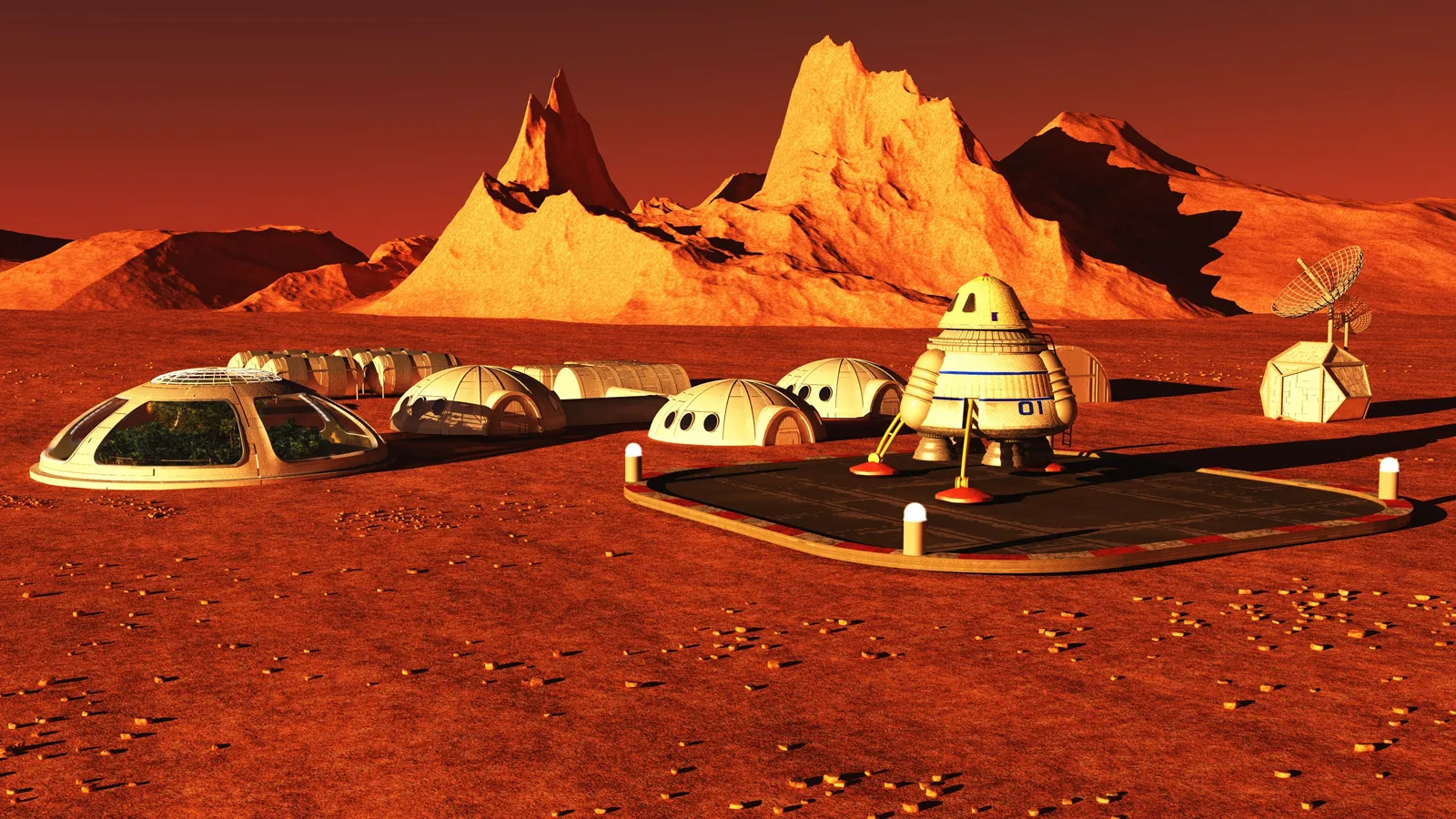
For thousands of years, humanity has looked up at the night sky and wondered what lies beyond Earth. Among all the worlds in our Solar System, one planet has captured our imagination more than any other: Mars. Its reddish glow has inspired myths, stories, scientific discoveries, and dreams of exploration. Today, that dream has become something much more serious. Scientists and engineers are no longer asking whether humans can visit Mars—they are exploring how people might one day live there.
Colonizing Mars is one of the greatest engineering and scientific challenges ever imagined. It would require solving problems unlike anything humanity has faced before. Every breath of air, every drop of water, every meal, every building, and every source of energy would have to be carefully planned. Mars is not simply another place to travel. It is an entirely different world with harsh conditions that make survival extremely difficult.
Yet despite these challenges, many researchers believe that a permanent human presence on Mars may become possible in the future. While enormous technological, economic, and medical obstacles remain, scientists have already begun studying how a Martian settlement could work.
Why Mars?
Mars is not the closest planet to Earth, nor is it the easiest place to live. However, among all the planets in our Solar System, it is one of the most practical candidates for future human exploration.
Mars has a solid surface, unlike the giant gas planets. A Martian day lasts about 24.6 hours, remarkably close to Earth’s 24-hour day, making it easier for humans to adapt their daily routines. The planet also experiences seasons because its axis is tilted by about 25 degrees, similar to Earth’s tilt.
Evidence gathered by robotic spacecraft shows that Mars once had rivers, lakes, and possibly even oceans billions of years ago. Today, large amounts of water exist as ice beneath the surface and at the polar regions. Water is one of the most valuable resources for any future colony because it can provide drinking water, oxygen, and hydrogen for rocket fuel.
Although Mars is cold, dry, and hostile, it offers resources that future explorers may be able to use instead of transporting everything from Earth.
The Long Journey to Mars
Reaching Mars is a major challenge in itself.
The distance between Earth and Mars constantly changes as both planets orbit the Sun. During favorable launch opportunities, the journey typically takes several months using current spacecraft technology.
Astronauts traveling to Mars would spend much of that time living inside a spacecraft. They would need food, water, oxygen, medical supplies, exercise equipment, and radiation protection throughout the voyage.
The spacecraft would also need highly reliable life-support systems capable of recycling air and water while maintaining safe living conditions far from Earth.
Every kilogram launched into space costs energy and fuel, making efficiency one of the most important aspects of mission design.
Landing Safely on Mars
Landing on Mars is much more difficult than landing on either Earth or the Moon.
Mars has an atmosphere, but it is extremely thin—less than one percent of Earth’s average surface atmospheric pressure. This thin atmosphere creates a difficult situation.
There is enough atmosphere to generate intense heat as a spacecraft enters, requiring a heat shield.
However, there is not enough atmosphere for parachutes alone to slow large spacecraft carrying humans and heavy equipment.
Future Mars missions will likely combine heat shields, parachutes, retro-rockets, and precision landing systems to safely deliver astronauts and cargo to the surface.
Landing accurately near pre-positioned supplies will be essential.
The First Homes on Mars
The first human habitats on Mars would almost certainly arrive before the astronauts themselves.
Robotic spacecraft could deliver habitat modules, power systems, communication equipment, scientific instruments, and construction machinery years in advance.
When astronauts finally arrive, their first priority would be activating these habitats.
Martian homes would need to maintain breathable air, comfortable temperatures, safe pressure, and protection from the harsh environment outside.
Unlike houses on Earth, Martian habitats would function more like miniature ecosystems, constantly recycling air, water, and waste.
Every system would need backup equipment because repair opportunities would be limited.
Why Mars Is So Dangerous
Life on Mars would be nothing like life on Earth.
The atmosphere consists mostly of carbon dioxide, with only trace amounts of oxygen. Humans cannot breathe Martian air.
Average temperatures remain far below freezing, although they vary depending on location and season.
The atmospheric pressure is so low that liquid water cannot remain stable on the surface for long under typical Martian conditions.
Dust storms can cover enormous areas of the planet and sometimes last for weeks.
Perhaps most importantly, Mars lacks a strong global magnetic field and has only a thin atmosphere, offering far less protection from cosmic radiation and energetic particles from the Sun than Earth provides.
These hazards make protective habitats essential for survival.
Building Stronger Shelters
Scientists are exploring several ways to build durable Martian homes.
One idea is to cover habitats with Martian soil, called regolith. Thick layers of soil could help reduce exposure to radiation, buffer temperature changes, and provide additional protection from tiny high-speed particles called micrometeoroids.
Another possibility is constructing habitats inside natural lava tubes. These underground tunnels, formed long ago by flowing lava, may provide natural shielding from radiation and extreme temperature changes.
Future colonies may also use robotic construction systems and advanced manufacturing techniques to build structures using locally available materials.
Using Martian resources would greatly reduce the amount of construction material that must be transported from Earth.
Producing Air to Breathe
Breathable oxygen would be one of the colony’s most valuable resources.
Initially, astronauts would likely bring oxygen from Earth.
Eventually, colonies would need to produce oxygen on Mars.
One promising method involves separating oxygen from carbon dioxide, which makes up most of the Martian atmosphere. This process uses electricity to break carbon dioxide into oxygen and carbon monoxide.
Water extracted from underground ice could also be split into hydrogen and oxygen through electrolysis.
Producing oxygen locally would support both human survival and future rocket launches.
Finding Water
Water is essential for drinking, cooking, hygiene, agriculture, and oxygen production.
Fortunately, Mars contains significant amounts of frozen water.
Orbiting spacecraft and surface missions have found evidence of water ice beneath the ground in many regions and within the polar ice caps.
Future colonies might drill beneath the surface to collect ice, then melt and purify it.
Water recycling would also become extremely important.
Modern space stations already recycle much of their water, and Martian settlements would likely rely on even more advanced recycling systems to minimize waste.
Every drop would matter.
Growing Food on Another Planet
Transporting food from Earth forever would be impractical.
A permanent settlement would need to grow much of its own food.
Scientists are studying how crops might be cultivated inside carefully controlled greenhouses.
Plants would require water, nutrients, carbon dioxide, and artificial or natural sunlight.
Because the Martian surface receives less sunlight than Earth, supplemental lighting powered by electricity might sometimes be necessary.
Instead of using untreated Martian soil directly, future colonies would likely grow crops in specially prepared growing systems designed to provide the right balance of nutrients and moisture.
Recycling plant waste could help create a sustainable agricultural cycle.
Fresh vegetables would also improve astronauts’ nutrition and mental well-being during long missions.
Producing Energy
Reliable electricity would keep every part of the colony functioning.
Power would operate life-support systems, communications, scientific equipment, lighting, heating, water purification, oxygen production, and food cultivation.
Solar panels are an attractive option because sunlight reaches Mars, although less intensely than Earth. Dust accumulation and dust storms, however, can reduce their efficiency.
For continuous power regardless of weather, small nuclear reactors are also being studied as a potential energy source.
Future colonies may combine multiple energy systems to ensure reliable electricity at all times.
Transportation on Mars
Astronauts will need vehicles to explore the Martian landscape.
Pressurized rovers could allow crews to travel long distances while remaining protected from the hostile environment.
Smaller vehicles might transport equipment between habitats.
Future transportation systems could eventually include autonomous robots that perform construction, mining, maintenance, and scientific exploration before humans arrive or alongside them.
As settlements expand, transportation networks would become increasingly important.
Communicating with Earth
Even at the speed of light, communication between Earth and Mars takes time.
Depending on the positions of the two planets, one-way communication delays range from about 4 to over 20 minutes.
This means astronauts cannot rely on immediate conversations with mission control.
Mars crews would need to make many decisions independently.
Advanced computer systems and artificial intelligence may assist with diagnostics, planning, maintenance, and scientific analysis.
Future colonies would become increasingly self-reliant.
Living with Lower Gravity
Mars has only about 38 percent of Earth’s surface gravity.
A person who weighs 100 kilograms on Earth would weigh only about 38 kilograms on Mars, although their mass would remain unchanged.
Lower gravity makes lifting objects easier, but scientists do not yet fully understand how living in Martian gravity for many years would affect the human body.
Research from astronauts living in microgravity aboard space stations shows that prolonged exposure to reduced gravity can lead to muscle loss, bone density reduction, and cardiovascular changes. Because Mars has more gravity than orbiting spacecraft but much less than Earth, understanding its long-term health effects remains an important area of research.
Regular exercise and medical monitoring would likely become part of everyday life.
The Challenge of Radiation
Radiation is one of the greatest health risks facing Mars colonists.
Earth’s magnetic field and thick atmosphere shield us from much of the harmful radiation that travels through space.
Mars provides far less natural protection.
Long-term exposure could increase the risk of cancer and damage living tissues.
Protective habitats, underground shelters, radiation-shielding materials, and careful mission planning will all play important roles in reducing this risk.
Scientists continue studying new methods for protecting future astronauts.
Recycling Everything
On Earth, many everyday resources are easy to replace.
On Mars, almost nothing can be wasted.
Future colonies would recycle water, air, metals, plastics, food waste, and even building materials whenever possible.
Efficient recycling reduces the need for costly resupply missions from Earth.
A successful Martian settlement would function as a highly efficient closed-loop system in which resources circulate continuously.
Building with Martian Resources
Carrying every construction material from Earth would be enormously expensive.
Scientists are investigating how Martian soil could be transformed into bricks, concrete-like materials, or components for advanced manufacturing.
Three-dimensional printing technologies may allow robots to construct buildings, tools, replacement parts, and infrastructure using locally available materials.
This approach, known as in-situ resource utilization, could dramatically reduce mission costs and increase long-term sustainability.
Medical Care on Mars
Healthcare would become far more complicated on another planet.
Astronauts could not quickly return to Earth during emergencies.
Future Mars missions would require advanced medical equipment, telemedicine support, well-trained crew members, and autonomous diagnostic technologies.
Researchers are also studying how prolonged isolation, reduced gravity, radiation, and confinement may affect both physical and mental health.
Maintaining psychological well-being will be just as important as treating physical illnesses.
Creating a Community
A colony is much more than buildings and machines.
It is a community of people.
Future Martian settlers would need places to work, eat, exercise, relax, learn, and socialize.
Maintaining strong relationships and emotional well-being would help people cope with the isolation of living millions of kilometers from Earth.
Art, music, education, recreation, and cultural traditions could all become important parts of daily life, reminding settlers of their shared humanity even on another world.
Could Children Be Born on Mars?
This question fascinates scientists, but the answer remains unknown.
Researchers do not yet know how lower gravity and higher radiation levels might affect pregnancy, childbirth, or childhood development.
Because of these uncertainties, any future decisions involving reproduction on Mars would require extensive scientific research and careful ethical consideration.
For the foreseeable future, early Mars missions would focus on exploration and survival rather than permanent multigenerational settlement.
Becoming Self-Sufficient
The ultimate goal of a Mars colony would be self-sufficiency.
Instead of depending entirely on supplies from Earth, settlers would gradually produce their own food, water, oxygen, fuel, construction materials, clothing, and replacement equipment.
The more resources produced locally, the more resilient the colony would become.
Achieving this level of independence would likely take many years or even decades after the first human landing.
Why Colonize Mars?
Scientists and space agencies propose several reasons for exploring and eventually establishing a sustained human presence on Mars.
A permanent settlement could greatly expand scientific knowledge about planetary evolution and the possibility that microbial life may once have existed on Mars. It could drive technological innovation, inspire future generations, and help develop systems for living in extreme environments.
Some also argue that becoming a multi-planetary species could reduce the risk that a single catastrophic event on Earth would threaten humanity’s long-term future. Whether this should be a primary goal remains a subject of scientific, ethical, and public debate.
The Future of Mars Colonization
No one knows exactly when large-scale human settlements will appear on Mars.
Major technological challenges remain, including transportation, life support, radiation protection, energy production, and sustainable resource use.
However, every robotic mission to Mars teaches scientists something new. Orbiters map the planet in remarkable detail. Rovers analyze rocks, search for evidence of ancient environments, and study the planet’s climate. Engineers continue improving spacecraft, robotics, habitats, and life-support technologies.
Step by step, knowledge is replacing imagination with practical engineering.
Conclusion
Mars colonization is one of the most ambitious scientific and engineering goals humanity has ever considered. Transforming a cold, dry, radiation-filled world into a place where people can live will require extraordinary advances in technology, medicine, agriculture, energy, and resource management. Every aspect of survival—from producing oxygen and growing food to building shelters and generating electricity—must be carefully planned using both supplies from Earth and resources found on Mars itself.
Although enormous challenges remain, the idea of living on Mars is no longer confined to science fiction. Research conducted today is laying the foundation for tomorrow’s explorers. If humanity eventually establishes a permanent presence on the Red Planet, it will stand as one of the greatest achievements in the history of science—a testament to curiosity, innovation, and the enduring desire to explore worlds beyond our own.