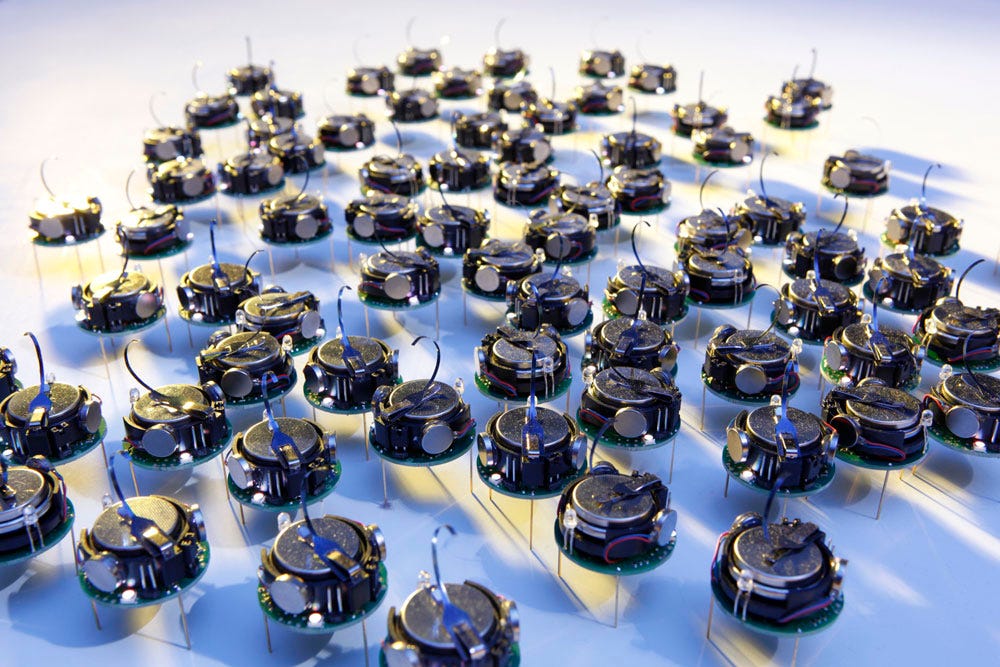
Imagine watching thousands of ants carrying food across the ground. No single ant is giving orders, yet together they build nests, find food, defend their colony, and solve surprisingly complex problems. Look up at the sky and you may see a flock of birds changing direction almost instantly, moving as though they share one mind. Beneath the ocean, schools of fish swim in perfect harmony, avoiding predators and navigating through changing waters without a leader directing every movement.
Nature has perfected the art of teamwork over millions of years. Scientists and engineers have long been fascinated by these collective behaviors. What if robots could cooperate in the same way? What if hundreds or even thousands of simple robots could work together to complete tasks that would be difficult, expensive, or even impossible for a single powerful machine?
These questions have given rise to one of the most exciting fields in modern robotics: swarm robotics.
Swarm robotics is transforming the way researchers think about automation, artificial intelligence, and teamwork. Instead of building one highly complex robot capable of doing everything alone, swarm robotics focuses on creating many relatively simple robots that communicate, cooperate, and coordinate with one another to accomplish shared goals.
Inspired by nature but powered by advanced engineering, swarm robotics could reshape industries ranging from agriculture and disaster response to medicine and space exploration.
Understanding Swarm Robotics
Swarm robotics is a branch of robotics and artificial intelligence (AI) that studies how large groups of relatively simple robots can work together through local interactions rather than relying on a central controller.
Each robot in a swarm usually has limited sensing, computing, and communication capabilities. Individually, these robots may appear quite simple. However, when they cooperate, they can perform remarkably sophisticated tasks.
This idea is known as collective intelligence or emergent behavior. The intelligence of the system does not come from one highly advanced robot but from the interactions among many robots.
Just as a single bee cannot build an entire hive alone, one swarm robot may have limited abilities. Together, however, hundreds or thousands of robots can solve problems efficiently and adapt to changing environments.
How Nature Inspired Swarm Robotics
The idea behind swarm robotics comes directly from observing living organisms.
Ant colonies provide one of the strongest inspirations. Individual ants follow relatively simple rules. They leave chemical trails called pheromones, respond to nearby ants, and search randomly for food. Despite lacking a central leader, an entire colony can build complex underground nests, locate food sources, divide labor efficiently, and adapt to environmental changes.
Honeybees offer another remarkable example. Worker bees cooperate to collect nectar, regulate hive temperature, protect the colony, and even make collective decisions about where to establish new nests.
Bird flocks demonstrate how simple rules can create beautiful coordinated movement. Each bird adjusts its position based on nearby birds, allowing the entire flock to move smoothly while avoiding collisions.
Schools of fish behave similarly. Every fish responds mainly to its closest neighbors, creating coordinated patterns that improve survival.
Scientists realized that these biological systems achieve extraordinary results without centralized control. Swarm robotics applies these same principles to machines.
The Basic Idea Behind Swarm Robotics
Unlike traditional robots, swarm robots are designed to interact continuously with one another and with their environment.
Instead of receiving detailed instructions from a central computer, each robot follows a relatively simple set of behavioral rules.
For example, a robot may move forward until it detects an obstacle, avoid collisions with nearby robots, communicate useful information to neighboring robots, and assist in completing a shared objective.
Although each robot follows only basic rules, the combined actions of the entire swarm create organized and intelligent behavior.
This decentralized approach allows swarm robotic systems to remain flexible, scalable, and resilient.
Decentralized Control
One of the defining features of swarm robotics is decentralization.
Traditional robotic systems often rely on one central controller that tells every robot exactly what to do.
In swarm robotics, there is usually no leader.
Each robot makes decisions independently using local information gathered from its sensors and nearby robots.
This approach has several important advantages.
If one robot stops working, the rest of the swarm can usually continue operating.
There is no single point of failure that could disable the entire system.
The swarm becomes more adaptable because every robot can respond directly to local conditions.
This decentralized organization closely resembles natural swarms.
Communication Within the Swarm
Communication is essential for cooperation.
Swarm robots exchange information using several methods depending on their design and purpose.
Some robots communicate through radio signals such as Wi-Fi or Bluetooth.
Others use infrared sensors, visible light, sound, or short-range wireless networks.
Some systems communicate indirectly by modifying their environment, a concept inspired by ants.
For example, instead of leaving chemical pheromones, robots may place digital markers on a map or update shared information that guides the movement of other robots.
Importantly, communication is usually local rather than global.
Each robot exchanges information mainly with nearby robots instead of communicating constantly with every robot in the swarm.
This reduces complexity and improves scalability.
Simple Rules Create Complex Behavior
One of the most fascinating aspects of swarm robotics is that extremely complex behavior can emerge from surprisingly simple rules.
A robot may only need to maintain a certain distance from its neighbors, avoid obstacles, follow detected targets, and share important information.
When hundreds of robots follow these same rules simultaneously, they naturally organize into efficient patterns.
They may spread out to search a large area, gather around an object that requires collective effort, form organized movement patterns, or divide themselves into specialized groups.
This phenomenon is called emergent behavior.
No robot understands the entire system, yet together they accomplish sophisticated tasks.
Components of a Swarm Robot
Although designs vary, most swarm robots contain several common components.
Each robot typically includes sensors that detect obstacles, nearby robots, light, temperature, sound, or other environmental conditions.
Small onboard computers process sensor information and make decisions.
Motors enable movement across land, through water, or in the air.
Communication systems allow robots to exchange information.
Rechargeable batteries provide energy for operation.
Many swarm robots are intentionally kept small, inexpensive, and energy-efficient so that large numbers can be deployed.
Researchers often prioritize simplicity because the true strength lies in the collective system rather than in any individual robot.
Swarm Intelligence and Artificial Intelligence
Swarm robotics is closely connected to artificial intelligence.
However, the AI used in swarm robotics differs from the AI found in systems like chatbots or image recognition software.
Instead of focusing on language or visual understanding, swarm AI emphasizes coordination, decision-making, adaptation, and cooperation among multiple robots.
Machine learning can further enhance swarm behavior.
Robots may gradually improve their movement strategies, learn efficient search patterns, or optimize teamwork through experience.
As AI algorithms become more advanced, swarm robotic systems are becoming increasingly capable of handling complex and unpredictable environments.
Searching Large Areas Efficiently
Searching vast environments is one of the greatest strengths of swarm robotics.
Imagine trying to locate a missing hiker in a dense forest.
A single robot might require many hours to search the entire area.
A swarm of hundreds of robots can divide the search region among themselves, communicate discoveries, and quickly identify areas that have already been explored.
This parallel search strategy dramatically reduces search time.
The same principle applies to underwater exploration, archaeological surveys, environmental monitoring, and planetary exploration.
Swarm Robotics in Disaster Response
Natural disasters often create dangerous conditions for human rescuers.
Collapsed buildings, toxic chemicals, unstable structures, floods, and fires make rescue operations extremely difficult.
Swarm robots can enter hazardous environments where sending humans would be risky.
Small robots can navigate through narrow gaps inside collapsed buildings.
Flying drones can map damaged areas from above.
Ground robots can search for survivors using cameras, microphones, thermal sensors, and gas detectors.
If some robots become damaged, the remaining swarm can continue its mission.
This resilience makes swarm robotics especially valuable during emergencies.
Applications in Agriculture
Modern agriculture increasingly relies on automation.
Swarm robotics offers exciting possibilities for farming.
Groups of robots can monitor crop health, detect plant diseases, identify weeds, measure soil moisture, and distribute fertilizers with remarkable precision.
Instead of one large machine covering an entire field, numerous small robots can work simultaneously across different sections.
This approach may reduce soil compaction, improve efficiency, and lower fuel consumption.
Future agricultural swarms may continuously monitor crops throughout the growing season, helping farmers respond quickly to changing conditions.
Environmental Monitoring
Protecting ecosystems requires collecting enormous amounts of environmental data.
Swarm robots can monitor forests, rivers, oceans, wetlands, and polar regions.
Aquatic robot swarms may measure water quality, temperature, pollution levels, and marine biodiversity.
Flying robot swarms can monitor forest health, detect wildfires early, and observe wildlife populations.
Ground robots may study soil conditions or track ecosystem changes caused by climate change.
Because swarms cover large areas efficiently, they provide scientists with valuable information that would otherwise require extensive human effort.
Medical Applications
One of the most exciting future possibilities involves microscopic swarm robots operating inside the human body.
Researchers are developing tiny robotic systems capable of navigating through blood vessels and body tissues.
Although much of this work remains experimental, scientists hope these microscopic swarms may eventually deliver medications directly to diseased cells, assist in removing blood clots, perform highly targeted treatments, or help diagnose medical conditions with minimal invasiveness.
Developing safe and reliable medical swarm robots presents major engineering and biological challenges, but ongoing research continues to advance the field.
Swarm Robotics in Space Exploration
Space exploration presents enormous challenges.
Planets, moons, and asteroids cover vast and often hazardous terrain.
Instead of relying on one expensive rover, future missions may deploy large groups of smaller robots.
Each robot could explore different regions, collect samples, map landscapes, analyze rocks, and communicate findings with neighboring robots.
If one robot fails because of harsh conditions, the overall mission can continue.
This redundancy makes swarm systems particularly attractive for exploring distant worlds where repairs are impossible.
Researchers have proposed swarm missions for exploring the Moon, Mars, caves, lava tubes, and even asteroids.
Underwater Swarm Robotics
The oceans remain one of Earth’s least explored environments.
Swarm robotics offers new opportunities for marine science.
Groups of autonomous underwater robots can map the seafloor, monitor coral reefs, inspect underwater pipelines, study marine ecosystems, and measure ocean currents.
Unlike a single submarine, a coordinated swarm can gather information from many locations simultaneously.
This greatly improves both efficiency and scientific understanding.
Advantages of Swarm Robotics
Swarm robotics provides several important benefits over traditional robotic systems.
Because many robots share the workload, tasks can often be completed more quickly.
The system remains functional even if some robots fail.
Adding more robots usually increases the swarm’s capabilities without requiring major redesigns.
Decentralized control improves adaptability because robots respond directly to local conditions.
Simple robots are often less expensive to manufacture than highly sophisticated individual machines.
These advantages make swarm robotics attractive for applications where flexibility, reliability, and scalability are essential.
Challenges Facing Swarm Robotics
Despite its enormous promise, swarm robotics also faces significant challenges.
Coordinating hundreds or thousands of robots requires carefully designed algorithms.
Communication can become difficult in noisy or crowded environments.
Battery life limits how long robots can operate.
Navigation remains challenging in complex terrain where GPS signals may be unavailable.
Preventing collisions while maintaining efficient cooperation becomes increasingly difficult as swarm size grows.
Engineers must also ensure that robots remain secure against cyberattacks and communication failures.
Testing large robotic swarms in real-world conditions requires extensive experimentation and careful engineering.
Ethics and Responsible Development
As swarm robotics becomes more capable, ethical considerations become increasingly important.
Researchers must ensure these systems operate safely around people.
Privacy concerns arise if robot swarms collect images or environmental data.
Clear accountability is needed when autonomous systems make decisions during rescue operations or industrial tasks.
International regulations may eventually guide the responsible development and deployment of large autonomous robotic swarms.
Like many emerging technologies, swarm robotics offers tremendous benefits when developed thoughtfully and used responsibly.
The Future of Swarm Robotics
Advances in artificial intelligence, sensors, batteries, communication systems, and materials science are rapidly expanding what swarm robots can achieve.
Future swarms may become more autonomous, more adaptable, and better able to learn from experience.
Construction robots could cooperate to build buildings with minimal human intervention.
Environmental robot swarms may continuously monitor ecosystems across entire continents.
Medical nanorobots could one day provide highly personalized treatments inside the human body.
Factories may use coordinated robot teams that reorganize themselves automatically based on changing production needs.
Space agencies envision autonomous robot swarms building scientific bases on the Moon before astronauts even arrive.
Although many of these possibilities remain under active research, steady progress continues to bring them closer to reality.
Swarm Robotics and Human Collaboration
Despite rapid advances in automation, swarm robotics is not intended to replace humans entirely.
Instead, these systems are designed to work alongside people.
Humans remain essential for setting goals, supervising operations, interpreting complex situations, and making ethical decisions.
Robots excel at repetitive tasks, hazardous environments, and large-scale coordination.
Humans contribute creativity, judgment, empathy, and strategic thinking.
Together, people and robotic swarms can accomplish tasks that neither could achieve alone.
A New Way of Thinking About Robots
For decades, many people imagined robots as highly intelligent individual machines capable of performing every task independently. Swarm robotics offers a completely different vision. Rather than relying on one powerful robot, it demonstrates that remarkable intelligence can emerge through cooperation among many simple machines.
This idea mirrors one of nature’s greatest lessons: extraordinary achievements do not always require extraordinary individuals. Sometimes, simple actions repeated by many participants create results far greater than the sum of their parts.
As researchers continue exploring the science of collective intelligence, swarm robotics is likely to become an increasingly important part of our technological future. From helping farmers grow food more efficiently to assisting doctors, protecting ecosystems, responding to disasters, and exploring distant planets, robotic swarms have the potential to transform countless aspects of human life.
Swarm robotics is more than an engineering innovation. It represents a new philosophy of intelligent machines—one built not on individual power, but on cooperation, adaptability, and the remarkable strength of working together.