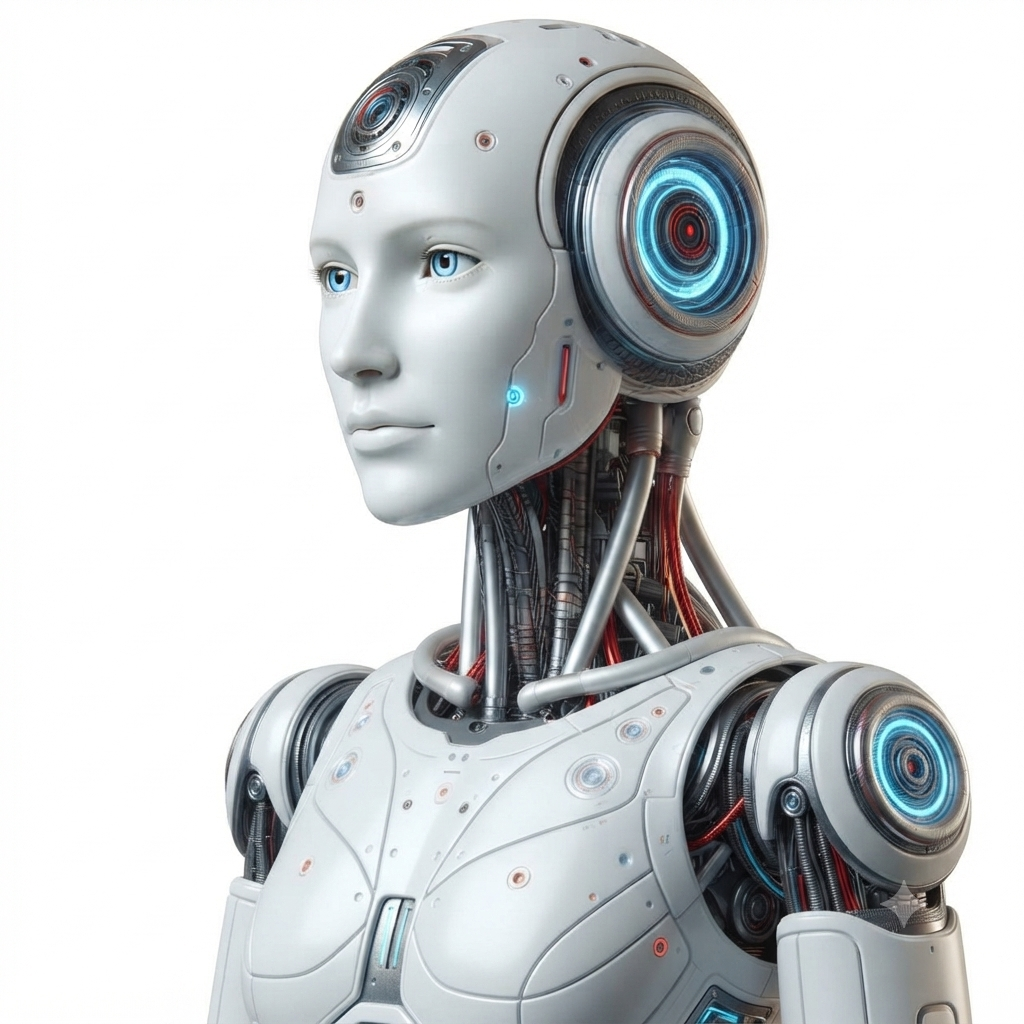
Imagine waking up to a world where your home prepares breakfast before you leave your bed, your car drives itself through traffic, your doctor detects diseases years before symptoms appear, and a digital assistant helps you learn, work, and solve problems every day. For millions of people, this future is no longer science fiction. It has already begun.
Artificial intelligence, often called AI, is becoming one of the most transformative technologies in human history. It is changing how we communicate, how we work, how we learn, how we travel, and even how scientists make discoveries. In just a few decades, AI has evolved from a fascinating research topic into a technology that influences billions of lives.
As AI continues to improve, an important question has emerged: Is artificial intelligence the future of humanity?
The answer is both exciting and complex. AI has the potential to improve countless aspects of human life, but it also raises difficult questions about ethics, employment, privacy, security, and the relationship between humans and intelligent machines.
Understanding AI means understanding not only a powerful technology but also the choices humanity must make about how that technology is developed and used.
What Is Artificial Intelligence?
Artificial intelligence is a branch of computer science focused on creating systems that can perform tasks typically requiring human intelligence. These tasks include recognizing images, understanding language, solving problems, learning from experience, making predictions, and sometimes even generating creative content.
Unlike traditional computer programs that follow fixed instructions, many modern AI systems learn from data. Instead of being told every rule explicitly, they identify patterns by analyzing enormous amounts of information.
This ability to learn makes AI remarkably flexible. It can recognize speech, translate languages, recommend movies, detect diseases in medical images, predict weather patterns, and assist scientists in analyzing complex research data.
However, today’s AI remains narrow AI, meaning it is designed for specific tasks. An AI system that plays chess cannot automatically drive a car or diagnose illnesses unless it is specifically trained for those purposes.
Despite impressive capabilities, current AI does not possess human-like understanding, consciousness, emotions, or self-awareness.
Why AI Has Advanced So Quickly
Artificial intelligence has existed as a scientific field since the 1950s, but its rapid progress has occurred mainly during the past two decades.
Several factors have contributed to this acceleration.
Modern computers have become dramatically faster.
The internet provides enormous amounts of digital data for AI systems to learn from.
Advances in machine learning algorithms have made pattern recognition far more effective.
Cloud computing allows researchers to train powerful AI models using vast computational resources.
Improved hardware, especially specialized processors, has made training complex neural networks increasingly practical.
These developments have transformed AI from an experimental technology into a practical tool used across nearly every industry.
AI Is Already Part of Everyday Life
Many people use artificial intelligence every day without realizing it.
When a smartphone unlocks by recognizing your face, AI is working behind the scenes.
When an online store recommends products based on previous purchases, AI analyzes shopping patterns.
Voice assistants answer questions using speech recognition and natural language processing.
Navigation apps estimate traffic conditions and suggest the fastest routes.
Streaming platforms recommend movies and music based on viewing habits.
Email services filter spam automatically.
Banks detect suspicious financial transactions using AI-powered fraud detection.
Social media platforms organize content with AI algorithms.
These everyday applications demonstrate that AI is not simply a future technology—it is already woven into modern life.
AI and the Future of Healthcare
One of AI’s most promising applications lies in healthcare.
Doctors increasingly use AI to analyze medical images such as X-rays, CT scans, and MRIs. In some situations, AI systems can help identify abnormalities that might otherwise be overlooked.
Researchers are also using AI to discover potential new medicines by analyzing enormous databases of chemical compounds and biological information.
AI can assist hospitals in managing patient records, predicting disease outbreaks, optimizing treatment plans, and improving administrative efficiency.
Wearable devices powered by AI can monitor heart rhythms, sleep patterns, physical activity, and other health indicators, helping individuals better understand their own well-being.
Importantly, AI is designed to support healthcare professionals rather than replace them. Medical decisions still require human expertise, clinical judgment, and ethical responsibility.
Transforming Education
Education is another area where AI is creating significant change.
Traditional classrooms often require one teacher to educate many students with different learning styles and abilities.
AI-powered educational tools can provide more personalized learning experiences by adapting lessons to each student’s progress.
Students who struggle with certain topics may receive additional explanations and practice exercises, while advanced learners can move ahead more quickly.
AI tutors can answer questions at any time of day, helping learners study independently.
Teachers can also use AI to automate routine administrative tasks, allowing more time for teaching, mentoring, and supporting students.
However, education remains deeply human. Motivation, creativity, empathy, collaboration, and critical thinking continue to depend heavily on human interaction.
AI in Scientific Discovery
Artificial intelligence is becoming an invaluable partner in scientific research.
Modern science often generates enormous amounts of data that would take humans years to analyze.
AI can identify patterns within these datasets much more rapidly.
Astronomers use AI to search for distant galaxies and unusual cosmic events.
Climate scientists analyze global environmental data to improve climate models.
Biologists study genetic information with AI assistance.
Chemists use AI to predict molecular behavior.
Physicists employ AI to process experimental results from particle accelerators.
By accelerating data analysis, AI allows scientists to spend more time asking important questions and designing innovative experiments.
Rather than replacing scientific curiosity, AI expands researchers’ ability to explore complex problems.
AI and the Workplace
Perhaps one of the most debated questions concerns employment.
Will AI replace human workers?
The answer depends largely on the type of work involved.
AI excels at repetitive, predictable, and data-intensive tasks.
Routine administrative work, document processing, inventory management, customer support, and certain manufacturing processes can often be automated.
History shows that technological revolutions usually eliminate some jobs while creating entirely new ones.
The Industrial Revolution transformed agriculture and manufacturing.
Computers changed office work.
The internet created industries that previously did not exist.
Similarly, AI is expected to create demand for new careers involving AI development, robotics, cybersecurity, data science, ethics, digital education, and human-AI collaboration.
Many future jobs may involve working alongside AI rather than competing against it.
Creativity and Artificial Intelligence
For many years, creativity was considered uniquely human.
Recent advances have challenged that assumption.
AI systems can now generate artwork, compose music, write stories, design products, and create realistic images.
Yet AI creativity differs fundamentally from human creativity.
AI generates content by identifying statistical patterns learned from enormous datasets.
Human creativity emerges from personal experiences, emotions, cultural understanding, imagination, and conscious intention.
An artist paints not only to produce an image but also to express thoughts, memories, and feelings.
AI does not experience joy, sadness, inspiration, curiosity, or love.
Its outputs can be impressive, but they are produced through computation rather than lived experience.
For this reason, many experts view AI as a creative tool that enhances human imagination rather than replacing it.
Can AI Think Like Humans?
This question has fascinated scientists and philosophers for decades.
Modern AI can perform tasks that appear intelligent.
It can answer questions, summarize information, recognize images, play strategic games, and generate human-like text.
However, these capabilities should not be confused with human thinking.
Current AI systems do not possess consciousness.
They do not have personal experiences.
They lack genuine understanding of the world in the way humans experience it.
AI predicts patterns based on training data.
Humans combine reasoning with emotions, memories, values, intuition, social relationships, and self-awareness.
Although AI can simulate conversation remarkably well, it does not have beliefs, desires, intentions, or subjective experiences.
Whether machines could someday develop these qualities remains an open scientific and philosophical question.
Ethical Challenges
As AI becomes more powerful, ethical questions become increasingly important.
AI systems learn from data created by humans.
If those data contain biases, AI systems may unintentionally reproduce or amplify them.
Ensuring fairness requires careful design, testing, and ongoing evaluation.
Privacy also presents major challenges.
Many AI applications depend on large amounts of personal information.
Protecting individuals’ data while enabling useful AI applications requires strong legal safeguards and responsible technological development.
Transparency is another concern.
Some advanced AI systems make decisions that are difficult even for experts to fully explain.
Researchers continue working to improve AI interpretability so people can better understand how important decisions are made.
Responsible AI development requires balancing innovation with accountability.
AI and Human Relationships
Artificial intelligence is also changing how people communicate.
AI-powered translation tools help individuals from different countries converse despite language barriers.
Digital assistants organize schedules and answer questions.
Companion chatbots provide conversation and emotional support for some users.
However, genuine human relationships remain irreplaceable.
Empathy involves understanding another person’s emotions through shared experiences and social connection.
Friendship develops through trust.
Families are built through love and commitment.
Communities grow through cooperation.
AI may assist communication, but meaningful human relationships depend on qualities that technology cannot fully replicate.
AI in Space Exploration
Artificial intelligence is becoming increasingly valuable in exploring the universe.
Spacecraft operating millions or billions of kilometers from Earth often need to make decisions without immediate human guidance.
AI helps spacecraft navigate challenging environments, analyze scientific observations, identify interesting geological features, and optimize mission operations.
Astronomers also use AI to search enormous collections of telescope images for new planets, distant galaxies, and rare cosmic phenomena.
As humanity explores deeper into space, AI will likely become an essential partner in scientific discovery.
AI and Climate Research
Climate science involves enormous quantities of environmental data collected from satellites, weather stations, ocean sensors, and climate models.
Artificial intelligence helps researchers analyze these complex datasets more efficiently.
AI improves weather forecasting, monitors deforestation, tracks melting glaciers, predicts wildfire risks, and optimizes renewable energy systems.
These capabilities may help societies better understand environmental changes and respond more effectively to climate-related challenges.
Although AI cannot solve climate change by itself, it provides valuable tools that support scientific research and evidence-based decision-making.
Risks of Artificial Intelligence
Like any powerful technology, AI carries risks if developed or used irresponsibly.
Misinformation generated by AI can spread rapidly online.
Deepfake technologies can create convincing but fabricated audio and video.
Cybercriminals may attempt to exploit AI for malicious purposes.
Automated systems may produce incorrect outputs if trained on incomplete or misleading information.
Excessive dependence on AI could reduce certain human skills if people stop practicing independent thinking.
These challenges highlight the importance of education, digital literacy, regulation, cybersecurity, and ethical oversight.
Managing AI responsibly requires cooperation among scientists, governments, educators, businesses, and the public.
Can AI Replace Humans?
The idea of machines replacing humanity appears frequently in science fiction.
Scientific reality is far more nuanced.
AI can outperform humans in certain specialized tasks involving speed, pattern recognition, and data analysis.
Computers can calculate millions of possibilities within seconds.
AI systems never become tired while processing information.
However, humans possess qualities that remain extraordinarily difficult to reproduce.
People understand social context.
They develop moral values.
They experience emotions.
They create culture.
They adapt creatively to unfamiliar situations.
They build relationships.
They exercise ethical judgment.
These uniquely human abilities remain central to leadership, education, healthcare, scientific discovery, diplomacy, parenting, and countless other aspects of civilization.
Rather than replacing humanity, AI is more likely to become an increasingly capable tool that extends human abilities.
The Future of Human-AI Collaboration
Many researchers believe the future will be defined not by competition between humans and AI but by collaboration.
Doctors may use AI to improve diagnoses.
Teachers may personalize education with AI assistance.
Scientists may accelerate discoveries through AI-powered analysis.
Engineers may design safer infrastructure.
Artists may experiment with new creative possibilities.
Farmers may optimize crop production.
Emergency responders may receive faster disaster predictions.
In each case, human expertise guides decision-making while AI contributes speed and analytical power.
This partnership has the potential to improve productivity while allowing humans to focus more on creativity, compassion, critical thinking, and innovation.
Artificial General Intelligence
Some scientists are investigating the possibility of Artificial General Intelligence (AGI)—a hypothetical form of AI capable of performing a wide range of intellectual tasks at a level comparable to humans.
Unlike today’s narrow AI systems, AGI would theoretically learn, reason, and adapt across many different domains.
However, AGI has not yet been achieved.
Researchers continue debating whether it is technically feasible, how long it might take, and what societal implications it could have.
Because AGI remains hypothetical, predictions about its arrival are uncertain and should be treated cautiously.
Humanity Shapes AI’s Future
Perhaps the most important realization is that AI does not determine humanity’s future on its own.
Humans design AI systems.
Humans choose how they are used.
Humans establish laws, ethical guidelines, and safety standards.
Technology reflects the intentions and values of the people who create and govern it.
If AI is developed responsibly, transparently, and with broad public benefit in mind, it can become one of humanity’s greatest achievements.
If developed carelessly, it could create significant social and ethical challenges.
The future therefore depends not only on artificial intelligence itself but also on human wisdom.
A Future Built Together
Artificial intelligence is transforming the world at an extraordinary pace. It is already helping doctors diagnose diseases, enabling scientists to analyze vast amounts of data, supporting teachers in personalized learning, improving transportation, advancing environmental research, and making everyday digital tools more capable than ever before. These achievements demonstrate that AI is not merely another technological innovation—it is becoming an important part of modern civilization.
Yet the future of humanity will never be shaped by technology alone. Our future will be determined by the choices we make about how technology is developed, regulated, shared, and applied. Artificial intelligence may become one of humanity’s most powerful tools, but it remains a tool created by people, guided by human values, and ultimately intended to serve human needs.
The greatest future may not be one where machines replace people, but one where humans and intelligent technologies work together to solve problems that once seemed impossible. In that future, curiosity, compassion, creativity, scientific understanding, and ethical responsibility will remain as important as technological progress itself. Artificial intelligence may help shape tomorrow’s world, but humanity will continue to shape the future of artificial intelligence.